








Congressman Mike Bost on gas prices, war in Iran, and why he won’t debate his Democratic opponent
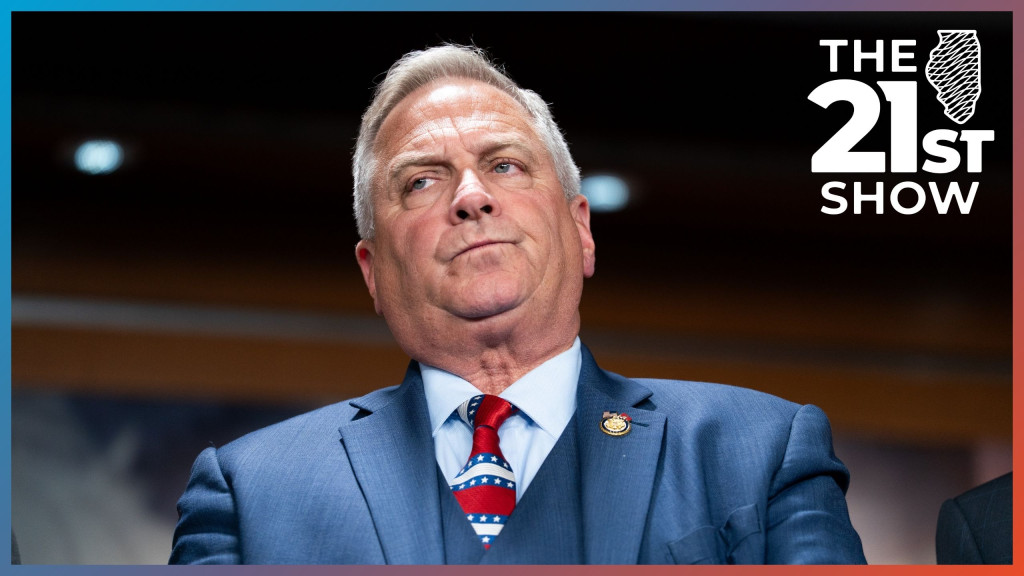
Congressman Mike Bost, who represents the southern third of Illinois, attends a news conference on March 5, 2026, in Washington. Allison Robbert/AP
// This is a machine generated transcript. Please report any transcription errors to will-help@illinois.edu.

[00:00:00]
Brian Mackey: From Illinois Public Media, this is the 21st show. I'm Brian Mackey. And we begin today with Republican Congressman Mike Bost as we continue our interviews for downstate House districts. Bost represents the 12th, which spans roughly the bottom third of Illinois. It runs from just outside the Saint Louis metropolitan area east over to Indiana and down through Carbondale to our southern border with Kentucky. He's been in office since 2015 and before that spent 20 years in the Illinois General Assembly. It's a district heavily gerrymandered to favor Republicans. Bost won both elections under the current map with 75% of the vote. He's facing another challenger this year, Democrat Julie Fortier. We spoke with her for a full hour on August 18th. We'll have a link to that conversation with this one on our website, twentyfirstshow.org. We offered Bost a full hour and we sought to do it live. His campaign agreed to 30 minutes taped in order to meet his schedule, we spoke on Thursday afternoon. Because of that, we cannot take calls live, but we did get an extraordinary number of texts, emails, and voicemails. Too many for the time allotted, and many of you wanted to ask him the same two questions. Why aren't you debating your opponent and why won't you hold an in-person town hall? We will get to that, I promise, and some of the other questions you sent in within the constraints of the 30 minutes he agreed to. As ever, you can let us know what you think about our program. The address is talk at twentyfirstshow.org. Talk at 21stshow.org. Congressman Bost, welcome back to the [21st] show.

[00:01:53]
Mike Bost: Thanks for having me on.

[00:01:55]
Brian Mackey: How much does a gallon of diesel cost in your part of Illinois right now?

[00:01:58]
Mike Bost: About $6.30. OK.

[00:02:00]
Brian Mackey: Why is it costing so much?

[00:02:03]
Mike Bost: Well, there's several reasons. One, because petrol is at a higher rate based on some not having the proper processing plants. The processing plants were shut down over the years. Let me tell you another reason why diesel is always higher than gas, which didn't used to be the case because it's an easier process to refine. But that being said, we have different nations, China in particular, that they don't burn gas, they burn diesel. That's not what caused the market to climb the way it is. There is pressures throughout the world on the diesel market right now, plus also in the United States and especially in Illinois, we have a tremendously high tax on our diesel fuel. Now we have been working the president earlier last week, especially for ag. Um, well, the president's was for ag and commercial use. They were able to shift over to the dyed diesel which you use for ag, and you can't use it in tractor trailers even if you're on a farm. It can only be used a normal time during the fact that there are combines or planters or whatever farm equipment. So by removing that, if it was removed at the full level, you would save about 80 cents per gallon.

[00:03:29]
Brian Mackey: For what it's worth,

[00:03:29]
Mike Bost: I saw Governor Pritzker remove the dyed diesel restriction.

[00:03:33]
Mike Bost: Well, he did, but he did not do it for commercial. He did it for ag. OK. And the question is, is, is, and I'm still, and trust me, I don't care whether it's a Democrat do it or Republicans doing it. I'm glad they're doing it during the agricultural, during the process of that we're in a harvest. That being said, the real concern we have is how is that going to be enforced later, because when you get to January, if you understand how and remember I came from the trucking business, so with the dyed diesel that's still going to have residue in your tank after January when this expires. So how is the enforcement mechanism, which is done by the states, not by the feds, backed up by the feds, but done by the states, how is the enforcement mechanism going to be handled? Then this dye kind of stains the tanks for good or for a long period of time and so there's some concerns there. So we're trying to do what we can to reduce that debt, but also I believe as the market catches up both on gasoline and diesel and these refineries come online. The level that they need to, you're going to see a very quick drop in those both gasoline and diesel prices, but

[00:04:43]
Brian Mackey: we've been talking for several minutes. You didn't mention the war in Iran as a proximate cause of the —

[00:04:50]
Mike Bost: There's a — what's happened in the straits because it's a worldwide market. But also let me tell you this, that that's asked for a bigger question. Do we take the short term pain to stop a war that's been going on for 47 years? Or do we continue to allow one country to fund terrorists and or do terrorism themselves to the level that they have for 47 years, and let me tell you why that's personal to me. Um, as most of my constituents know, I'm a United States Marine. I joined the Marine Corps on December 4th, 1979. I joined four days after the Iran hostages were taken because that's when that war started, when the Ayatollah and this regime that later has now morphed not only the Ayatollah, which is the Iran government, not the Iranian people, but then joining with the Muslim Brotherhood that their only mission is to destroy, destroy the state of Israel, kill every Jew, and destroy the United States. That is their — as the Muslim Brotherhood, that's what they believe. I believe that we should move faster, you know, look, the president has information that we as members of Congress, unless we're on committees of jurisdiction and or have a need to know, are not privy to all the information and rightfully so. But that being said, I hope that they move quickly to finish this war. The straits are now opening. We are, we have control of the area that is known

[00:06:28]
Brian Mackey: Do you think the war is going — how do you think we are doing as the United States government prosecuting this war?

[00:06:33]
Mike Bost: I wish it would have been — well, we're winning big time, but I would, I would have. Me, but not knowing what he knows, I would have moved quicker to go ahead and continue to hit them harder and beat them into submission, not negotiate, because I have been — my time in the Marine Corps and my time in government, Iran does not — are not fair brokers when it comes to negotiation. They cheat and they are the only time they want to negotiate is when they want to slow the attack down so they can build their forces back up. So the answer is we're winning. The question is how soon do we drop them completely. I hope that we drop them completely, but I can tell — I am convinced that this president, that President Trump, um, like I said, he has more information than me as a member of Congress, but I believe that he wants to — let the rest of the world know that we are trying to negotiate in good faith. Most people that have ever had to deal with Iran understand Iran doesn't negotiate in good faith, especially those people who are in the Middle East that have dealt with — that have part of our Abraham Accord, other countries that are tied with us there, that they're our allies. These all know and understand that trying to negotiate with anybody tied with this regime is not going to work.

[00:08:00]
Brian Mackey: Robert Kagan, who's a neoconservative scholar, he says, we've already lost because there's no way Iran is ever going to go back to the sort of free and open Strait of Hormuz that existed, you know, [78 months] ago. How do you respond to that?

[00:08:14]
Mike Bost: I trust our military and our power to drive them completely out so that they will, and if the people know that they are so weakened, there is people around this world that will encourage them to take over the government and go back.

[00:08:35]
Brian Mackey: Would you — ground troops, American troops putting, you know, stepping on Iranian soil?

[00:08:40]
Mike Bost: No, but I would encourage some of our allies who maybe have not made that commitment to their people to put boots on the ground.

[00:08:47]
Brian Mackey: Interesting. We had a question from a listener, a constituent, Jane in Southern Illinois, and we asked, I should say, listeners in our texting group asks, you voted four times, uh, she says March 5th, April 16th, May 14th, September 15th against a War Powers Act vote, and she wants to know why.

[00:09:06]
Mike Bost: I am glad to tell you that because you never take away the power of the administration to deliver on what they need to deliver in a time of war. If you want to have that debate, you have that debate during a time of peace. You do not have a debate like that at the time of war. Why would you do that? To our service members that are either near or doing the work without having boots on the ground and put them in a situation of an unfair advantage. I can tell you that as a member of the United States Marine Corps and as a member of Congress, I have a very, very important job, and that job is that our soldiers, our airmen, our — our, our sailors, our marines, and yes, even the Space Force never go into a fair fight. We're in a situation to win, and I will guarantee that I will not make a vote that will endanger their lives for political purposes.

[00:10:06]
Brian Mackey: Let's talk about another effect, uh, that is being felt across your district, and that is tariffs. What have you — them happening in the 12th district?

[00:10:15]
Mike Bost: OK, well, let me tell you this, um, the tariffs on China, uh, as we negotiated that, if you talk to our farmers across the area, which I do, ag is my second largest employer. China has been cheating a long time, and what we're trying to do and what this president is trying to do, understand this president does not um like large, large trade deals. He likes them one on one, one country to another country. Now when we start talking about tariffs and that's just it, we've got to talk about tariffs. We can't talk about tariffs all over because each tariff is for a different reason. Some of these tariffs have been put in place specifically to try to drive our onshore growth of certain industries. Others have been against certain countries to try to stop wars that have been going on a long, long time in their countries and around their region, some of those have been successful. Then when we start dealing with China, as I said, China cheats, but then we start looking into the USMCA deal. OK, that's where the United States, Mexico, and Canada, this was a deal that was cut during Trump's first administration, and the agreement of that was no tariffs would be put on. Well, and somebody says, well, that was his deal. Why is he breaking it now and wanting to drive it back to the table? Well, that's because after Biden took over as the president of the United States, Canada decided that, well, we don't want to put tariffs on, but we are gonna put 400% tariffs on dairy products, even though the agreement said they couldn't do that. So when Trump came back in, the idea is, OK, this isn't working, we're going to drive you back to that. OK, because that was a three-group deal, [3-party] deal, it also then brought uh Mexico back, which last week we're bringing Canada back to the table, but Mexico has come back to the table also because what's happening with our commodities is that we deal with sending across the border into Mexico. Though it's not a tariff that they're using, there's some other thing that we're trying to negotiate through right now, and that is the fact that the tariff that when we inspect our commodity by the train load on this side of the border, then it crosses over the border, our inspection is supposed to be exactly what an agreement was between Canada or between Mexico and the United States that it has been inspected. Instead, Mexico is now stopping these trains, doing another inspection, and then charging the producers for the inspection. Which is a kind of a roundabout way to reduce the cost of what their original uh price was. So, those things are happening. But another thing that is vitally important to understand is that in this United States, and I think it's been since Dick Nixon, it may have been before that. Every administration, though the president himself may not be the chief negotiator, but their administration is negotiating. Every administration has asked for trade promotion authority.

[00:13:44]
Brian Mackey: Sure. Although generally to make sort of global agreements and not, you know, impose multiple 100% tariffs on, on some countries with whom we had pretty good trading relations.

[00:13:54]
Mike Bost: I'm gonna explain this to you for — [a] tariff. I'm going to explain it to the listeners if you would allow me for the fact that when you do that, it gives the administration the power to negotiate those deals because otherwise if, if, if you don't, if you don't do that, then what happens is there can be no deals made because you have to go back to the board, which is Congress, to make that decision, and that has been common, and I can guarantee you that there were just almost as many tariffs put on during Obama, but there was nothing done during the Biden administration because that was the first administration since that time I mentioned before that did not ask for trade promotion authority. And so, um, you know what? Congress can give the power for trade promotion authority, but negotiating tariffs and negotiating trade deals has always been done through the administrations. And should be because that way the right people are at the table and you don't have to go wait, tell the people you're negotiating with, I've got to leave the table. I've got to go back to the chief board of executives, which is Congress, for enough authority to do what it is we're trying to do here. So you know the tariffs, they are [causing concern] in a lot of ways, but they're also helpful in a lot of ways. But it is a case where I think it's, I do think it's funny that we as Republicans who normally don't like tariffs, we realize that when President Trump said the first time that we have — you can't just ask for free trade. It has to be fair trade. And when we go back into the negotiations after these tariffs, when these countries come back, guess what? We're getting fair trade.

[00:15:46]
Brian Mackey: All right, we are gonna take a break on the program. We'll continue with Congressman Mike Bost when we return. This is the 21st show. Stay with us.

It's the 21st show. I'm Brian Mackey. We are listening to a conversation I recorded last week with Congressman Mike Bost, who is running for reelection in the 12th district, which covers about the bottom third of Illinois. He's facing a challenge from Democrat Julie Fortier. We spoke with her back in August. You can find that conversation alongside this one on our website, [twentyfirstshow.org], 21stshow.org. Again, we taped this conversation last week, so no calls during the program today. But we did get a lot of messages from listeners leading into this. And some of the questions were about federal funding for SNAP, food stamps, and it's estimated millions of people across the country are losing Medicaid coverage in the coming years because of the work requirements that were part of this One Big Beautiful Bill Act. We did get a call specifically about Medicaid. Let's listen to that.

[00:17:28]
Speaker 2: Hi, my name's Kelly. I live in Marion, Illinois, in southern Illinois. They're predicting that at least 2 of the 9 hospitals in Southern Illinois will have to close due to not having the Medicaid healthcare money coming in. They're predicting that 1 in 4 nursing homes across this nation will have to close when the Medicaid healthcare funds are cut. How does Representative Mike Bost propose to make up the difference and take care of his constituents in Southern Illinois who rely on those medical healthcare benefits?

[00:18:08]
Brian Mackey: All right, thank you for the message, Congressman.

[00:18:10]
Mike Bost: Good. I'm glad you asked because I'm gonna correct some things that were said there. One, Medicaid was not cut. Let me say that again. Medicaid was not cut. When the hospitals, the Rural Hospital Association of Illinois said that rural hospitals will suffer, I couldn't get them to show me the place in the language where that was going to be the case. And finally, I did get one administrator to admit what that was about, and I'll explain that to you. When we passed the Big Beautiful Bill, um, in it was the welfare reform that we've been trying to do for years, and that is if you are receiving Medicaid benefits and SNAP benefits, and you are between the ages of 18 and 65 years of age, you are not mentally or physically disabled, you're not pregnant, you do not have children under 12, then you are required to keep your benefits to go out, show that you're searching for work 20 hours a week, working 20 hours a week, or going to school to improve your opportunity to work for 20 hours a week. That is all that bill did. It did not cut. Now the hospitals believe, and also in there you have to check in twice a year. What the hospitals believe is that because they have to check in twice a year, some will fall off. Or because they don't qualify, those people who before would get [Medicaid] payments to the hospital that don't qualify for Medicaid — now all of a sudden the hospital's going to lose. Not only that, even though after they said that, even though I agree that it's not going to, because if it's somebody that was not doing it in the first place, how do you tell the average taxpayer that that's the case, we need to keep them on those rolls so that the hospitals can get paid for somebody who's not qualified to receive the benefit or the help. So then you add to that the fact that in that same bill, we put a tremendous amount of money into helping rural hospitals. Now the danger of that is that we gave it as a block grant to help the rural hospitals. The state of Illinois, there were about 50 hospitals originally that qualified to receive those benefits of the millions, billions of dollars, that instead the state changed their rules on what qualifies as a rural health department, rural hospital and facility, where they increased it to about, I think it was 91. So therefore they reduced what could be for the hospitals that are in my area that truly are rural, giving them to the burbs because [the] stipulation was, oh, if you touch something that might [qualify]. So there's a whole lot of misinformation that's been given on this particular subject and as of yet, matter of fact, I just got done visiting the hospital today and guess what? They told me we're doing really fine and we're going to be in service and we're going to be providing the services. And um

[00:21:39]
Brian Mackey: so the reduction in people getting benefits, I hear what you're saying there and uh maybe there's just differences of opinion on the effects that will have. What about the — I mean, there's also the state directed payments, right? Supplemental reimbursement rates. Some hospitals can be paid for specific services. There's a forecast of potentially a $4 billion hole in Illinois that the state government says it cannot make up. It cannot backfill.

[00:22:03]
Mike Bost: OK, then you need to look at the state law very closely, and the state law does not — they can redistribute and put it to where it needs to go. More politics is played with this than you realize, and I'm telling you, we have not cut Medicaid. We only put rules in place for people so that hopefully it is not a generation after generation of an entrapment, but is an opportunity to get a hand up, not a handout, and to be able to be taken care of and give the opportunity to move on to a productive uh income and job opportunities.

[00:22:48]
Brian Mackey: I hear what you're saying about that and I don't know how much time we should spend on this, but I mean, I think this is a separate issue from — you know, this is $60.1 billion according to the Kaiser Family Foundation, KFF they go by now, which is a nonpartisan organization. They say caps on state directed payments uh will account for what, $60 billion in reduced federal spending on hospital services. $4 billion of that will be in Illinois. I'm reading here from a Capitol News Illinois story.

[00:23:15]
Mike Bost: Yeah, and I'm, and I'm telling you that I think they're, they're, they're flawed because they're calculating in the things that I explained to you before. And that is the problem because see, I asked specifically of the rural Hospital Association, why and how. I wanted to see the language. I wanted to see where they thought we cut. We did not cut. Now, if the state of Illinois has changed their distribution, that's not done by the federal government, that's done by the state government. Now that may be a problem.

[00:23:46]
Brian Mackey: You mentioned earlier, uh, this idea that Iran was a threat to Israel. I want to come back to this idea. It's one of the few areas where you see increasing numbers of Democratic voters and Republican voters, especially the younger ones, thinking it's time for the US to reevaluate its relationship with Israel. What do you think about that?

[00:24:04]
Mike Bost: I think that's a wrong path. They're our greatest ally. Um, they have worked side by side with us. And many of the young, and not just young, anyone who doesn't understand this, the technology we have received from Israel is an amazing amount, a tremendous amount, um, the wisdom in medical uh treatments, uh, and that friendship and relationship. And also information that we can get on those who would be our enemies has been tremendous, and that relationship with Israel and the friendship that we have with Israel, um, and let me explain this. I have explained this to and I think my constituents, they agree with that. I may have a few that don't. I mean there are always going to be that group that don't, and they — I don't think they've spent much time studying the close relationship that we have with Israel. We are building right now and looking into a system that will be similar to the Iron Dome on the United States to protect us from those enemies that might develop weapons at a higher level. Um, and we got a lot of that technology from Israel. Um, so the friendship that we have with them is very good and should stay good. Um, and this uprising of anti-Semitic uh groups around this nation is very, very sad, um, to say the least. Um, and as far as from what I can talk to a majority of my constituents, I think I'm on the right side of this.

[00:25:52]
Brian Mackey: Couple of other topics we got messages about, um, one of them has to do with Illinois having had a long policy of allowing mail-in ballots, voting ballots to be counted for up to 2 weeks after the election. We heard about this from Teresa in Southern Illinois. She says she is a veteran. Let's listen to what she had to say briefly.

[00:26:09]
Speaker 3: We were stationed overseas for 2 years and it was very difficult to get our ballots, but we got them and we considered it an honor and a privilege to be able to return them in time to be able to vote. So having those extra few days makes a difference for the military members and I would appreciate hearing back from him as to why he thought it was necessary to go to the Supreme Court.

[00:26:34]
Brian Mackey: So that's just a part of her message, and I should say the US Supreme Court did find you had standing a few months ago. It upheld another mail-in ballot law in Mississippi, and then you dropped your case after that. So why, why did you want to challenge this policy in the first place?

[00:26:48]
Mike Bost: Well, first off, because the state of Illinois, whenever they say that they needed to be postmarked, that's not in the law. Which means you can continue to vote after if the — and the Supreme Court did rule they have to be postmarked, OK? So you must have postmarked. OK? That, that's fine, 14 days. But let me also say this, I was around when that bill was passed in the state of Illinois. And to the listener that asked the question, I want to say this. The first time I voted in my life, it was in 1980. No, 1982, 1980, 1980, 1980. Um, and I did that from [Twentynine Palms], California. And my vote counted. So before we gave the opportunity to count 14 days after the election without postmarked, without postmark, we were voting from our time in the military. I did it in 1980 under the law that existed before. But when a time was, and that's fine, I lost — I, I won my case before the Supreme Court and that does need to be explained to her, that hadn't — the only thing that had to do with was standing because the court in Chicago had ruled that I didn't have standing and the argument was

[00:28:19]
Brian Mackey: for non-lawyers, who gets to sue, who has the right to file a lawsuit over —

[00:28:22]
Mike Bost: the people on this have the right if you have harm. Harm is — and that's what the Supreme Court ruled in a majority decision that if you are a candidate, you have the investment because you have to monitor the cost and everything like that. Therefore, you have standing, so you have a financial investment in, and that's the reason why you have standing. So they overrode the Supreme or the lower court. We were going to take the case up. There was a similar case, as you said, in another part of the United States. They actually ruled pretty well, uh, but, but like I said, they ruled that you can count them after the election, but it must be postmarked, and I want to make sure that you understand that the state of Illinois law didn't say that.

[00:29:14]
Brian Mackey: And yet that was the policy I've heard for years and years, postmarked by the election day. That's what every board of elections would tell you.

[00:29:20]
Mike Bost: That's not what the law said that was passed in the state of Illinois.

[00:29:24]
Brian Mackey: All right, I, I mentioned we solicited questions from our listeners. Um, if there is one question we got more than any other, it is represented by these uh voicemails. Let's, let's listen to that.

[00:29:35]
Speaker 4: Hi, thanks for taking my call. My name is Robert and I'm from Jackson County.

[00:29:40]
Speaker 2: Hi, this is Laurie from [Mkanda].

[00:29:43]
Speaker 5: Roger [O'Fallon], Illinois.

[00:29:45]
Speaker 4: I wanna know if Mike Bost is ever going to [debate] Julie Fortier in the upcoming election. We need to see them face off.

[00:29:54]
Speaker 2: I would like to address Mike Bost and ask him why he refused to debate Julie Fortier.

[00:30:03]
Speaker 5: I want to know since Mike Johnson gave them the time off to campaign, why doesn't he do a debate with his opponent Julie Fortier? The people want to know that they can choose between the two what they both stand for. Please do a debate. Thank you.

[00:30:21]
Brian Mackey: All right, Congressman, I gotta say the number of our voicemails come in as emails and it has just been an overwhelming number in the past couple of days. So, uh, I want you to respond to that if you would.

[00:30:31]
Mike Bost: I would gladly respond. So when you do a debate, you've got a small group and I can have my time more valuable to my constituents by being out and going to events and going to meet people and going to greet people and get there and go to their doors, go around to events, go to farm bureau meetings, go to each one of this and gain uh the opportunity to talk with my constituents one on one. She has that right as well. That means both of us can present our argument without going to a studio to where you only get the small audience, um, and therefore, um, you know, we haven't, uh, actually for quite some time, uh, we have done our campaigning this way and that's what we're gonna continue to do.

[00:31:17]
Brian Mackey: What about town halls? We also heard people saying they wanted, uh, you know, people love the chance to yell at their congressman. Well, why not stand before them

[00:31:24]
Mike Bost: and give

[00:31:24]
Brian Mackey: them that opportunity.

[00:31:27]
Mike Bost: So let, let me answer that very quickly. That's why we switched to tele town halls. Used to be town halls could be had and they were civil and people didn't try to interrupt, so the people that were not the person yelling, but the people that were actually interested in the issue could hear. So after we began to see that take place, the new technology allowed us to do tele town halls. And I do tele town halls on a very, very regular basis. And with that we have the opportunity to not reach the people and just the people in the room, but we have a tele town hall that reaches 5 to 7,000 people at a pop.

[00:32:14]
Brian Mackey: Of course they can be screened for who gets to ask questions and how angry at you they may or may not be about.

[00:32:20]
Mike Bost: And if you'll listen to my town halls, that screening is very light because they, you know, I've had people and we let him yell for 5 minutes. My answer to one of them was though, thank you, because now you understand why it is that, that, that and what we have to deal with in our office because you, you want to take everyone else's time and I tried to answer his questions. He'd start yelling again. I tried to answer. I let it go for 5 minutes and I said, see, you're taking away the time of other people that want to have this conversation and really talk about the issues. That's the problem that has occurred um around this nation, um, actually ever since the first Trump campaign, and, um, so we're gonna continue to make sure we're using the technology and the opportunities to have these meetings. We do have meetings with farm bureaus, we have meetings with chamber of Commerce, we have all of that, but the tele town halls that we do are very effective and that's the way we're going to do our town halls.

[00:33:22]
Brian Mackey: Congressman Mike Bost, thank you for being with us and sharing your views.

[00:33:22]
Mike Bost: Thank you for having me on.

[00:33:22]
Brian Mackey: Thanks again to everyone who sent in their questions and comments for our conversation. Again, we spoke with Congressman Bost last Thursday. You can find this and our interview with his opponent, Julie Fortier at our website, twentyfirstshow.org. More to come after a short break. This is the 21st show. Stay with us.
Republican Congressman Mike Bost is running for another term in Illinois’ 12th District, which includes roughly the bottom third of Illinois. We’ll talk with him about gas prices, the war in Iran, cuts to Medicaid, and why he won't debate his Democratic opponent, Julie Fortier.
You can also listen to our interview with Fortier from Aug. 18, 2026.
Guest
U.S. Rep. Mike Bost
Republican, Illinois' 12th Congressional District
(Editor's note: Both Bost and Fortier were invited for a full hour, live on radio. Fortier accepted; Bost scheduled 30 minutes, pre-recorded.)