








Do humans have a future on Mars?
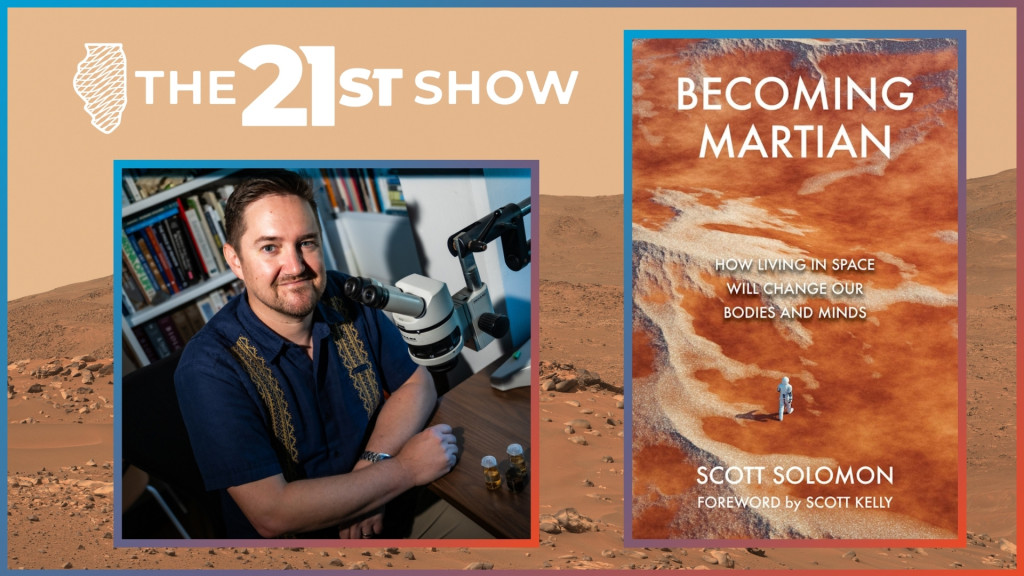
Portrait: Jeff Fitlow/Rice University • Book: MIT Press • Background: NASA
[00:00:00]
Brian Mackey: Today on the 21st show, it's the official policy of the U.S. government to work toward putting people on Mars. Debates about that usually focus on cost and national priorities. Less considered is what life on Mars would do to the people who go there. That, however, is the subject of a book by scientist and Illinois native Scott Solomon. It's called "Becoming Martian: How Living in Space Will Change Our Bodies and Minds." I'm Brian Mackey with Scott Solomon. Today on the 21st show, which is a production of Illinois Public Media, airing on WILL in Urbana, WUIS in Springfield, WNIJ in Rockford DeKalb, WVIK in the Quad Cities, and WSIU in Carbondale. But first, news.

From Illinois Public Media, this is the 21st show. I'm Brian Mackey. And this is Mars, the Bringer of War from Gustav Holst's "The Planets."

The planet Mars has had the attention of humankind going back to antiquity. Babylonians thought its movements told of future events. Dante made it a stop on the "Divine Comedy." It's where he imagined martyrs for Christ had their final resting place. And of course, the idea of Martians — little green men or otherwise — have been a mainstay of popular culture for more than a century.

Closer to the present day, Elon Musk has long been fixated on the idea of, as his T-shirt puts it, occupying Mars. Back in 2017, he'd said we'd already have humans there by now, with a crew vehicle launching in 2024. Obviously that has not happened. And earlier this year, Musk seemed to back off his ambitions, saying SpaceX had shifted its focus to building a self-growing city on the moon. In that post to his social media site, he speculated that could be achieved within a decade, while doing so on Mars would take 20-plus years. We'll see.

But beyond the tech billionaire class's enthusiasm for colonizing Mars, it's also the official policy of the U.S. government to get there. Among the goals outlined in a document called the National Space Policy of the United States of America is, quote, "extend human economic activity into deep space by establishing a permanent human presence on the moon, and in cooperation with private industry and international partners, develop infrastructure and services that will enable science-driven exploration, space resource utilization, and human missions to Mars."

All this got my guest today wondering: What would going to Mars mean for humanity? Scott Solomon was raised in central Illinois, graduating from Uni High in Urbana and the University of Illinois Urbana-Champaign. He earned a Ph.D. in ecology, evolution and behavior from the University of Texas at Austin. And today he's a professor of biosciences at Rice University in Houston, Texas. He's also a science communicator, creating online courses and a podcast, "Wild World with Scott Solomon." Beyond that, he's a research associate at the Smithsonian Institution, and the credential of which I am the most jealous — he is a fellow national of the Explorers Club in New York City, an exclusive organization whose members have included Neil Armstrong, Sir Edmund Hillary and Jane Goodall.

Solomon's latest book is called "Becoming Martian: How Living in Space Will Change Our Bodies and Minds." It was published in 2026 by MIT Press. I spoke with Solomon in March 2026, so no calls today, but let us know what you thought. Talk at 21stshow.org. Scott, welcome to the 21st show. Thanks for being here.

[00:04:21]
Scott Solomon: Hey, Brian, well, thank you so much for having me on.

[00:04:24]
Brian Mackey: All right, Scott, let's start with the human body in space. What are some of the things that happen to human bodies when they spend more than a short time in space?

[00:04:34]
Scott Solomon: Yeah, well, you know, it's an interesting question because just a little over six decades ago, we had absolutely no idea — when the very first astronauts went to space, there were still open questions about things as basic as: Can you swallow in microgravity? Would your eyes pop out of your head? Yeah, I mean, very fundamental things that we didn't know. And of course, now we know that you can indeed swallow, that your eyes will remain in your skull. But we have also learned quite a bit about what happens to people who are in a lower gravity environment, who are in the higher radiation environment of space.

And some of the things that we now know include the fact that your muscles start to get weaker as you spend more time in space, and it's especially true of the muscles that help hold your body up in gravity. So your back, your lower body, your legs. And as those muscles weaken, it also causes our bones to start to become more brittle, because basically our bones respond to what the muscles are doing. So when the muscles don't work as hard, the bones start to actually lose matter — they actually give up some of the calcium and the phosphorus that gives them their strength.

We also know that the radiation in space can affect our DNA. Radiation causes mutations, and that's the reason that we have to wear a lead apron when we go and get X-rays. X-rays are just a pretty small amount of radiation exposure, but if you're up in space for a long amount of time, you're being exposed to quite a bit of radiation. And so that can actually cause mutations that can be permanent changes to our DNA. For the most part, that doesn't seem to have caused any major health effects for astronauts that have been to space so far, but as I'm sure we'll talk about, as we go deeper into space and spend more time there, that is a concern.

[00:06:47]
Brian Mackey: Yeah, you mentioned the amount of radiation you get — like even on a commercial airplane flight — is the equivalent of one X-ray. How much more would it be if you're up in orbit, or potentially spending months and months going to Mars or beyond?

[00:07:03]
Scott Solomon: Yeah, so here's the thing: When we talk about space, it's actually really different depending on where in space you're talking about. So most of the recent experience that humans have had in space has been in a region that is close to the Earth called low Earth orbit. That's where the International Space Station is. It's about 250 miles above the surface of the Earth. And I mean, that seems far, but it's actually close enough to the Earth that it's still within the protection of the Earth's magnetic field.

So Earth is very lucky to have this magnetic field that surrounds it, and one of the things that that does is it basically blocks some of the radiation that is found in deeper space. So astronauts are above the atmosphere when they're on the International Space Station, so they're being exposed to more radiation than you and I are on the surface, but being inside of that magnetic field means that they're still partially protected.

So going deeper — going like the astronauts that are about to leave on the Artemis project and the Artemis 2 mission and make their way around the moon — they're going to be going outside of the protection of the magnetic field, so they're going to be exposed to much more radiation. And that would be true, of course, of anybody that goes all the way to Mars. And Mars doesn't have a protective magnetic field, nor does the moon. So being on the surfaces of another planet or moon without a magnetic field means that you're exposed basically to the full amount of deep space radiation.

[00:08:45]
Brian Mackey: So you mentioned that some of the earliest concerns, before we had been to space, were things like our eyeballs floating out of our sockets, I guess. I suppose we figured that that wasn't going to happen when we launched Albert and Albert 2 up into orbit and saw that they had survived that. But talk about some of the lessons we've learned over the years.

[00:09:06]
Scott Solomon: Yeah, right. So Albert was one of the very unfortunate animal research subjects in the early days of space exploration. Because we didn't know what was going to happen to a person's body in space, we — by "we" I mean NASA and the predecessors of NASA, the U.S. government researchers that were trying to understand what would happen to a person in space — decided to do some experiments using animals. And this is kind of a really sad chapter in the history of spaceflight, but I think it's an important one to know about.

So there were a series of experiments using different species of primates — some monkeys and then later chimpanzees, actually — which is interesting that the American approach was to use primates. This was part of the space race, and of course our adversary in the space race was the Soviet Union. The Soviet Union was also conducting animal research studies, but they tended to focus on dogs.

So, sort of famously, the very first animal to go orbiting around our planet was a dog named Laika, who was actually a street dog on the streets of Moscow that was part of this program that the Soviet Union engaged in to basically train dogs and then send them up into space. And in many cases — and this is true of Laika and it's true of many of the primates in the American studies — the animals didn't survive. But in some cases, they did teach us important lessons. They didn't survive, but they did survive long enough to demonstrate that being in space is not immediately lethal, and so that gave NASA and the Soviet space agency the confidence to send the very first people.

[00:11:10]
Brian Mackey: Yeah, that is a fascinating chapter in our history. Let's fast-forward a little to — I have a whole shelf of books on space and space exploration, but one story that was new to me in your book, "Becoming Martian," was that of James Irwin from Apollo 15. Tell me about what happened to him, in his heart.

[00:11:33]
Scott Solomon: Yeah, so James Irwin was one of the Apollo astronauts who walked on the surface of the moon. You know, only 12 people did. And I think it's something to remember, as we are now planning to return to the moon, that only 12 people ever actually went and landed on the moon and spent time on the surface — and he was one.

He was doing an EVA, which, you know, more commonly known as a spacewalk, or a moonwalk in this case. And NASA didn't collect a lot of biomedical data on the Apollo astronauts, which is an interesting fact — they sort of chose to just collect the minimum amount of information needed to make sure that those astronauts were OK, just sort of monitoring their basic vital signs, and that includes things like their heart rate.

And so they're monitoring this back at mission control, and they actually picked up on a heart arrhythmia, a type of arrhythmia called [bigeminy]. [🔴 REVIEW: Original transcript says "abijiminy" — verify correct medical term] And basically, this is something that apparently Irwin was not aware of at the time. He didn't realize that he was experiencing this irregular heartbeat. And mission control actually didn't inform him about it at the time. And so he did this — part of his mission was being on the surface of the moon and conducting experiments and testing gear and all of these things, and he did all that, and then made his way back into the spacecraft, and they made their way back to Earth. And it wasn't until later that —

[00:13:16]
Brian Mackey: We should say he had some mechanical problems with his suit, so he'd lost like 5% of his body weight. Well —

[00:13:22]
Scott Solomon: That's right, yeah, that's right. So he did have some issues that happened, and these were things that did happen from time to time with the Apollo astronauts. So that by itself wasn't necessarily outside of the norm. I mean, doing any kind of spacewalk or moonwalk is a very, very physically demanding thing, and the astronauts train for a long time of course to do that, but it's also just the kind of thing that is going to be one of the toughest physical things that they have to do.

So what was noteworthy, I think, about this is the fact that we don't really know much about what being on the moon — in the environment on the moon — does to our bodies, because being on the moon is different from being in low Earth orbit, like on the International Space Station or the space shuttle. For one thing, you're in a partial gravity environment. The moon has one-sixth of the gravity of Earth. And so that's different from being in a weightless, or effectively a zero-gravity environment, and we know a lot about what happens in zero-G. We don't know that much about what happens in [one-sixth] G. And as we make plans to spend more time on the moon, we of course would like to know that.

So the fact that this was a cardiac event — a relatively minor one in the grand scheme of things, but still something noteworthy — it is kind of intriguing. Now, the problem with a lot of these space medicine studies is that the number of individuals that you can study is so small that it's hard to draw general conclusions, and I think this is an example of that. So, are there cardiac effects or cardiovascular effects of being in a partial gravity environment? We don't know. That's one of the few examples of a known incident that happened in that environment. The question is, was it triggered by the conditions of being there, or did it just happen anyway — or was it just, as you said, doing a physically challenging thing, and any physically challenging thing might have caused that to happen.

[00:15:37]
Brian Mackey: Yeah, and we need to take a break in about a minute here. But is it related that then he comes back — you know, presumably these astronauts were pretty physically fit and carefully selected people — he has a heart attack two years later, another one years after that, and then five years later, he dies at the age of 61.

[00:15:54]
Scott Solomon: Yeah, of a heart attack. That's right. So again, it's hard to know because of such a small sample size. If you look at the sort of astronaut data altogether in aggregate, there's no increased risk of cardiac events among astronauts that have been to space, including to the moon, compared to the rest of the population — but we're dealing with a small sample size, so we don't know.

[00:16:23]
Brian Mackey: All right, we are gonna continue with Scott Solomon. His book is "Becoming Martian: How Living in Space Will Change Our Bodies and Minds." It's out now from MIT Press. We'll be back in a moment. This is the 21st show.

[00:16:40]
Speaker 2: I just found out yesterday that Linda goes to Mars. Every time I sit and look at pictures of used cars. She turned on her radio and sit down in her chair. And look at me across the room as if I wasn't there. My [lens is tomorrow]. [🔴 REVIEW: Verify lyrics] Really wish you wouldn't leave me here. [Land is gone]. [🔴 REVIEW: Verify lyrics] Well, I one day wish you'd bring me something home.

[00:18:02]
Brian Mackey: It's the 21st show. I'm Brian Mackey. A surprising number of songs about — or mentioning — Mars out there in the world.

We're talking today with Scott Solomon, who is a professor in the Department of Biosciences at Rice University in Houston, author of multiple books, including from 2016, "Future Humans: Inside the Science of Our Continuing Evolution," and most recently and more to the point for our conversation today, "Becoming Martian: How Living in Space Will Change Our Bodies and Minds."

A couple of text messages I want to share from our listeners on this subject. Christopher in Brimfield says, "I think we're gonna explore space remotely. Humans don't have to travel to space, unless we find a faster way to travel." Lloyd in Danville, though, says, "Space exploration is important because of scientific factors. There must be a balance between preserving our environment for life and survival. Mars might have meaning; however, we should focus more on saving our planet by making policies that put humans on a path of sustainability."

We first aired this conversation in March 2026, so no calls today, but you can always leave us a voicemail: 217-300-2121. [🔴 REVIEW: Host initially reads number as "217-32121" before self-correcting to "217-300-2121" — verify correct phone number]

All right, Scott Solomon, I mentioned at the top of the show that you're originally from central Illinois. I'd like to take a divergence from our talk of Mars and space to talk a little bit about your background here. Tell me about growing up in [Champaign-Urbana] [🔴 REVIEW: Original transcript says "uhchampaign Urbanannon" — verify intended phrasing] and how you got into science.

[00:19:36]
Scott Solomon: Sure, yeah, that's right. So my family moved to Champaign when I was, I guess, about 4 years old. So I grew up there and then went to high school at Uni High in Urbana. And I think that was part of when I really kind of got interested in science. I had some really great teachers there, particularly in biology. Mr. Stone, who really kind of got me excited about many aspects of biology, including insects, which ended up becoming something that I focused on quite a bit later in my education.

But then it was as an undergraduate student at the U of I that I had a really big — I guess you'd say realization, or something like that. What happened was, I had actually started off pre-med because I just really wasn't aware that there were career options for people that were interested in biology and wanted to do something other than medicine or something health-related. So I had started off doing that because I thought that was sort of like the main thing that you could do.

But I got involved in research as an undergrad, and I had the chance to go on a research expedition to the Galapagos Islands. So my professor at the time, Martin Wikelski, he was studying marine iguanas in the Galapagos Islands, and he needed a research assistant and I got asked to go. And this was like living out a [childhood dream]. [🔴 REVIEW: Original transcript says "and Charhood" — verify intended phrase]

Yeah, well, exactly, right? I mean, there's a reason that the Galapagos Islands inspired Darwin and has inspired many people since. It's incredible. And so yeah, while I was there, I basically was like, I can't believe this is a real job that people can do. I want to do something like this. And that was when I decided to pivot from medical school to a Ph.D. program in ecology and evolutionary biology.

[00:21:39]
Brian Mackey: And why UT Austin?

[00:21:42]
Scott Solomon: Yeah, so when I was looking at different graduate programs, I came upon a number of places that have really good programs, and UT Austin is one of them. I still wasn't quite sure what I wanted to do. I knew I really liked doing field research, like I had gotten a chance to do in the Galapagos Islands. And I had also had an experience, again as an undergrad at the U of I, where I was an exchange student for a year in Ecuador. And so that had, of course, helped my Spanish and really kind of introduced me to the wonderful ecosystems of South America, and I really sort of fell in love with them.

And so I thought, I really want to do something where I can do field research in Latin America and Central and South America. And it just so happened there was a lab at UT Austin studying leafcutter ants in Panama, and it really just captured my imagination, my interest. I started doing some work in that area and really kind of fell in love with that. And so, yeah, for my dissertation, I ended up studying leafcutter ants basically across Central and South America, actually with a focus on the Amazon rainforest. So trying to understand kind of how new species come into existence through evolution.

[00:22:58]
Brian Mackey: I think a lot of us are familiar with the idea of the ant colony you get out of the back of like "Boys' Life" magazine or whatever — that's like a glass sheet. How does that actually work in terms of field research? I presume you have something a little more sophisticated.

[00:23:11]
Scott Solomon: Yeah, Uncle Milton's ant farm, right? That was like the classic one, which I had. I had that as a kid, growing up in Champaign-Urbana. And I was intrigued by ants, but ants at the time when I was a kid were just like one of many things that I thought were fascinating. I mean, I was always outside digging around in the dirt and looking for, you know, dinosaur bones or something like that. So I was just kind of generally curious about all sorts of creatures.

When you're doing field research on ants, there are a lot of different things that people do, but what I was doing was really trying to understand this really complex interaction between this one group of ants — the leafcutter ants — and this fungus that they actually grow as a crop. So these kinds of ants are farmers. They are growing fungus as a crop the way that we grow corn or wheat. And to understand that, we needed to get into their nests and actually observe them and collect samples of not just the ants, but of the fungus garden. And so that looked like a lot of digging into ant nests. So I spent a lot of time with a shovel deep inside a nest of ants that are trying to bite me and trying to [collect samples]. [🔴 REVIEW: Original transcript cuts off — verify if audio contains additional content here]

[00:24:26]
Scott Solomon: [Continuing from previous segment] It definitely is a skill that you learn, like many things, I will say that. So there are ways that you can kind of avoid getting bitten, or at least get fewer bites, and I learned those skills pretty quickly by doing it.

But it's fascinating because you're actually — it's almost like being an archaeologist, where you are kind of getting a glimpse into this civilization. Because it really is. It's a complex society underground. There can be 5 million ants living in this underground complex that has all of these tunnels and chambers. And yeah, they're growing fungus, but they also have like a separate area where they keep all of their waste. They can manage disease outbreaks. They're actually using bacteria to treat disease. I mean, they're doing all these things that we used to think are unique to humans. And now we know that insects and other species as well are able to do these things. So I was just fascinated by it.

[00:25:29]
Brian Mackey: Maybe it's my ignorance as a human chauvinist, but I did think that agriculture, for example, was one of the things that set us apart. So how did they develop ant agriculture?

[00:25:41]
Scott Solomon: Yeah, that's one of the questions that we've been trying to investigate, and actually we now know that they've been doing that for 66 million years. So human agriculture, we think, began about 10,000 years ago, and here we have ants that have been doing it for 66 million years. And the number 66 million is a really important, relevant one, we think, because that's also the exact time in which the dinosaurs became extinct, right?

So we now are pretty confident that it was an asteroid impact that struck the Earth 66 million years ago and led to this major mass extinction event. And part of why it was a mass extinction event is that the impact caused all of this debris to be sent up into the atmosphere and traveled all around the planet and blocked out the light of the sun. So plants couldn't grow, lots of things died. And so if you are dependent on eating plants, or dependent on eating something that eats plants, you're in trouble. But if you are able to live off of something that, like a fungus, is based on decay, that's actually probably a pretty good time to be doing that.

So we think that's probably not a coincidence. We think it's likely that ants started raising fungi as a food source at this time, because it would have been one of the few reliable sources of food in that kind of almost post-apocalyptic world that happened soon after that asteroid impact.

[00:27:17]
Brian Mackey: I must say, a question that occurred to me as I was reading that section of your book: Ants have a 66-million-year head start on humans with agriculture — so why don't they have Beethoven and TikTok and orthopedic surgeons and the other stuff?

[00:27:31]
Scott Solomon: Are you sure they don't? I don't know. We'll keep looking. We keep discovering new things about them.

Well, yeah, I mean, look — on the one hand, they're nowhere near as intelligent as humans. But on the other hand, they've actually solved some of the problems that we're still wrestling with. And I'll give you an example again from agriculture. As I'm sure many of your listeners are well aware, one of the challenges that we often have in human agriculture is that the most efficient way to grow large amounts of crops is basically to grow them in a monoculture. You plant one giant field with the same type of crop, but that also leads us to being vulnerable to any kind of pest or disease, because if that pest can crack the code of how to attack that one crop, then it can wipe out your entire field. And so that's always been one of our challenges with large-scale agriculture: How do you grow crops at that scale while avoiding any kind of major pest or disease outbreak?

But the ants are doing something similar — they are all growing the same type of crop at a massive scale. So how have they been able to pull that off for the last 66 million years? What we do, of course, is a variety of things, but a lot of it involves the use now of pesticides of various kinds. And it turns out that ants are doing something along those lines, too. They actually are using bacteria that they cultivate on their exoskeleton, and those bacteria are actually producing chemical compounds that can keep some of the pests at bay.

So in a way, that's like, OK, well, they're also using pesticides. But I think the thing that is different — that the ants are doing compared to what we're doing — is that having live bacteria produce these pesticides is a real advantage. Because what we know is that the enemies, the pests, the diseases, are going to quickly evolve resistance to any kind of pesticide that we use. We develop a new pesticide, it works for a little while, and then it stops becoming very effective as resistance develops.

And so I think the thing that ants have figured out is that by keeping live bacteria, those bacteria can evolve in response to the evolution of the pests. So you have this kind of arms race between the pests and the pesticides. And we struggle to keep up in that arms race. The ants seem to be able to do a better job than we are because they keep live bacteria. So that's one example. They might not be very intelligent as individuals, but they've come up with some pretty clever strategies.

[00:30:21]
Brian Mackey: Yeah, and I know when you say "they've come up with it" — right? Because I think of like, you have that photo of yourself, right, that we're gonna post online here, with one of those binocular microscopes. It's not like the ants are thinking about this and developing these things. This is something that's happened through — I presume — natural selection, evolution?

[00:30:46]
Scott Solomon: Yeah, yeah, that's right. So that's a good point. So it's not like they have little scientist ants that are down there testing different pesticides and selecting the best ones. This is essentially a trial-and-error strategy that has led them to some pretty good solutions through the process of natural selection. Natural selection is sort of nature's way of inventing solutions to problems. And so, yeah, it's not a conscious choice, but it is something that has led them to some pretty remarkable accomplishments.

[00:31:21]
Brian Mackey: Well, and maybe this begins to bend us back towards your work, which is the idea that humans are evolving. And one of the questions that you're exploring here is how humans might evolve in space. So take me back to that basic point. Are humans in fact — are we still evolving, albeit at a slow pace, or slow to our perception, or our mere 77-year-or-whatever lifespan perception?

[00:31:48]
Scott Solomon: Yeah, that's right. So this was a question that I first got really interested in in my first few years as a professor. And actually I'll tie it back to the ants, because for me one of the things that was really intriguing is the idea that, OK, I'm studying ants, I'm studying fungi, we know they evolved in the past, but we also can sort of document ways in which they're still evolving.

And I always like to emphasize this, especially when I'm teaching my students about evolution, that it's not just — evolution isn't just about understanding what happened in the past, it's also an ongoing process. And that's true of ants, and it should be true of any species, including humans. And then the question that I had was like, well, can we actually show that humans are still evolving today? Because it kind of doesn't feel like it sometimes. I mean, it feels like we use our technology, we have culture, we have modern medicine, we have all these things that really kind of seem to separate us from nature.

[00:32:42]
Brian Mackey: Yeah, and I think you could look at culture and think it's an argument that we're not evolving. Maybe we're devolving with reality TV. But OK, that's maybe not fair.

[00:32:53]
Scott Solomon: Yeah, so, right — it doesn't seem like — well, one thing I'll just put on my professor hat for a moment and just point out: We have this idea that evolution means progress, but actually it doesn't have to. Evolution is actually just change, and it doesn't always make things better. And that's actually an important point for understanding not only how our species is still evolving today on Earth, but also what could happen to people on other worlds.

So as we think about how we might evolve in the future wherever we are — whether we're here or whether we're out in space — evolution has changed, and it can make a species better adapted, but there are other ways in which evolution happens, too. And that's a real kind of thing that I like to emphasize: Any kind of change from one generation to the next in our genes, and our traits that are heritable, that counts as evolution.

So, we are still evolving in that sense. There is still natural selection — it's not as strong as it used to be, but there are still examples. I mean, we actually saw this during the COVID-19 pandemic, unfortunately, in which some people were more susceptible to severe disease than others. And we now know that there's actually a genetic basis to a certain extent to some of that difference. And so —

[00:34:15]
Brian Mackey: Yeah, we saw that the virus itself — certain strains were more fit, I guess, to spread among humans. All right, we need to take another break. We're going to continue with Scott Solomon. His book is "Becoming Martian: How Living in Space Will Change Our Bodies and Minds." This is the 21st show. Stay with us.

[00:34:47]
Speaker 3: [Music]

[00:34:59]
Speaker 4: Is there life on Mars?

[00:35:11]
Brian Mackey: It's the 21st show. I'm Brian Mackey. We're talking with Scott Solomon, author of "Becoming Martian: How Living in Space Will Change Our Bodies and Minds." It's published by MIT Press. Solomon's also a professor in the Department of Biosciences at Rice University in Houston, a research associate at the Smithsonian, and a fellow of the Explorers Club in New York City. He's also an alum of both University High in Urbana and the University of Illinois.

We first aired this conversation in March 2026, so no calls today, but let us know what you think about going to Mars. Talk at 21stshow.org. [🔴 REVIEW: Host reads the URL as both "2firstshow.org" and "21stshow.org" at different points in the transcript — verify correct URL]

In the [14] minutes or so we have remaining, I do want to talk about Mars — that is the subject of your book. So, what did you learn about where the idea of human settlement on Mars comes from?

[00:36:03]
Scott Solomon: Yeah, well, as you brought up in the introduction to the show, we've had a fascination with Mars for as long as we've known what it was. Going back to sort of ancient cultures giving special meaning to the movement of Mars in the sky. But as soon as we were able to see it up close with telescopes and make observations of it, people started to really — I think I would say — imagine what things might already be living there and imagine the possibility that we could potentially go there someday.

It felt more like fantasy for a long time, and of course there's a ton of science fiction that has imagined not only Martians, but also humans going to Mars. And it wasn't until we got a sort of close-up look by actually sending spacecraft there that we learned that Mars is actually a pretty harsh place, and not one where we can easily live. But that hasn't stopped people from trying and from imagining and even working now on ways in which it would be possible for people to actually go there and survive.

[00:37:19]
Brian Mackey: What are some of the big challenges we would have to overcome to establish permanent residence on Mars?

[00:37:26]
Scott Solomon: Yeah, well, getting there is part of the problem, right? So it is far, and it takes with our current rocket technology between six to nine months just to get from Earth to Mars. But it's actually worse than that, because you can only go during a window of time that is about every two years. And that's because Earth and Mars are on different orbits — Earth is kind of on the inside track and Mars is on the outside track, so they're not always very close together.

So assuming that you can time it right and go, and in six to nine months you're there — once you arrive, well, now you're faced with a problem that Mars has a very thin atmosphere that makes landing there hard, because you can't easily parachute the way that we do with spacecraft coming back to Earth.

Let's assume that we get there and the landing goes OK. Now you're on the surface of Mars, and it has about one-third the gravity of Earth. So that's one of the challenges — we talked before about how being in a lower gravity environment affects our muscles and our bones, among other things. It also — having a very thin atmosphere and having no magnetic field like Earth has — means that radiation is affecting the surface of Mars, and basically you're getting almost full-strength radiation from space. So you need a lot of protection from that radiation if you're going to survive for very long.

[00:38:51]
Brian Mackey: What about water, right? There is ice on Mars — a lot of it below the surface. Can we just melt it, drink away?

[00:39:01]
Scott Solomon: Yeah, so you're right, we now know that there is actually abundant water on Mars, it's just frozen. So there are places where you have access to a ton of it at the surface — that's like the poles. But you're also right that below the surface, we think that there is a fair amount of water. Some of the rovers that have been on Mars have been able to kind of scrape away the surface and find some frozen water ice there.

So we think that, yes, you could access it and you could melt it and be able to use it — to use it as water to drink. But you can also take that water — and water being H2O, you can split it into hydrogen and oxygen — and that can give you oxygen to breathe. You can also use the combination of hydrogen and oxygen as rocket fuel. So that is something that would be important to be able to harvest as well.

[00:39:59]
Brian Mackey: I was also intrigued by your section on perchlorate, if I'm saying that correctly. What is perchlorate?

[00:40:06]
Scott Solomon: Yeah, so this is a chemical that, fairly recently, we've learned is found in the what we call the regolith — that's basically Martian soil. And this is a chemical that basically is toxic to plants and to people. And so this is really kind of a bummer, because again, we would need to be growing crops if we're going to be living on Mars, we need to have food to eat. And so the most straightforward way you would think would be to plant crops in Martian soil and grow them. But in order to do that, you'd have to remove these perchlorates, because not only would they be toxic to the plants, but even if the plants were able to handle them, if we ate those plants, we would be consuming those perchlorates. And those can basically affect the thyroid gland, and so it would be a very, very dangerous chemical to have in our food.

We do think that there are some ways in which you can remove it — it requires probably using a lot of water to kind of rinse that soil. So that does rely on having, again, abundant sources of water, which, as we said, it's there. But it's one additional challenge that we'll have to face to grow food there.

[00:41:25]
Brian Mackey: When I read that in your book, I was reminded of the scene in "The Martian" — the book by Andy Weir and the movie with Matt Damon — where he uses Martian soil and some feces he collected from the toilets on their base to grow potatoes. Does what we have learned — would that scene not have gone out the way it played out if we knew about the perchlorate?

[00:41:47]
Scott Solomon: Yeah, exactly. And it's a shame because I love that book and that movie, and so much of the science in "The Martian" is actually really good science. Andy Weir is sort of known for really doing his homework and getting the science right. And that's true also in the movie that actually just came out today, "Project Hail Mary," which is another great depiction of humans going into space and some of the challenges that we would face.

But yeah, when Andy Weir wrote "The Martian," we didn't yet know about the perchlorates. That was a more recent discovery based on some of the rover science. And so, yeah, it would not work the way that Mark Watney — right, the character played by Matt Damon — the way he basically just sort of planted potatoes in the soil, fertilized them, and then was able to harvest them. So he would need to take the additional step of removing those perchlorates from the soil before he could do that.

[00:42:47]
Brian Mackey: Fascinating. All right, in the time we have remaining — and let me remind listeners, we're speaking with Scott Solomon, who is a professor at Rice University in Houston and author of "Becoming Martian: How Living in Space Will Change Our Bodies and Minds" — let's get philosophical. You open the book with a quote from a Russian space pioneer. I'm not gonna try to pronounce his name. He says, "Earth is the cradle of humanity, but one cannot live in a cradle forever." Do you think that's true?

[00:43:17]
Scott Solomon: Yeah, this is a very famous quote by [Tsiolkovsky], [🔴 REVIEW: Original transcript says "Tykovsky" — verify correct spelling of name] and basically, yeah, arguing that sure, Earth is where we're from, but it doesn't mean it's where we have to stay.

You know, it's interesting — there are all these different motivations that people have for why they think we need to go to space and, in some cases, not just to visit but to stay. Some of the motivations I'm quite skeptical of, I have to admit. The idea that we can go and start society over and kind of get it right this time is very idealistic. I wish that were true. I am very doubtful that we would get it right if we started over again. I think we're more likely to just repeat the same mistakes that we've made throughout history.

But I am compelled by this idea that if we don't go — if we remain here on Earth forever — that ultimately some kind of disaster is likely to happen here, whether it's self-inflicted, like a nuclear war or something along those lines, or whether it's something external that we maybe don't have control over, like another asteroid impact. We know that these things have happened throughout history, and we expect that at some point another asteroid will come this way. Luckily, we are working on technologies to try to do something about it — to deflect it, for example — but we don't know yet if that would actually work.

So this idea that in the long run, if we want to ensure our survival — and actually the survival perhaps of all life on Earth — maybe one of the best strategies to do that is to not have all our eggs in one planetary basket, but to really spread out and become multiplanetary, and maybe even eventually reach other solar systems. Because if you really take the long view, in about five billion years or so, our sun is going to expand and engulf not only Earth but Mars as well. So if we want to really take a long view and survive indefinitely, we need to expand not only to the other planets in our solar system, but even to other solar systems.

So I do think that is a compelling argument. But at the same time, I'm really aware of the time frame that we're talking about here — that's a very long view. And I think, yeah, we should be working towards understanding what would be necessary to do that. But I also want to caution people against getting too far ahead of that. Let's make sure we're doing this in a thoughtful, ethical and responsible way, and not putting people unnecessarily in harm's way in the process.

[00:46:09]
Brian Mackey: Just a few minutes left. I mean, you mentioned the possibilities of nuclear war, nuclear holocaust some might say. Climate change creating significant problems for people, for our way of life at least. What do you think of the people who say, you know what, all this focus looking outward, looking to the stars — it's taking our eye off the ball of what we need to be doing right here, right now?

[00:46:38]
Scott Solomon: Yeah, well, look — as a biologist, as a lover of nature, I'm keenly aware of the challenges that we face here on Earth, that our environment is facing, that our planet is facing, that the other species that we share the planet with are facing. And I am very much an advocate for doing everything that we can to protect it.

I don't see it as having to choose between one or the other. I think it's something of a false dichotomy. I think that we can pursue both things, and in many ways I think that by trying to figure out how we would be able to live on other worlds, it will actually make us really appreciate and value how special Earth is even more than we already do.

I really firmly believe that no matter how bad Earth gets, it is probably always going to be a better place than Mars. Mars is just a really challenging place for a species like us that evolved here on our planet. So I think we absolutely have to do everything we can to protect our planet and the species here. But I think that we can do that while also going out and studying the worlds that live out beyond our planet and trying to figure out what would be necessary for us to live there.

[00:47:56]
Brian Mackey: Scott Solomon is — or I should say, is a professor at Rice University in Houston, Texas. He's a research associate at the Smithsonian, a fellow at the Explorers Club, and the author of "Becoming Martian: How Living in Space Will Change Our Bodies and Minds." Scott, thanks so much for speaking with us today on the 21st show.

[00:48:17]
Scott Solomon: Thanks, Brian. It's really been fun talking with you.

[00:48:44]
Speaker 5: She thinks she missed the train to Mars. She's out back counting stars.

[00:48:50]
Speaker 3: [Music]

[00:48:57]
Speaker 5: She thinks she missed the train to Mars. She's out back counting [stars].

[00:49:34]
Brian Mackey: We leave you today with the band Hum, formed in Champaign, Illinois, 1989. This is, of course, their biggest radio hit, "Stars," from 1995. That is it for us today. The 21st show is a production of Illinois Public Media. I'm Brian Mackey. Thanks for listening. We'll talk with you next time.
Today's show included a rebroadcast of the following "best of" segment, first aired March 20, 2026: Do humans have a future on Mars?