



‘One Last Dance’: What Ebertfest meant to local film buffs
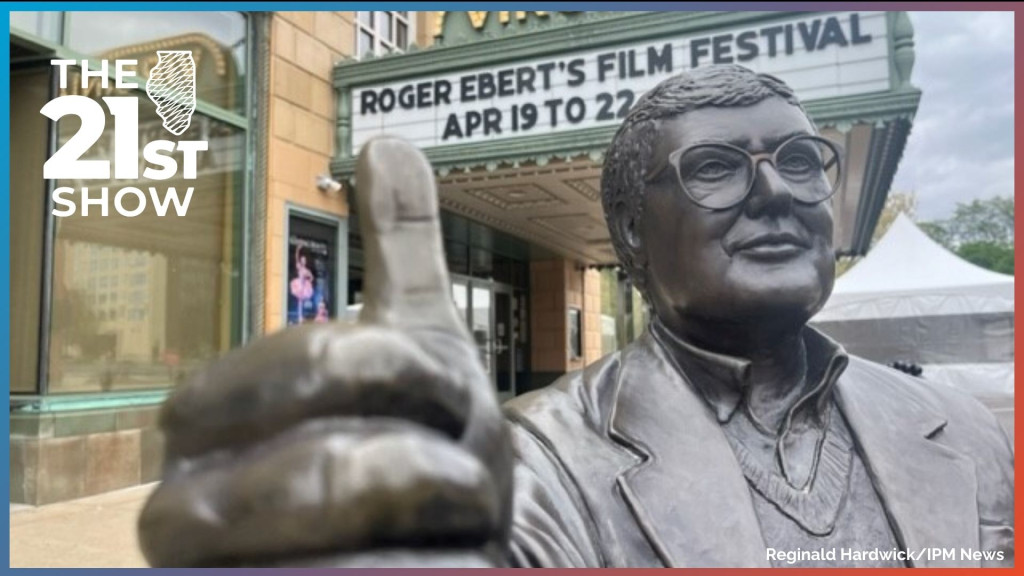
Ebertfest, an annual film festival held in Champaign will be ending this year. The final festival will be held this weekend on April 17 and 18. Reginald Hardwick /Illinois Public Media
// This is a machine generated transcript. Please report any transcription errors to will-help@illinois.edu.

[00:00:00]
Brian Mackey: Today on the 21st Show, movie critic and Champaign-Urbana native Roger Ebert started an annual film festival in his hometown. That was back in 1999. Now, Ebertfest is coming to an end, at least in its current form. We'll talk with co-founder and host Chaz Ebert about its history, the final festival this weekend, and the future of Ebertfest. I'm Brian Mackey, and that's coming up today on the 21st Show, which is a production of Illinois Public Media, airing on WILL in Urbana, WUIS in Springfield, WNIJ in Rockford-DeKalb, WVIK in the Quad Cities, and WSIU in Carbondale. But first, news.

From Illinois Public Media, this is the 21st Show. I'm Brian Mackey. In 1999, Roger Ebert was already an immensely successful film critic. He'd been writing for the Chicago Sun-Times for more than three decades. On TV he'd been hosting a review show for almost a quarter century, mostly with Chicago Tribune movie critic, Gene Siskel. But on the eve of the 21st century, Roger added another accomplishment to his legacy: founder and host of a film festival in his hometown, Champaign-Urbana. At the time, he wrote, "Every movie lover has shared the melancholy experience of finding a film to truly love and then discovering that most people have never heard of it. When I was asked by the College of Communications to host a film festival at the University of Illinois, my first thought was of such films. There are countless festivals devoted to the premieres of new films, but none dedicated to taking a second look at wonderful films that for one reason or another, haven't yet found the audiences they deserve."

The event once known as Roger Ebert's Overlooked Film Festival soon found its audience. Ebertfest, as it came to be known, has continued for more than a quarter century in Champaign, even after the death of its namesake in 2013. But then last September, the University of Illinois and festival management announced that the festival held earlier in 2025 would be the last. And that turned out not to be the case. Ebertfest is returning to Champaign's Virginia Theater for one last dance, as it's being billed, this weekend, the 17th and 18th of April. For the hour today, we're gonna talk about the history of Ebertfest, some of its most memorable moments, the upcoming event in Champaign, and its legacy and potential future.

Chaz Ebert has had a front row seat to all of it. She and Roger were married for 20 years and were also business partners, co-founding RogerEbert.com, working on television projects, and of course, creating Ebertfest. She's with us today. Chaz Ebert, welcome back to the 21st Show.

[00:03:13]
Chaz Ebert: Well, thank you, Brian. It's great to be back here.

[00:03:16]
Brian Mackey: And we're also joined by Nate Kohn, who's had a close-up view of Ebertfest. He's directed it since the first event back in 1999. Nate, welcome to you as well.

[00:03:27]
Nate Kohn: Great to be with you.

[00:03:29]
Brian Mackey: And listeners, you can join us throughout the hour today by giving us a call at 800-222-9455. We wanna know how you experience the movies in 2026. Are you still going to the theater? Do you prefer watching at home? Maybe you've been to Ebertfest in the past. What memories do you have of it? And what do you think is Roger Ebert's legacy? 800-222-9455 is the number. 800-222-9455.

All right, Chaz, again, as I mentioned, by the late 1990s, Roger's already a very famous film critic, arguably the most famous film critic. What brought about the idea for him to found and host a film festival?

[00:04:14]
Chaz Ebert: Well, you mentioned that that he had gone to the University of Illinois [for Cyberfest], and I think it was probably, um, Nate, I think you were a professor at, were you a professor at Illinois when that happened?

[00:04:30]
Nate Kohn: I wasn't a professor, but, um, they asked me to help produce Cyberfest. This was in 1997, uh, Cyberfest being the birthday party for Hal the computer from 2001.

[00:04:45]
Brian Mackey: If you [were an] undergrad at the time, I remember it well. It was a big deal on campus that spring.

[00:04:49]
Chaz Ebert: Yes, yeah, the computer said he was born in Urbana. Did he say Urbana? I was born in Urbana, Illinois.

[00:04:58]
Nate Kohn: Yeah, in, uh, 1997.

[00:05:00]
Chaz Ebert: 1997. I thought anyway, 1997.

[00:05:04]
Nate Kohn: OK.

[00:05:06]
Chaz Ebert: So anyway, so after, after Cyberfest, it, it was, you know, Roger thought that that was fun and I think they, you know, [were] talking to Arthur C. Clarke and uh Keir Dullea and others. Uh, I'm, I'm going to get a little of this mixed up because we did end up showing 2001 at Ebertfest as well. And so the university invited him back to do another film festival and we thought, we talked about it and we talked about the ethics of a film critic not [talking] about movies that he had not seen. He did not wanna be a shill for the studios. He had very high ethics and he said, "What I will do is, I, I, I don't wanna do anything that I don't really believe, but I would like to talk about films that maybe haven't gotten as much acclaim as they should have," and that's how we came up with the Overlooked Film Festival, talking about either films or genres that had been overlooked or formats such as, you know, well, uh, black-and-white movies, silent movies, 70 millimeter projected movies. So that was exciting to think that we could do something in the Virginia Theater on that giant stage and uh show people something that you don't get to see every day.

[00:06:41]
Brian Mackey: So Nate, uh, say a little more than, than we did just there about Cyberfest, about how you came to be involved in this uh ongoing project.

[00:06:49]
Nate Kohn: Uh well, I just got my PhD [at] Illinois uh in '95. And uh I was just hanging around uh teaching courses in the English department and they, they knew I uh the the the dean of the College of Communications at that time knew I had a background in producing feature films. And so they asked me to help produce this festival and we, as, as Chaz says we invited Roger down and the, the Virginia Theater uh had been shuttered for about a decade and it was on the verge of being torn down. And we went into it and we discovered that the 70 millimeter projectors were still in the booth. Uh they built the, they built the booth around the projectors. So uh we uh brought in James Bond from Chicago and he uh refurbished the projectors and we opened the theater, [showed] the film in there for [the first time] and show[ed] 2001 in there. Roger introduced the film. Roger did a Q&A afterwards and then it sort of became the model for, for the festival. Cyberfest also —

[00:08:01]
Chaz Ebert: I'm sorry, I was gonna say something that was really exciting too. We also discovered that they still had Todd-AO [the] ability to project Todd-AO projection, which was an old uh method but it's really saturated color and to show something like uh Donald O'Connor coming and showing "Singin' in the Rain" and dancing all around and so many things that most most theaters in the country did not have the ability to do. Oh, I'm so sorry, the the telephone is ringing.

[00:08:35]
Brian Mackey: That's, we can hardly hear it. Zoom does a good job of filtering that out. Nate, I think for, for people who aren't um steeped in, in the, you know, the, the history and technology of cinema, 70 millimeter, this, this may there are people out there who maybe don't really realize how film projection has evolved. So talk about that. Talk about at the time, I guess 35 millimeter was dominant. Now it's primarily digital. Talk about what it means to show a film in 70 millimeter.

[00:09:02]
Nate Kohn: Well, um, there were 70 millimeter [films that] produce[d], uh, a, a, a spectacular image, and the films that were generally shot in 70 millimeter were, were large films, uh, films [like] —

[00:09:17]
Brian Mackey: [Lawrence of] Arabia.

[00:09:18]
Chaz Ebert: Yeah, Lawrence [of Arabia]. We showed "Lawrence of Arabia" in 70 millimeter at the Virginia Theater. You could see almost even the specks of sand. You could see everything on the [screen]. Uh there's also another film that we showed um it's a French film, Monsieur, not Monsieur, what is it? Um, well anyway.

[00:10:03]
Nate Kohn: Jacques Tati, yes, and you could see so many things. People who saw it only in a smaller format missed a lot of the things on the edges. There were so many things that the filmmaker had little scenes going on that you missed if you didn't see it on the big screen in 70 millimeter. Yeah, and if you, if you look at 2001, which was shot in 70 millimeter, um, if, if you watch it at home or you watch it on on DVD or Blu-ray or something like that, um, it's slow and you, you can't figure out why he's, why Kubrick is holding the shot so long. And the reason was that he wanted, he, because of the 70 millimeter, you could look at different portions. He wants you to look at different portions of the frame, like you look at a, at a still photograph or a still painting. So you look at the uh at the Earth down in the, in the right corner and up in the left corner, you have the spaceship going out and uh and when you see the film projected [in] 70 millimeter in the Virginia Theater, for example, it's not slow. It's, uh, everything holds your attention and that, that's what 70 millimeter does for you. Um And uh we showed about a dozen true 70 millimeter films and then we discovered we ran out of 70 millimeter films uh that we could show and so we started showing films —

[00:11:18]
Chaz Ebert: We used to like to open Ebertfest with a 70 millimeter film and uh then we ran out of 70 millimeter films to show. I think we had shown them all. There is another one though that I think that we've missed that we need to go back and take a look at. But oh, but I forgot this is the last dance. We're not gonna do that. Oh my God. Oh, you know, oh, OK. [After] you know, after 27 years, everything has a cycle and everything, you know, things begin and everything has an ending, and I guess, uh, this is our ending, but there are so many things that I think we still could do and there is one film that I was wishing we would be able to show the audience this time, but our roster was too full, so, um, anyway.

[00:12:09]
Brian Mackey: We can come back to that maybe a little bit. So let's, let's talk about how, so let me remind listeners first, this is the 21st Show. We are talking about Ebertfest, which is this weekend in Champaign. It's the last one. At least that's what we've been told. Um, the last Ebertfest, which was founded in 1999. We're talking about it with Chaz Ebert, who of course, uh, was Roger Ebert's life and also business partner, founded this as well as other ventures he was involved in, and Nate Kohn, uh, director of Ebertfest since 1999. Um, and if you want to join us today, 800-222-9455.

So we were talking before about how this was the Overlooked Film Festival. Eventually that comes out of the title. How has programming the festival evolved over time? And Nate, I'll start with you.

[00:13:00]
Nate Kohn: Um, well, I'll tell you, I'll tell you a quick story about how the word "overlooked" came out of the title of the festival. Um, we wanted to show a film that was, uh, directed by Mike Nichols and we invited him to the festival and he said, "I'm not overlooked. I'm not coming." And uh and so we decided it's probably a good idea to, uh, to shorten the title of the, of the festival. Um, as far as the selection of the films, it really hasn't changed that much. Uh, while Roger was alive, he, he made the final decision on all the films that were shown. Uh, we, we don't accept any submissions. Um, uh, in the, in the early years of the festival Chaz, Roger and I would discuss, we'd each [draft] kind of lists of films and we [would] discuss them and, and Roger would make the final decisions as to which 12 or 14 films we, we showed. Uh, now Chaz and I sort of do the same thing. Um, we each come up with, uh, films that we think would be good to show in the festival, films that we remember from the past, films that, that were made a long time ago but had some new resonance with the, with the zeitgeist of the moment. Um, or there were films from Roger's, uh, list of great movies. Um, so it's a pretty, it's a pretty random and eclectic way to to choose films, but we always seem to come up with a, with a list that the audience enjoys.

[00:14:35]
Chaz Ebert: And the, and the other thing about the overlooked name is, you know, we, we did hear from some other filmmakers who said, "We don't like the idea of thinking that our films are going to be overlooked or were overlooked," and at the time, we were not showing only movies that were overlooked. There could be something that had been a blockbuster that we were showing and we said that, "OK, let's take the overlooked out of the name" and uh and some people thought that the overlooked referred back more to "The Shining," uh uh the Overlook [Hotel], and there is actually another film festival that I think has Overlooked in its name and I think that's in Saint Louis. So but Overlooked did not serve us anymore and just eventually we just started calling the film festival Ebertfest and that name stuck.

[00:15:29]
Brian Mackey: Absolutely. Yeah, I guess it's hard to argue that "Lawrence of Arabia" [or] "2001" were overlooked. All right, let me, let me share, we asked members of our texting group about uh their memories of Ebertfest and, and the man himself. Uh, you can join that, by the way, by sending the word "talk" to 217-803-0730.

Karen in Champaign says, "I have a cookbook that Roger Ebert wrote, 'The Pot and How to Use It.' I love this book, even in my sixties." Uh, she goes on to say, "The films that I have seen at the Ebertfests of the past stick with me for decades. He had excellent taste and was an excellent curator. The talkback is one of the best aspects of any film festival. The talkback brings a higher level to sharing a film together." She says, "Roger Ebert valued the nurturing of empathy in human beings. He believed that the hearing of our own stories and other people's stories through films creates a better sense of community. There is no better legacy that a human can leave than stirring the pot so that empathy bubbles up." Thanks for that message, Karen.

We are talking about the last Ebertfest today with two people who have been involved with it throughout its history. Chaz Ebert, Roger's longtime wife and co-founder and host of the festival, and Nate Kohn, the director of Ebertfest going back to the first one in 1999. You can join us today at 800-222-9455. That's 800-222-9455. If you're on the line, please stay on. We need to take a break. We'll get to some calls when we come back. More with Chaz Ebert and Nate Kohn ahead of this weekend's final Ebertfest. This is the 21st Show. Stay with us.

It's the 21st Show. I'm Brian Mackey. We are talking about Ebertfest going back from 1999 until 2026 when we are told this is the final Ebertfest, the Last Dance as it's being called. We're talking about that with Nate Kohn, who has been [the] director of Ebertfest since 1999, and Chaz Ebert, co-host and co-founder of the festival with Roger, as well as many other ventures. She was of course married to Roger for 20 years. 800-222-9455 if you want to join us today. 800-222-9455.

Chaz, before the break I shared that text message from Karen [in] Champaign about, uh, Roger's, uh, "The Pot and How to Use It." Uh, yes, you wanted to [respond] —

[00:18:23]
Chaz Ebert: [He was] so proud. He was so proud of that cookbook. That was one of the things, I mean, even with his movie career and everything else that he had done, he, his cookbook was one of the things he was most proud of because it became a bestseller. First of all, in Hawaii, and then I think it was translated into uh Japanese or and maybe even Chinese, and so he he was uh he was really proud of "The Pot and How to Use It" and we used to actually take a one crock pot or something to the film festival and cook some of the recipes when we could in between going to the movies down in in Champaign, so.

[00:19:08]
Brian Mackey: What a great, what a great story. Um, and he, he did love that it was a rice cooker if I'm remembering correctly?

Chaz Ebert: Yeah, yeah, amazing.

Brian Mackey: Um, let's go to the phones at 800-222-9455. We have Susan calling from Elgin on line one. Susan, thanks for calling in.

[00:19:26]
Susan: Hey there. Um, I just wanted to make the comment that, um, I've been a film fan my, my whole life. I mean, since I was very, very little and I knew old Hollywood and all the old movies. Um, but watching, um, Roger's reviews on television and reading [them] in our newspaper, um, boy, uh, they gave me a completely different take on how to think about film, and it opened up a lot of films for me that I wouldn't have otherwise known about because I lived in Des Moines, Iowa, so we're talking 1970s, but, uh, anything from "Amarcord" to "Fitzcarraldo" to, you know, just "My Dinner with Andre," all those films were films that I might not have otherwise discovered if it hadn't been for Roger.

[00:20:15]
Brian Mackey: 100%. Susan, thanks so much for sharing that memory. I appreciate it. Chaz, I, I imagine that's something you hear a lot from people about uh their introduction to film through his writing.

[00:20:26]
Chaz Ebert: Yes, I do. I hear that a lot and one of the things that we [have noticed], that's been if you if you if you notice in the last few years, there's been a little more of a retro look at films and so some films from the past have come back into theaters and uh which makes people go to the website to look for Roger's review of it. And now someone has approached us with something uh sort of a novel way to get some of Roger's reviews uh out in a, in a, in a different way that we are considering, um, but it's it's something that's not fully confirmed yet, so I can't [say] not quite.

[00:21:07]
Brian Mackey: The rice cooker [button] is not the little button on the rice cooker hasn't popped up yet. OK, that's right. That's right. Well, well, I will stay tuned for that because I've got a bunch of the great movies books and some of his other writings. So I, I look forward to hearing how that develops.

I wanna ask about some of your, both of you, about some of your favorite memories from Ebertfest. There's one particular moment I'm gonna start with. We're gonna set this up the way you set it up at the 2013 festival with Tilda Swinton walking out on stage along with Chaz.

[00:21:35]
[Archival audio — Tilda Swinton]: This is a woman of her word. Tilda promised you that we're gonna do something that they do at her film festival and film events in Scotland. We're going to have an audience dance along. She's serious, she is coming down into the aisles to get you to dance with her ['cause] if we dance up here, we're coming down to dance with you [because] if we dance up here you're just gonna sit and watch us and laugh, OK, so no no um observers allowed, participants only.

[00:22:29]
Brian Mackey: All right, uh, Barry White, "You're the First, the Last, My Everything." So, obviously as a radio show, Chaz, we're missing a visual element here. Can you describe for me the scene as you experienced [it], experienced it as you remember it?

[00:22:43]
Chaz Ebert: Yes, uh, Tilda Swinton was going to go on stage, uh, but I had, we had recently had loss in our family, me with Roger and Tilda's mother had passed recently, and we were both actually backstage crying. And we said we can't go on stage crying, we have to do something to bring forth joy. And Tilda said, "I know we have a danceathon at my uh film festival in Scotland. Why don't we do that?" And I thought that's great, you know, and so that's that's how that came about and the audience loved it. It's still one of the things that people talk about the most, aside from the movies, dancing all around the Virginia Theater with Tilda Swinton.

[00:23:35]
Nate Kohn: You can, there's a, you just have to Google it, uh, dance[,] Ebertfest [and] Tilda Swinton, and you can see a video of it. [At] that particular festival, I, I told the, the folks that do a documentary about our festival every year, Shatterglass, that they should um have 12 cameras covering that particular festival [because], uh, I knew it'd be something special. So, uh [we] cut a um a video of that dance the night after it happened and put it up on social media and it, it actually went viral. There were, there were something like 30,000 views of it that, that first night. So, uh, it's still up there. Uh, and I, I guess that's where you got the audio from, uh, that you just played.

[00:24:31]
Brian Mackey: Yeah, and we actually spoke with the, uh, with someone from Shatterglass yesterday [about] his film that's going to be screening uh later this week at Ebertfest. And Nate, what are, what are some of, some other memories that stand out to you over the years, some of your favorite moments?

[00:24:44]
Nate Kohn: Uh, well, one of the first memories was that of, uh, of Donald O'Connor, uh, coming with, uh, "Singin' in the Rain." Uh, he, he was not in great health. He was in a wheelchair, but, um, he insisted on walking out on stage, that he wasn't gonna go on stage in [a] wheelchair and, and he gave [Roger] the most wonderful interview [because] Donald O'Connor was true old Hollywood. He was a, a, a real movie star. And it turned out to be his, his uh his last public appearance before he uh passed away. Uh, so that, that, that, that always stays with me. And of course, the, the Tilda thing stays with me. But we've had so many fantastic guests over the years. I mean, it's, it's just hard to, uh, keep track of them all.

[00:25:38]
Chaz Ebert: You know, [one] of my memories is we kept going back and forth about whether we could show a movie that Roger had written called "Beyond the Valley of the Dolls" that was directed by Russ Meyer. And we finally said, yes, why not? It turned out to be a hit with the audience. But the thing that we never thought that we could do, we were able to get the band the Strawberry Alarm Clock to come play on stage. They had disbanded and they came back and reformed the group just to perform at Ebertfest, and I think they continued to to tour after that. So that was a joyous, joyous time, having [the] Strawberry Alarm Clock [with us to] show "Beyond the Valley of the Dolls."

[00:26:28]
Brian Mackey: [Among] Ebert fans that movie is sort of, I don't know if I don't want to use the word notorious, but right, it, it's, it certainly occupies some mind share, yeah, and he did not go on to write many other movies in life. So how did he come to think of that [film over time? Did] Roger —

[00:26:44]
Chaz Ebert: Roger actually, Roger actually did write more movies, some that we, uh, that maybe a couple that may become Broadway plays. So he didn't produce them as movies, but he did write other movies.

[00:26:58]
Brian Mackey: OK. Did he, did he change his, the way he thought about that film and that experience over time?

[00:27:05]
Chaz Ebert: He became very proud of it. I think at first he was, you know, uh, people used to call Russ Meyer a soft porn master. But Roger said that when you analyze Russ Meyer's films [and] later uh uh a women's group said that his films, the women were all take-charge and they were [in] a in a way a a a feminist film because the women were in charge and the women called the shots and they actually had a, they actually started having film festivals where they were showing Russ Meyer films and women were talking about them. So, yeah, Roger became, you know, he became just proud of the work that he did with that film.

[00:27:57]
Nate Kohn: That was, that was Russ Meyer's, uh, first and only venture into so-called legitimate filmmaking films financed by a major studio [which] was, I believe, 20th Century Fox, right?

[00:28:08]
Chaz Ebert: Right, right, mhm.

[00:28:11]
Brian Mackey: Interesting. All right, let me go ahead, go ahead, Chaz.

[00:28:15]
Chaz Ebert: Yeah, no, I was gonna say another one of my favorite, favorite moments is when the director Charles Lane brought his film "Sidewalk Stories" to us and he in it, he was uh sort of [like] the character of like the little tramp, it was an homage to Charlie Chaplin finding a baby and what to do [as] someone who was, uh, you know, a homeless man on the street, but he found the baby and he had to take care of it. That was really a very poignant, poignant movie and the audience loved it and we loved having Charles Lane at Ebertfest with "Sidewalk Stories."

[00:28:56]
Brian Mackey: Let me remind listeners, this is the 21st Show. I'm Brian Mackey. We're talking today with Chaz Ebert and Nate Kohn about Ebertfest. The Last Dance is this weekend at the Virginia Theater in Champaign, Illinois. Of course, it was founded by Roger Ebert in 1999. If you want to join us today, 800-222-9455 is the number. 800-222-9455. So Chaz —

[00:29:22]
Chaz Ebert: Brian, Brian, excuse me, it was founded by Roger and Chaz Ebert.

[00:29:28]
Brian Mackey: Thank you, thank you. Thank you for the correction.

[00:29:30]
Chaz Ebert: You know —

[00:29:31]
Brian Mackey: I just say I don't want to erase Roger's —

[00:29:33]
Chaz Ebert: No, we actually co-founded —

[00:29:35]
Brian Mackey: 100% and RogerEbert.com and many other [ventures]. I definitely don't want to [write] you out of that story.

[00:29:41]
Chaz Ebert: Well, let me ask you don't, because women have been written out of history for far too long.

[00:29:45]
Brian Mackey: 100%

[00:29:46]
Chaz Ebert: And it's time to stop.

[00:29:48]
Brian Mackey: So let me ask you about Champaign-Urbana. What does it mean to host the festival there at the Virginia Theater and not someplace like Chicago?

[00:29:57]
Chaz Ebert: Well, I would like for Nate to answer that first because that's also his hometown.

[00:30:04]
Nate Kohn: Yeah, I mean this, this festival is I, I always viewed it as Roger's gift to his hometown. Roger had a real love for Champaign-Urbana. If you, if you, if you read his book "Life Itself," you'll find [extensive] passages about his growing up in Champaign-Urbana, uh, and it's, uh, so it, it makes all the sense in the world [going] back to something we were talking about earlier. One of the things he wanted to do with the festival is, is [bring] the, is the caller said is bring films to east-central Illinois that they, that that the audiences there would never have had an opportunity to see, um, you know, uh, Fellini films and Herzog films. Uh, and then he wanted to introduce the community to these particular films, and he wanted to, he essentially introduced each film and it was [like] a, it was like a, a college classroom lecture on how to appreciate and understand the films that we were about to see. So it made the films far more enjoyable for the audiences.

So back to Champaign-Urbana, I mean, Roger and I grew up about four blocks from each other though he was slightly older than me. Um, and we were in high school [at the] about in high school at the same, at the same time he was a senior. I was a freshman, I believe. And uh he, he was at the school, he was, um, just everybody knew him. He was writing for [and] covering sports for the local newspaper. He was editor of the Echo, the, uh, the Urbana High School paper. Um, he was, he was just always, always writing, always doing things, and, and I think he captured in "Life Itself," uh, what growing up in Champaign-Urbana was really like, uh, and it was, uh, truthfully, he, he loved the town a whole lot more than, than, than I did. But, uh, but I do, it's, it's, it's, I mean, I, you know, well, you, you know what the weather's like there.

[00:32:21]
Chaz Ebert: Well, well, I, well, I like to quote Roger how he started the book. He said [about] being born there, "I was born in the center of the universe and I've had good fortune for all my days." I just love that. I love his writing so much and um he could romanticize almost any situation, but he talked about his childhood and how fortunate he was to be born there. And that as he grew older, to have a resource like the University of Illinois in his town. At one time he thought that he would go to Harvard and his parents said, "Boy, we don't have that kind of money for you to go to Harvard. It's a good thing you were born here in Urbana-Champaign because you have the University of Illinois and it's just as good as Harvard," so —

[00:33:13]
Brian Mackey: Beautiful, beautiful. All right. Uh, let, let me remind listeners, this is the 21st Show we're talking about Ebertfest, co-founded by my guest today, Chaz Ebert, along with her late husband, Roger Ebert back in 1999. This is the last year uh for Ebertfest in Champaign-Urbana this weekend, April 17th and 18th. We'll have details on that on our website. We're also talking today with Nate Kohn, who's been director of Ebertfest since its founding in 1999.

I want to share a message from a listener. Lloyd in Danville sent us a text message. He says, "Ebert's legacy will be the fact that whether or not a particular movie got good or bad reviews, if Ebert reviewed it, that meant it got reviewed by the most important critic of all times. Chaz has done a remarkable job at continuing his legacy. She deserves a tremendous amount of credit for that. My experience with movies today are by streaming. That's unfortunate because of the missed opportunity for socialization of people meeting at theaters. He, Ebert, was a great man with a clear vision."

All right, we're gonna talk more with Chaz Ebert and Nate Kohn when we come back about the last Ebertfest, which is happening this weekend again in Champaign-Urbana. If you want to join us today, 800-222-9455 is the number. That's 800-222-9455. This is the 21st Show. We'll be right back.

It's the 21st Show. I'm Brian Mackey. We are talking about Ebertfest. The Last Dance, the last version of Ebertfest is set for this weekend in Champaign-Urbana. We're talking about that with the co-founder of the festival, Chaz Ebert, who was also Roger's longtime partner in business and life, and Nate Kohn, who has been director of Ebertfest since 1999 when it was Roger Ebert's Overlooked Film Festival. If you want to join us today, 800-222-9455. 800-222-9455.

So, Chaz, last fall, the university and the Ebertfest team announced there would be no further events, at least not in Champaign-Urbana. We can get into what happened since that announcement, but why is it time to wind down? Why is it time for Ebertfest to come to an end?

[00:36:01]
Chaz Ebert: Oh, I, um, I don't know. It's time because the university said it was time and everything has a season. We just wanted to have a chance to do a proper farewell to all of the Ebertfest, we call them family, who've been coming over the years. There are so many people who have actually attended since the very first Ebertfest and we even have one person who is our presenting sponsor this year who actually started coming before [it was Ebertfest, when] it was he who first came to us [on] one of the [the] Ebert and Roeper Film Festival at Sea. So it wasn't even Ebertfest and then he started coming to Ebertfest and he's now one of our presenting sponsors. I guess it's just everything has a season.

[00:36:56]
Brian Mackey: Hm. Nate, how did, how did people respond to the announcement?

[00:37:01]
Nate Kohn: Um, they were not happy. Um, we have a, a very loyal and enthusiastic, uh, family of fans, and, uh, we, we heard from a lot of them, which is why we uh decided to, to give it a a proper conclusion. Um, I mean it was, uh, you know, we um we still do, but when, when uh Roger was alive, we would uh [sell] 1,000 passes to the festival within the first week uh uh before announcing any films at all. Uh, the tickets were sold because of Roger. And, and as Chaz says, uh, uh, many, many of those people who came to the, to the first few festivals are still coming to this festival. So, uh, we just felt we owed it to them and we owe it to ourselves, you know, to psychologically have a, have a proper end to the festival.

[00:38:04]
Chaz Ebert: And I have to say, Brian, I just wanna say what a pleasure it has been working with Nate all of these years because he is, it's, he's so easy to work with and we both love movies. We both have a deep knowledge of movies, so, uh, even after Roger passed away in 2013, when Nate and I would get together and say, "What do we wanna show this time," we both had a um you know, a broad uh, a, a, a broad sense of movies to offer. This year, it's going to be a little different. We're gonna show some newer movies, one that was shot in the Champaign-Urbana area and the environs around it, and for that movie, [the] the the auditorium [Theater], the [Virginia] Theater is going to be filled. We've sold so many tickets for that. Individual tickets as well as passes that it's gonna be great to be seeing the movie and that's "Chili Finger" uh starring John Goodman and Judy Greer will be there with us.

[00:39:19]
Brian Mackey: Yes, so we talked to one of the producers of that film yesterday as well. People can find that conversation at twentyfirstshow.org. There's also the, uh, the documentary about Roger and, and the Ebertfest called "The Last Movie Critic." Nate, what are, what are some of the other highlights people can see if they come out this weekend?

[00:39:38]
Nate Kohn: Well, the, the very first show at 9 a.m. on Friday morning is a, uh, is a, a low-budget independent film called "Charlie Bird" that is uh sponsored by the Alliance for Inclusion and Respect in Champaign. Um, it's just a, a beautiful little independent film about uh uh, a woman who's a music therapist in a, in a hospital and her interaction with one of the patients. Um, and uh, the writer, producer and star of the film, Samantha Smart[,] will be with us for that film. Um, next on that day at 11:25 we're showing, uh, "Nuremberg," the, the, uh, the film about the Nuremberg trials.

[00:40:32]
Chaz Ebert: [That's] one, I just wanna say that's going to be one to see on that big, big screen. "Nuremberg," the projection for that is gonna be just absolutely stellar, and we'll have the director James Vanderbilt. But one of the reasons we also wanted to have that movie is because Michael Barker, the co-president of Sony Pictures Classics[,] has been such a supporter of Ebertfest all of these years, and that was a movie that he presented, uh, at the, you know, for uh for Oscar consideration, uh, this year, this last year, and he'll be there, Michael Barker.

[00:41:11]
Nate Kohn: Mhm.

[00:41:12]
Brian Mackey: Let's, uh, let's see. I think we can get another caller in here, uh, who wants to talk about another, uh, uh, memory of, of Roger and one of the films he championed. Doug is calling from Naperville. Doug, thanks for calling in.

[00:41:25]
Doug: Thank you, Brian, and um I wanted to [thank] Chaz and to [lift] up Roger['s work] in the early 1990s for "Hoop Dreams," the documentary of the two young men, Arthur and William, uh in Chicago from 7th and 8th grade through high school[. It] is a great contribution Roger made to us and [I'll] just briefly add that you know Roger would say that you the mark of a great film is when you care about [the] characters and in the documentary you really care about these two young men deeply. And [I'd] be grateful also Chaz if you could uh please share thoughts on Roger's relationship with with Gene Siskel. Thank you.

[00:42:12]
Brian Mackey: Thanks, Doug.

[00:42:13]
Chaz Ebert: Well, thank you, Doug. You know, I have to tell you, almost every Friday, you know, at RogerEbert.com, we uh release our [movie reviews]. Our movie reviews every Friday, as do many other outlets. [There's] probably not a Friday that goes by that there's not some movie that I think, "Oh, what would Roger say about this one?" And some movie that I think I sure wish I could see Roger and Gene Siskel debate[d] back and forth. The thing that I miss, their enthusiasm because Roger, they were so[,] they so sincerely believed in what they were saying about the movies and they were passionate about it. They didn't think that movies, yeah, they could be an entertainment. Movies were a part of life. Movies, their their talking about it was so visceral that it brought you into the conversation about movies, about life, about different lifestyles, about, you know, different ethnicities, just cultural things. I miss[ed] the passion that they brought to film criticism. There are good, uh, no, no, don't let me tell you there are other good movie critics around now. I'm not saying that. I don't want anybody to think that I'm saying that, but I do miss what Roger and Gene brought to it.

[00:43:38]
Nate Kohn: And you, you know, [that] "Hoop Dreams" was directed by Steve James, the, uh, the Chicago documentarian. And he also, uh, he directed the, that, that beautiful documentary about Roger, um, "Life Itself" that we, that we showed at the festival, I believe the year after Roger passed away.

[00:44:02]
Brian Mackey: Chaz, can you talk about, I mean, so many, Roger means so much to so many people as a public figure, as a writer. I mean, my own moviegoing was influenced by him. I was also influenced by him as a young [newspaperman]. I still remember [some] of the non-movie things he wrote about over, over, over time, and you know, the way Macy's destroyed the Marshall Field's legacy in Chicago is one that stands out to me. Can you talk about [that], sharing, I mean, this is a man, this was your life partner, your business partner, about sharing him with so many other people. Is, is there a bittersweetness to that to you? How do you, how do you feel about that?

[00:44:35]
Chaz Ebert: You know, I'm, you know, he he contained multitudes, as he said, borrowing from Walt Whitman, um, he was just he was very prolific and he loved [to write]. He could sit and write and somebody said that he [wrote] that he thought at the speed of writing that uh his thoughts were s[uch that] his fingers could barely move to keep up with his thoughts[,] but he loved so many things, you know, uh, writing about movies. He liked writing about theater. What I [would] like [is] to do is collect a selection of his non-movie writings, just like when he was just incensed that Macy's was not going to use the Marshall Field's name and he thought that that was gonna take away something from the uh the culture of downtown State Street. And there are so many other things that he wrote about that I, I would, I would like to collect some of his non-movie writings and just publish them in a book. He was passionate about so many things, um, and because he sincerely cared. I think part of that is because he was an only child. And he said that he was surrounded by older people in his family. He [had] some cousins that he would see maybe not as often as he wanted to, the younger cousins. So he was surrounded by older people and I think that the way he he thought and the way that he wanted to be connected with people, part of that stemmed from being an only child. And so when he married into my family, my large family, I mean he was the center of, you know, [he] he loved being the center of attention and being surrounded by a lot of people and you could see that in in his writing, in his [appearances], um a lot of things like that, so yeah.

[00:46:32]
Brian Mackey: Yeah, well, I, I will be first in line to, uh, to pre-order that book if you, if it does come to fruition. So please keep in touch about that. So, uh, we're coming to the end of our time together. Chaz and Nate, just briefly, um, maybe just a minute or so each. [What] do we lose as we are losing this experience of collective moviegoing, right? Movie theater attendance is down. It's been that way since the pandemic. Um, Ebertfest is another opportunity people are now not gonna have, at least in central Illinois. Uh, to, to partake in films together. What what are we losing? And, and Nate, I'll start with you.

[00:47:07]
Chaz Ebert: Yeah, go ahead. I'm gonna let Nate answer the question primarily. However, what I wanna say is go to the movies. There are so many movies out that you need to see in a theater. It's great that people get to stream them at home. Sometimes people may not be able to afford, uh, going to see everything if they have a family, you know, so many people in the family. Movie theaters try to do that by having maybe Tuesday's discount days. Go see them and it's such a great experience to see them on screen. The one thing that I want to tell you about Ebertfest that I'm so excited about, we're having a play, it's called "Siskel [&] Ebert," Zack [Mostel] is Roger, an uncanny performance[,] and Steven Mitchell is Gene Siskel. That's one of the things that people are gonna see this weekend and it's gonna be great.

[00:47:58]
Brian Mackey: Sounds great. Nate Kohn, just about a minute left. What are we losing with this collective, uh, extinguishing of the theatergoing experience?

[00:48:07]
Nate Kohn: Uh, we're, we're losing a lot, um, but all is not lost because the movie theaters still exist. Uh, Tom Rothman, who's the head of, uh, of Sony, uh, was just speaking[;] I read about yesterday that uh how they are committed to the theatrical experience and, and he chastised theater owners for the half-hour of ads and, and uh trailers that, that go before each movie um that uh the theater should just basically just show the movies and that uh they're gonna make films that are gonna draw people into the theater. I mean, uh, a lot of theatergoing now, uh, is, is really event-based. So if you want to get people into the theater, you have to do something, something special in the theater like we do at Ebertfest to have the talkbacks after, after each show, and that draws people in. You'll find a lot of directors now travel with their films and uh [to] you know, smaller independent cinemas across the country and that draws audiences[,] or an actor from the film will appear with the film[.] If you're a producer and you make a film now you, you really need to commit, uh, a year after the film's done to take it and make make sure people see it, um, and that's what festivals, that's what festivals do for us as well. They bring people together. I'm —

[00:49:41]
Brian Mackey: I'm afraid, I'm afraid we have to, we have to end it there. We're out of time. I'm so sorry, but —

[00:49:45]
Chaz Ebert: I wanna talk about the astronauts seeing "Hail Mary" and loving being [in] a movie about astronauts at the time that they're in space.

[00:49:52]
Brian Mackey: That is an amazing, amazing, uh, confluence. All right, Chaz Ebert, co-founder of Ebertfest with Roger[,] and Nate Kohn, director of Ebertfest since 1999. Thank you both for being with us and Chaz, especially for, for talking with us so many times on Illinois Public Media over the years. Thank you so much. If you wanna go April 17th and 18th in Champaign-Urbana, we'll have full details on our website 21stshow.org. the 21st Show is a production of Illinois Public Media. I'm Brian Mackey. Thanks for listening.
In 1999, film critic and Illinois native Roger Ebert started an annual festival in Champaign to highlight overlooked movies. Now, Ebertfest is coming to an end at least in its current form. Ebertfest will be returning to Champaign’s Virginia Theatre for “One Last Dance,” as it’s being subtitled this weekend. The co-founder and the director of the famous local film festival discuss its history, this weekend’s festivities, and the future of the event.
GUESTS
Chaz Ebert
Host and Co-Founder, Ebertfest
Nate Kohn
Director, Ebertfest
You can find our previous segment about Roger here.
