



Filmmaker and journalist team up on new crime thriller novel set in Illinois
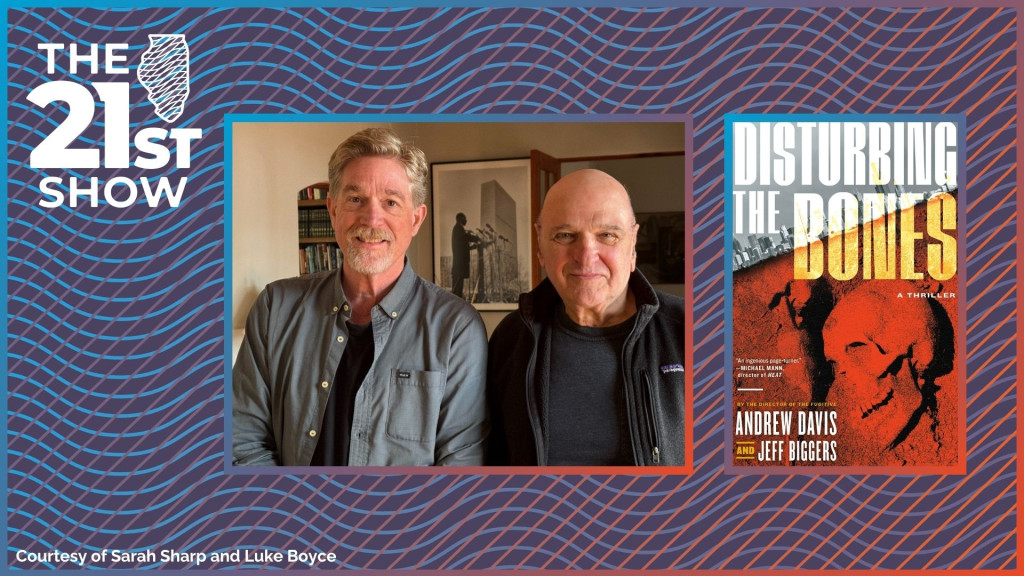
Images Courtesy of Penguin Random House
// This is a machine generated transcript. Please report any transcription errors to will-help@illinois.edu.

[00:00:00]
Brian Mackey: Today on The 21st Show, "Disturbing the Bones" is a novel that crosses a modern-day whodunit with a global political thriller. It follows a Chicago police detective investigating the cold case murder of his mother in Cairo, Illinois, and all that is set against the backdrop of a pending Chicago peace summit between the U.S. and Russia.

The book is the work of Jeff Biggers, a journalist, and Andrew Davis, a filmmaker best known for the 1993 action thriller "The Fugitive," starring Harrison Ford and Tommy Lee Jones.

[00:00:36]
[Film Clip]: I didn't kill my wife.

I don't care.

[00:00:42]
Brian Mackey: I'm Brian Mackey. We'll talk with Andrew Davis and Jeff Biggers about "Disturbing the Bones" for the hour today on The 21st Show, which is a production of Illinois Public Media. But first, news.

[00:01:00]
From Illinois Public Media, this is The 21st Show. I'm Brian Mackey.

"Disturbing the Bones" is the name of a novel set in Illinois. It's part crime story and part geopolitical thriller, and it travels from Chicago to Cairo, among other places. It's the work of two men, the film director Andrew Davis and a journalist, Jeff Biggers.

Both men are sons of Illinois. Davis was raised in Chicago and went on to direct big Hollywood films such as "The Fugitive," "Under Siege" and "Holes." Along the way, he worked with luminaries such as Harrison Ford and Tommy Lee Jones, Keanu Reeves and Morgan Freeman, and Michael Douglas and Gwyneth Paltrow, among others.

Jeff Biggers is also from Illinois, though at the opposite end of the state. He's written at least 10 books, including "Resistance: Reclaiming an American Tradition" and "Reckoning at Eagle Creek: The Secret Legacy of Coal in the Heartland." I first spoke with him back in December 2024. We'll be revisiting that conversation for the hour today.

I should note, as you'll hear as we go on, the day we originally spoke carries some historical significance relevant to the story. Because our program's on tape, we're not taking calls, but you can always let us know what you thought. Our email address is talk@21stshow.org.

All right, Jeff, I'm going to start with you. I'm never sure how much to give away when talking about a book like this, so maybe you can set up our discussion by giving us the elevator pitch for the story.

[00:02:37]
Jeff Biggers: Sure. Good morning, Brian. You know, it's a great way to start. Here we go all the way down to the tip of Illinois, and it's funny, Andy and I have been on this national tour to many, many states from the West Coast to the East Coast. And I think a lot of people don't realize how long Illinois is, you know. From where I'm from, it's 380 miles to Chicago.

And so our novel begins at the tip of the two great rivers, the Mississippi River comes down and it meets the Ohio River there in the town of Cairo, you know, really one of the most unusual places in America. And there at an archaeological site, an incredible archaeological site, of course, part of our great mounds culture, there's a young archaeologist who finds some bones and she follows the protocol. She sends those bones up to an FBI lab in Chicago because it's part of a federal highway project. And we realize those bones, in fact, do not come from an ancient archaeological site, but in fact refer to a cold case back to the great days of the civil rights movement in Southern Illinois that suddenly connects Cairo with a Chicago detective from Chicago and then begins the thriller.

[00:03:51]
Brian Mackey: And how much can we say about the sort of the geopolitical aspects of this? Andy, maybe you can talk about that.

[00:04:00]
Andrew Davis: Well, there's lots of weaving of geopolitical issues in the story. The novel is based upon a true archaeological dig that was where the group from Northwestern University out of Chicago found 26 layers going back 13,000 years in one campsite. And when I heard about this story, I thought, well, what are we going to be remembered for? What is our archaeological history going to be remembered as? And I thought about the missile silos and the atomic weapons that we have endangering us. And it was a metaphor for, you know, who are these people? What kind of world do they live in that they have these weapons that could destroy everybody on Earth?

And then there's another geopolitical aspect to it because Southern Illinois, where the confluence of these two rivers are, is where Ulysses Grant mounted the Civil War. It was his headquarters. And it became infamous. Dred Scott was [enslaved] nearby, and in the '60s, when Black people were not allowed to have jobs or work downtown, have access to things in Cairo, they protested and the Klan rose up and Nazis came down from Chicago, and John Lewis was there and Jesse Jackson. So it was a hotspot.

And in our story, we have a woman running for president who's from Chicago, sort of — in my idea of it, was with Jeff, was that it was a Michelle Obama-type character. So there was a weaving of an African American woman running for president and these issues of race and militias and racism was part of the story we built.

There's another aspect to this which is atomic weapons, because in our story, there's a terrible accident that takes place. And some missiles go awry in Siberia and Mongolia that are controlled by the Russians, and it causes a huge peace conference to be called in Chicago, sort of like what happened in the past with NATO conferences and the demonstrations of '68 over issues. And so we were weaving together global issues with a personal family story of who is this body in the ground this young archaeologist has discovered.

[00:06:29]
Brian Mackey: You've done a great job, I think, hitting a lot of the high points and plot points that people will want to know. Jeff, you reminded me it was 82 years ago today that the first human-made nuclear reaction was created under the football stadium at the University of Chicago. Can you talk a little bit about that history and how it connects to your story?

[00:06:50]
Jeff Biggers: You know, Brian, today, really, December 2nd is really one of the most important days, not just in Chicago and Illinois history, but I think worldwide. It's when we had the first self-sustaining nuclear chain reaction. And of course, this was part of our Manhattan Project and it went on to actually produce plutonium for nuclear weapons, and including one that was used in Nagasaki.

And I think this beginning of the atomic age is something that we really wanted to talk about, that in fact, it's not a relic of the past, but it's something that's very much part of our present today, that we've reached a kind of a new age of fail-safe systems that we have to reconsider.

And so, in our novel, we don't want to give away the spoiler, but there is a nuclear incident that the world has to respond to. And of course, in our book, we have a new president who feels we have to bring people back to Chicago where the atomic age began to reconsider how we're using nuclear weapons and how we can actually go toward a policy of disarmament and peace.

And so it really becomes this very contemporary thriller. It's a very present-day thriller. We really talk about issues that I think we're grappling with that are literally leaping from the headlines. I think we see, of course, Russia's use of hypersonic missiles in the Ukraine, and of course of many of the sophisticated weapons we're seeing in the Middle East now.

And we really wanted to touch on this. The idea of the archaeological site combined with our nuclear policy may seem like something that's completely divorced, but in fact, it's that metaphor of as we go deeper and deeper under each layer, we begin to discover that there's this terrifying policy at play today that we have to really reconsider.

[00:08:42]
Brian Mackey: All right, let me take a moment to remind listeners this is The 21st Show. My guests for the hour today are Andrew Davis and Jeff Biggers. Together they've written "Disturbing the Bones," a novel that travels from Cairo in Southern Illinois to Chicago, Siberia. It involves both global politics and, as we've been hearing, a very personal crime story for one Chicago detective.

Jeff, you mentioned Southern Illinois, and I've said this before, Cairo is closer to Mississippi than Chicago in more ways than one. Talk about what you knew, what you understood of that sort of place, the history of racism there when you were coming up.

[00:09:22]
Jeff Biggers: Sure. You know, I'm originally from Saline County, which is a couple of counties over more in the southeastern state. Probably for a lot of listeners, you know about the Garden of the Gods, which is, you know, the beautiful place of hiking and we have actually a couple of real mountains that have crept up in Southern Illinois. And it's a completely different culture. It's where basically part of the Ozarks meets with the Cumberlands.

And as you go down toward the Ohio River Valley, you come to Cairo, which is, as you say, it's part of the Delta, the Mississippi meeting up with the Ohio and it's part of a delta, Mississippi Delta culture that even goes further down to Memphis and of course down to Mississippi and New Orleans.

And so as someone coming from that region, and when Andy began to discuss the project, you know, originally, the idea was we worked on a screenplay toward a film that we're still pursuing, and then we shifted over to the novel. The idea was how can we begin to set a scene and set an entire book or film in this region without discussing the conflicts between social division and the conflicts between white and Black that we had in Southern Illinois.

And I think that's so much what we wanted to bring out in Cairo is that it's really still one of the great historical hotspots in Illinois culture that we have to continue to excavate and understand and really find these amazing stories and bring them to light. And of course, that real great story is what happened in the '60s and '70s with the civil rights movement and how there was such a fallout from it that has left Cairo as it is today, which is ultimately one of the great cities that has almost collapsed in the South.

[00:11:06]
Brian Mackey: Yeah, we've had a number of conversations on the show, both about present-day Cairo, their efforts to just get a grocery store back in town. And they had to form a co-op to do that. For seven years, they had been without a source of fresh groceries to the history, as you mentioned, you know, there was a freedman's camp in the Civil War. There were these gun battles between clansmen, or at least people who fought like clansmen, and local residents in a housing project there.

Andrew, coming up in Chicago in the '50s and '60s, that city was not a paragon of racial harmony either. What did you understand about that as a young person?

[00:11:49]
Andrew Davis: Well, I was unfortunately living in the middle of a race riot when I was a kid. There was a public housing project called Trumbull Park, which was on the southeast side by the steel mills. And it was built in the '30s, and in the '50s, a Black family was allowed to move into this all-white housing project. And it turned into a really ugly situation where, you know, local bars became clubs. Blacks were not allowed to go into certain areas who worked in the steel mills, were not allowed to use certain stores. And the Chicago Police Department had squad cars surrounding this Trumbull Park area for over a year and a half.

You know, and there's a novel written by Frank London Brown, who was one of the families that moved into the project called "Trumbull Park." So I grew up in that kind of ugly world of, you know, people being afraid of each other. And then things changed, of course. The population moved and found other areas to get away from each other and some people started living together more openly like in Hyde Park by the university.

So, you know, race issues has been a part of my life. My parents refused to move when the neighborhood started changing from a mostly white neighborhood to a mixed-race Black neighborhood. And my first film was called "Stony Island," which is a street on the south side, but it's where great musicians come from, but it was a story about a white kid growing up in a Black neighborhood and putting a band together. So the theme of race and racial issues has been an important part of who I am.

When I was at the University of Illinois, I remember being on WILL and being a young journalist and going down to Greene County, Alabama with McKinley Foundation to do voter registration and being in touch with the managing editor of Newsweek and CBS down there. I was the journalism student, got to drive everybody around in this little Volkswagen followed by the Klan. And then of course we went back for Selma — I wasn't there on the bridge, but my friend Vincent [Wu] was — and we went back to walk on the Capitol, you know, when [Harry] Belafonte was there and [Marlon] Brando and everybody to walk and hear Martin Luther King speak in Montgomery in front of the Capitol.

So race has been a big important part of what matters to me because I think that our division in our country right now is so based on race and, tragically, and the history of where we come from and that we're all immigrants and how this country was built and who paid for it is a theme that runs through a lot of what's going on in the world today.

[00:14:56]
Brian Mackey: Yeah, definitely a through line. All right, we need to take a break in a couple of minutes, but before we do, Jeff, can you just tell the story of how you and Andrew met and came to work together?

[00:15:06]
Jeff Biggers: Sure, it's a great story. We met, of course, in good old sweet home Chicago. I was in town to do some radio interviews like today with my book "Reckoning at Eagle Creek," which dealt with the history of Southern Illinois and coal policy. And every time I go to Chicago, I would go to the Heartland Cafe in Rogers Park where our dear friend Michael ran the cafe and it was a real hub, not just for the community of Rogers Park, but also for artists and writers and activists. And very much part of my family as well.

And I'll never forget I was going there. I called Michael and said, hey, I'm coming up for lunch. He says, you know, I've got a very unusual friend I really want you to meet. And there was Andy for lunch. It was many years ago, and we began to talk about various projects and from there, really began the birth of this whole novel and film project as you'll see.

[00:15:58]
Andrew Davis: I read — I read "Reckoning at Eagle Creek." We'll talk about that after you come back.

[00:16:02]
Brian Mackey: Very unusual friend, I guess. Yeah.

[00:16:06]
Andrew Davis: Michael James, I gotta talk to him, unusual friend.

[00:16:09]
Brian Mackey: All right, we are listening back to my conversation with Andrew Davis and Jeff Biggers, originally recorded in December 2024. Together, they wrote a political thriller called "Disturbing the Bones." It's a novel that starts in Cairo in Southern Illinois and works its way up to Chicago. It involves both a personal crime story and geopolitical events. We won't say too much more than that because there are a lot of twists and turns.

With that, we're going to take a break. We'll have more with Andrew Davis and Jeff Biggers when we return. Again, because our program's on tape, we're not taking calls live today, but you can always let us know what you thought. Our email address is talk@21stshow.org. All right, more to come after a break. Stay with us. It's The 21st Show.

[00:17:03]
I'm Brian Mackey. We're listening back to my conversation with Andrew Davis and Jeff Biggers, co-authors of the novel "Disturbing the Bones." Davis is a longtime filmmaker best known for works such as "The Fugitive," "Under Siege" and "A Perfect Murder." Biggers is a journalist and author whose past books include "In Sardinia" and "Reckoning in Eagle Creek," among others.

I originally spoke with Davis and Biggers back in December 2024. You'll hear a reference to next year. Keep in mind that that is in the past now. That said, we're also not taking calls today, but we do appreciate hearing from you. So you can email us anytime, talk@21stshow.org.

All right, Andy, you were talking, you were at the cafe, you meet Jeff. How does this become a collaboration on a screenplay and then a book eventually?

[00:18:29]
Andrew Davis: Well, as Jeff said, he was there talking about his novel "Disturbing the Bones" [EDITOR'S NOTE: Book title appears to be stated incorrectly here - likely "Reckoning at Eagle Creek"], which is basically the story of his family in Kentucky and what the history of mountaintop removal was and how it drove the family up to Chicago and to Appalachian neighborhoods that I became familiar with in 1968 when I got out of college.

And so I read this book and I went, wow, this guy really understands Southern Illinois and I wanted to set the story in Cairo and I thought, this is a real writer. I'm just a director and a screenwriter, you know, I was a journalism major but this is a real person who's a wordsmith.

And so we started talking about working on this screenplay together and spent quite a bit of time working on the screenplay. And then after a while, I think Jeff had done a lot of great research and I had these boxes of research and I said, you know, let's not be controlled by, you know, a minute a page, which is what a screenplay is. And I said, let's be able to expand this and talk about the texture and the history of these characters.

So we started working on a novel and that's what happened and then it just evolved and evolved. It was during COVID, we were working remotely between Iowa and Santa Barbara and, you know, it just evolved and this relationship developed and it was a wonderful appreciative relationship with two different writers. As Jeff said, we had four eyes, you know, so we were able to edit and throw things back and forth to each other.

[00:20:09]
Brian Mackey: Jeff, talk about that from your perspective, 'cause writing a book can often be a solitary experience and, you know, there's a downside to that, but you also have a lot of control that you don't have when you have a collaborator brought in. So what was that process like?

[00:20:23]
Jeff Biggers: Oh, I know. And I have always been a kind of a lone wolf writer, you know. The idea of working with someone for me was, you know, I just couldn't fathom it. And I'm mad at myself because it took me 30 years to see the incredible impact of collaborating with someone like Andy, you know, his legacy and his experience, his sense of timing, sense of development, the dialogue.

And so here we were working through Zoom and Google Docs and of course, confronting the COVID period and the Hollywood strike and all these different issues, but we're suddenly, you know, reading the dialogue together and we're working on scenes together. And if it's a Chicago scene, Andy would take over the writing 'cause that's his strength. It was something in Cairo, Southern Illinois, I would handle it. And then we began to give each other, you know, the critique back and forth that was immediate and not something you'd send off to an editor and wait, you know, a month or two to get feedback from.

So it was an incredible experience. In fact, for your listeners, I would just always encourage you to work with other people, especially on these kind of creative projects, because the end result to me is just so much sharper and it's just so much more lively and creative, as we found with this project.

[00:21:35]
Brian Mackey: And Jeff, you've written a lot of books before, primarily, I think maybe exclusively nonfiction. Correct me if I'm wrong on that. How is it different for you having to be a little more imaginative in ways?

[00:21:47]
Jeff Biggers: Yeah, more imaginative, but at the same time, you know, to really have that sense of timing, I think that's the mastery of Andy Davis's films. If you think of "Stony Island," up to "The Fugitive," up to "Perfect Murder" and "The Guardian," all these films that he's worked on, what you have is this incredible sense of timing. You're always on the edge of your seat.

And Andy brought that into the literary world where as we began to lay out our chapter and our stories and the dialogue, there was constantly this sense of how do we keep the reader turning pages? How do we keep them on the edge of your seat? How do we keep them guessing and provide that little bit of clue, like any great thriller needs to make you want to know what's going to happen on the next page.

[00:22:33]
Brian Mackey: Andy, you know, it strikes me that directing a film is, you know, there's an artistic aspect to it, but it's really craft and it's management, right? There's so many people involved, from the cinematographers to the lighting people, even the catering people. The director is just responsible for such a huge symphony. How is it working in this more solitary way with just one other person as compared to, you know, leading an entire film production?

[00:23:03]
Andrew Davis: Well, I think what was great about working on the novel versus a screenplay is that we weren't doing this for a studio. We were doing it for ourselves. We didn't have to satisfy any rules or prequel issues, you know. This is something we could just come up with on our own.

And I didn't find it isolating at all. I mean, you know, being on a movie set is thrilling in many ways. It's overpowering, you know. I come from camera, so I felt very comfortable being on the set. I wasn't intimidated by the technology or that stuff and my parents were actors, so I never really felt uncomfortable on the set or nervous about that. I had enough experience literally behind the camera as a cameraman, as a cinematographer before I started directing.

But working with Jeff was just, you know, wonderful. It was liberating in the sense that I could have somebody who could do something better than I could do, you know, who could take words and put them together in a way that was, you know, lovely and fluid and heartwarming. And at the same time, you know, I could push him to say, you know, this is boring or this is something we can make a little more exciting or we need to figure out how we don't lose that character we talked about 10 pages before.

[00:24:36]
Brian Mackey: Let me remind listeners, this is The 21st Show. We are talking with Andrew Davis, the filmmaker, and Jeff Biggers, the journalist and author. Together they've written "Disturbing the Bones," a novel that follows a police detective from Chicago to Cairo in Southern Illinois. And ultimately, it's also a global political thriller about a terrible nuclear accident and an attempt to forge a new peace in the world.

I'd like to maybe talk with each of you about some of your past work and how it relates to this new project. And Jeff, maybe I'll start with you. Your book "Reckoning at Eagle Creek," which was a very personal story for you. Maybe you can talk a little bit about that and returning to Southern Illinois after so many years, really around the world, having left Illinois behind and what that was like.

[00:25:30]
Jeff Biggers: Right. I appreciate you asking about that. You know, "Reckoning at Eagle Creek" talks about my family that we actually came into Illinois 215 years ago as really one of the first Baptist missionaries. And then we settled in the Garden of the Gods area. In fact, we actually homesteaded that right after the 1800s, over 200 years ago.

And then while I was working abroad in Mexico on a different book, I get a letter from my uncle saying, you know, while you're chronicling everyone else's culture and history, you've lost your own. And in fact, our 200-year-old farm had been strip-mined.

And so I went back to really understand what we lost. And I grew up, I think like a lot of people in rural Illinois, that when you pack up the old '60 Chevy and moved away, be it to Chicago or St. Louis or far west, there was a sense of getting out of Southern Illinois, of leaving your cultures behind, your histories behind.

And it really forced me as a young person to go back and really understand, you know, what did we lose besides just the farm. And there I began to realize the ancient history of archaeology and Indigenous movements and Indigenous occupation and even up to the Shawnee having a settlement there, to the role of legal slavery in the land of Lincoln. We rarely talk about the fact that our Constitution, of course, in Illinois, allowed slavery exactly where my family had settled because there was a salt wells.

And so, this began the whole excavation process of history to what I call "restorification," that we have to restore part of our history that's been ignored or eliminated or completely eradicated as we see with strip mining.

And that came into play in the novel because our young archaeologist is a similar type character. It's a young woman who grew up from Cairo, grew up in Cairo, but then jets off to Yale, then goes off to these international archaeological digs. And then she's summoned home very much like I was to do an archaeological dig right in her own backyard there in Cairo. And there she begins to realize her own family's very deep and entrenched history with the racism of the region, but also their desire to break free from it and confront with it.

And I think those personal issues is what we really wanted to give the characters both from Cairo and Chicago, and really develop these characters who are dealing with a lot of history and trauma, but also the incredible desire to move on.

[00:28:01]
Brian Mackey: So Andy, Jeff left Illinois and you also left Chicago, but it seems like it's been much more of a prominent character through your work, obviously in films such as "The Fugitive" and of course "Stony Island," which was when you were — I don't know if you were still in Chicago at that point when you made that film, but talk about your relationship with the city over your lifetime.

[00:28:25]
Andrew Davis: Well, I actually left Chicago in 1971, I think, as a young cinematographer and moved to San Francisco and was involved with my mentor Haskell Wexler, who basically had a kid who he worked with who liked hot cars named George Lucas who was making his first movie called "THX 1138" at Francis Coppola [Zoetrope] Studios. Anyway.

"Stony Island" was a film about my brother growing up on the south side of Chicago about a young white kid in a Black neighborhood putting a band together and that became the basis of proving that I could make a film on my own. It was so hard to get in the cameraman's union. I decided it was easier to be a director. I'd seen "American Graffiti" and "Mean Streets" and so these directors are going back to their youth, so I'm going to do it.

Well, it turns out that Chicago became, you know, the most wonderful back lot I could ever find. You know, I understood the locations. I had crew members who I'd grown up with there and I did a film called "Code of Silence" in the early '80s and that became a big hit. It was an action film, but it had a lot of underscored political themes about police cover-ups and things like that and work with some first-time actors who had never been in movies before but were still real policemen like Dennis Farina.

And was able to develop a series of films in Chicago. The next one I did after that was "Above the Law" and then I did a film called "The Package" which in many ways inspired this novel. "The Package" is a story about an arms agreement that the generals between Russia and the Soviet Union in those days, and the United States do not want to give up their nukes. And that became the metaphor for this story, you know, when we have this terrible accident that takes place and a new president says we have to get rid of these nukes. We can't use them. They're dangerous just in terms of their testing. And the generals are saying over my dead body, are we giving up our nuclear weapons, which is the theme of today.

But Chicago is, you know, the place where we shot "The Fugitive," we shot "Chain Reaction" there. And I did another film called "Above the Law" there with Steven Seagal, which was very political film. So I was able to do action films that had political themes and use Chicago as this backdrop.

[00:31:06]
Brian Mackey: And people may forget "The Fugitive" who maybe haven't seen it in a while. It is also a political movie in terms of pharmaceutical companies and decisions that they make. Although no spoilers, if you haven't seen it, you should rewatch that.

Let's go to the phones because you mentioned the nuclear dimension of this story. And we have a call about that. Paul is calling from Urbana on line one. Paul, thanks for calling in.

[00:31:31]
Paul: Hi, but I have a little [frontispiece] which is that I'm from the Washington-St. Clair County line town and there's a coal mine [head] coal-burning plant there that the Sierra Club Prairie chapter has a lawsuit against because I think they're just spoiling my home turf but that's another story, another show.

Yeah, what is your motivation about the nuclear part of this without revealing plot twists? I guess it's because there's an absence of serious discussion about, you know, how far we are with the Union of Concerned Scientists moving us closer to the midnight hour than we ever have been. So I guess that's part of your motivation is to bring it into discourse. But yeah, I appreciate you elaborating on it if you could.

[00:32:24]
Brian Mackey: Thank you so much for the call, Paul. I appreciate that. Andy, two minutes until we need to take a break. But if you want to go ahead and talk about, yeah, how nuclear, the nuclear threat, how you're thinking about it.

[00:32:35]
Andrew Davis: Well, I mean, as a kid who had to hide under his desk during air raid drills and, you know, this has been part of our life. And it's getting crazier and crazier. I mean, you know, everybody wants their own nukes now because they're afraid of this country or that country attacking them. It's global. And it's totally insane. Jeff, why don't you talk about it, you're really articulate about this.

[00:33:01]
Jeff Biggers: You know, at this very moment, your listeners are tuned in Illinois Public Radio, but over 3,000 accountable nuclear warheads are currently being deployed on either land-based or submarine-launched ballistic missiles and bomber bases and there's, you know, there's over 12,000 nuclear weapons spread out around the globe. And we really have one agreement left, for example, it's the New START Agreement, which was signed in 2010 by Russia and the U.S. And that actually has to be renegotiated next year. And so we're really hanging by a thread in terms of any kind of control.

We're really at the brink as we've often talked about with our nuclear policy in a renewed arms race which we've obviously seen with the war in the Ukraine. I think what we really wanted to raise is something that Andy's been doing for decades. You know, when "Under Siege" came out 30 years ago, the New York Times said this is an incredible movie that blends action with art to raise provocative questions about nuclear weapons. And of course, 10 years later, when "Holes" came out, the New York Times said, hey, this is not a film for kids only. This is a film about greed and racism.

And I think Andy's ability to raise provocative questions about weapons, about racism, about social division is precisely what we're trying to do with this new novel called "Disturbing the Bones." And we really focus on these provocative questions today about our nuclear weapons policy.

[00:34:30]
Brian Mackey: All right, and we will continue raising some of those provocative questions here on The 21st Show with Andrew Davis and Jeff Biggers. Stay with us. It's The 21st Show.

[00:34:44]
I'm Brian Mackey, and this is from the 1978 film "Stony Island."

[00:34:50]
[Music Clip]: Better watch...

[00:35:50]
"Stony Island" was the directorial debut of my guest, Andrew Davis. We're also hearing from the writer Jeff Biggers. Together they co-authored the political thriller novel "Disturbing the Bones," which travels from Chicago to Cairo and also involves some deep existential questions about our world and the nuclear risk under which we're all living.

I spoke with them back in December 2024, and you'll hear a reflection of that as the conversation continues. To illustrate that 0.1 quick note, in the last segment, Jeff mentioned the New START nuclear treaty between the U.S. and Russia. That agreement officially expired in 2026. With that, let's get back to the conversation.

Andy, I wonder if you'll indulge me talking a little more about "Stony Island," which again was your directorial debut. It was featured at Ebertfest earlier this year. I just watched it last night. And I hate to say this, I was eight days — it was eight days before I was born was the scenes that were shot at Mayor Daley's funeral.

[00:36:51]
Andrew Davis: I love, I like talking to young people. So sorry, yeah.

[00:36:56]
Brian Mackey: But it's such an amazing postcard of that time and place and specifically that scene at Daley's funeral. It — I'm watching it and I'm thinking, boy, this really reminds me of the way some of the Chicago protests were shot at "Medium Cool." And I do a little googling, and of course, you were involved in that production as well. You mentioned Haskell Wexler. Can you just talk about what you learned there and that connection and how that's influenced your work over time?

[00:37:24]
Andrew Davis: Well, I think I, you know, I was a journalism major at Illinois. I wanted to be Walter Cronkite. And, you know, we were being handed these AP and UPI wire reports about Vietnam that were lies. And I said, you know what, I'd rather be involved in coming up with images and stories on my own rather than being told what to say. You know, I was a cinematographer and a young cameraman and so I decided to basically make a film about my brother who was a kid growing up on the South Side.

And, you know, I just think that telling stories that have a little bit of heart and soul, along with some action and some fear and some humor, you know, it's like you want to make a great stew of a story and so that's what we tried to do. That was Rae Dawn Chong, by the way, singing that song which was written probably the day before we shot that scene and it was improvised. It was not having things all structured and planned out and storyboarded. It was having things happen in front of the camera and capturing it. And then editing it in a way so it became more formal like a movie.

I just want to go back on something that I'm going to jump back in the story just to say that we're going to spend $1.5 trillion on rebuilding our nuclear arsenal. And I think that people need to be aware of the insanity of how much money we're spending on learning how to kill each other better, you know. And so to make movies that can talk about issues and let people be aware of what we're facing is both a responsibility and a journey that we all need to be on.

[00:39:08]
Brian Mackey: Yeah, the New York Times just had a big piece about that, um. What, a month or so ago, the price of rebuilding the nuclear arsenal, if people want to learn more about that.

So, all right, let's stick with that nuclear theme then, because Jeff, it strikes me as important a topic as it is, when you think of sort of the popular culture, mass culture. There was a time when, you know, from "The Day After," maybe in the '80s, certainly before that, "Doctor Strangelove," but even through more recent films, you know, "The Sum of All Fears," "Under Siege," as we mentioned, you know, when the threat of nuclear weapons and a nuclear holocaust was more present in people's minds. And maybe you have a different perspective, but it strikes me that it just isn't the way it used to be. And maybe you can just talk about how you have seen that and why you think that is.

[00:40:05]
Jeff Biggers: Well, I think we're daily waking up to so many issues right now. And of course, the climate crisis is first and foremost what we should be dealing with. But it's all connected, I feel. And I think the issue of our nuclear arsenal is something that has kind of fallen to the wayside in terms of being attentive to what's happening.

You know, Brian, there was a novel that came out when I was a kid called "Fail-Safe," that ultimately was connected to the great film "Dr. Strangelove." And it really didn't talk about a nuclear attack or nuclear war. It talked about the what if there's a nuclear accident. And I think that illusory age of fail-safe systems is really what we're trying to bring up in our novel, is not necessarily that someone's going to go out and shoot a missile at someone else. But that miscalculations have always been part of our nuclear past, you know.

In 1961, a B-52 bomber was carrying two nuclear bombs, and it came one switch away from detonating when it crashed in North Carolina. And then a few decades later, you had someone like Russian President Boris Yeltsin, who activated his nuclear briefcase because he thought we were in the midst of a war. In fact, it was just a Norwegian scientist with a rocket that was studying the northern lights.

And so we posit this question of, you know, why do we continue to live in this illusion or delusion that we have a fail-safe system, especially in the age of cyberattacks. And of course, for this, we go back to Southern Illinois, where we have the Scott Air Force Base and the great Cyber Command Center. And that all weaves into our thriller asking that very provocative question, what if something catastrophic happened? And that's something we're really asking all of your listeners and all of the readers and everybody today to consider with our nuclear policy.

[00:41:57]
Andrew Davis: I just want to say that, you know, we've got these big issues in the story, but basically it's a story about people. There are three main characters, this young archaeologist, a woman from Cairo, who discovers amongst this incredible find 26 layers going back 13,000 years, the body of a journalist, of an African American woman whose son is now 65 years old and she disappeared in the early '80s, in the '70s and he hasn't known what's happened to his mother all these years. And now he's got to go down to Southern Illinois and figure out what's happening.

And so there's a general who's building a highway. He's a master builder and he's able to figure out how to put things in the ground that last forever. And so our story in some ways is a blend between "In the Heat of the Night," a film that maybe young people don't know about, which was an incredible film about the cop who goes down to the South and tries to find some justice and "Doctor Strangelove." It's a thriller, and at the same time, it's a story about what we're doing with the planet.

[00:43:14]
Brian Mackey: Can you say more about the — you mentioned, and maybe this is something you don't want to talk about or can't talk about, but the sort of the business of Hollywood and whether these sort of films that, yes, it's a story at heart, but it also has some of these ideas. Is there the appetite for that these days? Or is that different than it was in the past?

[00:43:37]
Andrew Davis: It's a tough road to do something that is both provocative intelligence and doesn't have something that comes from some kind of a sequel fabric, you know, or a comic book fabric. Now I'm very glad "Oppenheimer" did so well and was so well received. It was opening a door that maybe we can follow. But it'll be difficult. If we want to make a movie out of this, we're going to have to have some very big actors and the support of the studio, and so the studios are in disarray right now. They don't know what to do quite.

It was a good weekend, but all those films that were successful this weekend cost about $200 million each. And so in order for a studio to spend $200 million on a movie, plus another $100 million advertising and the thing's got to gross close to a billion dollars to break even. So it's a dilemma, and there are so many things out in the world now between what people are doing on their phones and with streaming, it's very hard to get the attention to get people to go to a theater and pay for it.

[00:44:42]
Brian Mackey: Jeff, have you felt that with books as well? There's been a, you know, we talked about movies, but I just saw an article in The Atlantic within the last day or so they're talking about young people don't really think of books as a worthwhile, you know, pursuit for a way to gain knowledge anymore.

[00:45:01]
Jeff Biggers: Yeah, I mean, I think the publishing world still continues to churn along and do well. I think COVID ironically gave a boost to a lot of writers because people were at home and began to pick up books again and order books. You know, every year, there's over 150,000 books published. And so I think part of us coming on to radio programs like this and doing national book tours is to find our audience and to widen our audience, and to remind people, you know, that a great page-turner, a great thriller can have a very serious message, can have a deep meaningful message.

And that storytelling, be it on the screen or on the stage, or on the page, it is really about, you know, us all coming together to talk about these questions and then find some sort of resolution and really connecting with the characters in our own lives. So I'm pretty hopeful. And I hope your listeners pass the word with our novel "Disturbing the Bones" is something that hopefully book clubs will be reading, book clubs that want to talk about social justice issues or book clubs that like a good crime and murder mystery. It's really a crossover type book that we hope reaches a broad and mass audience.

[00:46:17]
Brian Mackey: My mom recently joined a new book club. If she's listening, maybe she'll want to consider this for that. Just —

[00:46:24]
Andrew Davis: Can I, can I please — go ahead, go ahead. You know, it's interesting because they don't teach penmanship anymore in the schools. Kids don't know how to write because they can use their computers. They can type, right? They can use their fingers on a phone. And so I think we have to come out with the audio version of this book right away because, you know, people would want to ride in their car and listen to it.

And so there are different ways that people are communicating and absorbing information. So it's a transition, definitely, you know, what's going on in the world right now.

[00:46:57]
Brian Mackey: Yeah, and storytellers have to adapt. What's next for both of you? You mentioned, you know, potentially turning this into a movie. I know a lot of writers have found success with sort of serial limited series, miniseries on streaming platforms. Where do you go from here?

[00:47:16]
Andrew Davis: Well, I think Jeff and I want to go back to the screenplay now and take what evolved into the novel, what grew and we got better in the novel and try to synthesize it down into a screenplay. I think in terms of two hours, I'm not a series guy right now, you know. I suppose that we could develop this into six hours if we wanted to. I'd rather make it into a two-hour movie and then do a sequel after that. And I really loved working with Jeff, so I hope we get to continue working together.

[00:47:48]
Brian Mackey: And Jeff, same question, what's next for you?

[00:47:51]
Jeff Biggers: Well, likewise, we're full blast, you know, looking at the screenplay again and seeing how we can expand that and kind of bring back a lot of the different stories that we included in the novel into the screenplay. And then I continue to my work as a cultural historian and a writer. I actually have another book on Italy coming out next year that is part of my life as well.

So, a lot of things at play, but certainly, this is a story "Disturbing the Bones" that I think it's going to be with us for a long, long while and have long legs. I just received an email a couple of days ago of a review in the United Arab Emirates of our book and got photos from people in Europe who are reading the book now. And so I really hope it's one of these projects that continues to grow both on the stage and on the screen.

[00:48:44]
Brian Mackey: That was Jeff Biggers along with Andrew Davis. Their book together is "Disturbing the Bones." Again, we originally had this conversation with them on the program back in December 2024. You heard Jeff mention next year in that last answer, and that of course is now in the past.

That's all the time we have for our show today. Before we go, I want to mention our website, 21stshow.org. While you're there, you can find all the ways to contact us, email, voicemail, social media. You can also find links to subscribe to our podcasts or just look us up wherever you listen. Apple, Spotify. You can even find us on YouTube audio now. Just search for Illinois Public Media.

The 21st Show is produced by Christine Hatfield and Jose Zepeda. Our digital producer is Kulsoom Kahn. Technical direction and engineering comes from Jason Croft and Steve Morck. Reginald Hardwick is our news director. Thanks to the band Public Access for our theme song. The 21st Show is a production of Illinois Public Media. I'm Brian Mackey. Thanks for listening. We'll talk with you again tomorrow.
Today's show included a rebroadcast of the following "best of" segment first aired December 02, 2024: Filmmaker and journalist team up on new crime thriller novel set in Illinois.
