








High costs put strain on Illinois farmers during harvest
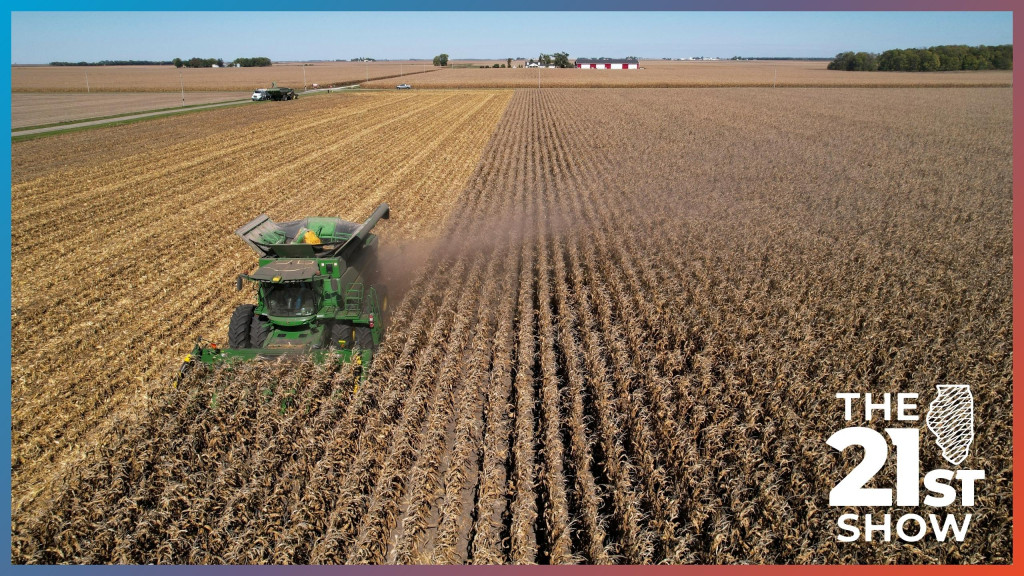
A combine harvests corn near Allerton, Illinois in this file photo from 2023. Joshua A. Bickel/AP
// This is a machine generated transcript. Please report any transcription errors to will-help@illinois.edu.

[00:00:00]
Brian Mackey: It's the 21st show. I'm Brian Mackey. According to the U.S. Department of Agriculture, Illinois corn is 63% harvested, soy is 66% harvested. That was as of Sunday of this week. That means in the next few weeks we'll start to see fewer combines in the fields and the quiet winter months before we begin the cycle again in spring. But as all of this has — there's been one word on the minds of everyone in the fields: diesel.

[00:00:38]
Speaker 1: Diesel prices here in California hit all-time highs in the last couple of days

[00:00:43]
Speaker 2: as farmers face soaring fertilizer and diesel costs due to the war in [Iran]. That

[00:00:47]
Speaker 3: means it's costing more to fuel the trucks that bring food, packages, and everyday products across the country,

[00:00:52]
Speaker 4: and we're already seeing some of those economic ripple effects. Consumer prices overall are up 3.4% compared to last year, and as we enter the colder months, you'll likely be paying more for your home heating bill, as much as nearly 9% more with the [Iran] war still ongoing. It's unclear when these price hikes will stop. One JPMorgan forecast put it plainly, quote, "We simply don't know how to model the endgame."

[00:01:17]
Brian Mackey: Well, as those clips indicate, farmers are being particularly hard hit by the high costs of diesel fuel, which does play a vital role in the fields. And besides high fuel prices, there are also high prices for fertilizer, which has continued to be unaffected by the uncertainty over what's happening with the Strait of Hormuz. So for the rest of the hour today, we're going to get a sense of how the harvest has been going so far and talk about the effects those high input prices have had on our farmers and the rest of us who buy and consume their crops. Joining me now to talk more about this is Steve Turner, a farmer based in Cass and Mason counties. He specializes in wheat, corn, soybeans, rye, popcorn, green beans, pumpkins, and alfalfa. Steve, welcome back to the 21st show.

[00:02:03]
Steve Turner: Oh yes, glad to join you this morning.

[00:02:05]
Brian Mackey: Also with us, Josh Linville, vice president of fertilizer for StoneX, a market analysis firm. Josh, welcome back to you as well.

[00:02:13]
Josh Linville: I appreciate it. I thought I had a hard job until I heard that list of things he has to cover. That's — that's quite the list of crops.

[00:02:19]
Brian Mackey: And also with us is Nicholas Paulson, uh, the [Gardener Hinderleiter] endowed professor — correct me if I — my pronunciation there — in farm management at the University of Illinois Urbana-Champaign. Nick, welcome to the 21st show to you.

[00:02:35]
Nicholas Paulson: Well, you did that great. Uh, thanks, thanks. Glad to be here.

[00:02:39]
Brian Mackey: Glad to have you. And listeners, you can join us today — 800-222-9455 is the number. How have you seen fuel prices affecting you, particularly if you use diesel, maybe you're on a farm? Are you concerned about your energy costs this upcoming winter? And what would you like to learn about the role of fuel and fertilizers in our ag industry? 800-222-9455. That's 800-222-9455. All right, Nick, I'm gonna start with you. Generally speaking, what is driving the high costs for diesel fuel?

[00:03:17]
Nicholas Paulson: Yeah, well, I mean, economists are usually pretty careful in terms of, uh, you know, tying certain factors to, uh, uh, economic impacts like that with any sort of certainty. But, you know, I think in this case, we have a pretty clear, uh, smoking gun. Um, you know, we really saw prices spike, um, immediately — um, start to spike immediately following the start of the Iran conflict, uh, there at the end of February. Um, and so, you know, anytime you have conflict in an energy producing region like the Middle East, or with the Russia or Ukraine, uh, or, uh, we tend to see prices for those products increase. Um, and it's, it's all associated with, uh, supply chain bottlenecks that are created — uh, closure of the Strait of Hormuz has been talked about a lot. Um, and, you know, longer term, we're looking at, uh, damaged infrastructure because we are talking about real conflict regions here. And so whether it's refining capacity for energy or whether it's production facilities that produce some of those fertilizer products that come out of those regions, um, those are gonna be longer-term hiccups that are gonna continue to put pressure on prices and, um, uh, again, kind of create some of those supply chain issues that, that lead to those higher prices.

[00:04:36]
Brian Mackey: One of the things I've been hearing a lot about is this idea of red dye diesel, which I — I got to admit was not a concept, uh, that I was familiar with until this year, or if I had been, I forgot about it. Tell me, what is the difference, uh, Nick, with red dye diesel versus, you know, uh, non-red dye diesel, I guess.

[00:04:55]
Nicholas Paulson: Uh, well, red dye diesel, uh, literally has a red dye in it, and that helps differentiate and, and identify it. Um, and the key thing here is sometimes that's referred to as, as off-road diesel or, you know, with agriculture — you know, growing up on a farm, we always just called it the [ag diesel]. Um, and it is for use in off-road vehicles like tractors and combines, um, from the farmer's perspective. Um, and it is exempt from, uh, some of the taxes that are applied to kind of standard on-road diesel that you can buy for, you know, passenger vehicles, semi trucks that use diesel fuel, um, you know, that you see at gas stations, um, along the, along the freeway, for example. So, um, the, the net price to the, to the buyer or the user of that fuel is cheaper because of the, uh, the, the taxes that are applied being different there.

[00:05:47]
Brian Mackey: All right, Josh, I'm gonna bring you into the conversation now. Tell us about the state of the fertilizer industry.

[00:05:54]
Josh Linville: Yeah, unfortunately a lot of things he just discussed about on the diesel side are affecting the fertilizer, right? We've got a lot of problems with fertilizer supplies not only here domestically but around the world, and that's driving our prices, but so is the logistical cost. I mean, it's costing more to move trucks, railcars, barges, unfortunately vessels. One of the main things that we watch weekly is watching vessel rates from the Middle East to the New Orleans, Louisiana market, our base price point for North American fertilizers. That price is almost tripled from what they used to be. So you look at the Strait of Hormuz — that's blocking three of the world's largest urea exporters and [hydrous] exporters, one of the top five phosphate exporters. But worse, it's driving gas costs up that produces nitrogen around the world. It's driving sulfur and [hydrous] up, which is hurting phosphate production[s] — that doesn't even begin to touch on European production suffering. Buyers holding off as long as they can because the price is so grotesquely high versus where all the input values are. And unfortunately it's a situation we're 8 months into this, and a lot of people are saying, well, if it'll just reopen it'll solve it. It'll take a while to solve this. We can't open it overnight and expect supplies to get back to normal.

[00:07:04]
Brian Mackey: All right, Steve Turner, farmer in Cass and Mason counties, how's your harvest been going so far this year?

[00:07:12]
Steve Turner: Well, as we speak, uh, we're very fortunate that we're probably — here by the weekend, should be down about done with our harvest. Uh, uh, we've really been blessed this year. There's been an area here where we're located here in Cass Mason County where I don't remember too many years that we have really dodged weather situations of extreme storms and wind. Now when I say that, that has helped us along with the harvest — I'm very pleased with overall. But you don't have to go far in Illinois or down the road 10 or 20 miles from me and start getting into farmers that maybe do not feel that way. The storm fronts did not come right, or drenching 4 or 5 inch rains and wind. There again, we were fortunate this year that we didn't have to battle any of that. But what usually goes around comes around with weather, so I don't know what next year will bring. But there are areas beyond what I could give a report of that I know we're struggling, and there's a, you know, very large belt of Illinois that basically got drowned here the last few weeks, and I know they're trying to catch up and dealing with mud. And when you have conditions like that, it slows harvest down and — you're talking about diesel fuel, we can talk about that too — you're going to burn more diesel fuel too. So there's my situation. I can give you a good report, but I know there are a lot of operations that this has been a tough harvesting year by weather and all the input costs that have already been talked about.

[00:08:35]
Brian Mackey: Well, you know, we hear so much about diesel — you mentioned it there. Let's get into that. So, Steve, tell me, day to day, how much fuel are you using? What sort of things are you using it for? How are you getting it? Take, take us through your operations and diesel fuel.

[00:08:50]
Steve Turner: Yes. Worst of all, everything we use on our diversified farm machinery-wise is diesel. We're probably 85 to 90% powered by that, very few gasoline motors except maybe in a car or two or a truck. I put it in perspective of this: our combine we run, uh, it's a fairly large combine we classify as farmers — we run a 12-row corn head on it. When we pull out in the field, we're burning anywhere from 15 to 16 gallons an hour for that to get the job done, and you can do the math on farmers — usually don't put in 8-hour days, or long days on that. And in the same way, when we look at the trucks going up and down the road hauling the grain, you're looking at maybe 3 to 6 miles a gallon type of a rate on that as far as mileage and what you get out of your gallon of diesel fuel. So very intensified. We just, you know, from our even our livestock operation, the chores any livestock operation does out here — everything is mechanically powered by diesel. And when you look at cost a year ago to now, and just can easily add a dollar onto that and maybe more. And you know it's not uncommon — I know, for farmers, and I'll [below] and high for some operations — to be looking at maybe [1,000 to 20,000] gallons a year this harvest season to get that done and get field tillage done, for maybe some to do fall preparation, and some come under that amount, and some [under] that. And that's just for fall operations, not looking at the whole year. So, there again, a big hit on costs from what we budgeted and planned and borrowed money from banks with operating money back in January and February. This is a big cost increase that was not in those plans and has to be absorbed and found a way to work in our budgets and try to stay profitable.

[00:10:35]
Brian Mackey: So, uh, Nicholas Paulson, I'm gonna come back to you. Um, we just heard there how much, you know, one farmer can go through in terms of diesel fuel. Can you put that in a, in a sort of a broader perspective? Because we've heard a lot about, you know, Governor Pritzker signed, I think, an executive order, uh, you know, supposedly trying to make things a little easier for farmers with regard to this red dyed diesel. I've heard President Trump talking about it, although candidly I've lost track of where that proposal — if it actually went through or not. I mean, put this in a broader perspective for us.

[00:11:09]
Nicholas Paulson: I think, you know, particularly on the, on the red dye or the off-road diesel, you know, some of the, the things that have been done at the state or the federal level — levels — to allow for broader use of that in situations where, um, you know, until recently has, has not been allowed — honestly, is, is not a huge direct benefit to most farmers. They, they were already eligible to use, you know, again, red dye or off-road diesel for some of those harvest, um, you know, in-field operations throughout the year and at harvest that, that, that Steve kind of took you through there. Um, you know, I suppose if they got diesel-burning pickups that maybe they weren't burning, uh, the red dye diesel, you know, that might potentially save a few dollars. I think the bigger benefit of that is just the broader, uh, trucking industry, um, you know, moving all the, all the goods around the country — is, is done largely by semi truck, and, and this would, you know, create the opportunity there for some, for some fuel savings, um, in, in sort of that sector.

Um, you know, I, I, I, I think it's kind of a follow-up to Steve — I'd, I'd kind of reiterate his point. His, the numbers he threw out there are kind of exactly the same numbers I would have thrown out there if you'd asked me to kind of put an average around it. Um, the increases in diesel prices that we've seen since the early part of this year — you know, uh, he talked about, I think he mentioned $1 per gallon. I would, you know, in percentage terms, it's about 50% higher than it was earlier this year and, and, and kind of the few crop years leading into this year. And, you know, when we look at things on a per acre basis, those direct diesel, uh, fuel costs don't look large. But when you start taking that to the operation level, um, you know, you're looking at, you know, easily [$100,000,] $10,000, $15,000, $20,000, up to $30,000 [per operation in] what, what would be foregone, uh, potential profits with these higher fuel prices that we're looking at. And again, the, the, the timing is, is tough, 'cause a lot of the fuel-intensive operations are occurring here at harvest, and the, the timing of the price increase and the, and the spikes we're seeing this year I think made it pretty difficult, um, for farmers to, to, to, you know, pre-book any fuel at, at some of the lower prices. Um, and then as we look ahead to 2027, you know, we're gonna have the, the entire crop year, um, you know, the, the, the planting season as well as the harvest season potentially next year impacted by these higher fuel prices. So that hit next year, relative to what fuel costs would be at, at lower prices, is, is gonna be even bigger potentially in 2027.

[00:13:49]
Brian Mackey: You know, can you sort of verbally describe like what a pie chart would be for an acre of corn in terms of costs, profits, and then — you know, I'm just trying to get a sense of how big that piece of pie is — or corn bread, or whatever you want to phrase it — that is, you know, now being eaten up by fuel that that would have been profit otherwise.

[00:14:09]
Nicholas Paulson: Yeah, you're gonna ask me to do math in my head on the radio. That's, uh, that's dangerous even —

[00:14:13]
Brian Mackey: — for dangerous —

[00:14:15]
Nicholas Paulson: You know, you know, again, I'm speaking in, in averages, and every farm is different. That's why averages can be dangerous to talk about. But when we look at the, the, the relatively large group of farms that we have the ability to track here in Illinois, you know, on a per acre basis we're looking at fuel costs — and I'm just gonna use round numbers here, and again these are just averages — but you know, maybe uh diesel fuel, the direct cost of diesel fuel, would be something like $20 per acre at prices prior to, uh, uh, the, the levels that we're seeing this year. Um, and that would be more like $30 per acre now. Um, when I say that that's a relatively small piece of per acre costs, the, the context there is — so if we're talking $30 per acre in fuel, we might be looking at $700 to $800 in other production costs, plus the cost of farmland. If it's a rental situation, you know, total cost would, would easily be looking in the $1,000 per acre range. So that $30 fuel cost is a small piece. But if you're a farmer that farms 1,000, $2,000, $3,000 acres, um, you know, that $10 per acre increase in that cost — that's where that $10,000, $20,000, $30,000 hit to profitability comes in.

Um, you know, the biggest cost category, particularly when we look at corn production, and the most variable cost category, is gonna be in, um, in that fertilizer, um, uh, component. And so, um, a much bigger chunk there, and it, and it can vary a lot — anywhere from, you know, $150 an acre to as much as, you know, $300 per acre at some of the, um, uh, peak prices, depending on when that, when those products were priced and, and obviously the application rates that farmers are using. So, um, fertilizer is a much bigger share on that per acre basis. Um, fuel's smaller, but, but still can translate to pretty big swings, um, you know, in terms of where farmers thought they might be prior to planting in the winter versus what they're having to deal with now, actually harvesting the crop and having to pay those, those fuel and, uh, fertilizer bills as they plan for next year.

[00:16:26]
Brian Mackey: Yeah, well, we happen to have a fertilizer expert with us, but we need to take a break. So that's a good tee up for what we'll get to after the break. We're speaking with Nicholas Paulson, a professor in farm management at the University of Illinois Urbana-Champaign, Josh Linville, uh, vice president of fertilizer for StoneX, the market analysis firm, and Steve Turner, a farmer based in Cass and Mason counties in central Illinois. If you want to join us today, 800-222-9455 is the number, especially if you have seen high fuel prices affecting your work, be it on a farm or elsewhere. We'd love to hear about it. 800-222-9455 is the number. More to come. This is the 21st show. Stay with us.

It's the 21st show. I'm Brian Mackey. We are talking about the harvest this season and particularly how the high costs of inputs like diesel fuel and fertilizer, uh, have been affecting farmers this harvest season. We're talking about this with Steve Turner, who's a farmer based in Cass and Mason counties, specializes in wheat, corn, soybeans, green beans, pumpkins, alfalfa, among other crops. Uh, we've also been talking with Nicholas [Paulson], who is a professor in farm management at the University of Illinois Urbana-Champaign, and Josh Linville, vice president of fertilizer for StoneX, the market analysis firm. If you want to join us, 800-222-9455. That's 800-222-9455.

Josh, speaking for myself as a person who did not grow up on a farm, I think of fertilizer as something that goes in in the spring, but, uh, in, in the industrial agricultural setting, it's actually, you know, more of a year-round thing, or certainly a fall thing as well. Tell us — talk us through that. What are some of the products that farmers might be, uh, applying in their fields in this season of the year?

[00:18:45]
Josh Linville: Yeah, so we're getting very close to it, right? November 1 seems to be the kickoff point for fall applications widespread. There are some regions, some farmers who might go a little bit earlier, but that's kind of the general golden rule date. And when you start to look at the fall application season for nitrogen applications, a lot of farmers will use anhydrous — that is the gas version of nitrogen, very potent, very pure, 82% nitrogen in that product. They'll also go back on with phosphate and potash applications, both dry goods.

And listen, your farmers are going to shift. There are going to be some who adhere to the fall application — that's what my family does in northwest Missouri, and a lot of farmers across Illinois do that — um, but there's some that will wait until next spring and say, well, sometimes there's some opportunities there. Maybe Mother Nature doesn't allow it in the fall and they have to go till spring. Or it could be situations like this where farmers are going in and they're looking at the price of fertilizer, seeing them extremely high, and then going to the elevator and seeing that price extremely low, and realizing that the relationship between the input and the output is so out of the norm, it may be worth it to drag our feet and wait till next spring. That won't be everybody, but that is something that the market is watching very closely as we near November 1st.

[00:19:58]
Brian Mackey: You know, when we spoke last on the program, I think it was in March, planting season was getting started and, you know, we were talking about the fertilizer and how it was being affected by all of America's wars — but right, the metaphorical trade war with Canada, the actual bombs-and-bullets war with Iran. Did you think this would still be an issue halfway through October — what, 7 months later we are now?

[00:20:24]
Josh Linville: Yeah, end of this month is going to be the 8-month anniversary. And no, at the beginning of it, I didn't think it'd be more than a couple-day situation. I thought that we'd go in there, we would accomplish the goals that we want to do, and we'd get out. I don't believe anybody ever truly expected, number one, the drone technology to be as successful as it has been. And listen, I don't think this drone technology is something that Iran thinks for a second can be used to destroy the U.S. Navy. That's just simply not an option. But they are hurting the economy significantly by stopping those vessels, and you don't have to attack every vessel. You just have to attack enough so that those owners and those ship captains, those crews, say, I'm not going through there. It's not worth the risk. And that's what's hurting us so much longer. They don't have to win the war. They have to prolong it.

So yeah, here we are [7-8] months later, and this thing is still going on. And frankly speaking, if you're Iran, why do you stop? You're being successful. They haven't been able to counter your aggression in that narrow body of water, and you're making everybody in the world hurt because of it. They're — I don't want to say that they're winning, but they are making it much more difficult than folks thought originally.

[00:21:33]
Brian Mackey: Well, the, uh, we've talked about on the show, the neoconservative scholar and thinker Robert Kagan has said they're winning, and that they're — you know, if you judge it based on the Strait of Hormuz, we may never be going back to, to the status quo the way it was before, at least not anytime soon. Um, Steve Turner, on, on Monday the Trump administration announced it would make $8 billion available to aid farmers with fuel costs, um, focusing on what — tier one commodities, I guess — your corn and soybeans, uh, other eligible commodities announced at a later date. As a farmer, Steve, what do you think of this?

[00:22:10]
Steve Turner: Well, with everything that's been explained here in the economic squeeze that American agriculture and farmers are going through, you know, we, we'll welcome that assistance to help get through it. Now it's just been announced and the devil is always in the details, and, uh, we'll see. And I think I've read here this morning somewhere about they're planning on that being in hand or out here and up and going in more details by November, so we'll have to see there. But I wanna make a point here. That will do some offset of what we're going through right now. And I've heard Josh explain very well and Nick both about the — and I'm going to classify it as a long tail we're going through right now. In other words, you know, the fuel prices we're looking at, you look at the wars, the infrastructure, the damage that's been done — this is not, like I said, this is not a light switch that's going to turn this off. In other words, if the conflict — and this is Steve Turner's opinion — would stop tomorrow, which it cannot, this is going to take a long time to recover from. And you know what, I'd be, I'd be glad to be wrong on that statement, that we'd see it. But myself, I'm looking to next year and, uh, definitely gonna be budgeting in higher fuel prices. The question is gonna be at what rate and how high. And I — if we can sit here a year from now and see some relief, that will be great. But boy, right now I'm, I'm not too rosy and optimistic about that.

But back to that announcement there — as anything out here, we're gonna convert to work, put it to use on our farms, but we got to see the details and how much it does curtail. We're back to what Nick talked about, how much per acre basis does that help out here? And we'll find out when it gets announced more.

[00:23:56]
Brian Mackey: Yeah, and Nick, from a policy perspective, do, do you have a, a thought on this, this plan — $8 billion? I mean, it seems like, you know, if you factor in lost foreign markets and everything else, it's, it's certainly not going to, you know, make good on all the economic disruption there's been in ag in the past few years.

[00:24:16]
Nicholas Paulson: You know, we've been in sort of what I would call a, a, a pretty unprecedented cycle, um, I guess really dating back to, to some of the programs that helped to offset some of the trade losses. Um, back in, you know, as long ago now as, as, as 2018, with the MFP programs, um, programs during the pandemic, uh, we had the, uh, emergency commodity assistance program that, that made some payments last year for 2024 challenges. The bridge program that made payments this year for 2025 challenges. We've got some big government, uh, payments out there, uh, going out even in the last couple of weeks for, for some of the standing programs in the farm bill, and then now the announcement this week about the, uh, the $8 billion.

As Steve put it very well, the, the devil will be in the details on that, in terms of the amount of support actually received by any individual farmer based on how they calculate those, those rates and, and what crops get, get what sort of dollar per acre. Um, and again, I think Steve hit it on the head — that's, that's a welcome and, you know, definitely in the short term, uh, arguably, uh, some necessary support to at least partially offset some of the challenges that are being dealt with. Um, you know, at the same time, I think as economists, I think most of the folks in my profession, you know, we also look at maybe some of the, um, unintended consequences of, of some of those support programs, and, and we think a lot about, you know, what does that do, um, in terms of taking pressure off some of the adjustments that really do need to be made, um, uh, in terms of input costs, to get our farmers back to, um, a situation where they can be, you know, profitable based on market signals, um, rather than having to, you know, wait every year and, and rely on the announcement of a, of a, of a government program that may or may not make them whole. And so, um, you know, I, I think it's the solution that we, that we sort of have in the, in the short term. Um, but also, you know, it does raise, raise concerns longer term — again, 'cause this is a, this is a long-tail event, another really well-put point by Steve.

[00:26:32]
Brian Mackey: You know, Steve, I wonder how you've been think — how have you been, as we're looking to next year, right, and, and thinking about costs and the situation — as we've been talking about, doesn't seem to be like it's gonna be necessarily changing, uh, before next spring's, uh, planting season kicks in. What are you thinking about in terms of, like, usage of diesel and fertilizer, maybe potential efficiencies? I know long term there's — I've read articles about potential electrification of some farm implements, but I gather that's a long way off and it would be a huge investment of money. So, so where are you in terms of trying to be more efficient, I guess, with your, with your fuel consumption, for example?

[00:27:12]
Steve Turner: Well, that's a good question. And I'll come back to fuel here in a minute, but when you look at fertilizer cost, even before everything we talked about happened, we were as farmers budgeting some pretty high fertilizer costs we thought then already. So when I look back last year at this time, myself and a lot of farmers already were pushing the pencil, and we were making sure we were being more efficient, and in some cases some of us looked hard and did some cutbacks on some fertilizer and, and, trying to save money, trying to get through. And cutback's a cutback — and can you keep doing that year in and year out? Now we roll forward, now we're looking at higher fertilizer costs. So it's going to be — well, first of all, it's going to be one of the tough budgeting years of putting the cash flow together to basically turn into — any farmer will, for a bank or anybody they do for operating money to operate the farm — it's going to be super tough.

The fuel part of it — yeah, we can look at trying to reduce some passages over the field possibly. We can do some tweaking like that. And the other — we're, we're just gonna have to be evaluating where we're at. And you know, look at it this way: am I gonna be looking at $5 diesel or am I gonna be looking at $6 diesel? Or — I hate to be a pessimist — even higher? I, I hope not, because you get in some levels like that going higher than — I, everything I've said, I've got to reevaluate and see where I'm at. But this is — there's no way — this is setting up to be a very tough budgeting year. And I might just close with one comment: we were looking at next year's prices of corn flirting around $5 a bushel, and all my farming time that was always a very profitable level when you had $5 corn and you had yield out here, and farmers were smiling. We're not smiling right now, and that's kind of the sad situation we're in right now. We might look at elevated grain prices or better grain prices, but our input cost — the elevation of them is doing it. And I thought in my farming career I've seen a time where maybe $4.85 corn still won't be at a profitable level. That's pretty tough out here to keep a long-term plan going and keep a farm sustainable out here.

[00:29:19]
Brian Mackey: Well, we are almost out of time. Um, Nick Paulson, let me come back to you. You, uh, you specialize in helping agricultural producers make the best — you know, what would you say — farming risk management decisions. As you're thinking about the outlook for next year, what advice do you have for farmers as they're thinking through all this uncertainty?

[00:29:42]
Nicholas Paulson: Yeah, I mean, unfortunately, we've, we've sort of been thinking about that and, and talking with, with farmers about exactly that question now. Um, uh, since, since 2023, we came off some, again, some pretty good price relative to cost relationships that resulted in some good profitability. Um, in the, uh, 2021 and 2022 crop years, um, you know, commodity prices came down, uh, input costs and, and production costs have remained elevated. And then some of the spikes this year are, um, as Steve said, pushing our break-evens, um, you know, on a, on a price per bushel basis for what a farmer needs to get to even break even, in the kind of levels that, that always would have been viewed as, as profitable price levels — as, as Steve said, $5 corn and, and $12 beans, you know, uh, historically would, would be viewed as, as very good prices. But, but with the cost structures we have, it's, it's a real challenge.

So I think in terms of advice, um, you know, again, some of the things Steve mentioned that they're implementing, um, trying to identify efficiencies — a, a big one on the fertilizer side that we've tried to communicate to farmers, um, you know, is that you really take a look at your application rates to try to maybe find some efficiencies, reduce the amount of product that you're, that you're applying, to, to keep those costs down. Um, you know, there, there, there are university-based recommendations that are, they're really research-objective, profit-driven, uh, recommendations out there, um, that can help, you know, justify some of those reductions, uh, particularly with higher input prices and, and the output prices that we're seeing. Um, and I think you gotta, you know, even, you know, take a look at some of the other practices as well. Some, some folks I think are gonna look harder at, you know, reduced tillage or even no-till systems to try to reduce the trips across the field and the fuel that they burn doing that, um, trying to identify some efficiencies with other inputs. But it's a real challenge for farmers because they're, they're largely price takers on both the input and the output side. And so, you know, they're, they're, they're in somewhat of a limited position.

[00:31:51]
Brian Mackey: Getting it from both ends. All right, Nicholas Paulson is [Gardener Hinderleiter] endowed professor in farm management at the University of Illinois Urbana-Champaign. Steve Turner is a farmer based in Cass and Mason counties. Josh Linville is vice president of fertilizer for the market analysis firm StoneX. Thank you all so much for sharing your knowledge and experience with us today here on the 21st show. Appreciate your time.

That is it for us today. Coming up on tomorrow's show, the Illinois-based writer Daniel Krauss has been having a heck of a year. He won a Pulitzer Prize in May for his novel "Angel Down." Last week, another movie — or I should say another novel of his was made into a movie, came out in theaters. It's called "Whale," about a scuba diver who gets swallowed alive by a sperm whale. He's also coming to Champaign, uh, in the next week or so to screen "Night of the Living Dead," about which he's written a nonfiction book, uh, this year. We'll talk with him about all that and more. The 21st show is a production of Illinois Public Media. I'm Brian Mackey. Thanks for listening.
Harvest season is well underway across Illinois. According to the USDA, 63% of corn and 66% of soybeans had been harvested as of Sunday, Oct. 18, 2026.
It’s been an expensive year, especially with the high cost of diesel and other inputs. We’ll talk about that and the outlook for next year.
Guests
Steve Turner
Farmer in Cass and Mason counties
Josh Linville
Vice President of Fertilizer, StoneX
Nicholas Paulson
Gardner Hinderliter Professor in Farm Management, University of Illinois Urbana-Champaign