








Illinois cannabis use has climbed since legalization
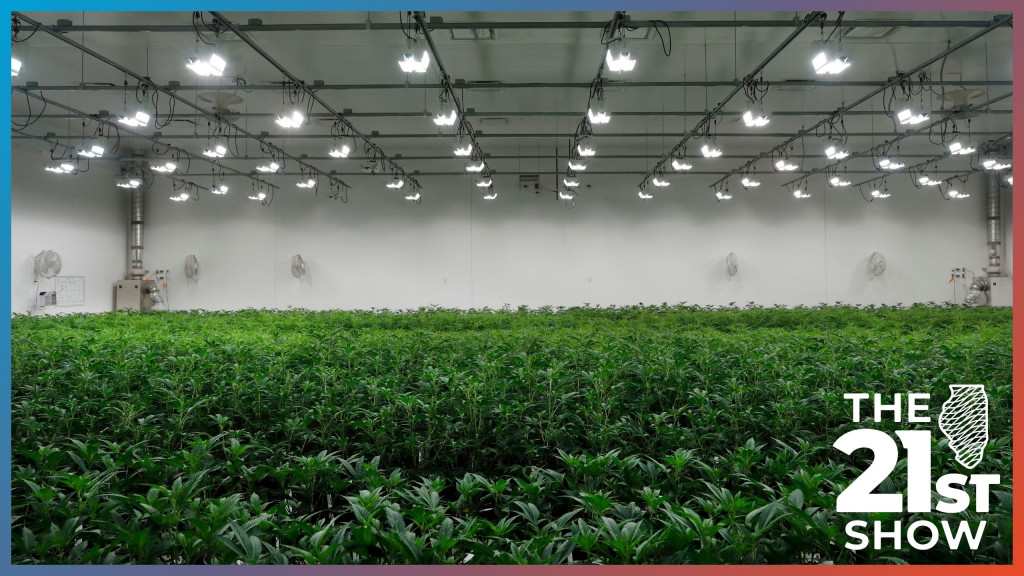
Marijuana growing at Revolution Global’s cannabis cultivation center in Delavan, Illinois in this file photo from Jan. 14, 2020. Charles Rex Arbogast/AP
// This is a machine generated transcript. Please report any transcription errors to will-help@illinois.edu.

[00:00:00]
Brian Mackey: It's the 21st show. I'm Brian Mackey. Recreational cannabis became legal in Illinois almost seven years ago, January 1st, 2020. We were the 11th state to legalize marijuana. Flash forward to today, and almost half the states in America have done that. It's much more widely available than it used to be. And so, what effect is it having on our society and our health? One part of the law that allowed recreational marijuana here requires annual reports about that. And to be clear, we're talking about the commercial market, not the medical marijuana program. The Illinois Cannabis Project at the University of Illinois Chicago has been doing that work for several years now, and its latest report came out a couple of months ago. The head of that team is James Schwartz. He's a professor and interim associate dean for research in the Jane Adams College of Social Work at UIC. He's also the principal investigator for the Illinois Cannabis Project. I spoke with him late last month. We're sharing that conversation for the first time today. No calls for this part of the program, but we did get your thoughts on this topic ahead of time, uh, from people in our texting group, as you'll hear a little later. If you wanna join that for future conversations, you can send the word talk, T-A-L-K, to 217-803-0730. All right, let's start at the top level. What do we know about the extent to which people are using cannabis in Illinois?

[00:01:31]
James Schwartz: Uh, that's a big question and, uh, try to narrow it down. Um, we, we look at many different aspects of it for the report. We try and be as comprehensive as possible, sort of the reports kind of ballooned over the years. It's now pretty long, but overall, just to give a sort of a, the, the overall high-level view that it, it's, there's no question that uh use has increased among uh people in Illinois, use of use of cannabis. So, uh, I won't quote too many statistics today, but, um, to give you some perspective on that, uh, if you, if you ask people, did you use marijuana or cannabis in the past year, if you ask that question in the years just prior to when cannabis was legalized, you would get about 15% of the uh a population 12 years and older saying yes I did, I've used cannabis in the past year.

[00:02:25]
Brian Mackey: It's about 1 in 6 people, 15%, yeah,

[00:02:28]
James Schwartz: yeah, that's right, that's right. And to put it in that same metric, it's now 1 in 4 people if you ask that question, 23, 24 is the most recent data we have. Um, it's now about 24.9, 25% of people say, yeah, I used it in the past year. Um, if you, if you dive down further and you try and get at where use might be a little concerning, um, or a lot concerning, depending on circumstance, and you ask, uh, how often did you use cannabis in the past month, if you used it in the past month. And our sort of threshold for frequent use is 20 days or more in the past month. So you ask people, did you use at least 20 days or more, which is almost not quite, but almost daily. And that has increased from about 5% to about 9% of the population now. So, we have a, a, a fairly sizable portion of Illinois population that is using cannabis uh regularly, almost on a daily basis. So, um, definitely we've seen increases.

[00:03:31]
Brian Mackey: 1 in 10, wow, that's, or almost 1 in 10. That, that's striking. So, there was, there was a fear, one of the fears when this became legal is that it might make it more accessible or popular among teenagers. What have you been seeing there?

[00:03:45]
James Schwartz: That is one of the, I think one of the most interesting and I don't know, confounding is the right word, but we have not seen that at all. In fact, we've seen the opposite, that youth use has declined. Uh, since the law went into effect. And I remember looking at these data and past reports and saying, we must be doing something wrong. How can that be? Because there were all kinds of projections prior to the laws, and then, and it, it was a major concern that, well, we're normalizing you, it's gonna be more available throughout the state. So youth are gonna pick up on that and use it. And that's not at all what happened. It's declined. And, um, and, and the reason I'm fairly confident in that finding for the state is that's been the finding elsewhere in, in most states as well, and nationally, that youth use has declined uh since, since this wider spread adoption of cannabis. And I don't know that we know why, uh, uh, it's happened.

[00:04:44]
Brian Mackey: You've anticipated my next question. What's your hypothesis?

[00:04:48]
James Schwartz: I have, you know, hypotheses about it, but one is that, for example, it may actually in some ways have made cannabis harder to get because it's no longer, they, they sort of stepped a bit onto the market, you know, on to the illegal market, and so there's not, you've put some folks out of business, in other words, by having cannabis available legally, and so, youth were, you know, may have been getting it from these illegal sources. Although if you ask them where they get it, it's usually from family or friends. Um, if you ask youth, where are you getting your cannabis from? So, uh, we don't know. We, honestly, we don't, we don't know why and it's, it's a good question to think about in future reports to try and get at this very surprising finding, but very, uh, uh, uh, a very happy finding that we're all, we're all kind of relieved to see that.

[00:05:35]
Brian Mackey: You know, I have a kind of a sidebar question on, on the data. Since you mentioned you at first, when you first started seeing this, you thought, well, maybe we're doing something wrong. You know, and, and I follow political polling and surveys pretty closely, and that kind of research has had some real serious problems in recent years. Can you just talk a little bit about, you know, in the public health space, how good is survey research? How confident are you in it? Has it been plagued by some of the same, you know, lack of, uh, people answering their phones, those sorts of things, or have you found other methods?

[00:06:08]
James Schwartz: Well, we in Illinois, we rely a lot on other people's data collection. We, we don't do a lot of our own data. We rely on, uh, what's called secondary analysis in, in the social sciences. So someone has collected data, someone else has collected the data, and you go in and analyze it. So, we've been analyzing, uh, one of our primary sources, for example, is the National Survey on Drug Use and Health. There's some other big surveys like the Illinois Youth Survey, which goes out and surveys high school students, high school and middle school students, and some other, other surveys done by the Centers for Disease Control. And so we, we try and look at all of those surveys results together and see how, how consistent are the findings across surveys. Now, sometimes we can do that, sometimes we can't because each survey is somewhat unique.

Um, I don't think there are the same problems that you're referring to with the political polls, and my understanding of what's driving that is people, uh, uh, they, they become biased because people tending to support one party versus another are more reluctant to, to respond to questions. I don't think that's the case with the survey data that we're accessing. You're always worried with substance abuse research, and this is something you can't avoid. You're always worried about um, people underreporting their use, right? Because I don't wanna, I don't want to fess up, and then there are certain circumstances where that in particular becomes a concern. We might talk later on, for example, about pregnant women. You ask pregnant women about their drug use, they're very reluctant, uh, many of them are very reluctant to talk about it because they don't want things affecting their family or their, you know, someone coming in and investigating them for, for their child. So, there are certain populations where you're concerned about that. I think overall the data are reasonably good quality. And we use the same, we try and use the same sources across years. So, assuming that whatever bias is in there is consistent across years, we can at least get some information about trends, you know, it's going up, it's going down. May not be pinpoint accuracy because of some of the biases I think you're alluding to, but I, I think it's pretty good.

[00:08:17]
Brian Mackey: Well, one of the trends you do look at in this report is, uh, adults with severe mental illness. So talk about what's happening there.

[00:08:25]
James Schwartz: Well, one of the clearest signals, um, in the report of, of a population of concern. So, um, people are asked, uh, in order to identify people with severe mental illness in the survey, they're asked, how often in the past month have you experienced symptoms of anxiety, symptoms of depression, had a hard time getting out of bed and, and so, you can separate people into categories depending on how frequently they experience these symptoms, these symptoms of psychological distress, um, and that are consistent with having a severe mental illness such as major depressive disorder, anxiety disorder, schizophrenia, bipolar disorder. And um over that same time period we were just talking about for the state, the 2018, 2019 out to ['23, '24], the increase among people with the most serious or most severe experience of these symptoms of psychological distress went from 34% [past year] to 59% past year. And frequent use, the measure that we also talked about, which is 20 days or more in the past month, went from 17% to 33%. And the findings are very consistent as you increase the severity, as you, as severity of mental illness increases, the use of cannabis either periodically or very frequently also increases almost a linear fashion. So it's a, it's a population of, I think, of great concern for us or should be as a public health issue.

[00:10:02]
Brian Mackey: That's interesting, and I, I do, I know a, a, a physician who sees patients and, and sees this in her practice that people are sort of like self-medicating instead of with, you know, prescription pharmaceuticals, they're using cannabis to, to manage their anxiety. Uh, which may have some follow-on consequences. All right, we, we need to take a break. Uh, we're talking with James Schwartz, principal investigator for the Illinois Cannabis Project at the University of Illinois, Chicago. They've put out their, uh, in the past few months, they've put out their latest annual report on cannabis usage across the [21st] state. We'll talk more after a break. This is the 21st show. Stay with us.

It's the 21st show. I'm Brian Mackey. We're talking about the effects of legal marijuana in Illinois, almost 7 years after that happened. My guest is James Schwartz, who's been researching this over the past several years. He's a professor and interim associate dean for research in the Jane Adams College of Social Work at the University of Illinois Chicago. And he's also the principal investigator for the Illinois Cannabis Project, which puts out the report we've been talking about. Again, we originally taped this conversation toward the end of October. You'll hear us talk a little bit later about the Illinois Hemp Act, and at the end of the show today, I'll have an update on some developments around that law. Long story short, enforcement of that has been delayed while businesses affected by the law sue the state to have it blocked. Before we taped this, we asked members of our texting group for their opinions on marijuana. I'll say that took us a bit because it turns out the service we use blocks the terms marijuana and cannabis, cause I guess they think people are spamming. We had to get creative with our wording. In the end, we called it weed. That said, I'll pick up where we left off.

Uh, we did get a range of opinions. Jesse and [Mattoon] says, I think it's been good and bad. It's made it much safer to purchase without worrying about unsavory additives. The bad is I see many more people in traffic in public spaces smoking it unabashedly. Overall, I'd say it's a good thing if the licensing is done equitably. We also heard from Christopher and [Brimfield] who said, I personally don't like people who have or are smoking weed around me. The smell's very strong, lingers for hours. You can smell the car in front of you if they're smoking. In my opinion, that weed will not make your life better. Thank you for those messages. Again, you can join our texting group by sending the word talk to 217-803-0730.

So, yeah, I guess it is more prevalent. I, I certainly experienced that, especially in bigger cities. You're just walking down the street, you'll smell it, uh, the way you used to smell cigarette smoke. Um, so, yeah, I, you may, you alluded to this earlier, uh, before the break. One of the findings in your report, um, that is most worrying, uh, is cannabis use during pregnancy. So, what do, what do we know about that?

[00:13:35]
James Schwartz: Yeah, interesting topic and one that we have more fully embraced as we've gone along over the years of collecting these data. There's, there's a, there's a something of a black hole with respect to um, cannabis use among pregnant women in terms of the data that are routinely collected. You, you, you don't have enough, uh, pregnant to perinatal women, uh, in national surveys, uh, to get relatively robust estimates for them. So, and the one major data collection system that does focus on pregnant women, uh, [PRAMS], uh, doesn't ask about cannabis. It asks about alcohol and tobacco. They only asked about cannabis one year back in like 2017 or 2018. So we started collecting it ourselves. We wanted to understand, um, it's not, it, it's not a representative survey, we're, we're, but it's, it's, I think, does provide some, some useful information.

Women, um, what, what we learned is that um, many women, not, it's not a huge percentage of women, but it's still unnoticeable in Illinois. I'd say it's like 10 or 11%. Uh, I don't, don't hold me to that exactly, but, um, it's about that percent, uh, and, uh, are using it according to our surveys. And so we wanted to understand why. And it's almost, uh, the, the predominant response is that they're using it for some of the same reasons you talked about, Brian, people self-medicating for their mental illness. Anxiety, depression, nausea. They're usually, either they started, they were cannabis users, heavy cannabis users prior to pregnancy and they just continued, or they uh started experiencing these symptoms and use cannabis to medicate, thinking that it was safer than, for example, using something like opioids. Um, which they've been dissuaded from using, right? So cannabis is legal, I can use this. And one of the issues that the women identified is that, uh, they get very inconsistent advice from their healthcare providers. There's not a standard set of recommendations across healthcare providers say, yes, you should use it but cut way down or don't use it at all. And in particular, what women were after was, um, OK, if I can't use this, what can I do? Right? So don't just tell me to stop using, I'm using it for anxiety and depression and nausea. What is a safer alternative? I need that information as well. And they haven't, they haven't, as, as a, as a rule, been getting that uh specific information from their healthcare providers. So it's something that we have been trying to get the message out and promote that, you know, with, with respect to perinatal women, um, they do need clear medical, uh consistent clear medical advice and offered clear alternatives, uh, to, to use. The good news is that, um, in even women who start using during the first trimester of pregnancy, uh, the large majority of them curtail their use by the time they get into the 2nd and 3rd trimester. Uh, and don't resume it until they're outside of their pregnancy again. So,

[00:16:41]
Brian Mackey: well, I know you're not a, you're not a physician, physician, doctor, but can you say what the recommendations are? I mean, as com, you know, for example, compared with alcohol use during pregnancy or smoking, cigarette smoking or

[00:16:52]
James Schwartz: something. Well, I, I would say clearly, I, I, I, I can say pretty definitively, don't use, don't use cannabis during your pregnancy. It's not, it, it, it, the, the, uh, we've also been looking at, we have a, we have a report coming out to, uh, I always, the [IGPA], it's just down at your, your institute of [Urbana]

[00:17:09]
Brian Mackey: Champaign, and public affairs, yes,

[00:17:12]
James Schwartz: right, we, uh, my, my, um. My co-PI Doctor [Dana Franceschini], who's at the University of Wisconsin Whitewater, she was a Jane Adams, uh, has that report coming out, which we, we wrote together, and we examine like what are the potential effects on the fetus and, and mother. And there are some, there are some, the literature isn't entirely consistent, but there are some in terms of preterm birth, low birth weight, and, and so on. And so, it's, it's generally the, the recommendation for the group that is uh the American Association of Gynecologists, I forget, a [guy], I'm sorry, I forget that acronym, but their, their, their standards are clear about don't use, don't use cannabis. What alternatives a physician would recommend, I'd have to, I'd have to defer to my colleagues who are physicians who, who treat women during pregnancy and uh, I, I don't know. I don't know that myself.

[00:18:06]
Brian Mackey: Yeah. All right, I'm gonna share a couple of more text messages from listeners. We heard from Aaron in Springfield who said, it's nice to know what it's like to live in a state that allows people to act normal and be free to live a life without fear of being arrested for using a recreational intoxicant that is not addictive. Uh, but then we heard from Lloyd in Danville, who, uh, noted that people are still being arrested for cannabis, and he said weed remains a target for law enforcement as it relates to underprivileged people. So, professor, what do, what do we know about that?

[00:18:40]
James Schwartz: Well, may I address both points? I want to push back on the first one a bit. It is addictive. Uh, cannabis use disorder is a recognized disorder in the Diagnostic and Statistical Manual, which is the, the primary diagnostic manual, in, in the United States for diagnosing mental disorders, as well as the international classification of diseases. Um, there's cannabis abuse and dependence, so that, that is not accurate. It, it, it is, um, it, it, you can become dependent on cannabis.

Um, so, the second, second part about are people being arrested. Uh, they're right. Um, we, we looked, this is the first report where we looked at an alternative data source for arrests. Uh, we had previously been relying on the Illinois State Police information where they tracked Cannabis Control Act violations. And there's been a huge decline in Cannabis Control Act violations, almost 90% from 2016 to [2025]. So, one of the success stories, and I know Governor Pritzker in office was particularly interested in these issues of equity and counteracting the effects of the war on drugs. Where Illinois still has an issue is, we believe with respect to open carry laws. Uh, what's happening, what seems to be happening is that, uh, people are in their cars, as someone mentioned, you can smell the cannabis coming out of the car, or they might just have an open container of cannabis in their car. They're being stopped for a traffic traffic offense, and then the cannabis is found in the car. And then that's added to the arrest. And we have found that there is a very, very disproportionate number of arrests among particularly young Black men for violation of these laws, and we, we emphasize that in this report that there's still work to do in terms of equitable dispensation of justice, and Illinois has among the strictest open carry laws among states, and that's something that the state might want to review because it is having a disproportionate effect. Your, your texter is exactly right about that, and it's, it's in the report. So and

[00:20:54]
Brian Mackey: open carry would be like, so in the alcohol context, I think that's intuitive if you have a can of beer with the top popped or the, you know, bottle where the cap's off, I guess if you have a, uh, I don't know, a tin or a bag of gummies with like the seal broken, that counts as open

[00:21:09]
James Schwartz: carry, yeah, or a joint in the car, yeah.

[00:21:11]
Brian Mackey: You know, speaking of traffic safety, what, what do we know about marijuana and traffic safety? Because, you know, the, the caller or the texter mentioned smelling it. I feel like I smell it at least a couple of times a month. I got to hit that little button on my car that makes the air indoor only, so it's not wafting in. Like, do we know anything about cannabis and traffic safety?

[00:21:31]
James Schwartz: Well, we do. I mean, it's one of the grayer areas where we don't have great data sources. I've been looking at uh, national transportation fatality data. So we've been looking at it in terms of where there's a fatal crash and where they test the driver. And the THC, the, the, the THC being the drug that's in cannabis that's responsible for your getting high, um, is showing up in a, in a larger number, at a higher percentage of tested drivers over recent years. The problem is, the problem with those data and why I, I hesitate a bit is because you don't really know what percentage of all fatal accident drivers are being tested, or it's a, it's, it's an increasingly lower percentage. And the other caveat here, so, so there's a large number that aren't getting tested, but the data that we do have suggests it is an increasing factor in at least fatal crashes.

Um, there's not, the, the DUI information is simply not there. There's not data on you're arrested for cannabis for a DUI. It's just, it's just, as far as I know, doesn't exist. And the other, the other caveat I wanna mention is that often when the person tests positive for cannabis, they test positive for something else too, in particular, alcohol. So it's, it's actually more of the rule, like in 2/3, I think of the cases where they test positive for cannabis, they've also been drinking or they've been using, you know, benzodiazepines like Valium or something like that. So, it's not a clear-cut, it's only cannabis causing this, these issues. So, like I said, it's a gray area. I wish we had better data on that. Um, but the data do suggest that it is, it is, uh, is a problem. There's a lot of issues with, with measuring cannabis use and attributing it to the, as opposed to alcohol. You, you drink alcohol, it's in your system, it leaves your system fairly quickly. Uh, so if you, if you detect alcohol in the system, you know that the person's been drinking recently. Cannabis can stay in your system for up to 2 weeks or longer, depending on how heavy you use it. So, if a person is stopped and they test positive for cannabis, unless the officer sees it in the car, smells it, um, you're not sure were they using it at the time, or are they a user, so it's, there's some difficulty in, in making that discernment.

[00:23:44]
Brian Mackey: Well, there's a lot that we didn't get to touch on, including this, the new Illinois Hemp Act. We're almost out of time, I guess. I don't know if you want to talk briefly about that or just talk about what other trends you're most interested in following in the years ahead.

[00:23:56]
James Schwartz: Yeah, that's a great point. I'm sorry I, I waxed on so long. Uh, the Hemp Act is very important, and it's gonna be very important to monitor it. What Illinois did was they brought, and I'll, I'll try and be brief here too, they, they, they brought hemp under the same umbrella as cannabis, whereas stores had been selling hemp-based products, uh, that have the same level of intoxicants or more as compared to cannabis [tox] without any regulation.

[00:24:22]
Brian Mackey: And you say stores, you could just go into the gas station, convenience mart kind of thing and see it

[00:24:26]
James Schwartz: everywhere. No age restrictions, nothing, no regulations. That's all, that's all gone now. Effective November 12th, you're not going to be able to sell these intoxicating [products] outside of the regulated cannabis industry. So, it'll be interesting to see what happens with these stores. It'll be interesting to see what happens with our population estimates, cause we know some of what we've been attributing to cannabis probably was hemp. Cause people don't always make that distinction when you ask them, have you used weed or, you know, have you used pot or weed? They might not make that distinction between hemp. So, it'll be interesting to see what happens to our [prevalence] estimates very quickly. I'll just say pediatric exposures remains a concern for for us. It, it's elevated. Kids, little kids, 3 years, 3 years old, or, or, or 3 to 5 years old are getting into mom and dad's or their parent or someone's,

[00:25:16]
Brian Mackey: oh yeah, the gummy bears, they look like gummy bears. Yeah,

[00:25:18]
James Schwartz: absolutely. They're made like candy and, and, um, showing up in, uh, [the day] showing up in emergency departments and reports to poison center. That's the other, I think, red flag area. It's been, it rose dramatically after legalization. It's leveled off, but it's still at a much higher level than it was pre-legalization. So thanks for letting me squeeze that in. Yeah,

[00:25:39]
Brian Mackey: no, that's, that's a great point. I'm glad you brought it up. James Schwartz is professor, interim associate dean for research in the Jane Adams College of Social Work at the University of Illinois Chicago and principal investigator for the Illinois Cannabis Project. Professor Schwartz, thanks for sharing your work with us on the 21st show.

[00:25:55]
James Schwartz: Thank you for having me on. It's always a pleasure to speak with you, Brian. Appreciate it.

[00:25:59]
Brian Mackey: A quick update before we go. After we recorded that conversation with Schwartz, a group that calls itself the Illinois Healthy Alternatives Association and a few hemp businesses sued the state over the Illinois Hemp Act. Again, that was supposed to take effect last week, but the state has agreed to pause enforcement until a federal judge hears arguments on a request for a temporary restraining order and preliminary injunction that is scheduled for this Thursday. On that note, that's it for us today. The 21st show is a production of Illinois Public Media. I'm Brian Mackey. Thanks for listening. We'll talk with you again tomorrow.
Cannabis use in Illinois has risen sharply since recreational sales became legal nearly seven years ago. About 25% of people 12 and older now say they used cannabis in the past year, up from roughly 15% before legalization, and daily or near-daily use has nearly doubled, to about 9%.
One finding surprised even the researcher behind it: youth use has actually declined since legalization, a pattern also seen nationally. James Swartz, who leads the Illinois Cannabis Project at UIC, isn't sure why, though he suspects legalization may have squeezed out some illegal sellers — even as teens who do use cannabis say they mostly get it from family or friends.
The report flags one population of particular concern: adults with severe mental illness. Past-year use among that group rose from 34% to 59% over the same period, with frequent use — 20-plus days a month — climbing from 17% to 33%.
Read the report
Illinois Cannabis Project: 2026 Annual Cannabis Report
Guest
James Swartz, Ph.D.
Professor and interim associate dean for research, Jane Addams College of Social Work, University of Illinois Chicago
Principal investigator, Illinois Cannabis Project