








Illinois lawyers are drinking, gambling and burning out at high rates, new report finds
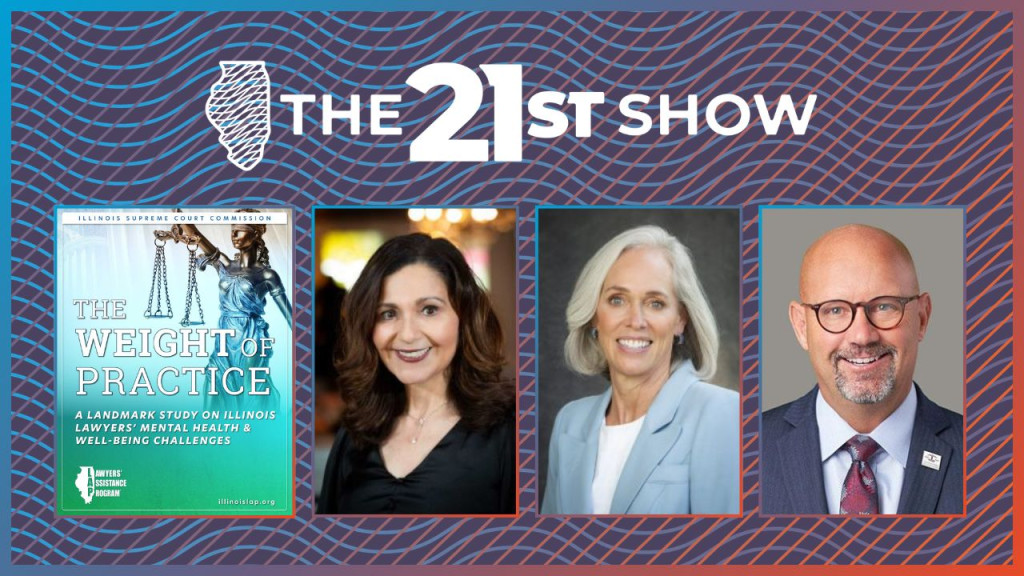
From left: Diana Uchiyama, Susan Clancy Boles, and Shawn Kasserman Uchiyama and Boles: ILAP • Kasserman: Tomasik Kotin Kasserman LLC
Brian Mackey  •  00:02
Today on the 21st Show, the law can be a challenging profession with long hours, demanding clients, and high stakes for success or failure. A new study finds all that has taken its toll on Illinois lawyers, one in five of whom rate their mental health as fair or poor. Joining me to talk about that are Diana Uchiyama, a psychologist and former public defender. She now runs the Lawyer's Assistance Program in Illinois. Also with us, recently retired Judge Susan Clancy Bowles and Shawn Kasserman, a practicing attorney. We'll talk about the stories behind the numbers and what's being done to improve the situation. I'm Brian Mackey, and that's all coming up today on The 21st Show, which is a production of Illinois Public Media. But first, news. From Illinois Public Media, this is The 21st Show. I'm Brian Mackey. Nobody goes into law expecting it to be an easy ride. Long hours, demanding clients, high-stakes cases can wear on a person well beyond a rough day at the office. A new survey of Illinois attorneys puts a number on that wear and tear. One in five, one in five rated their mental health as at best fair or quite possibly poor. That, in turn, has led to above-average substance use, gambling, and suicidal ideation. And the demands and norms of the profession are such that asking for help is not always so easy. All this is documented in a new report called The Weight of Practice. It's from a group called the Illinois Lawyers Assistance Program, which is an official commission of the Illinois Supreme Court. My guests today are joining us to talk about this from three different perspectives as a psychologist, as a judge and as a lawyer who's lived it himself. Dr. Diana Uchiyama is a licensed clinical psychologist who heads the Lawyers Assistance Program. Before that, she spent more than a decade as a public defender in Cook County. Dr. Uchiyama, welcome to The 21st Show. Thank you for being with us.

Diana Uchiyama  •  02:20
Thank you, Brian. Thank you for having me here.

Brian Mackey  •  02:23
Judge Susan Clancy Bowles just retired after leading the 16th Judicial Circuit in Kane County. She's now president of the Lawyer's Assistance Program Board. Judge Bowles, welcome to you as well.

Susan Clancy Bowles  •  02:35
Thank you, Brian. Pleased to be here.

Brian Mackey  •  02:37
And Shawn Kasserman is a practicing Chicago attorney and past president of the Illinois State Bar Association. He's also been open about his own struggles. Shawn Kasserman, welcome to you. Thanks for being here.

Shawn Kasserman  •  02:49
No, good morning, Brian. I'm very pleased to be here. Thank you.

Brian Mackey  •  02:53
Listeners, you can join us today, 800-222-9455, especially if you've ever worked in or around the law. We'd love to hear about your experience and the experience of people you've been with, with dealing with mental health struggles, possibly addiction in that profession. 800-222-9455 is the number to join us. Or maybe you've just been a client or someone else involved in our justice system who has seen the toll that mental health and substance use can take on the profession. Let us know. 800-222-9455 is the number. 800-222-9455. All right, Diana Uchiamman, I'm going to start with you. Tell me more about the survey and what it says about the state of mental health in the Illinois legal profession right now.

Diana Uchiyama  •  03:42
Yeah, LAP is an organization that we take the problems that lawyers experience in the profession very seriously. The Illinois Supreme Court has made us an arm so that we can kind of figure out what's happening in the profession and then create strategies to help people get better. And so what we see in the day-to-day, behind-the-scenes operations in the Illinois Lawyers Assistance Program is exactly what the survey highlights, is that we are in a mental health crisis. We have a population of judges and attorneys who are struggling. They have higher rates of substance use disorders, specifically related to alcohol use. And with the legalization of things in our community, we often confuse legality with safe. And what we're seeing is problems related to high rates of alcohol use, high rates of cannabis use and an increasing rate of gambling use disorders in the profession.

Brian Mackey  •  04:44
Interesting, because those are all I was going to say recently. Obviously, alcohol has been legal for a long time, but relatively the other ones relatively recently legalized here. How did you get nearly 7,000 Illinois lawyers in this survey to open up about something so private?

Diana Uchiyama  •  05:01
Yeah, that's a great question. You know, these are really topics that are very difficult to discuss and very difficult to share. And so the Illinois Lawyers Assistance Program has spent years building up rapport with populations of attorneys throughout the state and with judges. We do a lot of presentations, educational trainings. And in doing that, we have created this rebound effect of people self-referring to our organization. And in doing that, they've placed great trust in our organization to highlight what they're experiencing in the profession. And so in getting a 12% return rate on a survey that's talking about topics that none of us want to share, how much we're drinking, how stressed we are, how much trauma is being infused into our system on a regular basis, how we cope with the struggles and how often we feel despondent and great levels of despair is really a sign of courage and bravery from the people who placed great amount of trust into our organization to highlight the problems so that we can come up with solutions to help lawyers get better.

Brian Mackey  •  06:19
What do you make of this, this sort of headline finding that I mentioned that one in five lawyers rate their own mental health as fair or poor?

Diana Uchiyama  •  06:27
I think the day in and day out of what the Illinois Lawyers Assistance Program clinicians see is exactly what the survey showed is that mental health is really becoming a crisis. And the young people who are coming into the law are experiencing fair and poor mental health as they navigate the beginnings of their career as lawyers. And so we have to really look at this data and say, we're all responsible for fixing the problems in the systems, for supporting behaviors that are no longer in our best interest. And now that we have measurable findings, which no one can dispute just because this is a reliable and valid survey sample of the entire population of attorneys in the state of Illinois, we have to change things that are no longer working and support lawyers and judges who are struggling.

Brian Mackey  •  07:27
And I definitely want to come to the idea of what might change later in the conversation, but I'm going to put a pin in that for now. And Judge Susan Bowles, I want to come to you to talk about how you saw the stress of practicing law showing up in your courtroom in Kane County.

Susan Clancy Bowles  •  07:43
You know, Brian, as a judge, you see it different ways. You clearly, I most recently was in a courtroom for a number of years, seven or eight years, a jury trial courtroom where oftentimes I would have trials that would last, you know, two or three weeks. So I would see certain individuals during that time in a very stressful time because they're not able to go into their normal office during that two or three week period because they're showing up to do, you know, the jury trial. And even just the stress over that two or three week period and to see how people's patience changes or their demeanor changes was so incredibly interesting. But also by the same token, you unfortunately witnessed many times people who would not appear on cases all of a sudden. And for the first, you know, five years, They would show up every time their case was up and all of a sudden now they weren't showing up at certain times or they would appear disheveled, whether that's because of dress or coming in, not looking all put together, realizing that, hey, court is starting on time. we're ready to go. Not keeping up with communications on the cases. So not realizing many times I'd have attorneys in my courtroom and I would call a case and be like, so-and-so, this is your case. And it'd be like, oh, judge, wow, I didn't know this case was up today. So different ways the stress appears that, and again, being local in a county, I worked with many of these people before I went on the bench. So you've seen these people over the course of years in different situations, both inside and outside of the courtroom. So it's kind of a bird's eye view of how stress can affect different professionals during a time that kind of crisis.

Brian Mackey  •  09:49
Can you speak, and I know you probably can't get into specifics, but in a general way. How does this sort of rebound on the clients, right? Either people accused of crimes or people going through divorces or trying to get justice or defend against accusations of malfeasance in their work or something like that. How does this rebound on them?

Susan Clancy Bowles  •  10:09
Well, and that's the huge issue, right? Because obviously you go to an attorney, you want representation. You expect an attorney to appear on your case every time your case is up. And when that doesn't continuously happen, obviously the client is going to suffer with regard to that. There has been only one time, thankfully, while I was on the bench that ultimately because I had an attorney not showing up over the period of three different times the case was up, where I indicated in an order that I need the client to come into court because I needed to let the client know for whatever reason, your attorney is not showing up. You need to get a hold of your attorney or you need to have different representation. So it does rebound back on the litigant. And again, that's part of my job too, is to protect the litigants to make sure that they are fairly represented in the courtroom. So that's a difficult balance for sure.

Brian Mackey  •  11:15
Shawn Kasserman, I want to bring you into the conversation now. So you are an attorney in practice, trial lawyer, right? Personal injury, those sorts of cases. How did stress show up in your career?

Shawn Kasserman  •  11:28
Well, Brian, as a personal injury lawyer on the plaintiff's side, but I think this is true for all lawyers. Stress is a natural and inherent part of what you do. And it has been for 36 years of my practice. It's there. I like to think of stress as two-sided, really. There's, you know, part of stress is positive. It keeps you fired up and into what you're doing. And certainly when we go to trial, the trial of a stress can be invigorating. And sometimes I would suggest there's very few things that are better. Where stress comes into play adversely and way too often in the practice of law is when it overwhelms you, when it gets to you and starts to affect your personal life, your professional life, your physical health, your mental health. And I see that happen. I felt it happen. If I'm being bluntly honest, it probably happens to all But when that happens, and Judge Bowles mentioned the rebound effect on clients, I think one of the problems with lawyers is the last thing they're going to do is let their clients suffer. They'll let their family suffer. They'll let themselves suffer. They'll let their mental and physical health suffer. But they're going to do anything and everything they can for their client. And that's somewhat how we were trained. But we have to find a better way to keep that commitment in place without letting our personal lives be disrupted.

Brian Mackey  •  13:00
I wonder if it's different, if you see it differently in, say, for example, I mentioned you're a trial lawyer, right? It's one thing if you're a salaried lawyer, you're a general counsel. Obviously, deadlines are important, but you have that sort of cushion. You are in this branch of the practice where it's sort of eat what you kill, to be blunt about it. I wonder if you see that, you know, adding to the stress or how that interacts with what we've been talking about.

Shawn Kasserman  •  13:23
It does. Although as president of the Illinois State Fire Association, we have 38,000 members or so. And I had the privilege of getting to know lawyers across the 102 counties and across the various aspects of practice. And I can assure you that they have their own stressors, their individual issues that they have to deal with. And sometimes it's financial. You know, there's counties in the state of Illinois that have five lawyers. And not only does that increase the stress of having to take care of everybody, it's hard to make a living. So I think it would be a mistake to kind of pigeonhole certain attorneys are more subject to these issues than others. I think they're faced across the state. I'm sure Diana knows more about that, but that would be my perception.

Brian Mackey  •  14:15
Yeah, I know. That's fair. And, Diana, actually, I was going to ask you because you were a public defender in Cook County in the past, right, which is I know it's the largest unified court system in the country. I presume it's the largest unified sort of public defender's office or the busiest in the country. How did stress show up in that line of work?

Diana Uchiyama  •  14:33
Oh, my gosh. You know, Shawn, I think what you highlighted is really accurate and is this concept that it's not just people who are, you know, in these high profile cases. shows up in different ways. I had a caseload that was unbelievable of felony cases. I was at 26 in California and my caseload was exploding as most people couldn't afford attorneys in the system. And so, you know, we're designed and taught in law school to show up. I think what Shawn said is that other areas of our life suffer in the representation of our clients, in the things we see, in the things we hear, in the autopsy photos we see. And like that never goes away. And so this pressure to be available, to be more, do more in these type A personalities, we're all highly competitive. We want to win cases. The pressures that we face are internal as well as external, right? Meaning that the way I'm built and the way Shawn's built and the way Judge Bowles is built are similar, right? That we have this desire, we all come into the profession with this values-based, mission-oriented, I want to fix certain things for certain people. And it can just overwhelm us, this need to show up and be available. And in this age of media where we're always on and people can reach us and people, there's never any time off. And oftentimes I walk into organizations where they're like, you need to answer clients at all hours, regardless of what time it comes in. So I think the pressures we're facing are increasing just based on our ability to use our cell phones, our laptops, this ability to work remotely. It's not getting easier. It's actually getting harder. And because of who we are and what we're trying to do, we often use behaviors to compensate for what we're experiencing, meaning like using something or eating too much or not taking care of ourselves or losing our marriage or having terrible relationships with our children, because there's only so much energy to go around.

Brian Mackey  •  16:53
Yeah. All right. We're going to continue this conversation. We need to take a break on the program. If you want to join us today, we'd love to hear your perspective on what we've been talking about at 800-222-9455. That's 800-222-9455. We are talking about a new report focusing specifically on the mental health struggles of people in the legal profession. Again, you can join us, 800-222-9455. This is The 21st Show. Stay with us. It's The 21st Show. I'm Brian Mackey. We are talking today about a report that's come out within the last month called The Weight of Practice. It's from the Illinois Lawyers Assistance Program. This is an official commission created by the Illinois Supreme Court to look after the mental health of people in the legal profession in Illinois, who, of course, are registered and have their ability to practice law governed by the Illinois Supreme Court. We're talking about that with Diana Uchiyama, who's a licensed clinical psychologist and a former public defender. She runs the Lawyer's Assistance Program. Also with us, retired Judge Susan Clancy Bowles of Kane County, Illinois, and Shawn Kasserman, practicing attorney in Chicago, also past president of the Illinois State Bar Association. If you want to join us today, the number is 800-222-9455. And let's go now to the phones. We have Case calling from Effingham. Case. Thank you for calling in.

Caller: Case from Effingham  •  18:35
Thank you. I just had a quick question for Dr. Diana. I wanted to know exactly how much she believed that external factors play a role in substance abuse and of the profession.

Brian Mackey  •  18:58
And what do you mean, like external factors, like the economy, broadly speaking, and things like that?

Caller: Case from Effingham  •  19:06
Correct.

Brian Mackey  •  19:06
Correct.

Caller: Case from Effingham  •  19:07
So, you know, the American Medical Association did a study and they found out that 75% of on non-genetical mental illnesses in diseases today were related to stress factors, such as competing against AI as an attorney when people can go online and basically do pro se themselves You know, the job stability is in question. And also, economically, the profession isn't as lucrative as it used to be. So there are external factors as well as internal, which are genetic factors, you know, cluster A or cluster B personalities, how people tend to deal with these issues. And I just want her take on what she believe about external factors playing a role in the substance abuse in the profession of law.

Brian Mackey  •  20:29
All right, Case, thanks so much for the call. Dr. Diana Uchiyama, I'll leave that to you.

Diana Uchiyama  •  20:34
Thank you. Case, I think that's a great question. I think, you know, it's really hard to put quantifiable statistics on that. But, you know, all of us come into the world and we may have precursors, things, genetic risks, right, that predispose us to mental health issues. Or there might be environmental cues that suggest that certain habits are OK. And then we walk into a profession where there's high stakes competitiveness. It's adversarial in nature. So, you know, any time there's pressure on the system, whether it's internal or external, there will be more problems, meaning, you know, we do see higher rates of suicide when there are economical downturns in the general population. And so that increases risk factors, right? And so if we can see that sometimes every behavior that we utilize to manage stress can be overused and then it can become maladaptive. So people are designed to use strategies that work until they overuse them and then they become problematic, like the use of alcohol, the use of gambling, the use of drugs, right, to kind of minimize the anxiety or the despair we're feeling internally. So I think it's quite a complicated question. I think it's a great question. But when And there are low, like if you spend $300,000 on law school and then you're only making $75,000 a year and you have all these loans, it's really hard to kind of start your life, create a life, have family and support them and then take on the pressures of the profession while dealing with difficult economic times, maybe low clients. So lots of pressures that really influence our decision making and the way we manage our stress, depression and anxiety over time. But I think it's mixed up and complicated and it's always internal, external and learned all at once.

Brian Mackey  •  22:39
Judge Bowles, I'm going to come to you next. We had a caller who not on the line right now, but made the point that mental health issues affect everybody. It's not just lawyers. Why should people, broadly speaking, in Illinois care about the mental health troubles of one particular profession?

Susan Clancy Bowles  •  22:57
Well, I think it's important because obviously people's liberty and whether it's staying out of jail, staying your freedom or your money at stake or somebody who's been horribly injured, it's such a high stake game in the justice system. and our system is based on fairness and everybody needs to be treated fairly. And that means you want to treat the attorneys fairly, but at the same time, if they're not doing their job, then you do have, as a judge, have to look out for the litigant as well. So mental health, I agree. I think mental health issues affect everyone. It isn't just our profession. And I agree with what Shawn said. I think that some stress can be a motivator and it can help in certain ways. It's just when it becomes the norm that it becomes the issue. And especially for the younger generation who comes in and is just starting out. So I don't think the legal profession is any more important as far as the mental health issues. But the ramifications can be profound. I mean, just using an example, somebody can lose a leg, a wrong leg in surgery. And now if you have an attorney that isn't at the top of their game in representing that particular individual, this is going to be an individual, obviously, that is affected for life. So it's a high stakes game. That as well as people's liberty interest and their freedom and not sitting in jail because their attorney's not showing up on certain cases or in certain dates that they're supposed to be showing up in an attempt to either resolve the issue or get the person out of jail. So that's just an example.

Brian Mackey  •  24:57
Shawn Kasserman, I want to talk about the stigma around mental health. Is it different for lawyers than it is for other professions and how so?

Shawn Kasserman  •  25:06
Well, unfortunately, I don't think it's historically been different. And that's the beauty of what Dr. Diana and the Lawyers Assistance Program has done here, is they have brought forward the statistics, the factual analysis of what's taking place. So that if you're reading this report and think to yourself, you know, I'm overwhelmed, I'm overcome, I'm not doing this job the way I wish I was doing it. You know what, all of a sudden you realize you're not one of 100,000 lawyers. You're part of 20% of lawyers that need help and can get help. It goes even further. When you look at that 20%, the numbers of folks within that 20% who have thought about suicide or have thought about suicide in the last two weeks are astronomical. And what this report does is two things along those lines. It lets all of us know that, hey, there's some serious stuff going out there that you need to be on the watch for, for your people, for the people you work with, for the people you care for. But it also tells these folks that are suffering in this manner, hey, you're not alone. This isn't unique. And in fact, when I read, the first time I read this report, I thought to myself, what Dr. Diana is doing and what the Lawyer's Assistance Program is doing is empowering people that need that power. When they're at their weakest, she's giving them the power to help themselves and more importantly, most importantly, to ask for help. She's turned it from a stigma into a strength, if that makes sense to you.

Brian Mackey  •  26:49
Do you think that the sort of the receptivity of, say, you know, people with their names on the doors of law firms, as you are, is different today for a junior associate coming in and saying, hey, I need I need a week off. I'm going crazy here versus what it would have been, you know, 10, 20, 30 years ago.

Shawn Kasserman  •  27:06
Yeah, it's much different. And we're moving in the right direction. 30 years ago, if a lawyer was suffering from depression or any kind of mental health issues, he or she would be pretty much left alone. And they'd sink or swim on their own. And I actually, I worked in a law firm for a long time who's the head of the law firm had admitted that he can no longer drink. And went and got help and came back. And he was there not only as an example for many folks, but he was keeping a pretty close eye on us, too, and wasn't afraid to stick his nose in and say, hey, this doesn't look healthy. Let me try to help you here. And, you know, I think as time evolves, people like me who have been mentored by people like that, it exponentially grows. And we're getting more and more people who see this more clearly. And the report really helped bring all of that into focus.

Brian Mackey  •  28:12
Diana Uchiyama, how common is, so one of the things that this report gets into is, and we've talked about it a little bit here, but let's go into some greater detail, substance use, gambling, other problem behaviors. How common is risky drinking among Illinois lawyers compared with what you'd expect in the general population?

Diana Uchiyama  •  28:32
Oh, it's much higher, Brian. And, you know, in the survey, you know, and I like to say this survey, this landmark survey is the voice of the people who are struggling. They took the time to put quotes in about their suffering. And, you know, the Illinois Lawyers Assistance Program becomes the voice of the people of the population of attorneys who responded. And I take this very seriously because shame lives in secrecy and silence. So in the results of the survey, 34 percent of the population of attorneys indicated they had a moderate or high alcohol use disorder, which is astronomical. Right. And 13 percent indicated that they were frequent drug users, with 97 percent of the population indicating cannabis was their drug of choice. And the majority of people were utilizing these strategies because of the high pressure, high stress environment. You know, and Shawn is right. A little stress goes a long way and can be motivating. But when we're told to do these astronomical billable hours, right, there is a correlation between asking for too much from people and the pressures and stress they're experiencing in the profession and the way they view their workplace. And so what we want to do is use this information, these findings, you know, to make, like Galileo says, measure what is measurable and make measurable what is not so. Because we need to tell people that this cannot carry on, that in the age of being available at all times, people are declining in functioning, not improving their mental health. And we're using tactics that are no longer in our best interest. And what Judge Boll said is that we have to represent the people and we have to be sure that our work is good and that our tactics aren't invading our practice. And so the weight of practice, the title, is because the toll of the work on the human spirit and what happens to us over time when we're asked to be too much for too long.

Brian Mackey  •  30:51
Judge Bowles, I wonder how you've seen the legal profession's relationship with alcohol and other substances, be it cannabis or even harder drugs, change or not change over your career.

Susan Clancy Bowles  •  31:03
You know, that's a great question, Brian. And both Diana and Shawn, I'm sure, can attest to this. It used to be, alcohol used to be a very prevalent part of attorneys getting together. Bar associations, there would always be events that involved alcohol. And I just know certain counties in the state would have big parties, one annual parties, and be out at somebody's farm or somebody's separate lake house where the bar association would go on the whole purpose really was to kind of not be downtown, but be somewhere where you can enjoy yourself and just get wild. That has so much changed now within our profession and how not just bar associations, but how functions are run. It isn't all around the alcohol and the party. around the profession and education and wellness and ethics. So it has changed dramatically over my career. I was a practicing attorney for 17 and a half years before I went on the bench for 20 years. And it is night and day from when I was a young attorney working at a big firm downtown in the city where people would go out pretty much, what, three times a week after work, have drinks, sit around till however many hours, till now today, obviously not practicing attorney, but things have just changed dramatically.

Brian Mackey  •  32:44
All right, let's get another caller in before we take a break here. Paul is calling from Urbana online too. Paul, thanks for calling in.

Caller: Case from Effingham  •  32:53
Well, thanks for taking it. I don't know that people will agree with this, but I think the malady goes much deeper.

Caller: Paul from Urbana  •  33:00
I think that we need to sort of admit that the whole system is really fraught because we have this idea. It was said earlier, you're entitled to a fair trial. Most cases don't go to trial. They are plea bargained. It's coercive plea bargaining in most cases, I think. And I think that's the root of people's malaise to a large extent. When you have to tell somebody, well, you have to take this bargain because, well, we don't have anything else to offer you. I see that as incredibly dispiriting for any attorney to have to do. So I'll just leave it at that and let the broader audience think about this, too. because I think it's an extremely important issue.

Brian Mackey  •  33:57
Paul, thanks for the call. Appreciate it. We need to take another break. We can respond to that when we get back, or we can talk about other aspects of the report and maybe some potential solutions about what can be done to improve the state of the legal profession for people in it and for those of us who rely on it to get justice and other problems resolved in our society. We're speaking today with Diana Uchiyama, director of the Lawyers Assistance Program, which is a commission of the Illinois Supreme Court, retired Judge Susan Clancy Bowles of Kane County, and Shawn Kasserman, trial attorney in Chicago and past president of the Illinois State Bar Association. The subject of our conversation is a new report showing that one in five Illinois lawyers say they rate their mental health as fair at best or possibly poor. This is the 21st show. We'll be back after a short break. Stay with us. it's the 21st show i'm brian mackey and we are talking today about the weight of practice that is the name of a report about the legal profession law practice it's from the illinois lawyers assistance program which is a commission of the illinois supreme court and we are talking it today with Shawn Kasserman, a practicing attorney from Chicago, past president of the State Bar Association, retired Judge Susan Clancy Bowles of the 16th Judicial Circuit, which is Kane County, and Dr. Diana Uchiyama, a licensed clinical psychologist who heads the Lawyer's Assistance Program and in the past worked as a public defender in Cook County. If you want to join us today, 800-222-9455. As we are on the air today, one of my colleagues who used to work in Texas noted a story that he and his colleagues had covered in the past. The first woman elected Dallas County District Attorney resigned in 2016. After 20 months, she had had multiple attempts to end her life. And after years of shit therapy, she was able to talk about it just a couple of years ago. She had been a judge and a prosecutor before that, but just more examples of what we've been talking about, which is one in five Illinois lawyers saying they struggle with mental health, or at least they rate it at best fair or quite possibly poor. If you want to join us today, 800-222-9455 is the number, 800-222-9455. I do want to talk about one other aspect of the report before we get to some of the solutions in our time remaining, which is this idea of cognitive decline. There has been something of a national conversation on this related to our politics. We've seen members of Congress and President Joe Biden having some issues or at least discussion around their cognitive state. And this is something that did come up in the report. Diana Uchiyama, can you talk about what the finding was here about cognitive decline and retirement among attorneys?

Diana Uchiyama  •  37:14
Yeah, that's a great question. It was one of the things I wanted to explore in our landmark survey was, you know, we have an aging population of baby boomers in our country, right, across the board. And we tend to be reactive rather than proactive about coming up with solutions, right? So currently, you know, we have a pretty significant population of attorneys who are working longer and longer in the profession. And we don't have any strategies for how we're going to handle people who may be in a state of cognitive decline. So the Illinois Lawyers Assistance Program has behind the scenes been handling a lot of problems in the practice of law where people who may not have the cognitive capacity to practice are referred to our agency. we do screeners and then we refer out to determine whether a person has some other issue or if it is a memory impairment issue. And we've been working behind the scenes to create strategies for people to get out of the practice of law with their dignity intact before it becomes a disciplinary procedure. And so, you know, with the aging population of attorneys, we have large percentages of attorneys over the age of 60 in the state of Illinois. And this is probably nationwide that are have no plans to retire. But, you know, we use our brain for the practice of law. And so we've got to come up with plans and language that says if we have known issues related to brain functioning, that we should give up our license before it becomes a problem and impacts the clients or the people that we're representing.

Brian Mackey  •  39:10
Shawn Kasterman, have you experienced this where you've seen somebody across the courtroom from you, either cognitive decline or maybe substance use affecting their work or something else? And how does an attorney handle that? Because on the one hand, it's presumably advantaging your client to have that happening. But obviously, it's bad for the profession all around and the human beings involved on the other side. How do you approach that?

Shawn Kasserman  •  39:35
I've seen it in people that I love. I've seen it in people that I work with and love, and I've seen it in my opponents. And what I've watched over my career is an evolution of ignoring it, which is I think what people tended to do when I first came around, to a situation where even if it's your opponent, you find a way to do the right thing. And that may be quietly talking to leadership in that law firm and just ask the question, right? Hey, is everything okay with John Smith? You know, I saw him in court the other day. You don't have to go past that. You don't have to report anybody to the ARDC or anything. You don't even have to say anything to the individual. But just plant the seed in somebody who might be able to do something to help that person. You know, you pointed out Joe Biden and something clicked with me when I heard you say that. Can you imagine how much better Joe Biden's life would be, what his legacy would be if somebody had come to him in his fourth year when he decided to run again and said, hey, Joe, you know, maybe this isn't perfect for you. Maybe you've slipped a little bit. Maybe you've missed a step here and there. Instead, they told him what he wanted to hear. They, I presume, they allowed him to continue forward. And then we all watched him crash on the debate stage as an individual who wasn't qualified for that position. It's the same way in the practice of law. My mentors, I love them. If and when they start to slip, I owe it to them to help point that out, to help protect them from themselves. Because the truth is, Brian, they probably don't see it, right? They're not looking in the mirror and thinking, you know, my cognitive abilities aren't what they used to be. They're telling themselves, I still got this. I still got this. We love what we do. Okay. A lot of us get way too much of our self-worth from what we do. It's up to the people that care about these lawyers who are slipping to go and protect them from themselves. And I think the report does a great job of pointing out the need for that to happen. And I also think that the profession is moving in that direction. I think we're all getting better at that.

Brian Mackey  •  42:04
Diana Uchiyama, we're coming toward the end of our time together. So let's talk about some solutions. If you could change one thing, what is the top change you'd most want to see among Illinois law firms, courts, and the legal profession more broadly?

Diana Uchiyama  •  42:19
You know, I have this belief that we need to create as many lanes as possible, right? Because everyone might choose a different lane to get the help they need. But what we need to do is monitor vacation time. Are people taking time off? You know, we've often viewed these high achieving attorneys who never take time off, never take vacations as the leaders, you know, and that's the opposite. What we know is they have higher rates of burnout, higher rates of coping inappropriately with the pressures of the law. So there should be someone in HR monitoring that people are taking time off on a regular basis. We should not give this concept of unlimited vacation time, which means you can't take any vacation. We should not punish people for taking time off and being unavailable. We should create opportunities if a person is struggling with substance use and mental health, that they can go to someone safely in their environment and say, I need to take care of myself and I need to take time off to do that. without the fear that it's going to affect becoming partner or it's going to affect your legal career or your security clearance if you're a federal lawyer. And we have all these institutional biases that set people up for failure that make them stay in secrecy and shame. And what we have to do is make more opportunities for people to have these opportunities to take care of themselves in healthy ways and not have to kind of keep working while they're struggling.

Brian Mackey  •  44:07
Shawn, what about you? What changes would you make? I'm sure you have colleagues and opponents, past or present, who are, you know, if you can't stand the heat, get out of the kitchen. What would you like to see change in the profession?

Shawn Kasserman  •  44:18
I think we need to teach mental health awareness like we teach evidence and torts and property law. I think from the day we get into law school, there should be, as part of your education, a procedure, a policy, an approach that incorporates mental health of you and the people you work with and around into your education and therefore into your practice. And I think that's happening. There's there's mental health coaches out there that lawyers can go to. I see a therapist myself. I think it's imperative for mental health to sit down and be able to talk about this stuff. And I believe that we need to teach that to our up and coming lawyers, our new lawyers, and hopefully the lawyers that have been around for a bit or for a long time time who haven't learned that, we can teach them too, because you can't, we can't just ignore it. It's there. It is dealable. It is something we can deal with. The Lawyer's Assistance Program has taken a great first step, but we need to show folks a path towards positive, healthy mental health, and it's out there, and we just need to show it to them.

Brian Mackey  •  45:41
Judge Bowles, we haven't talked as much specifically about judges, right, the 900-something judges in the state of Illinois, who are, of course, ultimately accountable to the people who elect or retain them. But talk about that. What changes in the profession of judging would you like to see?

Susan Clancy Bowles  •  46:00
You know what, I think, Brian, the changes could really happen best at a local level with jurisdictions having, again, I go back to a Bar Association and our Bar Association in King County is a very strong one and it's very active and around roundtable discussions where judges and attorneys are all in a room together and perhaps even this survey, the weight of the practice survey being the topic that everyone's discussing, to be able to discuss openly mental health, wellness, what the expectations are as judges when people are appearing in front of you. And if wellness becomes an issue in your practice or for your individual situation on a given day or a given week, here's what the judges would expect that you would do if you have a case coming up. Again, I think opening up the discussion and not making it a taboo subject. Judges are talking about it. Lawyers are talking about it together. The judges are actually educated. Diana comes to teach to all of the judiciary every two years. It is a requirement for judges to go to school for a week to get continuing education. And LAP always has at least one session, if not more. And it's only becoming more and more. So it's a big part of the judiciary. We understand the mental health component. And again, I think being able to have open discussion with attorneys can only help bring it out into the forefront even more.

Brian Mackey  •  47:47
Diana Uchiyama, last question to you. If an attorney out there is listening to us and, you know, knows they need help, but is, you know, maybe they're worried that the consequences of asking for help could be worse than, you know, continuing to just hold things together with scotch tape and bubble gum. What do you say to them?

Diana Uchiyama  •  48:06
I would say that it takes 15 seconds of courage to send an email to our organization and then the rest becomes easy. We are confidential with immunity and no cost, thankfully, due to the Illinois Supreme Court, who has established rules 1.6 and Supreme Court Rule 21 for both attorneys and judges to come to lap without fear so that they can get better. And I think that is the beauty of Illinois is that from the Supreme Court down, we have this belief that people have the autonomy and capacity to get help by sending an email to gethelp.org at IllinoisLawyersAssistanceProgram.org. and that in doing that, you have access to clinicians who can figure out a plan of attack to make you the best version of yourself, despite the problems that you may be struggling with in the moment, because life is full of joys and low moments, and we're going to experience every single one of them as a human being. And then you add in the fact that we're lawyers and judges where we have additional pressures. And what we say is that it is more normal than not based on the data that we have discovered in the weight of practice. And our survey results support that by accessing help before it becomes a problem, you are minimizing the reverberating effect of the struggles you may be experiencing by getting help before it becomes a bigger problem.

Brian Mackey  •  49:49
All right. Diana Uchiyama is executive director of the Lawyers Assistance Program. Susan Clancy Bowles is a retired judge from Kane County. Shawn Kasserman, past president of the State Bar Association and a lawyer in Chicago. Thank you all so much for being with us and sharing your perspectives with us today here on The 21st Show.

Shawn Kasserman  •  50:08
Thank you, Brian.

Diana Uchiyama  •  50:08
Thank you, Brian.

Susan Clancy Bowles  •  50:09
Thanks, Brian.

Brian Mackey  •  50:10
We will have a link to this report at our website shortly. That's 21stshow.org. The 21st Show is a production of Illinois Public Media. I'm Brian Mackey. Thank you for listening. We will talk with you again tomorrow. All right. Bye.
Nobody goes into law expecting an easy ride, but a new survey puts hard numbers on the wear and tear of the profession. Nearly 7,000 Illinois attorneys responded, and one in five rated their own mental health as “fair” or “poor.”
The findings come from a report called “The Weight of Practice,” from the Illinois Lawyers’ Assistance Program, an official commission of the Illinois Supreme Court. It found that 34% of respondents showed signs of a moderate or high alcohol use disorder, and 13% reported frequent drug use, with cannabis the overwhelming drug of choice. As Dr. Diana Uchiyama, who heads the program, put it: “Shame lives in secrecy and silence.”
Uchiyama talked through the findings with a retired judge, Susan Clancy Boles, who watched the stress play out in her own courtroom; and attorney Shawn Kasserman, who has spoken openly about his own struggles. The conversation ranged from workplace culture and cognitive decline among aging attorneys to why asking for help is still hard — and why, in Kasserman’s words, the report has “turned it from a stigma into a strength.”
Guests
Dr. Diana Uchiyama
Executive director, Lawyers’ Assistance Program
Former assistant public defender, Cook County
Susan Clancy Boles
Retired judge, 16th Judicial Circuit (Kane County)
President, Lawyers’ Assistance Program board
Shawn Kasserman
Founding member, Tomasik Kotin Kasserman LLC
Past president, Illinois State Bar Association