








‘Forgotten Souls’ tells the stories of missing Tuskegee Airmen
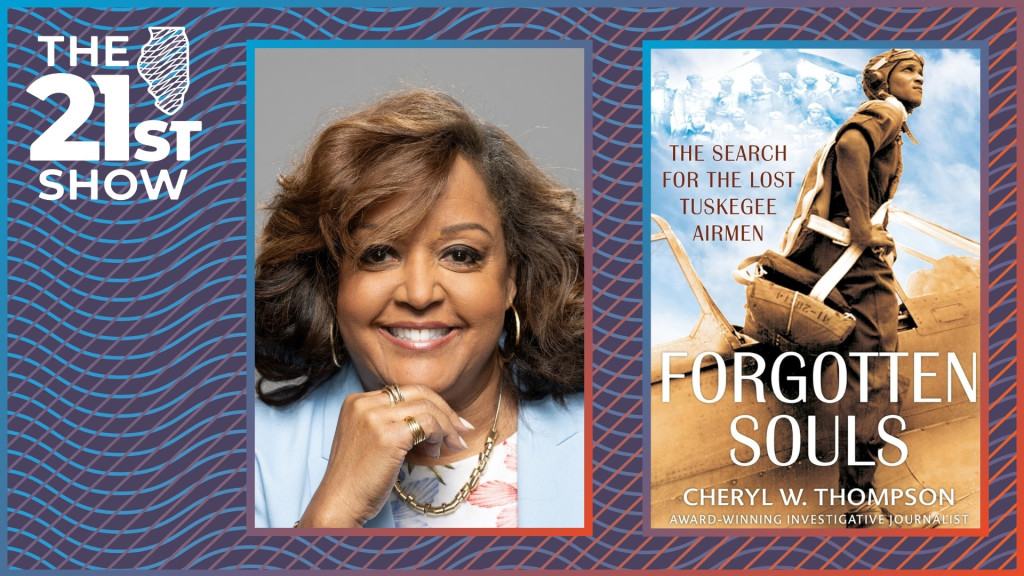
Marvin Joseph via NPR / Kensington Publishing Corp.
[00:00:00]
Brian Mackey: Today on the 21st Show, the Tuskegee Airmen have been celebrated for their military victories and for breaking racial barriers in the segregated Army of World War II. But 27 of them went missing in action, and all but two were never recovered. Their stories are the subject of a new book, "Forgotten Souls: The Search for the Lost Tuskegee Airmen." It's by Cheryl Whitlow Thompson, a distinguished journalist who grew up in Illinois and whose father was himself a member of the unit. I'm Brian Mackey. We'll talk with Thompson today on the 21st Show, which is a production of Illinois Public Media, airing on WILL in Urbana, WUIS in Springfield, WNIJ in Rockford-DeKalb, WVIK in the Quad Cities and WSIU in Carbondale. But first, news.

[00:01:00]
From Illinois Public Media, this is the 21st Show. I'm Brian Mackey.

[00:01:09]
Newsreel Announcer: At Freeman Airfield in Indiana, typical training takes place which is being duplicated in many other centers throughout the country.

[00:01:16]
Brian Mackey: This is newsreel footage from World War II showing Americans in training.

[00:01:21]
Newsreel Announcer: These boys will fly bombers, the B-25 type. Briefing is important. It pays to know what it's all about before hitting the sky trails with those dynamite eggs.

[00:01:35]
Brian Mackey: You wouldn't know it from the narration, but everyone in the film is black, from the captain giving the briefing to the pilots in their leather jackets and the ground crew loading those dynamite eggs.

[00:01:47]
Newsreel Announcer: Their mission fully understood, the trainees don parachutes and get ready for flight. Now they're going to have the chance of putting their classroom studies into practical use, for this is just what they'll have to do when overseas.

[00:02:03]
Brian Mackey: These men are part of a select group known as the Tuskegee Airmen. Roughly 1,000 were trained at Tuskegee. Nearly 100 were killed, and of those, 27 went missing. Most were never recovered, leaving a trail of unresolved grief that would haunt their families for decades. Their stories are the subject of a new book, "Forgotten Souls: The Search for the Lost Tuskegee Airmen." It's by the investigative journalist Cheryl Whitlow Thompson. Born and raised in Chicago, Thompson attended the University of Illinois Urbana-Champaign, where she earned a bachelor's degree in speech communication and a master's degree in journalism. Her journalism career began with the News-Gazette in Champaign-Urbana, and she eventually made her way to the Washington Post, where she was part of two Pulitzer Prize-winning teams across two decades. Today, she's an investigative correspondent for NPR and the senior editor overseeing member station investigations. Cheryl Thompson, welcome back to the 21st Show. Thanks for being with us and congratulations on the book.

[00:03:16]
Cheryl Thompson: Thank you.

[00:03:18]
Brian Mackey: I should note by happy coincidence, this Thursday, the fourth Thursday in March, marks Tuskegee Airmen Commemoration Day. If you want to join our program, you can give us a call at 800-222-9455. That's 800-222-9455. All right, Cheryl, let's start with some of the history. What sort of jobs did black men have in the military before World War II?

[00:03:32]
Cheryl Thompson: Well, they had pretty much menial jobs. They certainly were not pilots or officers, and so they did various things — cooks and other, I don't know that you would call that menial, it's certainly respectable, but it wasn't like being a pilot.

[00:03:52]
Brian Mackey: Or really having much to do with combat, I guess with the exception of some of the World War or Civil War regiments. But tell me about the 1925 study that you quote from extensively in the book. It's called, using the language of the day, "Employment of Negro Manpower in War."

[00:04:10]
Cheryl Thompson: Yeah, I stumbled across this report when I was researching for the book. I found it somewhere in the National Archives and it was just like a page-turner, pretty much, and not in a good way, right? I mean, most of the things that I read, I was sort of in disbelief. But, you know, it basically talked about how black men were less than, inferior, the brains were smaller, they couldn't lead anything if their life depended on it. It was those kinds of really derogatory and offensive things, and the whole study was like that. It wasn't just like a paragraph. This was the entire study.

[00:04:50]
Brian Mackey: It struck me that it was structured like a scientific study though, right? Although I think today we'd call it pseudoscientific. It even talked about how black men have a fear of the dark or something like that.

[00:05:04]
Cheryl Thompson: Yes. That's exactly what it said. Those are some of the things — they had a fear of everything apparently according to this study, and it was signed off by, you know, the powers that be. But they had a lot of issues with black people just being in the military. They just didn't think they could cut it. They didn't think they could follow orders. There was nothing positive in there.

[00:05:29]
Brian Mackey: So who is Eugene Jacques Bullard, if I'm saying that right?

[00:05:34]
Cheryl Thompson: So Eugene Jacques Bullard was the first — he was an American who was the first to fly, black, but not in this country, because this country did not have black pilots, so he was forced to go over to Europe and fly.

[00:05:51]
Brian Mackey: He joined the French Foreign Legion. He was a sort of a, what would you say, a grunt, a ground soldier for a while, and then he thought he wanted to be a gunner and turns out he was sort of surprised that they were going to make him a pilot, right?

[00:06:03]
Cheryl Thompson: He was surprised and he rose through the ranks and he actually on the side, I believe, and you're testing my memory, Brian, but I think he was a boxer.

[00:06:11]
Brian Mackey: Yes, yes. Yeah, and I guess he sort of proved, you know, he's doing this before that study even came out. So, as we're building toward the creation of the units that would become known as the Tuskegee Airmen, what changes in America that sort of makes that happen?

[00:06:32]
Cheryl Thompson: I think one of the things that happened that changed things were the power of the press, particularly the power of the black press, because it was the Pittsburgh black newspaper along with the NAACP and other organizations that really forced the hand of Washington military officials and said, you know, you should really have black men, black men should really be flying. And it took, it was basically a campaign. It did not happen overnight. But they pushed and pushed and pushed. And also I will say that Eleanor Roosevelt, whose husband was president at the time, had a hand in it as well. She had come to Tuskegee with her husband and she had heard about these men and she said, well, you know, I hear you guys could fly, so take me up. And I gotta tell you, you know, her security detail was just like livid. It's like, oh my God, no, no, no, no, no, no, no, no, no. And she ended up flying with Chief Alfred Anderson, who I always kind of chuckle because he taught himself how to fly and I thought, ah, I'm not so sure I'd go up in a plane with him, but he was brilliant and she went up with him and he took her on and he took her for a spin and came back and she said, well, you guys can fly all right. And so she had a hand in it too. But what the black press didn't want, they didn't want the the Army, the military, to be segregated. And of course it was. Basically these pilots, these black men who ended up, you know, becoming a part of of history, they were segregated. They built an Army airfield in Alabama specifically for them. Everything there was specifically for them, so they really weren't integrated. That was their base, that was their home, and that's where they lived and socialized and went to school at Tuskegee.

[00:08:34]
Brian Mackey: Yeah, I thought it was interesting. One of the people you cite in the book called it like an Air Force within the Air Force.

[00:08:41]
Cheryl Thompson: Yes, that was General Parrish. Yeah, it was like two separate militaries, right? It was like two separate entities. But, you know, they survived and they thrived and they were, you know, they were soldiers, so they did what they were told to do and they did it well.

[00:08:59]
Brian Mackey: Even before we get to Tuskegee, there's an Illinois connection at the beginning of this process. Can you just talk briefly about what happened at the former Chanute Field in Rantoul, Illinois?

[00:09:10]
Cheryl Thompson: Yeah, well, they went there for training. Chanute, I, man, I have fond memories of Chanute as a college student because, you know, as you know, it's right down the road and so I would spend a little time there on the weekends.

[00:09:24]
Brian Mackey: It was decommissioned by the time I was a student a decade or so later, but yeah.

[00:09:29]
Cheryl Thompson: Well, they had officers, you know, I wasn't looking for just anybody. But that's where they trained and they went to school and you know, so there were a lot of those men who actually went there, which I didn't know. It's sort of a well-kept secret, I think among some people, but you know, military people know of it. But that's where they did a lot of the training and schooling.

[00:09:53]
Brian Mackey: Yeah, the 99th Pursuit Squadron, as it was called, I guess launched there March 1941. You say more than 250 enlisted black men trained at Chanute where they learned how to service aircraft before they were transferred to Tuskegee for their initial flight training. One of the other things I learned from this book that I did not know is Chicago, Chicagoland at least, was considered as a potential location for this school.

[00:10:17]
Cheryl Thompson: Yeah. It was. They were looking for a place to build this school so they could send these men, and so someone suggested Chicago and someone else said, are you kidding me? Like we don't have enough political issues in Chicago without building a school there, because they were looking at putting it near Joliet where of course, you know, the prison is. And so they said, no, no, no, no, no, we don't need that headache, so let's find someplace else. But their official excuse was, well, you know, let's go south because the weather's better and they can get more flying time in a climate that is warmer, and so that's how they chose Tuskegee.

[00:10:58]
Brian Mackey: Yeah, I guess that does make some sense, although one can't help but note that, you know, sending educated black men to the rural South is, you know, it's not exactly a welcoming place for educated black men or really for any black men. Talk about the, yeah, go ahead.

[00:11:14]
Cheryl Thompson: No, I was gonna say, not during Jim Crow.

[00:11:17]
Brian Mackey: Right, so tell me about the environment in which these, you know, the Tuskegee men worked and trained.

[00:11:24]
Cheryl Thompson: Well, again, you know, they were basically relegated to the Army Airfield, which by the way was built by a black architectural firm, black engineers. Everybody that had anything to do with it was was black, which is really interesting. And so it was their home. This Army airfield was opened in, I believe it was 1942, and that's where they went and there were four, at the time there were four runways, and so they took off from there, they landed there. This base had, you know, a hospital, a PX, an entertainment complex, sports. That was their life and they went to about 10 miles outside of that because really that base was not in Tuskegee proper. It's sort of on the outskirts. It's really kind of in the middle of nowhere. I went and I found the owner of the land because of course the base closed in 1946, I believe, and the land is owned by a private family, and so I tracked down the owner and he was more than happy to give me a tour. And so it's really on the outskirts. As a matter of fact, if you're driving, you would never even know that anything there existed 80 years ago. But that was their home. And then they would go on to Tuskegee, it was actually Tuskegee Institute at the time before it became Tuskegee University, and that's where the men went to school. And there were dorms there, I don't know that they call them dorms, but they're still there. They're still standing on the campus. And that's where they did everything. That's where they learned to fly in various planes and they did their schooling there. They socialized there. And occasionally, you know, they would go into town but they weren't welcome. And when you talk about the Illinois connection, there was General Charles McGee who was the first one I spoke with of the men who who had flown in Europe who were still around, and he also, by the way, went to University of Illinois in Champaign, and that's where he actually met his wife. And he pledged [a] fraternity. He was an Alpha. And he was the one, because he was one of the earlier pilots — and he actually, he and my dad were in the same cadet class — and he told the guys who came along, you know, right after him, like, don't go into town. Like I'm warning you, like just stay clear of the town because the sheriff does not want you there. Even though Tuskegee had a fairly large black population, it was the Jim Crow South and they were not wanted, period. And so if they went into town, which they often did, they would sometimes get into trouble and General Benjamin O. Davis Jr., who basically commanded those troops, he would have to show up in the town and get them out. But he was very protective of his men as well.

[00:14:18]
Brian Mackey: Yeah, you even cite a story where some medics, black medics, were looking for a crew that had gone down. And they stopped in a diner to use a phone because they couldn't quite find it, you know, to call into the base. This is presumably before ambulances had radios or things like that. And they were kicked out or they were told they couldn't use the phone, I guess, until they sort of, you know, told what their mission was.

[00:14:42]
Cheryl Thompson: Yeah. The guy who worked at the diner said, I'm sorry, you can't use this phone, you know, meanwhile there's like dead people. And he had later apologized for it after I think he realized, you know, what had happened, but it was sort of after the fact. But that was the treatment they received there. And particularly since some of these men were from up north, it really was a rude awakening for them. I mean, yes, you know, segregation and and discrimination certainly existed up north, but they weren't used to that kind of life at all. And so they took chances that they didn't see as taking a chance when they did certain things.

[00:15:24]
Brian Mackey: Yeah, I was particularly struck. You had a couple of men gave the same story of riding a train from, you know, either Philadelphia or New York, somewhere up north, and then they kind of come to a town in the Mason-Dixon line and the conductor says, you gotta go to the, you know, the car up front that's going to get all the soot blowing in from the engine car. And, you know, when they sit down to eat in the dining car, there's this green curtain that's drawn around them. And it was like it was new to some of these men.

[00:15:51]
Cheryl Thompson: Yeah, yeah, it was new, and particularly those two men were George Hardy and Harry T. Stewart, both of whom became lieutenant colonels. And one was, George Hardy was from Philadelphia and Stewart was from New York. And so neither one of them, you know, they didn't think twice about it. And I remember when I was talking to Colonel Stewart and he was sharing those stories with me. And he had boarded the plane, and he had boarded the plane with some of his white friends from New York. He had gone to school with — he was from Queens — and they had boarded the train, I'm sorry, the train, and they got on there, and when they got to the Mason-Dixon line, the conductor said, oh, you're gonna have to move to another car. And his friend said, well, that's OK, Harry, we'll go with you. And the conductor said, oh no, you won't. This is for, this is a colored car and you will not go. And these guys didn't understand that because that's not what they were used to. They weren't familiar with that kind of treatment. And so, and Stuart had a choice, you know, he told me, he says, you know, I could have stayed there and probably been arrested. And so he decided, he thought about it and decided, you know, I'm going to be smarter, but I'm going to get my revenge at some point. And he did.

[00:17:07]
Brian Mackey: All right, we'll talk about that after a break. My guest is Cheryl Whitlow Thompson. The book is "Forgotten Souls: The Search for the Lost Tuskegee Airmen." We'll be right back.

[00:17:40]
[music: "Stormy Weather"]

[00:17:52]
Brian Mackey: It's the 21st Show. I'm Brian Mackey, and this is Lena Horne, who was a favorite performer among the airmen who trained at Tuskegee. She visited there multiple times and performed for the troops. You might have seen the green highway signs announcing Champaign County as the birthplace of the Tuskegee Airmen. They were activated as the 99th Pursuit Squadron at Chanute Airfield in Rantoul, 1941, but they soon moved south, trained at the Tuskegee Army Airfield in Alabama. From 1941 to 1946, they flew more than 1,800 missions in Europe and North Africa during World War II. As we were discussing before the break though, answering that call of duty meant serving a country that saw these men as second-class citizens. They began their service more than 80 years ago. It was only relatively recently in our history that their stories and accomplishments have become more widely known. They were awarded the Congressional Gold Medal in 2007. But about 100 Tuskegee airmen were killed, 27 went missing, and their stories are the subject of a book by my guest today, Cheryl Whitlow Thompson. It's called "Forgotten Souls: The Search for the Lost Tuskegee Airmen." You can join us today at 800-222-9455. That's 800-222-9455. So, so Cheryl, when these men do get to participate in military missions, what sort of missions do they get to fly?

[00:19:20]
Cheryl Thompson: Well, their job was to protect the bombers, so they went on reconnaissance missions, various types of things. They went a lot to Austria, Yugoslavia, the former Yugoslavia. They went various places, but their main job was to protect the bombers. And the bomber pilots were white. And interestingly, the bomber pilots never knew that the people protecting them, these men protecting them, were black until they landed and emerged from the cockpits. Can you imagine what that was like?

[00:19:58]
Brian Mackey: I have tried. Yes. Yeah. Especially for some of them, more than others, I'm sure, depending on what prejudices they were bringing with them. What sort of dangers did they face?

[00:20:11]
Cheryl Thompson: Well, they faced the dangers that any military pilot would face: being shot down, being taken, you know, being captured. Surprisingly, these men, and maybe not surprisingly, these men, about a third of them, at least of the 27 who didn't come back, had plane troubles, so they went down and disappeared when they had mechanical failures. So they faced all kinds of things, but mainly, you know, you're trying to stay alive up in the air. And when you have mechanical failures too, like I know that there were a couple of the pilots — when I started this book, I should say there were seven of the men who flew over in Europe during World War II who were still living and I talked to five of them and the daughter of one, the other two were too ill to speak with me. But, you know, one of them told me that he had a [tech], the tachometer on his plane never worked. The whole time he was flying over there, it never worked, so he had to kind of, you know, like fly by sight, and it was really very interesting. And he said the day he turned his plane in, the tachometer started working. You know, it was those kinds of things. Colonel Stewart told me that sometimes oil would spew onto his windshield and it made it really difficult for him to see. And so it's just a lot of, I mean, I can't imagine. First of all, you know, when I was in Connecticut a few weeks ago at the Northeast Air Museum talking about the book and someone showed me one of the planes and I can't imagine how these guys even fit in these planes. It was so tiny, which explains why the guys couldn't be over a certain height. They generally weren't over 6 feet tall.

[00:22:07]
Brian Mackey: Yeah, yeah, I was surprised. I was surprised by that as well when I came across that in the book. Let's talk about, well, let me ask you about, you mentioned mechanical trouble. Is the suggestion that these planes were inferior because of who these men were, because they were black men, or, you know, was this a universal issue in World War II?

[00:22:25]
Cheryl Thompson: Well, I think it depends on who you ask. I think white and black people would say yes, it in part was because they were black. I will say I stumbled across another document. I ran across an interview by General Brigadier General Noel Parrish who commanded the troops initially. He was white, of course, because when these guys, you know, became pilots, there were no black officers, so, you know, except Benjamin Davis, and actually he was, you know, he was in the first graduating class. But General Parrish talked about what it was like commanding these guys and also mentioned in this really huge report, there was a part, you know, I was, I'm going through this report, Brian, and I'm thinking, OK, all right, this is like watching paint dry. And then boom, all of a sudden I stumble across this fascinating — you know, thing where he said, you know, there were people in Washington at the Pentagon, at the War Department, who did not want these guys. There were a lot, most of them didn't want these men flying. And so there was someone or some people who said to General Parrish, or he heard it somewhere or something, that said, you know, they had problems with a plane. I want to say it was a B-26, but don't quote me on that. It was some plane that was really bad. And, you know, pilots died in it and it was just a crappy plane. And so someone suggested, we've got an idea. Let's take these planes. Let's send them to Tuskegee, and then we can solve two problems at once. Bad planes, dead Negroes, problem solved. No more program. I could not believe it when I read it.

[00:24:18]
Brian Mackey: And one of the white officers, and I can't remember if this is someone you interviewed or if this was from one of the oral history interviews you quote from, but said when he was assigned to this unit, he wasn't sure if his job was to actually train the men or to sort of bury the program so it wouldn't be, you know, troublesome.

[00:24:34]
Cheryl Thompson: Yes, that was General Parrish. Yes, that was General Parrish. And the men actually liked him. They, you know, according to him, they really had a good mutual respect. And so he really, you know, he was a military guy and he wanted to do the right thing. But when someone suggested that with the planes, he's like, no, no, no, no, no, that's not happening on my watch. I'm not going to do that. And he's like, listen guys, we've got a war going on. We need everybody we can, every able body we can get. Why would you guys want to, you know, think like this and do this, but you know.

[00:25:09]
Brian Mackey: It is, it is hard to believe. All right, let's go to the phones at 800-222-9455. We have Yancey calling from Rock Island, Illinois. Yancey, thanks for calling in.

[00:25:19]
Yancey: Hey, and thank you for the book. I hope your efforts turn out fruitful. And three things. There was a strength trainer who was a nationally ranked weightlifter during World War II. His name is [Rudy Sablo], and I'm also, he was an Olympic weightlifter, and I too was an Olympic weightlifter, so I had a chance to get some training insights and advice on strength training from him while I was training at Lake Placid for a special camp. The other thing was that he mentioned too that he was in training, the pilots had to meet weight limits, so he was really on top of them. They had a nutritionist also that was involved but to make sure that they made the weight when the weight checks were done and to make sure that they were up to snuff as far as, you know, strength, strength and, you know, general health. But that was [Rudy Sablo], and I don't know if you mentioned him in your book, but I hope you, you know, put it in your notes. The third thing too, wasn't there, I know you're dealing with Air Force or Army Air Force, weren't there some black Navy pilots that were being inducted to to fly for the Navy at that time. So thank you for the time.

[00:26:40]
Cheryl Thompson: Thank you. Yes, there were. They called him, I wanna say it was the Golden 13. But they were 13 and they trained at Great Lakes Naval Base outside and, you know, up, outside of Chicago, north of Chicago. But in answer to your question, I think it was the second question, there was a weight [limit]. Most of these men weighed anywhere from like 140 to like 160. Right. They were little guys. They weren't always short in stature, but they were, yeah, they weren't, yeah, they had to fit in those planes. And, you know, the daughter of one, Captain Dixon, who was one of the, he was the first one they found the remains of back in 2018 which led me to do this book, and he was over 6 feet tall. And his daughter, he has, he had one child and she was an infant at the time and now she's in her 80s, and she always believed that he couldn't get out of the plane because he was tall and so when he had, because he had plane issues, and she believes that, you know, I don't know how she would know, but he tried to get out and couldn't because of his height. So they were very strict on on height and weight.

[00:27:56]
Brian Mackey: Wow. Thanks for the call, Yancey. Appreciate it. 800-222-9455 if you wanna join us today. 800-222-9455. We're talking with Cheryl Thompson, author of "Forgotten Souls: The Search for the Lost Tuskegee Airmen." So about that, tell me about Samuel Gordon, Lieutenant.

[00:28:15]
Cheryl Thompson: Well, Lieutenant [Gordon]. He was from New York. He's from Long Island actually, Amityville, and he was one of 13 kids. And he comes from a fascinating family. His older sister who just died last year at 104, she was the country's first black military nurse after President Truman desegregated the military. So he's from a really interesting family. But he went down, and his family believed at first, I think they were told that maybe he might have been captured, but it doesn't look like that really happened. But his remains have never been found.

[00:29:10]
Brian Mackey: You say he was, so he's based in Italy. It's March 16, [1945]. He's on only his third mission. The war would end less than a month later, and he has a midair collision with another pilot.

[00:29:22]
Cheryl Thompson: Yes, with another pilot, and the witness to that was George Hardy, I believe, who I mentioned earlier who was from Philadelphia, and they became really good friends in the military. And even after Lieutenant [Gordon] disappeared, George Hardy kept in touch with his family and they remained friends until George Hardy died last year. He was the last of the seven to die. So they're all gone, all of those who served over in Europe, the pilots, they're gone. But yeah, it was, yeah, he hit a plane and he went down and they've never recovered him. His sisters, a couple of his sisters were, again, military nurses and there's one left. And she would go over, the two would go over to Italy. And they would always kind of — because his older sister was a military nurse, you know, she was based over in Europe. And when the sisters would go out, they would tool around looking, you know, to see if if they could find him somewhere. And, you know, every street they walked down, every time they saw, you know, a young black guy, they wondered, are you my brother? And it just, you know, it's kind of a heartbreaker because for all those years they've wondered. And his sister, the lone surviving sister who's now in her 90s, she's a retired school teacher, and she said to me, she said, she still lives in the homestead that the family, the parents actually built from scratch with burned-out lumber. And she said to me, she said, you know, I kept the same phone number, with the exception, I think they had to change like the exchange, in hopes that if he surfaced, he would know where to call.

[00:31:13]
Brian Mackey: And it's so interesting. I mean, this is a time, you know, we're so used to people being available in an instant by text message today. It's interesting to think about how different that must have been back then to, you know, to not know if somebody was a, maybe you hope that he was a prisoner of war or something like that, or, you know, had amnesia, I guess. I don't know.

[00:31:33]
Cheryl Thompson: Yeah, no, there was really no way for them to know unless somebody came knocking on your door, unless you received a telegram. I mean, it just didn't, the communication level was really bad then. It just, you know, they didn't know. And there was one guy who, [John Prowell], who his wife, his wife was pregnant with, I think it was child number three. I don't know how he made it home so often. But he did, and he had three children. And it was funny because he knew he was having the third child. And but then his wife, because he was writing back and forth, I have some of the letters, his daughter, who's in her 80s, kept some of the letters they passed it down from throughout the family, and I've read some of his letters. And after a while, his wife stopped getting letters from him and she just wondered like what's going on. And it turns out that he went missing, so their letters kind of crossed in the mail. She gave birth, but he never got the letter because he had disappeared, so he never knew that his third child was his only son. And so he died. Yeah, he died without knowing.

[00:32:49]
Brian Mackey: So just a couple of minutes until we need to take another break. But can you talk about the experience of the families? I mean, what did you learn about the idea of grief when someone is missing versus when you have a body to bury?

[00:33:02]
Cheryl Thompson: Well, you know, it's sort of like these families have never gotten closure, right? They've just never — now with Lieutenant [Gordon], his family decided to have a sort of a service for him at Arlington even though they had no remains. That's what they decided to do because, you know, after, after these men were gone for a year and a day, the military would declare them basically dead. They were missing in action and then dead after a certain period. But they decided to have a ceremony at Arlington, so there was, you know, a caisson, it was empty, and they did the whole military thing. But I think for them that was their closure. They'd rather have a body, but they did what they thought was best for the family to to move on. But if you think about it, Brian, it was, you know, 70, 80 years ago and their parents are gone, the men's parents are gone, their spouses are gone, some of their children are gone. They never got to know any grandchildren, you know. The siblings are mostly gone even though there are some, there's a handful still around, and they all still hope that somebody will let them know something, that the military will, someone will take an interest and try to at least bring them closure by figuring out what happened to these men.

[00:34:29]
Brian Mackey: Mm. All right, we're going to continue after a short break. My guest is Cheryl Whitlow Thompson. The book is "Forgotten Souls: The Search for the Lost Tuskegee Airmen." This is the 21st show.

[00:34:48]
[music]

[00:35:20]
Brian Mackey: It's the 21st Show. I'm Brian Mackey. My guest today is Cheryl Whitlow Thompson, an investigative reporter and editor at NPR who's also author of the new book "Forgotten Souls: The Search for the Lost Tuskegee Airmen." It's about the 27 black Army aviators who went missing over the skies of the European theater of operations in World War II. If you want to hear more and meet Cheryl, she's actually got an event coming up next month. It's in Chicago, April 9th at 7 p.m. at Call and Response Books, which is in the Hyde Park or Kenwood area of Chicago. We'll have more information about that in a link on our website, 21stshow.org. If you want to join us today, you can do so at 800-222-9455. And let's go back to the phones now. We have Gordon calling from Northern Illinois. Gordon, thanks for calling in.

[00:36:13]
Gordon: Yeah, thank you for taking my call. I remember when the author referred to the Army manual for World War II. There is also an existing Army manual for the Negro in World War I as well. And I did some research on Camp Grant, which is the major, you know, induction point for both World War I and World War II. And the thing I'd like to just point out interestingly is that during the influenza epidemic in 1918 at Camp Grant, that was the first time the Army allowed African American nurses to tend to white enlisted men. And so because of the drastic shortage of people available, that was, I think, a very significant impact. But there was considerable, at Camp Grant in 1918, they did have an African American officer corps and there's photos where you can see the whole layout of all the people, personnel involved. And over on the right-hand side they have all of the African American officers and the enlisted people at the camp. So, the final point, I was curious as to how much research she did through letters and personal documentation, because I find that often very fruitful when I'm trying to give some background of the people you're looking at or discussing. Thank you.

[00:37:37]
Brian Mackey: All right, Gordon, thanks so much for the call. And just for our listener's sake, I can't remember if Gordon mentioned this, but Camp Grant was an Army facility outside Rockford, obviously named in honor of the American Civil War General Ulysses Grant. Cheryl Thompson, how about that letters? What sort of research?

[00:37:52]
Cheryl Thompson: There were letters, which I was really surprised because I'm thinking like who keeps this stuff, but apparently they did. In the case of Lieutenant John Prowell, who has the daughter, you know, who had, he had the three children, when his aunt died, when their aunt, well, his aunt died, or yes, she, the daughter was cleaning out the aunt's house and underneath the bed was a suitcase, and she pulled the suitcase out and in the suitcase were all kinds of letters and paraphernalia and, you know, college stuff and it was just, it was like a gold mine. And so some of the families did keep these things. There were several families who shared letters and photos and everything with me so it really to me it really helped tell the story of who these men were.

[00:38:43]
Brian Mackey: How did you come to be interested in the stories of the missing Tuskegee Airmen?

[00:38:49]
Cheryl Thompson: Well, it started when I was at the Washington Post. One of my colleagues had done this story on the remains of one that the military thought was a Tuskegee Airman. And so he did this amazing story and the Post rightfully ran it on the front page. And it was Captain Lawrence Dixon, the one whose daughter I said, you know, thought her dad was tall and couldn't really get out of the plane perhaps. And so I said to him because he knew about my dad and I said, do you think there are others missing? And he says, yeah, there are. And I said, well, that's your book. And he said, no, that's your book. And so that's how it came to be. And I said to him, even before, you know, as I was thinking about it, I said, are you sure you don't want this? And he's like, no, it's yours. It's yours. So, you know, I'm thankful because it was, you know, it was an interesting journey for me. I learned a lot because I didn't know much about, I, I'm, I'm not a history buff. Well, I wasn't a history buff. And so I just, you know, I learned so much and it was fascinating. And so that's how it came to be. And I still wasn't quite sure, you know, that was in 2018 and I thought, OK, I can write a story, I can do an investigation, but a book, like 70,000 words, it's like that's a lot. It was overwhelming. And I, you know, after thinking about it for a couple of years and talking to people and doing a little research, I thought, OK, let's just do it, you know, and so it was a challenge, but in a good way. It really did challenge me and I really am happy that I did it, whatever comes from it. You know, I'm really happy that I went through the process.

[00:40:37]
Brian Mackey: Let's go back to the phones. We have Kevin calling in from Varna, Illinois. Kevin, thanks for calling.

[00:40:43]
Kevin: Yeah, about 30 years ago I met a gentleman named Mike Preputnik, P-R-E-P-U-T-N-I-K, because you can search the story and find it. He was a nose gunner on a B-25, 27, never remember quite what, but they actually crash-landed basically at Ramitelli Air Base and had to stay on base with with the Tuskegee Airmen, who that was their base, until they could get their plane and get out of there. And as you can imagine, an all-white bomber crew flying into a black base. The pilot had no intention of intermingling whatsoever. Apparently they were kind of divvied out to the various tents for the night to sleep. The pilot chose to sleep in the mess hall where he would be by himself, so everybody said, well, that's fine. And then they shut the heat off in the building. He froze that night and decided he would join everybody. And really changed his attitude about the people around him. So, very interesting story. You can find it online with a little searching.

[00:41:51]
Cheryl Thompson: Well, that's interesting. Karma is a funny thing, isn't it? It is interesting because, you know, these black pilots were the ones who protected the bombers. And I will tell you, in 2023, the military found the remains a couple of years before that of one of the airmen, Lieutenant Fred Brewer out of, he was from North Carolina, he was out of Charlotte, and I went to his repatriation in December of 2023. And outside during, at the cemetery, there was this older white gentleman in a wheelchair. And of course I had to, the reporter in me, I had to figure out like who he was because, you know, he looked to be old enough to have been in that war. And so I go over to him and his name was Andrew Pendleton. And I said to him, like, you know, I told him what I was doing and he said, you know, he said, if it weren't for these black pilots, I wouldn't be here today because he was a bomber pilot and they protected him. And he said I owed it to them to come here today. And that to me says a lot about that war. And yes, that guy might have slept somewhere else, but in the end, they really forged friendships, a lot of them over the years, black and white, because they, you know, somebody saved your life, kind of hard not to be thankful.

[00:43:18]
Brian Mackey: So you mentioned visiting the lands and I should say we only have about five minutes, six minutes left in our time. There is a Tuskegee Airmen National Historic Site, but there's nothing where the actual airfield was. Tell me about your experience there.

[00:43:34]
Cheryl Thompson: No, there's nothing there. So it's gated off. There's a chain link fence, and it's very overgrown now. It's 1,700 acres, and the only thing that's left though, there, what's left is one of the four runways is still there because the owner, when I found him, I said, hey, you know, I'm coming to Alabama, can you give me a tour? And he was like, yeah, so I met him at the site. And it was fun though imagining what that place would have been like in its heyday, right, because there were certain foundations that still existed to buildings, right, where the entertainment complex was or where the hospital had been. And there was a chimney, a part of a chimney that was there. And so it was just, you know, it was like I enjoyed like thinking about wow, what this place must have been like and the and the life that these men had in terms of just the camaraderie and and being there and their life before, you know, before going over to Europe, before fighting the war. There's nothing there. There's a cabin there. I'm sorry, there's a cabin there that the owner owns and it's, it's out by like a little small body of water, not a lake, but some body of water, and he actually said, oh, you know, next time you come back, you're welcome to stay here. And I was like, thanks, but there were like dead animals on the wall. I don't think so, but, but it was very sweet. It was very sweet of him to offer and I'm like, no, no, I'm a city girl, sorry. But you can imagine what the place must have been like 80 years ago, how vibrant, you know, how vibrant it was then.

[00:45:19]
Brian Mackey: You know, we're at a time when plaques about black history are being removed from national parks, you know, military bases, Navy ships are being renamed. I wonder how you are making sense of that as you are, you know, launching this, this history, this, you know, in part, overlooked, sometimes overlooked chapter of American history out into the world.

[00:45:39]
Cheryl Thompson: Yeah, you know, I, um, I will say that my hope, and I don't know when I came to this realization during this process, but my hope is that someone in the government will say, you know what, these men were important. They deserve, the families deserve to have some closure. Maybe we can see if we can find some of these men's remains. Or, you know, I know somebody like Lieutenant [Gordon] will probably never be found because my research showed that they actually found him but they might have buried him in — and they buried him in in a coffin that they had somebody else's name on. And, you know, you can't disinter someone so unless they're 100% sure he will just always, you know, be, be missing. But there are some, you know, there's technology has changed so much over the years that yes, some of these men, I'm sure crashed into the, the Mediterranean, into the sea, the Adriatic. But I don't know if technology has come far enough where they could sort of go down and see. I mean they found the Titanic, so, you know, I'm not sure if they could find planes, but,

[00:47:04]
Brian Mackey: But that's good. We've interviewed people, especially in the Pacific. There are, there are a number of operations and the military still does work to, you know, identify remains from that era if they can be found out there, yeah.

[00:47:17]
Cheryl Thompson: Yeah, I, yeah, I think these families just would like some, some bit of closure, whatever it is, you know, to say, oh, you know what, we found, you know, we found this or we found this dog tag or we found something that will give them some closure because they know that, you know, I mean, all they're gonna, if they find them, there's, you know, they're, they're, they're gone. But they just have never been, no one has communicated with them for years and years and years. There was one guy who's a, left, actually it's Lieutenant [Gordon], it's one of his nephews who's an anesthesiologist and he said to me, he said, you know, I submitted my DNA some years ago, he said, and I never heard back from the military. They never bothered to get back to me. So, you know, it's that kind of thing. I think the families just want somebody to, you know, say something, say something. They just left them hanging for eight decades.

[00:48:16]
Brian Mackey: Cheryl Whitlow Thompson is an investigative reporter and an editor at NPR. She's also the author of the new book "Forgotten Souls: The Search for the Lost Tuskegee Airmen." Cheryl, thanks so much for sharing your work with us today on the 21st Show. Great to talk to you again.

[00:48:31]
Cheryl Thompson: Thank you, Brian. Always good to talk to you.

[00:48:34]
Brian Mackey: If you wanna hear more, if you wanna meet Cheryl, again, she's got an event coming up next month in Chicago, April 9th, 7 p.m. at Call and Response Books in the Kenwood, Hyde Park area on the south side. More information at our website, 21stshow.org.

[00:48:54]
[music]

[00:49:18]
Brian Mackey: That's all the time we have for today. Coming up tomorrow, self-driving cars were once a vision of the future. Now the company Waymo is hoping to put its autonomous rideshare vehicles on the streets of Illinois. We'll talk about what's happening, how they work, and why some people have concerns with the technology. We wanna hear from you about that. You can send us an email, talk@21stshow.org. That's talk@21stshow.org. Would you ride in an autonomous taxi? Let us know. talk@21stshow.org. The 21st Show is produced by Christine Hatfield and Jose Zepeda. Our digital producer is Kulsoom Khan. Technical direction and engineering comes from Jason Croft and Steve Morck, and Reginald Hardwick is our news director. You can find a podcast of this program at Apple, Spotify, YouTube, or wherever you listen. Just search for the 21st Show. The 21st Show is a production of Illinois Public Media. I'm Brian Mackey. Thanks for listening. We'll talk with you again tomorrow.
Roughly 1,000 Black men were trained in Tuskegee, Alabama to serve as Army aviators in World War II. Nearly 100 were killed — and of those, 27 went missing. Most were never recovered, leaving a trail of unresolved grief that would haunt their families for decades.
Their stories are the subject of a new book called “Forgotten Souls: The Search for the Lost Tuskegee Airmen" by Cheryl Whitlow Thompson. An award-winning investigative journalist, Thompson is currently a reporter and editor at NPR. She's also a native of Chicago and earned two degrees from the University of Illinois Urbana-Champaign.
Guest
Cheryl Whitlow Thompson
Author, “Forgotten Souls: The Search for the Lost Tuskegee Airmen”
Investigative Correspondent, Senior Editor for Member Station Investigations, NPR
Book Talk & Signing
When: 7 p.m. Thursday, April 9, 2026
Where: Call & Response Books, Chicago
Admission: Free (no book) / $37.15 (with book) — register here