



Rep. Darin LaHood defends Iran war, discusses tariffs and immigration solutions
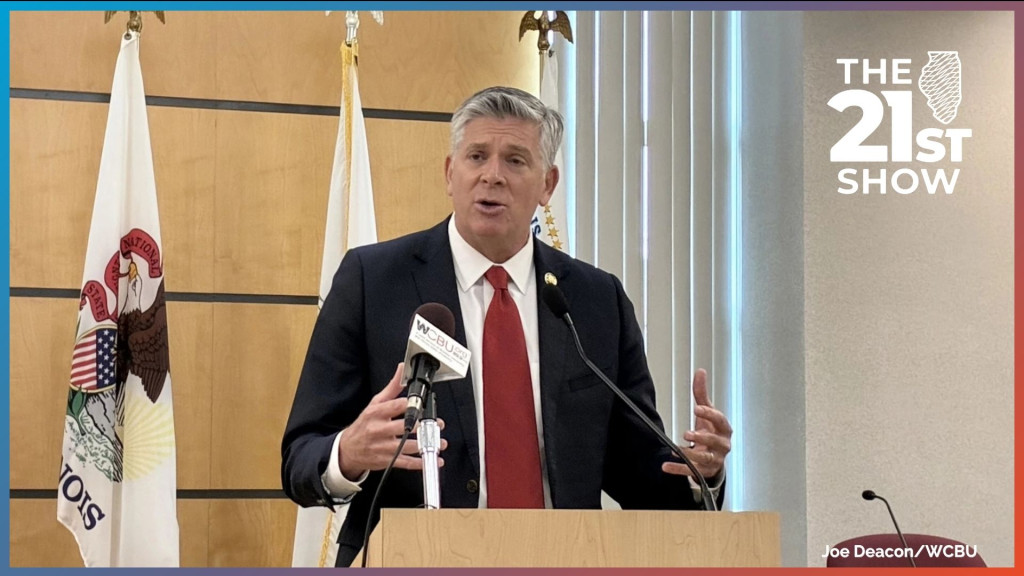
Joe Deacon/WCBU
// This is a machine generated transcript. Please report any transcription errors to will-help@illinois.edu.

[00:00:00]
Brian Mackey: From Illinois Public Media, this is the 21st Show. I'm Brian Mackey. And my first guest today is Congressman Darren LaHood. He's campaigning for a 6th term representing Illinois's 16th Congressional District. The district includes a large part of rural northern Illinois, starting in Galena, then snaking east and south, wrapping around Rockford, Peoria, and Bloomington, but avoiding the urban cores of those communities. Of course, Democrats in Springfield drew the map just that way to maximize the number of Republicans in that district and Democrats in the neighboring district.

Representative LaHood has been in Congress for just over 11 years — 11 years and 13 days, in fact. Since the district boundaries were redrawn, he's won with about 2/3 of the vote back in 2022, and last election cycle, he was unopposed. This year, he again faces a challenger, Paul Nolly, a Democrat. We spoke with [Nolly] on the program last month. You can find that interview on our website, twentyfirstshow.org. But today we're hearing from the incumbent. So Congressman Darren LaHood, welcome back to the 21st Show.

[00:01:15]
Darren LaHood: Well, Brian, thanks for having me on and always good to be with you and your listeners and look forward to a good conversation today.

[00:01:23]
Brian Mackey: Me too. And listeners, we are live with Mr. LaHood for about the next half hour and change. If you have questions for him, especially if you are in the 16th District, please join the conversation at 800-222-9455. That's 800-222-9455.

All right, first question. Last time you gassed up, how much did it cost?

[00:01:46]
Darren LaHood: Way too expensive. I've been on the road in my district over the last week, and, you know, I have a Ford Expedition and it costs about $100 to fill up, which is way, way too much.

[00:02:02]
Brian Mackey: Well, the reason I'm asking about this is — and we'll start with — we got a number of questions from listeners. Lloyd wants to know, I'd like to hear LaHood comment on the war, gas prices and interest rates, specifically, how much does he expect working men and women can take?

[00:02:17]
Darren LaHood: Well, the number one thing that I've heard throughout my district is obviously the cost of living and the high cost of diesel and gasoline prices and petrochemicals throughout my district. Whether it's my farmers that are concerned about diesel prices, which are way too high, or the price of gasoline. And there's a direct correlation between the current conflict in the Middle East and where that's at.

So I will say a couple of things on that. You know, there's been some talk about a suspension of the federal gas tax, which will have a minimal effect, but will send a message that we need to work on reducing gas prices. There's also a proposal currently in the Senate right now to restrict exporting of diesel outside of the United States. Senator Grassley has advocated for that, which will help on diesel prices. I know that's under contemplation right now.

But the bottom line is, because of the conflict in the Middle East, the Strait of Hormuz has not allowed oil to appropriately flow through, and so we're in the situation we are right now.

I'll address the Iran conflict. I do serve on the House Intelligence Committee, and I'll just make a couple of observations on that. I agree that Iran, over the last 50 years, has engaged in the state sponsorship of terrorism. They've been a malign cancer throughout the Middle East. And so presidents for 50 years have talked about taking on Iran. President Trump did that, and I give him credit for that. Today, as we have this conversation, Brian, Iran has no more ballistic missiles that can harm the United States. They don't have any hypersonic missiles that can harm our allies in the Middle East. We've destroyed their navy. We've decimated their nuclear weapons. But unfortunately, because of drones, they've been able to still use drones to go after some of the ships and other things in the Middle East.

There's no doubt when you zoom out and think about years ahead, the Middle East will be a safer place because of the action we've taken. And the world will be a safer place for that. But I think what we're finding is it's much easier to get into a conflict than out of a conflict right now. And I think specifically because of drone technology, Iran has been able to cause the Strait of Hormuz to be disrupted, and that's obviously causing the high price of fuel.

[00:04:49]
Brian Mackey: That was not a surprise to anyone who has looked at this — you know, the possibility of conflict in that region for decades now — that the Strait of Hormuz would be closed. And yet the administration seems to have been unprepared for that. What do you make of the situation we find ourselves in now, more than [six to seven] months into this war?

[00:05:09]
Darren LaHood: Yeah, it's problematic. There's no doubt about it. But again, an Iran with nuclear weapons and an Iran that continued to harm its own citizens — remember, Brian, they killed 50,000 of their own people. They're ruled by religious zealots and mullahs that have no regard for human life. They have blood on their hands from what they've done in Iraq and other places. But yes, there are consequences, and that involves the Strait of Hormuz.

I have advocated for negotiation and an off-ramp. I hope we can reach that. But again, you're dealing with a religious regime that is ruled by [fatwas], and they have not abided by any international agreements, by U.N. resolutions, by treaties in the past, and so that's what we're dealing with now. But again, it doesn't mean that negotiations still couldn't happen. I know yesterday our State Department team was meeting with the Iranians in New York during the U.N. General [Assembly] going on. Secondarily, we continue to work with the Omanis and the Pakistanis to try to have a resolution — to see if we can have an off-ramp here.

[00:06:28]
Brian Mackey: We got another message from Barbara in Gibson City, Illinois. She says at the U.N. yesterday, Trump mused, quote, "Do I annihilate the Islamic Republic and do it quickly, never giving them a chance to kill and destroy people and countries again? Do I drive them into hell?" unquote. And she wants to know, what does my congressman say about that?

[00:06:48]
Darren LaHood: Well, I think we need to be careful about annihilating an entire people or a country on that. Having said that, the only thing that Iran seems to understand is brute force. Again, I go back to them killing up to 50,000 of their own people that were trying to establish democracy in Iran. But, you know, they continue to be obstinate. They continue to not want to engage in negotiation.

But I think that's more rhetoric than it is reality. Again, that's not something that I think is supported by Congress. And complete annihilation is most likely going to take ground troops. I'm not supportive of that. So I think we have to be careful about the rhetoric we use and about the next step forward.

[00:07:43]
Brian Mackey: You know, Article One — as you well know — of the Constitution says the Congress shall have power to declare war. And you say that the Congress doesn't support ground troops or what it would take to really annihilate Iran. But what indication do you have that this administration is at all constrained by what Congress thinks in terms of [war-making]?

[00:08:02]
Darren LaHood: Well, I think it's a fair point, Brian. We've had a number of discussions on this in the broader Congress, obviously in the Intelligence Committee where I serve, where we watch closely our adversaries, including Iran and the Islamic regime there.

But in terms of my own interpretation, Brian, on what traditional war is — let's remember 15 years ago, in the early [2000s], we had a conflict in Afghanistan and obviously in Iraq where we lost up to 7,000 men and women, way, way too many. But that was a war in the traditional sense of a war.

In this conflict with Iran, that again has gone on too long, you know, we've lost up to 19 of our airmen and a few people on the ground. That is 19 too many. But from the standpoint of a traditional war and the definition of a war, I'm not of the opinion that we've reached that in terms of the War Powers Resolution. So we're not there yet. It is clearly a conflict, but not the traditional definition of a war.

[00:09:13]
Brian Mackey: All right, so much to talk about and our time is limited. I'm gonna move on. A couple more messages from listeners, though. Randy, rural Peoria County, says, I think LaHood has done an overall good job. I want him to be more independent, more watchful over our troops. He says all my children are military. Randy also says, can he at least try to help us small farmers that are trying to clean up wood lots so they do not burn down in the future — so many hours in equipment and no help.

So Randy's a farmer. We also heard from Gene in Bloomington, though, who says, as a farmer, I am furious that he — Mr. LaHood — supported tariffs even though he's now kind of sort of backing away. As a citizen, I'm furious he supported the so-called [One Big Beautiful] Bill that hurts so many, especially those in rural areas.

Congressman LaHood, what do you say to Gene and other Illinois farmers on tariffs in particular?

[00:10:02]
Darren LaHood: Well, I've been very vocal — first of all, during the first Trump administration and now during the second Trump administration — I've been vocal from the very beginning on tariffs. And what I've said is tariffs ought to be used in a strategic and tactical way to go after bad actors. And there are plenty of those — China, for instance, Iran, North Korea, and Russia. But using blanket tariffs as economic policy, I don't agree with, and I've publicly spoken out against that. I've expressed that in a number of hearings and whenever I'm back in my district.

I think tariffs should be used in a more nuanced way to go after countries that don't abide by the same rules and standards that every other industrialized country in the world does. I frankly — and I've said this publicly — tariffs are the Achilles' heel on the economy. That 10, 15, 20% tariff that's added on to goods is not good for my farmers. About 40% of the corn and soybeans grown in my district go somewhere else around the world. They get loaded on barges on the Illinois and Mississippi rivers, go down to New Orleans, and go around the world. We need more markets and customers.

And I've publicly advocated for that. I've expressed that in public hearings to our trade ambassador, Jason [Greer], to the president and his team. We should not predicate our economic policy on blanket tariffs. It hurts our manufacturing and it hurts our agriculture industry, too. So I'll continue to take that position.

[00:11:36]
Brian Mackey: Well — I say it's well known that the president loves tariffs. The Supreme Court has been a check on him with regard to this. Why has the Republican congressional majority not been able to check him on some of these things, despite your advocacy, as you say?

[00:11:50]
Darren LaHood: Well, I was supportive of the amicus briefs that were filed saying that the president's actions on tariffs were unconstitutional. As you know, and you referenced, it was a 6-to-3 decision. Justice Gorsuch wrote the opinion back in April saying that the predicate the president used for tariffs was unconstitutional. And what did Gorsuch say? He said, if you want to do what you want to do with tariffs to the administration, you have to go through the legislative branch, Article One. And I take my job very seriously, and that's why I continue to advocate for tariffs to be used in a strategic and tactical way.

We ought to — and I've been very supportive of — bilateral trade agreements with our allies. The U.K., for instance. India, for instance. Japan. I've advocated and supported bilateral trade agreements, not predicated on tariffs, but opening more markets. I've been very supportive of a renewal of the USMCA, our trade agreement with Canada and Mexico. I'm not supportive of a trade war with Canada and have publicly said that.

But make no mistake about it, we have not had enough pushback in Congress. And by the way, Brian, many of my Democrat colleagues support the tariffs because they're supported by unions, which again I think is detrimental to our economy because of tariffs.

[00:13:13]
Brian Mackey: What does that say — that this message, or this ability to resist what the president loves in this regard — is that the Congress has been unable to do this, that the Republican majority in Congress has been unable to do this?

[00:13:27]
Darren LaHood: Well, I think there's been significant pushback. And I'll give you another example. Because of the Ukraine-Russia conflict, we don't have enough fertilizer. Fertilizer prices have spiked because of the conflict in Iran. We have a 20% tariff on fertilizer coming from the country of Morocco. So we needed more fertilizer. So I authored a letter that went to the president several months ago saying you need to lift the tariffs on Morocco because of the high price of fertilizer. He did that. He temporarily reduced the tariff on Moroccan fertilizer. Today we have Moroccan fertilizer coming in.

My point on that, Brian, is this is a good example of how we should use tariffs in a strategic and tactical way. Morocco is an ally. We shouldn't be putting tariffs on there. I think we're better by not having tariffs on Canada and Mexico and England and Japan and South Korea — our allies. I'm all for bringing more manufacturing and jobs back, but I worry about the collateral damage that's done to our ag sector.

[00:14:34]
Brian Mackey: We need to take a break in about a minute and a half here. So, as quickly as we can — the Trump administration, just this morning, there's news that it is removing 760,000 people from the Affordable Care Act. You know, Republicans have been trying to repeal this law. [There was] a news release from your office: "LaHood votes to dismantle Obamacare." That was back in 2016. Here we are a decade later. Obamacare is still very much intact. There's been no alternative. What is the path forward on health care? And again, in about a minute.

[00:15:04]
Darren LaHood: Yeah, I mean, this requires a longer answer, but I would just say this: I'm still of the opinion that Obamacare did not fulfill the promises it originally intended to do — that it was gonna bring down the cost of health care, that we'd have more competition, that we'd have lots of options in rural America — which is just the opposite. So I don't believe it's worked the way that it should.

Now, does that mean we can make changes and revisions to significantly change that by bringing in more competition, more options, more availability to help bring down the cost? Of course. And I've supported legislative proposals to do that. Unfortunately, we haven't been able to come to a consensus on that when it comes to health care. But it's one of the biggest issues I hear, particularly in rural America. I've had a number of hospitals and institutions in rural America change because of that.

But what I am supportive of is bringing in more competition, going after some of these health insurance companies that are making billions of dollars. Frankly, I think there's collusion there that we ought to expose and go after them. Thirdly, holding the drug companies accountable has to be part of the conversation.

[00:16:08]
Brian Mackey: And we'll have to continue the conversation after a break. I'm sorry to interrupt. We are on a fixed clock here. Congressman Darren LaHood is with us for the next segment as well. If you want to join in, 800-222-9455. This is the 21st Show. Please stay with us.

It's the 21st Show. I'm Brian Mackey. We are talking with Congressman Darren LaHood, a Republican who is seeking another term representing Illinois's 16th Congressional District, which covers much of the northern part of our state — specifically the rural areas between Galena, Rockford, Peoria, and Bloomington-Normal. His opponent this year is Democrat Paul Nolly. We spoke with him last month. You can find that conversation at our website, twentyfirstshow.org. You can join us at 800-222-9455. That's 800-222-9455.

All right, Congressman, one of your campaign positions has been that federal spending is out of control. The deficit the year you were first appointed to Congress was $440 billion. It's gone up and up and up most years, excepting coming down from the pandemic spending. But it's about $2 trillion so far this fiscal year. You know, Republicans have had the House for the majority of that time, full control of government for at least four of those years. How would keeping Republicans in charge get different results with regard to federal spending?

[00:17:50]
Darren LaHood: Well, Brian, there's no doubt that we've been deficient in reducing federal spending. And I think it's problematic — the reason why we're $40 trillion in debt — really unacceptable. If you go back to the last time that we had zero debt, roughly 1999, Bill Clinton was president, Newt Gingrich was speaker, we were at zero debt. So we've gone to $40 trillion in roughly 27 years.

Now, I will say there were three existential events that occurred over that time that caused much of that debt. Obviously, 9/11 and the reaction to 9/11, which was about $6 or $7 trillion added to the deficit. The financial meltdown [of] 2008 added a significant amount to the debt because of the bailout of a lot of different companies and entities in the car industry. And then of course, COVID, as you just referenced, another roughly $5 or $6 trillion. So a good maybe half of that has been due to that.

But the second part is the inability to control spending. As you know, we're up to about 73% of our federal budget [being] three programs: Medicare, Social Security, and Medicaid. And it's on a trajectory that's not good for the country.

And so there has to be, I think, a combination of pro-growth initiatives and bringing in more tax revenue in our country and the private sector flourishing. Secondarily, there has to be a concerted effort to have a balanced budget every year in Congress, which we have not been able to do. And then thirdly, you have to look at some of these core programs, Social Security, and how we come up with a solution.

One thing that I've talked about is a federal debt commission. Because this is a Republican and Democrat issue — presidents for the last 30 years have talked about this and no one's been able to do it. And so a federal debt commission has been proposed that would be bipartisan, created for basically one year by members of the House and Senate, bipartisan, that would come up with concrete solutions and then have an up-or-down vote, or votes, on how you do this. This is similar to what was called the Simpson-Bowles initiative, but I think we're at the point now where we have to do that.

I will also say you need buy-in from the White House — or whoever the president is — to engage on deficit reduction.

Last point that I will make on this, Brian, is you look at polling across the country and ask people the top 10 issues they care about, debt and deficit isn't in the top 10. And even what's more frightening is most people don't know the difference between $1 trillion, a billion, and a million — because it's funny money to most people. It doesn't affect them on a monthly or weekly basis, although it does, because it affects your mortgage, it affects your car payment, it affects inflation. But there's not the downward pressure from constituents and people back home. But eventually the music's going to stop, and we're going to be in a bad position if we don't address this.

[00:20:52]
Brian Mackey: So you say the Congress, or people in Washington, have not been able to get a handle on spending. I think Democrats would say the people are willing to spend but not willing to match tax revenue necessarily, especially Republicans, with the spending they want to do. And here we have President Trump proposing $5,000 checks for every adult American. If Republicans keep control of Congress, that could cost more than $1 trillion — that's $1 trillion with a T, which is $1,000 billion and $1,000,000 million. How — do you support that idea?

[00:21:25]
Darren LaHood: I don't think it is good fiscal policy to be giving away $5,000 to every citizen. I think it's going to add to the debt, as you alluded to. I think if the shoe was on the other foot and Democrats were advocating for this, I would have an equally same response on that. I'm not supportive of that. I don't think it's good fiscal policy. And it's not something I'm gonna advocate for.

[00:21:56]
Brian Mackey: OK, we have some callers on the line. Let's go to Julie from Millwood on line two. Julie, thank you for calling in.

[00:22:04]
Caller Julie: Hi. I'm a nurse. I work [in] low-income child and adult psych in central Illinois. We have had so many people that are not able to come in and see our psychiatrists and get their medications because of the [One Big Beautiful Bill]. I have a number of people that can't afford to come in, and if you've ever priced [anti]psychotics, mood stabilizers, even ADHD medication, then you know you can't afford them out of pocket. Hospitals are calling [us] because they're going out of business. They've already been shut down around the United States because the hospitals in the rural areas cannot afford the cuts that they have received from you guys. I have people that are going hungry now because they're on SNAP and it's been taken away.

If you have family members that have mental illnesses in your house, then you probably spend a lot of time helping them. And as a point, you can't work. And if you have a significant mental illness, you can't work. I'd like you to see how someone with active psychosis is able to sit there and go to Hardee's and say, "Would you like a burger with that?" And you guys are not listening.

[00:23:25]
Brian Mackey: All right, Julie, thank you. I appreciate you calling in and sharing your perspective so much. Let's ask the congressman to respond to it.

[00:23:34]
Darren LaHood: Well, thank you, Julie, for the phone call and thanks for the work you do in the mental health space and behavioral health space, and with the work you do as a nurse — really, really essential to our society.

You're not wrong, Julie, in terms of the epidemic of mental illness and behavioral health, particularly in rural areas, and not having proper access. I'll mention a couple of things on it. Four or five years ago, I secured $4 million for a new behavioral health center in Peoria, Illinois. It's called Trillium. Trillium has 73 beds. It serves to treat mental illness and behavioral health. I believe strongly in continuing to support institutions like Trillium in Peoria, which helps our veteran population, helps our school population, helps our criminal justice system so that we're not warehousing people and they can get the proper treatment they need. Trillium has been extremely helpful with beds and psychiatrists and people there that are treating mental illness. But we need that all over the state. We need that in our rural areas, because you're exactly right — we don't have enough access to people, and the cost has gone up.

Now, you mentioned the One Big Beautiful Bill and your criticism of that, and I get that. I did support that. But I think it's important to remember that we want to move people that are on Medicaid off of Medicaid into work. Now, Medicaid is an important social safety net, and what I've said is — if you have a child with developmental disabilities or [an] adult [with] developmental disabilities, your Medicaid is not going to be touched. If you're a young mother on welfare, your Medicaid is not going to be touched. If you're a senior on Medicaid, it's not gonna be touched. But if you're an able-bodied working adult — say you're in your 40s or 50s and you have the ability to work — we're gonna require that you go through some training and try to get a job. We have 7 million unfilled jobs in the country now. It doesn't mean that everybody that is an able-bodied working adult is gonna find a job. I get it. And sometimes behavioral health and mental health gets in the way. But the biggest social service program that we can provide people is a job. And so we're going to see how this plays out. But in other states that have been more aggressive in doing that and getting people a job, it helps all of us — because it saves taxpayer money, gets people into a job so they're not reliant on the federal government. And so we're focused on able-bodied working adults and transitioning them to a job.

[00:26:08]
Brian Mackey: Another caller. We have Evan calling from Rockton on line one. Evan, thank you for calling in.

[00:26:15]
Caller Evan: Congressman [LaHood], you've said that the Iran war has gone on for far too long, multiple times today, yet you voted against every measure to end U.S. involvement. How do you reconcile those votes with what you're telling us as your constituents?

[00:26:27]
Darren LaHood: Well, I'm going to support our military. I'm going to support General [Kane]. I'm going to support our folks that are on the aircraft carriers over there, on the submarines — underwater — our Air Force that's involved over there. Because I think it is a noble cause to have a denuclearized Iran.

If you think about, Evan, the malign activities that Iran has been involved with, I think it's important to look at the context. They have blood on their hands for supporting the Shia proxies in the Iraq War. They supported [Hassan] Nasrallah and Hezbollah in southern Lebanon. They were the core supporters of Hamas in the Oct. 7 attack on Israel. They now are supporting the Houthis in Yemen. They are again a terrorist organization that needs to be dealt with.

Conflict is never easy, but the reason why I took those votes that you articulated is because I'm going to support our military and the objectives of a denuclearized Iran. That's better for the United States. It's going to make the Middle East safer in the long run. Now I know that's difficult now because of high energy prices, and I'm the first to admit that. But I thought it was important to support our military in their efforts to take on Iran.

And remember, Iran killed 50,000 of their own people — democracy movement people. This is a regime that has not abided by any sense of rules or treaties or structures. That's not the U.S. position. That's the position of the U.N. and the world.

[00:27:55]
Brian Mackey: We have about five minutes left in our time together, and I want to go a little bit bigger picture and talk about the problem of political violence in America. In fact, we are taping a conversation later today with Robert Pape, who's a researcher out of Chicago who has a new book, who is very concerned that we're entering an era in which many Americans think political violence is an acceptable answer to our disagreements. And part of the story he includes is the idea of ICE agents in our cities, you know, throwing people to the ground, bullying civilians, wearing masks and not name tags.

So let me ask you about that in particular. There have been many attempts to try and bring ICE under some sort of more normal law enforcement operating rules, or at least proposals. What do you think about that? Should ICE agents be free to mask themselves and not wear name tags when they're operating in Illinois cities?

[00:28:50]
Darren LaHood: Well, Brian, I think there's been a reduction from some of that that you articulated, and appropriately so. I don't think anybody liked seeing the scenes that we saw in Minneapolis, in Chicago, and other urban cities — L.A. and some of those others.

[00:29:04]
Brian Mackey: There was just an episode in Evanston this past weekend where a man was wrongly identified and left on the side of the road, and the agents just kind of drove off after [detaining] him.

[00:29:13]
Darren LaHood: So I think there are examples of ICE agents going too far. But I will say this: I think part of the reason — two years ago in our presidential election — part of the reason President Trump got elected is to fix our broken immigration system. Now that takes varying degrees.

But I will just tell you, it was an unmitigated disaster at our southern border over a period of four years where we allowed 11 million people to come into the country. And has there been some overreaction to that with some of the things you articulated? Yes, I would make that argument. And we ought to remedy that and fix that.

But from the standpoint when I talk to most of my constituents and they know that we're enforcing the rule of law at our southern border — border crossings are down 98% — that's good for the country. We ought to be sending people that are criminals back to their country of origin, which we're doing. We ought to have an immigration system that gives people the legal due process they deserve in the court system. But if they're here illegally, they ought to go back to their country of origin.

I say all that as — it doesn't mean we shouldn't fix some of the problems related to ICE and the reduction of the violence and some of these things that have gone on. I'm supportive of that. But I'm also supportive — and I've introduced legislation on this — to have a legal immigration system that allows more people to come to this country legally. I have a bill that I've introduced that would basically double the amount of legal immigrants that come to our country over the next five years. It would streamline the process so it doesn't take five or four years to come to this country. I would also streamline their process to make sure we're bringing in more skilled labor to the United States. Right now, 92% of the 1.2 million legal immigrants that come in are based on chain migration or a family connection. We ought to expand that and bring more skilled labor in. And my legislation has broad bipartisan support on doing that.

So I think it's a combination of things we ought to look at. Yes, we ought to fix some of the problems that we've seen with ICE, but we also have to focus on legal immigration and make sure we have a pathway for people to come here.

[00:31:14]
Brian Mackey: Masks and name tags — would you support legislation that prohibited ICE agents from doing that, except in maybe some extraordinary circumstances?

[00:31:21]
Darren LaHood: Well, I'm always gonna look out for the safety and the security of our law enforcement officers, whether that's our local police department or whether that's ICE. I think there are some instances where that can be justified, but not all. I think having proper guidelines in place that reflect the behavior our law enforcement ought to have should be in place on that. And so I think it's on a case-by-case basis, Brian, but I think we ought to look at that and scrutinize it and use our due diligence to make it a better system.

[00:31:54]
Brian Mackey: Last question. So much of what ails America now is declining trust across our society. You know, people say Democrats or Republicans — they don't say they want to enact policies I disagree with. They say my opponents want to destroy America. I wonder what you are doing personally to rebuild trust across some of the divides in our society. And we have about a minute and a half.

[00:32:17]
Darren LaHood: Well, I would just tell you, in D.C. I'm part of the Congressional Prayer Caucus, which is bipartisan. We meet every Thursday morning, Republicans and Democrats, and talk about ways that we can work together. If you sat in there, you wouldn't know who's a Democrat or a Republican on that. When I'm in D.C., I try to go across the aisle every week I'm there and meet another one of my Democrat colleagues. It doesn't mean we're gonna agree on everything, but building a friendship and a relationship I think is important. We may disagree on 80 or 90% and come from different philosophical [perspectives], but I think it's easier to work together.

I would also point out the signature piece of legislation I passed in the last year here, Brian, was the Affordable Housing Tax Credit. My bill had almost 200 co-sponsors — 100 Republicans, 100 Democrats. Now it doesn't get a lot of publicity. It's not going to be on CNN or MSNBC. But it's significant in terms of filling the housing void that we have, which is rural, suburban, and urban. And we got that passed into law, signed by President Trump. We'll build 50,000 new housing units. Did it in a bipartisan way. There are other examples of that that I've been engaged in, but I'm going to continue to find ways where we can collaboratively work together to reduce the partisanship and try to find ways we can work together to move the country forward.

[00:33:36]
Brian Mackey: Congressman Darren LaHood is seeking reelection in the 16th District. Thank you for being with us and sharing your views.

[00:33:41]
Darren LaHood: Thank you, Brian.

[00:33:42]
Brian Mackey: And again, his opponent this year, Democrat Paul Nolly — we spoke with him on the program last month. You can find that conversation at our website, twentyfirstshow.org. More program to come after a short break. Stay with us.

---

**Flagged for Human Review:**

- **[00:02:02]** — Listener's name "Lloyd" and context of the question (submitted via message) should be verified against original audio.
- **[00:04:49]** — "more than 667 months" in original transcript appears to be a transcription error. Rendered as "[six to seven] months" based on context, but the specific duration of the conflict being referenced should be verified.
- **[00:05:09]** — "Fatahs" in the original transcript is unclear. Rendered as "[fatwas]" based on context (religious decrees issued by the Iranian regime), but should be verified against original audio.
- **[00:05:09]** — "UN General Council" in the original transcript has been rendered as "U.N. General [Assembly]" based on context. Please verify against original audio.
- **[00:08:02]** — "15 years ago in the early 90s" appears contradictory in the original transcript. Rendered as "the early [2000s]" based on context. Please verify against original audio.
- **[00:10:02]** — "the so-called big Be bill" in the original transcript appears to be a transcription error for "the One Big Beautiful Bill." Rendered accordingly in both the caller's question and subsequent dialogue. Please verify against original audio.
- **[00:10:02]** — Trade Ambassador referenced as "Jason Greer" in original transcript. Please verify spelling of name against original audio.
- **[00:22:04]** — Caller Julie's reference to "ipsychotics" in the original transcript appears to be a transcription error. Rendered as "[anti]psychotics" based on context. Please verify against original audio.
- **[00:23:34]** — LaHood refers to "treatmental ill. Illness" in the original transcript, which appears to be a transcription error. Rendered as "treat mental illness" based on context. Please verify against original audio.
- **[00:26:15]** — Caller Evan addresses "Congressman Hood," which may be an informal truncation or transcription error. Rendered as "Congressman [LaHood]" based on context. Please verify against original audio.
- **[00:26:27]** — "General Kane" should be verified against original audio, as this may be a transcription error or a reference to a specific military official.
- **[00:29:04]** — "shutting him down" in the original transcript is ambiguous. Rendered as "[detaining] him" based on context. Please verify against original audio.
- **[00:32:17]** — "philosophical agreements" in the original transcript appears to be a transcription error. Rendered as "philosophical [perspectives]" based on context. Please verify against original audio.
Representative Darin LaHood is campaigning for a sixth term representing Illinois’ 16th Congressional District. His district includes a large part of rural northern Illinois — starting in Galena, then snaking east and south — wrapping around Rockford, Peoria and Bloomington — but avoiding the urban cores of those communities. Democrats in Springfield drew the map this way to maximize the number of Republicans in the district. Since the district boundaries were redrawn, LaHood won with about two thirds of the vote in 2022 and in the last election cycle, he was unopposed.
This year, LaHood again faces a challenger, Democrat Paul Nolley, who joined the program last month. LaHood joins the program to make his case for another term.
GUEST
Rep. Darin LaHood
U.S. Representative, Illinois 16th District
