



Republican Darren Bailey on his second run for governor
llinois Public Media
// This is a machine generated transcript. Please report any transcription errors to will-help@illinois.edu.

[00:00:00]
Brian Mackey: Today on the 21st Show, Republican candidate for governor Darren Bailey. Four years ago he ran and lost to the incumbent Democrat JB Pritzker. Now he's trying again. We'll talk with him about his politics, policy, and navigating social issues in a state where Democrats have been dominant for more than a decade.

[00:00:21]
Darren Bailey: We're getting absolutely nowhere when we continue to gripe and argue and haggle about these things that obviously isn't going to change in a Democrat supermajority.

[00:00:32]
Brian Mackey: I'm Brian Mackey with Darren Bailey for the hour. Coming up today on the 21st Show, which is a production of Illinois Public Media, airing on WILL in Urbana, WUIS in Springfield, WNIJ in Rockford DeKalb, WVIK in the Quad Cities, and WSIU in Carbondale. But first, news.

From Illinois Public Media, this is the 21st Show. I'm Brian Mackey, and my guest for the hour today is the Republican nominee for governor, Darren Bailey. Democratic Governor JB Pritzker is seeking a third term in the state's highest office, and we had an interview with him that aired earlier this week. Bailey, of course, faced Pritzker four years ago in 2022, and Pritzker won that election. Bailey is a farmer from southern Illinois. He started his political career on the North Clay Board of Education in Louisville, Illinois. Served there 17 years, 12 as the president of the school board. He was then in the state legislature from 2019 to 2023, two years in the Illinois House and two years in the Illinois Senate. After his first run for governor back in 2022, Bailey moved on to the Republican primary for the 12th congressional district from Illinois, challenging incumbent Congressman Mike Bost in the Republican primary. Bailey narrowly lost that. Bost won the general and remains in that seat today. Now Darren Bailey is running again for governor. In the primaries this year, he defeated three others to win the Republican nomination.

On Wednesday afternoon, Mr. Bailey joined me in our Urbana studios, and I should say for those of you who are keeping score at home, we asked both candidates, Governor Pritzker and Mr. Bailey, for a full hour-long program. The Pritzker team got back to us and offered 25 minutes. That's how long that interview lasted. We did get a full show with Mr. Bailey, hence the difference in timing and length of these two interviews. For our radio listeners, this conversation is also on video. You can find this on YouTube. Just search for the 21st Show. That said, no calls today, but you can let us know what you think by emailing talk@21stshow.org. Darren Bailey, welcome to the 21st Show. Thanks for being here.

[00:03:00]
Darren Bailey: Well, it's an honor to be here. Thank you so much for the invite.

[00:03:03]
Brian Mackey: So I want to ask you about your background. What was it like for you growing up in — and I want to get this right — is it, you say Louisville, Louisville, Louisville —

[00:03:11]
Darren Bailey: Illinois.

[00:03:12]
Brian Mackey: Got it.

[00:03:14]
Darren Bailey: Spelled like Louisville, Kentucky, but pronounced correctly. So —

[00:03:17]
Brian Mackey: Tell me about growing up in Louisville.

[00:03:20]
Darren Bailey: Well, it was quite awesome, of course, growing up on a farm. I learned to work and just had a lot of freedom, rode motorcycles a lot in the countryside, and hunted, fished, close to family. And I wouldn't trade it for anything else. You know, fair season is kind of coming to an end, but participated in 4-H in my younger days and during high school FFA, and I'd like to attribute those programs to just being able to get up. I never dreamt that I would be doing what I'm doing now, but I do remember the times in 4-H where it was your turn every other month or every few months to stand up and give a presentation in front of your peers, and I absolutely hated it. You know, if I were to quit, it would be for that reason. But no, I had a wonderful childhood and, like I said, my dad taught me a hard work ethic. And we were in church on Sundays and just always attended, you know, part of school events, and we stayed busy, but yet it was a lot simpler then than it is today, and we've tried to raise our children in the same way.

[00:04:37]
Brian Mackey: What pulled you off the farm and into politics?

[00:04:39]
Darren Bailey: Well, I tell people, you know, with the advent of social media, it's easy to get on and complain about things and walk away from the argument. However, I've always voted. We've always been involved, served for 17 years on our school board, and just always been involved in our community and in our church.

But in 2017, we had had — it was close to the end of June and we'd had a pretty long and tedious wheat harvest. It was muddy that year, so we finished up, we loaded our four children up, and at that time four grandchildren, and we all got away, escaped to Florida for a little bit. And Cindy's birthday is on July 4th, so we were going to celebrate the Fourth of July in Florida. And during some downtime, I just happened to pick my phone up and check out the social media, and I saw that the Illinois General Assembly was back in session again. I voted but I was not very engaged with politics, and especially with Illinois politics. And I just, it struck me odd that the General Assembly was in session over July 4th, started doing some research, realized Illinois had been without a budget for a while. But then something else quickly caught my eye as I began to, you know, tap on certain events — that my state representative in southeast Illinois, a very conservative district, was supporting the 32% tax increase. And I've got, you know, 15 men and women that work on the farm with me, and I thought, wow, this seems to be the last thing they need. And, you know, my view of government is usually it's too big and it needs to shrink.

So I contacted my state rep, contacted my state senator, had the discussion, learned, and as I began to learn more, I was kind of frustrated at the situation. So I did the American thing. I got on Facebook, started sharing articles, started complaining, and before long people were contacting me, friends and that knew us, and suggesting that I would run for state rep, of which I was very disgruntled about, and I knew that I was in trouble. So our family began to — we prayed, we fasted. There was a time that I wanted to make sure my sons were ready to step into the role of management on the farm, and we believed that this was an open door that we needed to go through. So that is why I am here today.

[00:07:03]
Brian Mackey: Four years later, you're running for governor, and now it's four years after that. Why the leap?

[00:07:10]
Darren Bailey: Well, I got elected as a state rep and honestly I believe in term limits. I really thought that I would serve for 10 years and come back home and resume life. I showed up the first year that JB Pritzker was elected governor and showed up the first time ever that my party Republicans were in the super minority, and I quickly became disgusted at how Illinois politics worked, and especially being in this super minority — it was like we didn't exist. We did not have a voice.

So instead of just, you know, sitting there — I like to be productive. I like to get things done, be a part of change. So probably more than anything, COVID might have opened the door to my next step into the Senate, because when the state was shut down and I argued vehemently on the House floor even — you know, hey, I understand your high areas in Chicagoland. If you want to close doors and force people to stay home, so be it. But gosh, in southern Illinois, we're kind of naturally socially distanced. So why don't you just leave us alone. But instead, the governor went ahead and started imposing these executive orders of shutdown. And again, I remained very, very active on social media. I do a lot of videos trying to educate people and business owners from, you know, your former area in the suburbs in northern Illinois started calling. And people who had perishable items, grocery stores, restaurants, etc., they're like, what do we do? They're making us close our doors and we've still got to pay bills, and this isn't working out too well. So I sued JB Pritzker. I went to many other people to try to figure out how to do this because I'm a farmer, and we won that lawsuit, and then we began to go around the state and say, hey guys, there's no law here. Open your doors up — churches, businesses, nobody shuts you down. You just shut down of your own accord. If you want to be shut down, fine.

So that step, then my state senator stepped down and people then asked me to step into his place and expand my territory and run for state Senate, of which we did. And I loved serving in the Senate, but again it was difficult to — I was able to work and get bills, work with Democrats and get bills passed on their behalf. But when it came time to run for governor, I had to choose: Do I want to stay in the Senate or do I want to run for governor? And for us, the choice was evident. By then I felt like Illinois needed a voice that was being tampered down. I didn't like the direction that JB Pritzker was taking the state, so that's why we stepped into that run.

[00:09:46]
Brian Mackey: So I have a long list of policy topics I want to cover with you, but before we get to that, I feel like I have to acknowledge — and this is a difficult subject, but you've mentioned your family a few times. I want to offer condolences, as some listeners and viewers may recall, your son, daughter-in-law, and two grandchildren were tragically killed in a [car/helicopter] crash last year. Again, condolences to you and your family for that.

[00:10:09]
Darren Bailey: I say thank you. To this day, even at the White Sox game that we were at recently, everywhere we're at, every day, people are coming out and continued offering prayers and acknowledgement and condolences. And I will say there's a lot of good in Illinois, and Cindy and I have experienced that goodness, and especially through this. But, you know, people ask, gosh, how do you do it? How do you get by? And because of our faith and because of their faith, we know that they are home. We know where we're at, they are at. We know that we will be reunited with them one day. So I appreciate that, but I also have to acknowledge that because I tell you, without that hope, without our faith, I have no idea what state of mind or what state we would be in. So thank you for that.

[00:10:55]
Brian Mackey: So you mentioned taxes. This is always a big concern, especially among Republican voters. You mentioned, I think, a 32% tax increase — that was 3.75 to 4.95 percentage points on the income tax rate. What would you do to change that as governor?

[00:11:13]
Darren Bailey: Well, I think, you know, that was — when that was done in 2017, the budget was $32 billion. That was implemented. The budget became $34 billion. So there it was, a $34 billion budget the first year I stepped in as a state representative, the first year JB Pritzker stepped in as governor. Today it's a $56 billion budget. I think we honestly have to ask ourselves, are we comfortable with that? Is that necessary? Is that money being spent wisely?

[00:11:43]
Brian Mackey: To be fair, a big chunk of that was inflation, not all of it though.

[00:11:47]
Darren Bailey: Yeah, and I will argue that, you know, a big chunk of it — maybe we're talking 10 to 20%. Are we OK with the fact that nine years later, we're sitting on a $56 billion budget, and during that time, probably pushing $80 billion of excess tax dollars has been brought in, you know, out of the pockets of the taxpayers? That's excluding the COVID money that was hundreds of billions of dollars that was brought in, and we have no accountability for it.

Why is the state of Indiana — which has, you know, 12.5 million population, state of Indiana has about 7.5 million population, so they're a little over half of what we are — yet their budget this year is a $24 billion budget, definitely a little under half of what we are, and they're sitting on a $5 billion surplus in their budget. Their pension debt is $1 billion. Ours is $140 billion. And we have to ask ourselves over the last eight years, where have we gone? Has it gotten better? Has it gotten worse? Has it maintained?

Republicans, Democrats — that's what I'm hearing. This is what is different right now today than it was four years ago. Everybody, everyone, especially our friends that we're meeting every day in Chicago, are feeling the pinch and they're tired of it. They want to know where their money is going, where it's went, and why we are still sitting in this position of, you know, more taxes.

[00:13:18]
Brian Mackey: You've cited the Department of Government Efficiency, or DOGE, that effort led by Elon Musk last year at the federal government to try and make cuts and cost savings there. And talked about, you know, trying to do something similar here in Illinois. Where would you start cutting?

[00:13:33]
Darren Bailey: So I want to make sure that — I want to be very clear. You know, I use that terminology and an acronym just because people vaguely understood what it meant. I don't know that — I might argue that it was not handled efficiently or effectively at the national level, OK. Ours — so, you know, as your listeners are listening to this, I ask — I love to ask the question, who is your state representative and who is your state senator? And right here in the Champaign-Urbana area you've got several that represent. Many times people don't know who their state rep and who their state senator is. They usually know who the congressperson is and they usually know who the U.S. senator is, but our problems that we're struggling with here, they're coming from Springfield, and we have to acknowledge that and get involved. So I love asking them that. I also sometimes ask, you know, who's your lieutenant governor now and who have the lieutenant governors been in the past, and as a matter of fact, what does the lieutenant governor do? And many don't even know that.

So that's the beauty of my lieutenant governor, Aaron Delmar [Aaron Del Mar], who is the Palatine Township highway commissioner. He's been heavily involved in Cook County government. He knows how this works.

What we want to do is break down this budget so that people understand, you know, that for four years, I continued to look at a 3,500- to 5,000-page document that resembled nothing that what a budget should look like — bills and information from decades old that's just been piled onto, and people have no idea where this money's coming from, where it's going.

We've all heard the promise of, you know, when gambling became legal that it was going to take care of our school issues, yet here we are still underfinanced with schools. Recently, the recreational marijuana was passed in hopes that, with the promises that that was going to take care of all the state's mental health issues, yet JB Pritzker continues to push hundreds of millions of dollars to who knows where towards mental health. So those days must end.

So our accountability process will begin to show where the money's coming from, where it's going, where it's been going. We developed a website in January. It's called Blueprint for Illinois. It kind of gives our plan on what we, you know, the roadmap of what we hope to do to get Illinois turned around, but within that is a search engine. Literally within 24 hours — and to this day, people still continue to bring information — it was discovered that a grant a year and a half ago of $200 million from the state of Illinois went to JB Pritzker's own personal Hyatt Hotel in the form of a remodeling grant. We were able to expose that. I mean, that is a tip, a little tiny sliver, tip of the iceberg.

[00:16:28]
Brian Mackey: OK, we need to take a break. We're listening to an interview I recorded Wednesday with Darren Bailey, the Republican nominee for governor of Illinois. A couple of quick notes. Bailey mentioned a lawsuit against the state over COVID-19 stay-at-home orders. In July 2020, a judge in Clay County did void Governor Pritzker's executive orders, but later that year, a different Sangamon County judge essentially tossed out the earlier order from the Clay County judge. Also regarding that $200 million for a Hyatt Hotel, that's taxpayer-funded investments over the past decade and a half for the Hyatt Regency McCormick Place. More after a short break. This is the 21st Show. Stay with us.

It's the 21st Show. I'm Brian Mackey. My guest for the hour today is Darren Bailey, Republican nominee in this fall's election for governor of Illinois. I spoke with Bailey yesterday, Wednesday, in our studios in Urbana. We've had to edit the conversation for time. You can listen to and watch the full interview on our YouTube page. Just search for the 21st Show. Because our program is on tape today, no calls, but you can let us know what you thought. Our email address is talk@21stshow.org.

Before the break, Mr. Bailey was talking about the state budget and showing people where money is coming from and going to. So you can say you want to break down the budget. I mean, this process does happen every spring. There's committee hearings, there's working groups, there's the Commission on Government Forecasting and Accountability doing it. I —

[00:18:20]
Darren Bailey: I sat on the COGFA — the COGFA —

[00:18:22]
Brian Mackey: The two governors.

[00:18:23]
Darren Bailey: So one was the budget representation of the General Assembly. The other was the budget representation for the governor's office. Do you think they ever agreed with the numbers? No, we never — I mean, it was a joke. You sit up, you go to these committees and you're given this information, a big pile of paper, then somebody's got to do something else. The committee — there's never any action. I was on that committee for two years, and it was — again, maybe that's some of what led me to, you know, run for governor, because I see how this process has played out. I ask the people, you know, that are listening: How many of you have ever attended a hearing in Springfield? And if you haven't, please do, because you will become thoroughly disgusted with how government is being played out, especially under the leadership of JB Pritzker.

[00:19:10]
Brian Mackey: My point in mentioning COGFA — which is an acronym probably most Illinoisans have never heard of and probably will never hear of again, and maybe that's OK — but is that we have the broad outlines of what state money does, right? There was someone who famously once said the American government is essentially, when you look at where the money goes, a health insurance company with an army. So the state of Illinois, you could say, does a lot of health insurance. We pay for prisons, universities, schools get a big chunk of our money. Which of those areas do you think is most overfunded and most ripe for cutting? We've seen many fewer prisoners are incarcerated in Illinois than were 10 years ago, and that was a process started by Governor Bruce Rauner, a Republican. We see schools crying out for more money, and that money's gone up a lot in the past 10 years. So what is overfunded, writ large, big-picture areas in state government?

[00:20:01]
Darren Bailey: We have to ask where the money's going. A $56 billion budget, and you just said it. Our schools are receiving less — pension, or our prisons are being cut back. Schools are receiving less, but they've had to — they've made the difference up with property taxes. So farmers, business owners —

[00:20:15]
Brian Mackey: Schools are receiving more than they're —

[00:20:17]
Darren Bailey: Receiving more, but it's because of — but the state funding is less than it ever has been. JB Pritzker outlined that in January in his state of the state address. Go back and listen to that. He said — he bragged on it. He said state funding of schools — he put this all together in a package. He said state funding of schools is at an all-time low. And he's right. He's pulled the rug out from under financing for schools, and we all know that, because then schools have to go to their local communities and say, gosh, we're not getting as much from the state, so do we let teachers go? Do we cut programs? Or do we increase our property taxes? And for a long time, people say, well, gosh, we want to provide a good education, and so they've increased the property taxes. That's why property taxes in Illinois are the second-highest taxes in the nation.

But then he went on, and his next comment was more alarming. This is what he paralleled that with. And he said in January at the state of the state address in Springfield, he said our graduation rates are at an all-time high. And you want to know what? He's right about that, because under his leadership, public schools can no longer flunk, and they can no longer hold any student back. They're pushed on automatically to the next grade level regardless of where they stand. Any teacher, any administrator, will agree with that and understand that, and it is so frustrating because it is destroying our future when we're pushing children out the door that, by the state's own standard — go to the Illinois State Board of Education and you will see these numbers, state average — the children that graduate every year, 70% of them cannot read, write, and do math at grade level. And for our friends in the Chicago public school system, it's 90% that cannot read, write, and do math at grade level. That is an average. There are schools out there that are doing exceptionally well; those are included in that average. So go to the Illinois State Board of Education's website. You can even look up your own school district and see the report card. Our schools are failing because JB Pritzker is almost forcing them to. It's not the teachers' fault. It's the state that comes in and determines and demands what they must be teaching. I believe in local control. I think that the authority should lie within our local school boards to let them decide how they're going to educate our children.

But by and large, when you look at the big picture, JB Pritzker spent $3 billion last year taking care of people who are here illegally. See, that's one of the authorities — the three authorities that are set within the governor's power in Illinois. The governor can issue executive orders, you know, make something happen faster, may get pushed back. The governor has control of the purse strings, so the governor can reach in, move money around at will. That's exactly what this man's been doing — that's what he did, giving illegals free housing, free healthcare, while ignoring our senior citizens, ignoring our veterans, ignoring the homeless that you have here on the street, ignoring people in need. And then finally, the governor's third — what I believe most important — authority is filling all these agencies with the proper people to head up and truly get things done. As well, you take a University of Illinois — on a two-year rotation, the governor places trustees that sit on that board. So you encompass all of that, and that's how we get the state turned around.

But the answer to the question — I don't believe it's really accurate to assume that the money is being spent wisely in order to think that, well, what are we going to cut or what are we going to raise taxes on. I am contending that the money's there, and we've got to — that's why we put a 1% cap on our property taxes. Let's think about how long is that going to take — then maybe homeowners stop selling their homes and moving out of state. But maybe they keep their homes now, and maybe because they keep their homes there's a need for housing, and the housing market increases and we start building more houses, and then people start — then you start generating the income that the state needs and bringing business back.

[00:24:25]
Brian Mackey: So you mentioned your sort of rise to prominence in Illinois had a lot to do with your objections to the COVID restrictions that were put in place back in 2020, 2021. You know, this gets at a question. If you are elected governor, you are essentially the head of a 60,000-person company, right? You've got tons of employees, huge geographic spread. Who are you seeking to get advice from if we are to have a situation like a pandemic or some other financial crisis or, God forbid, a war or something — you know, the real tragedy. Who are you looking to? What in your background prepares you for leading such a massive company, essentially?

[00:25:05]
Darren Bailey: You know, having been a business person — being a farmer, you know, I'm, with my family, we farm 12,000 acres. We have a trucking company and an excavating business, working and actually building something. I guess I'm going to turn that question on you and I'm going to ask you what qualifies JB Pritzker. This man's a trust fund child. He inherited $1.5 billion. He has absolutely nothing — absolutely nothing you can point at and say that man grew and that man built. And my question is, who has he surrounded himself with, and did it work for us? And the answer is a resounding no, because I believe that many of the agency heads that sit out there are patronage positions. I don't think that a lot of these people that should be making decisions on their own are able to make them on their own.

So I will be surrounding — starting now, between November 4th when we win the election — putting together the teams, the people, so that upon inauguration these agencies are headed with smart people who actually have experience in their field, that they're able — they will be answering to me, but they will then be able to actually kind of change the format and the frustration of what's taking place here in Illinois. I think there is a vast difference between me and JB Pritzker.

[00:26:30]
Brian Mackey: Are you looking to conservative think tanks? I mean, where's your bench?

[00:26:35]
Darren Bailey: My bench is anybody, anybody who is passionate. I believe there are probably Democrat state reps and senators that I worked with in Springfield — no, it doesn't always have to be a conservative. I want the best, the brightest person, but I want someone with a backbone who'll step up, make decisions, and move forward and get things done, because there is honestly not almost a single agency out there that, you know, I believe is living up to where it should be.

[00:27:06]
Brian Mackey: How do you work with the state legislature, which is more than likely going to be controlled by Democrats? Your predecessor as a Republican governor was, by bipartisan accounts, a failure in doing that. National Review called him the worst governor in America.

[00:27:25]
Darren Bailey: That was before [J. B.] Pritzker, so —

[00:27:28]
Brian Mackey: The worst Republican governor in America, and it was the cover story, actually. So how do you work with supermajority Democrats as a downstate conservative Republican?

[00:27:40]
Darren Bailey: I think that's what sets this election cycle up as an amazing opportunity for Illinois. So first and foremost, especially our friends up in the Chicago area in these highly populated areas — I ask a lot of people, when I ask that question, who's your state rep, who's your state senator — I say, well, go figure out who yours is. And if they served with me, ask them what they think of me. And several did, and most of them came back with the same answer: Well, I don't agree with Darren Bailey, but I respect him.

And there were bills that, you know, floor leader Greg Harris in the house came with pharmaceuticals that he couldn't get enough support on, and one of his staffers saw me talking about the high cost of medications to our senior citizens, and we were able to get a bill passed. JB did not sign that. In the Senate, Senator [Pacione-Zayas] came and needed some help with some, you know, junior colleges, community colleges, and I was able to get help from our side of the bench and we did get that passed and signed into law.

So my messaging: affordability, safety, and education. Those are the only three things I've pushed out. Everything else that I was probably carrying along with me four years ago — those aren't just 80/20 issues, those are 90/10 issues. So we get elected — let alone the shock waves that it's going to send across Illinois, it's going to send those across the nation. Many elected officials have discovered they have one priority that sometimes supersedes your campaign promises, and that's getting reelected. Well, in order to get reelected, hopefully the education that I'm going to bring to the people — people are going to start realizing that their struggle to financially survive in Illinois, the fact that they're concerned about the Safety Act failing, the fact that they're concerned about our schools failing, it's all coming from Springfield.

So I believe that my door will be open. We are going to only deal with those issues. Why everybody shows up and writes up, you know, 8,000 bills is beyond me — a lot of time and a lot of energy taken up with that. We need to give people the satisfaction of understanding that they can afford to live in Illinois, that they're safe, that their children are going to be properly educated. And I think when we do that, when we start making Illinois a more business-friendly place instead of exiting, I think businesses are going — everybody seems to want to be in Illinois just because of our location, the rivers, the Great Lakes, the rails, the roads. It's more affordable and convenient and efficient for them to be here. I think we will see a return when they realize and have some faith and trust that, OK, I can come here, be safe, and make money. I think that's the answer, and I think that any Democrat — as I said, most Democrats — you know, I've always had respect for them, they had respect for me. I think that's going to reciprocate as governor, and I think they're going to want to come to the table and focus on those issues and come up with real solutions.

[00:30:38]
Brian Mackey: You can say you're focused on economic issues, but there are going to be people in the Republican coalition pushing you to change what, you know, Illinois has done with abortion law, for example, right? Governor Pritzker says it's a safe haven state for people. You know, Democrats are going to be trying to catch you out on —

[00:30:58]
Darren Bailey: That every day.

[00:30:59]
Brian Mackey: So how do you navigate those social issues? You can say you want to focus on the economics, but these things are going to —

[00:31:05]
Darren Bailey: Come up.

But that's what divides us. You can't — that's only going to divide us in Springfield. Those, those, you know, those aren't 80/20 issues, and I've learned that. I think that when we have conversation, when we work together — I don't know what it's going to take, 10 days, 100 days, 10 months, you know, a year or two, I don't know — but that is going to be my focus. It's going to remain my focus. It has to. Get rid of this political divide, make sure that we understand each other, and that we can — wow, what is it going to look like to a nation when they see Illinois — a state that's known for corruption, a state that's known for political division — that a new chapter, that we can work together. That is my goal, because that is the only solution. That is the only way that we can save this state.

[00:31:53]
Brian Mackey: Bruce Rauner was arguably most weakened by his right flank deserting him because they didn't like his sort of non-position on abortion. How do you resist that in the Republican coalition? And the federal government potentially passing rules that disallow this mailing of medication among states.

[00:32:14]
Darren Bailey: Well, the federal government could do what the federal government does. I'm representing Illinois, and knowing — again, one of the biggest aspects of me running again is learning from everything that I learned four years ago. And this is one — in Illinois, [we] must have developed trust in government and in its leaders. And we're getting absolutely nowhere when we continue to gripe and argue and haggle about these things that obviously isn't going to change in a Democrat supermajority. [I] fully acknowledge that. So let's turn our energy and let's focus on — you know, on what we have here. Plus, every single day, I'm with a woman — Miss Cindy Bailey. On August 2nd, we celebrated 40 years of marriage, and having her by my side to bounce ideas off, to stay in check — that's worth everything in the world. So many governors don't have that at their disposal.

[00:33:16]
Brian Mackey: Our listeners can't know — and even our viewers can't see — she's sitting here in the studio behind the cameras with us today. So explain —

[00:33:23]
Darren Bailey: Greatest asset.

[00:33:25]
Brian Mackey: With that, we need to take another break. We're listening to my interview with Darren Bailey, the Republican nominee for governor of Illinois. We spoke Wednesday afternoon at our studios in Urbana. A few more notes. According to Bailey, Pritzker said school funding is at an all-time low. We looked through the transcript of the state of the state speech and found no evidence of that. In fact, Pritzker boasted about how his administration prioritized school funding, putting billions more into public education, end quote. Indeed, this year's budget included another $350 million increase in state funding for schools, though over the past few years many districts have gotten farther from what the state considers adequate funding. Also, in February, Pritzker said graduation rates were at a 15-year high, not an all-time high. And while there are competing claims on state spending on healthcare for people who are not citizens, last year's spending does not reach the $3 billion level Bailey claimed. Beyond that, last year's state budget ended health coverage for non-citizens between ages 42 and 64. That's it. What you're hearing has been edited for time. You can watch the full interview on our YouTube page, just search for the 21st Show. More to come after a short break. Stay with us.

It's the 21st Show. I'm Brian Mackey. Let's get back to my interview with Darren Bailey, the Republican nominee for governor of Illinois. I spoke with him yesterday, so no calls today, but let us know what you thought. talk@21stshow.org.

You mentioned the Safety Act earlier — criminal justice policy. This is the law that, among other things, eliminated cash bail in Illinois. Advocates would say it gives judges discretion to keep dangerous people behind bars who might otherwise be able to scrape the money together to get out on the street. And the backers say the system is better off with that discretion being in judges rather than the bank account making the determination. What do you say to that?

[00:35:46]
Darren Bailey: Well, from what I've understood and heard, I think most judges would argue that that doesn't necessarily really exist, that it's almost set in motion of what they have to do. You know, we've kind of got a twofold question there — with our prison system failing as it is. I mean, I'm hearing from Department of Corrections workers every day, as far as the inmates having really more rights than the people that are supposed to be keeping them safe and correcting their, you know, their nature, and that's unfortunate. So likewise, out on the street, it's really the same way — when law enforcement brings someone in, that person's usually out on the street before law enforcement fills out their papers.

I think the most recent example of the failure of the Safety Act is this felon who had an ankle monitor, winding up in JB's backyard, jumping the fence, being in his backyard — about what's that been, about a month ago? You know, thank goodness there were cameras, there were state police. Things came to an abrupt halt. Later, when this felon was interviewed, he had no idea it was JB's backyard. Let's consider if that was my backyard or if that was your backyard. Let's consider what could have been drastically different. I think that exemplifies the failure of the Safety Act more than absolutely anything else — that it's not working.

There are reports of, you know — we read every day about the crimes that are committed in Chicago by people who should have had an ankle monitor on, and it was cut off, the battery was dead, and there are days sometimes without being able to follow up and fix this situation.

So no, I think we've got to go back. If we need to address safety issues, no doubt, but the Safety Act — there's no fixing it. If there's a problem, let's address the problem. Because honestly, I was a state representative when the problem first came, you know, on the floor, and that was that Kim Foxx couldn't keep up with the full jails in Chicago. So many of these people, you know, owed $150 to get out. They couldn't afford the $150 — so let's just, they needed a break. And I stood at that time and I said, OK, Chicago representative, if that's what life's like up there, you represent your area, I will trust you, but I can tell you that that's not what I need for, you know, Clay County. That's not what I need for my district. So I'll support that if you just want to do that for Cook County and exempt any other county under 2 million population or whatever. But they refused to do that. And then before we knew it, it morphed into what it is now — without any law enforcement, without any state's attorney, without the people, you know, who live this and work this having any say whatsoever. It was all done behind closed doors. It came out and it was brought up at 2 a.m. in the morning and it passed at about 7 a.m. the next morning.

[00:38:47]
Brian Mackey: So what do you do? Do you build more jails, do you think? I mean, what should be the population of our jail system if people are not going to be getting out on bond or on bail while they're still, you know, accused but innocent until proven guilty under our system? Do you build more jails?

[00:39:05]
Darren Bailey: What do you do? So again, sometimes that question's asked and I think that's the wrong question. I think we give law enforcement the ability, you know, to do their job so that people don't want to — people think twice before they commit a crime. But then we have to back up and we have to ask, why is this such a problem? And that's what Cindy and I are seeing on the south and the west sides of Chicago, this lack of opportunity. Young people, young men, young women, 24 hours a day — when we're going back up to our apartment at midnight, 1 in the morning, seeing people out on the streets walking around. We've been to the businesses in Inglewood and on [Kinwood] and in Oak Lawn, and just seeing and understanding that, gosh, there's no grocery stores around here. The grocery stores, the Walmarts, they packed up and left. And recently a Walgreens closed their doors, because, you know, supposedly they had a million dollars stolen last year alone, and they can't do anything about it because you can't go and arrest a person walking out the door with a 55-inch TV on their shoulder because it's going to cost them more to prosecute that, and knowing that that person's going to be let go. It is an absolute failure. And recently, Save A Lot stores completely pulled out of the area. So there are these vast food deserts, shopping deserts. These people need hope and they need help.

So instead of spending $3 billion on people who are here illegally, we need to be putting that money back into these communities and giving these young people some hope, because Cindy and I are seeing them, talking to them — you know, some of them are serving as baristas at coffee shops and stuff, and they just, as you're talking to them, there's just no hope to some of these people. So you create a different atmosphere so that they can get educated, thrive, and survive.

But then, to our current Department of Corrections system, which is again absolutely failing because of the directors and such and the course of action that it's on — after all, what is the Department of Corrections? It's supposed to correct behaviors, but many times we're finding that these inmates are being locked up in overcrowded jail cells and sometimes locked down for hours and days and weeks at a time.

[00:41:19]
Brian Mackey: Unfortunately, I'm glad you mentioned — because you just mentioned a few minutes ago that you think some inmates have more rights than the correctional officers — and yet we've seen, and I asked Governor Pritzker about this on a program that aired earlier this week: the Joliet Treatment Center, which was meant to treat people with serious mental health problems in our prison system, as you know. This was launched under Governor Rauner and then continued under Governor Pritzker. It's that, you know, that sort of treatment that has reportedly fallen by the wayside, and now people there are setting themselves on fire in their cells in an attempt to apparently call attention to their dire situation. You know, what is your reaction to that? What do you do about, you know, these difficult, intractable —

[00:42:07]
Darren Bailey: Issues. Well, first of all, I can't believe and trust anything that JB says. Everything that he says is pretty much opposite of what I say. So one of us is lying. And we're living what he's been doing for the last eight years, so I have a fair case to point at and say this man doesn't know what he's talking about.

[00:42:25]
Brian Mackey: Well, just to be clear with our listeners, the people setting themselves on fire — that was based on reporting, independent reporting by ProPublica and Capital [Illinois].

[00:42:34]
Darren Bailey: So why are they being held? Why isn't the system working? That's back to my point. They're understaffed. We still have paper mail coming in that's laced with fentanyl, and prison guards are walking by these jail cells and someone blows dust on them and the next thing you know they're in the emergency room. So yeah — I wish this was live so people could — I'm, you know, Department of Corrections, anybody out there who knows, you need to speak up and get your message out, because I'm hearing it every day, a lot of frustrated people and concern that this system isn't working because it doesn't allow them to perform their duties for a host of various reasons.

We need to stop the drugs coming in the prisons, number one. We need to let this system begin to work. Why are they overcrowded? Maybe they're overcrowded because of, as I mentioned before, lack of opportunity in many of these communities, that these young people, or whoever, are making bad decisions out of desperation. You're right — this is a serious, packed question, but it doesn't have to do with just the prison workers, the prisons. It's a broad array of, really, in my opinion, what's all wrong with Illinois.

[00:43:47]
Brian Mackey: So we're coming to the end of our time together. A few more politics questions. So you're running in a state — you know from firsthand experience — the last decade of elections have been about 55D, 45R, give or take three points here and there. Why do you think that is? Why has no Republican won statewide since 2014?

[00:44:08]
Darren Bailey: Well, I think it's because of low voter turnout. I think there's a lot of apathy. You know, these midterm elections, we had decent turnout in a presidential election, but still not to the point we need. Illinois, we need to see people showing up and voting, and basically that's what I'm doing — I'm just pleading with everybody, because I'm talking to a lot of people who are just frustrated. Our vote doesn't count, for whatever reason. Get your vote in.

We had about a 46% turnout. You know, there's about 10 million eligible voters in Illinois, and only 70% of them are registered. And then, so when you hear the numbers of a 40% turnout, that means 40% of 70%, not of the whole, not of everyone eligible. So if people want their voice heard, they've got to show up and vote.

So, you know, at the last election, JB Pritzker spent $35 million on mail-in voting, and you know, AP News called the race two minutes before 7, and we were on the phone with AP News to have the conversation. No, you might want to retract this. But they said, no, we've been doing this for over 100 years, and you have a low voter turnout. The people just aren't showing up to vote. So on a low voter turnout, you can't overcome, you know, those odds. If we get up to a 55% turnout of all registered voters, we've got a victory on our hands.

[00:45:36]
Brian Mackey: So your idea of Republican defeats is low voter turnout. I'm going to try a different hypothesis on you, and I've talked to just about every other Republican I've interviewed in the last few years about this. As long as Donald Trump is the major political force in American life, more people in Illinois dislike him and what he's doing than like him and what he's doing — there are a sizable number of people who do like him, right? But more don't, and that makes it basically impossible for Republicans to do well here. What do you think of that?

[00:46:03]
Darren Bailey: And that certainly holds true to our governor, because he obviously hates Donald Trump more than he loves Illinois, because his solid focus is continually on that man and he can't focus on his own governorship. So one message — because there are a lot of independents, a lot of moderate Democrats coming and talking with me who have that, and that's a question they have. I said, President Trump has nothing to do with me serving as governor of Illinois. It's me. It's the people of Illinois and it's the General Assembly, and that's the way that it should be.

I mean, even JB Pritzker is obsessed with President Trump because — I assume he's running for president. So you know, that brings in a whole other question of what are we going to do for somebody that's running for governor who's going to turn right around on November 4th or shortly after and address his time and energy announcing for president, because his campaign stops and his moves and everything the man's doing seems to be focused on issues outside of Illinois more so than our state itself. As a matter of fact, he was at a Caterpillar event, you know, a few months ago, and was asked that question about the frustration of the people of Illinois, and he said, if you don't like it here, move. That seems to be his solution.

So no, it doesn't matter who the president is. If I were elected the last time and Joe Biden was president, I would be working with him. I would be bringing all the money, the assets, and resources that we need as a state from D.C. and utilizing those for the people of Illinois, because [that] again is a problem that we're suffering from the lack of. So I don't care who the president is. All I want to do is get Illinois turned around and restore voters' confidence in government, which is severely lacking right now.

[00:47:52]
Brian Mackey: But you have been, you know, a supporter of the president all along and front row at some of his rallies and things like that. How do you think he's doing? In terms of Illinois — a lot of funding held up, things like that we've heard —

[00:48:03]
Darren Bailey: The funding held — everything that he's doing for the funding being held up is JB Pritzker's problem. That's not a D.C. —

[00:48:10]
Brian Mackey: Even for disaster declarations and things like that?

[00:48:13]
Darren Bailey: There's JB Pritzker. Yeah, there's no reason — I don't believe that D.C. — these are agencies, it's not always just the president. There's a reason I think JB is playing a game with us by not allowing this money to find its way here so that he can point and blame it on Trump. Now, I believe that wholeheartedly.

[00:48:13]
Brian Mackey: Do you have evidence for that?

[00:48:13]
Darren Bailey: Well, do you have evidence that he doesn't? I mean, other states are getting it. Why are other states getting it? Why is Colorado, New York, New Jersey — he's not. Where else is he holding it up at? There you go. So how do you know — the exact same, you know, Gavin Newsom was a former son-in-law of his. How do we know that that's not the case?

Let's — what we really need in Illinois is to clear the table of these issues. We need to get — JB Pritzker hasn't worked for us. A third term — why on earth, how on earth can he stand, regardless of who the president is? He had everything at his fingertips with Joe Biden being president. How did that help us? There is no one I can talk to, no one I can find, that can honestly sit here and tell me that life is more affordable for them today, that they feel better about Illinois today than they did eight years ago, because it's simply not true. Everybody's pocketbook is feeling that, and I think we need to face reality and say we need a change. What do you have to lose? Let's get something different. Let's create a new roadmap, and I think we're going to have that opportunity on November 3rd.

[00:49:39]
Brian Mackey: Darren Bailey, thank you for being with us.

[00:49:40]
Darren Bailey: Thank you.

[00:49:41]
Brian Mackey: Before we go, a few more quick notes. An analysis last month by the Associated Press found President Trump approved more than 75% of disaster funding requests from states that voted for him in 2024. Less than half the requests were approved in states that voted for Kamala Harris.

Also, I mentioned the reporting on the Joliet Treatment Center. That was from the Marshall Project, WBEZ, and the Chicago Sun-Times.

Again, we had to edit today's conversation for time. You can find the full version on video on YouTube. Just search for the 21st Show, which is a production of Illinois Public Media. I'm Brian Mackey. Thanks for listening.

---

**Flagged for human review:**

- [00:09:46] — Mackey refers to "a cra helicopter crash." The original transcript appears to contain a transcription error ("cra"). Audio should be reviewed to determine whether this was a "car crash," "helicopter crash," or another type of accident. The phrase has been rendered as "[car/helicopter] crash" pending verification.
- [00:13:33] — Bailey's lieutenant governor is referred to as "Aaron Delmar." This may be Aaron Del Mar. The name spelling should be verified against official candidate filings.
- [00:16:28] / [00:18:22] — Mackey says "the two governors" in response to Bailey saying "COGFA." This exchange appears to be a mishearing or transcript error; "COGFA" is the Commission on Government Forecasting and Accountability, not "the two governors." Audio should be reviewed to confirm Mackey's exact words.
- [00:30:59] — The exchange between Mackey and Bailey ("come up" / "But that's what divides us") appears to overlap or be split across two speaker turns. Audio should be reviewed to confirm correct speaker attribution.
- [00:31:05] — Bailey's line begins mid-sentence following an apparent interruption. Audio should be reviewed to confirm the transcript accurately reflects the speaker exchange.
- [00:39:05] — Bailey refers to a neighborhood as "Kinwood." This may be "Kenwood," a Chicago neighborhood. Audio should be reviewed to confirm.
- [00:42:25] — Mackey refers to "ProPublica and Capital." This may be "ProPublica and Capitol News Illinois" or another outlet. Audio should be reviewed to confirm the full outlet name.
- [00:48:13] — Three consecutive timestamps read [00:48:13]. The original transcript does not provide distinct timestamps for Bailey's response and Mackey's follow-up question ("Do you have evidence for that?"). Audio should be reviewed to assign accurate timestamps to each speaker segment.
- [00:18:22] — The email address appears in the original transcript as "talk at 2firstshow.org" and "talk@2firstshow.org." It has been standardized throughout as talk@21stshow.org to match the show's name ("the 21st Show"), but the correct address should be verified.
Democratic Governor JB Pritzker is seeking a third term in the state’s highest office. He was on the program earlier this week. Republican Darren Bailey is a farmer from Southern Illinois. He started his political career on the North Clay Board of Education in Louisville, Illinois. He served 17 years there, including a dozen as its president. From 2019 -2023, he served one term in the Illinois House and one in the Illinois Senate.
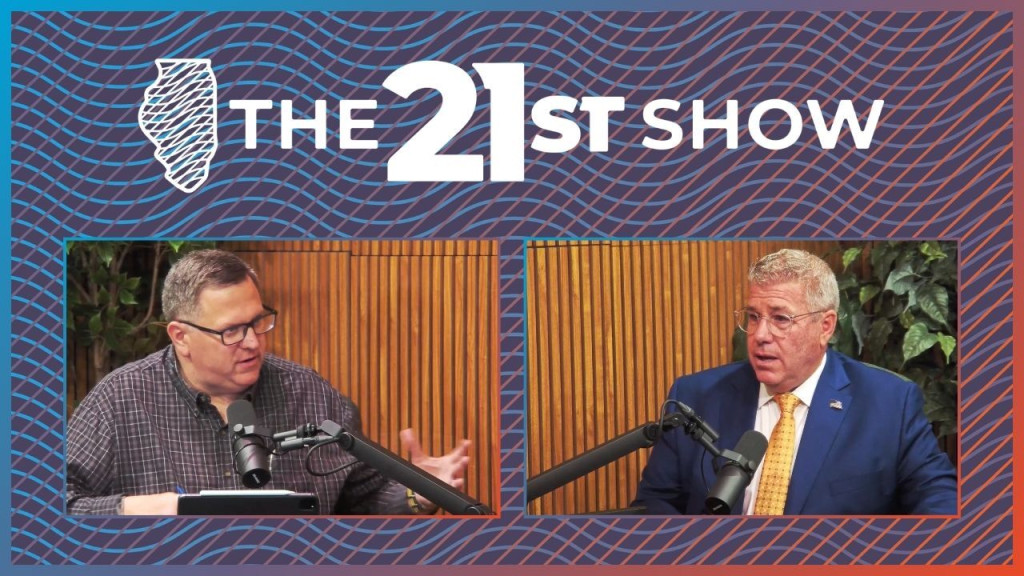
Bailey faced Pritzker in the governor’s race in 2022 and Pritzker won that election. Now, Bailey is running again for governor. In the primaries this year, he defeated challengers to become the Republican nominee. Bailey sat down with 21st Show host Brian Mackey at Illinois Public Media's studios in Urbana to discuss why he's embarked on this journey for the second time.
This conversation was edited to meet the time constraints of our radio broadcast. You can watch the full version on YouTube.
GUEST
Darren Bailey
Republican Nominee, 2026 and 2022 Illinois gubernatorial elections
