



Route 66 in Illinois: The history behind ‘America’s First Black Town’
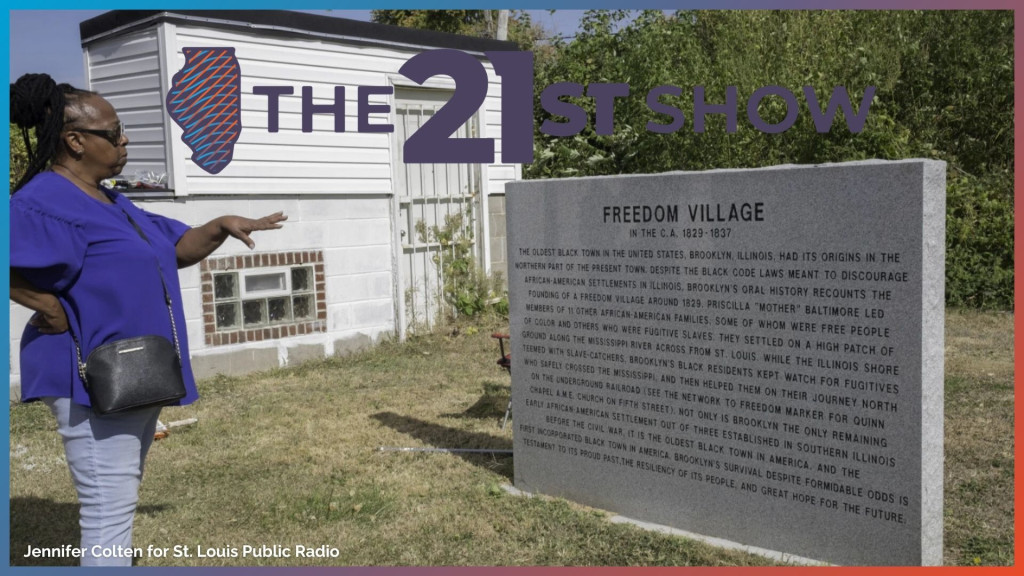
Roberta Rogers looks at a monument at Quinn Chapel AME Church marking Brooklyn, Illinois, as a historic freedom village and honoring founder Pricilla "Mother" Baltimore. Located on Route 66, Brookly is known as America's first Black-majority town and it played a significant role in American-American history. Jennifer Colten for St. Louis Public Radio
// This is a machine generated transcript. Please report any transcription errors to will-help@illinois.edu.

[00:00:00]
Brian Mackey: It's the 21st show. I'm Brian Mackey, and we are back live and coming to the end of Route 66 week on the show, which also means we're coming to the end of Route 66 in Illinois. Just before the highway crosses the Mississippi River, it passes through the Metro East region in towns like Granite City, East Saint Louis, and Brooklyn. And it's this last community, Brooklyn, that is our final subject today.

Brooklyn's history predates Route 66 by about a century. It was an important station on the Underground Railroad. It was part of the blues and jazz scenes in the early 1900s, and it's said to be America's first majority Black town incorporated and controlled by African-Americans. In 1926, when Route 66 was commissioned, Brooklyn was on the path, but later realignments of the highway would bypass the town, part of a longer story of sidestepping Brooklyn, the legacy of which can still be felt today.

Joining us now to talk more about all of this history is Sundiata Chajua, associate professor emeritus of history at the University of Illinois Urbana-Champaign. He's literally written the book on Brooklyn. It's called "America's First Black Town." Doctor Chajua, welcome back to the 21st show.

[00:01:29]
Dr. Sundiata Chajua: Glad to be here, Brian. I appreciate you having me. And —

[00:01:33]
Brian Mackey: I appreciate you being here. Listeners, you can join us for this part of the program today at 800-222-9455. 800-222-9455. All right, so I said Brooklyn's history predates Route 66 by 100 years. So take us back to — what is the 1820s? How did Brooklyn become a town, a place in the first place?

[00:01:58]
Dr. Sundiata Chajua: Well, I'm taking you back to the 1830s. So sometime between the winter of 1830 and 1831, Mother Priscilla Baltimore, who was — what do they call them — an exhorter. I guess it would be an evangelist today. She led 11 African-American families. Some were quasi-free, meaning that they weren't enslaved, but they did not have complete human rights, citizen rights within the United States or the state in which they resided, and others were enslaved. And so they come into the American Bottoms, and my theory, since they don't show up on any census records, is that they're basically a maroon community hiding out.

By 1837, a group of five white men — abolitionists out of Alton — come in, plant the land, and create a town which they call Brooklyn. The African Americans by the early 1840s purchased land in the town. They are always the overwhelming majority — I think 7/8 — and they begin to build, you know, those anchor institutions: Quinn Chapel AME Church, a Baptist church, and a number of other kinds of institutions to maintain their life. There's always a small white population, and there's a — what we'll call American apartheid — in that the whites tend to live in Upper Brooklyn and Black folks tend to live in Lower Brooklyn, but it's always a Black majority city.

[00:03:44]
Brian Mackey: I understand people may know this by the name of Lovejoy. That's what the post office was called until it closed a few years back. What does that name come from?

[00:03:54]
Dr. Sundiata Chajua: Well, it comes from Elijah Lovejoy, who was one of the first martyrs in the cause of the anti-slavery movement. He was in Alton, Illinois. He was a newspaper editor, and he worked basically out of Godfrey, which is a section of Alton, and it becomes important for another reason that I'll circle back to. But he printed a very strong anti-slavery editorial, and the mob — a slaveholding, [slavery-]supporting mob — raided and set fire to his newspaper in the warehouse in which he was housed, and he died in that process.

[00:04:38]
Brian Mackey: This is where they also threw the press into the river, right?

[00:04:42]
Dr. Sundiata Chajua: Yes, absolutely, yeah.

[00:04:44]
Brian Mackey: So talk about — how does Brooklyn continue to evolve? When does it sort of become what we now think of as America's first Black town?

[00:04:53]
Dr. Sundiata Chajua: It gets incorporated in 1874. And that's three years, I believe, before Mound Bayou is incorporated, and it's maybe a year before Boley. So it's the first majority Black — and by this time we're talking about 90, 92% of the population being Black — to become a municipality, to be incorporated with the rights of home rule. And that's the distinction.

Certainly, Brooklyn is not the first all-Black or majority Black settlement, right? The maroon communities in Florida in the Great Dismal Swamp were all-Black or majority Black communities, but they're not incorporated as municipalities within the United States. They lie outside that governance, for a good reason, right? So Brooklyn has the distinction of becoming the first area with an overwhelming Black majority to become an incorporated town within a state. Now, technically it's incorporated as a village and not as a town or city.

[00:06:15]
Brian Mackey: Which is a — yeah — distinction under Illinois law. So talk about Brooklyn's place at this time in history, and really through the Great Migration, right? It's a magnet. I mean, I think a lot of us think of the Great Migration as the South to, you know, places like Chicago and Detroit, but these smaller towns had their own role to play.

[00:06:36]
Dr. Sundiata Chajua: Well, you know, let's roll back a bit before the Great Migration, right? So once enslavement is abolished, you're gonna get a strong movement from the bordering slave states to Illinois. So Brooklyn's early population is overwhelmingly made up of people who come from Kentucky, Tennessee, and Missouri. You'll get a few people from the Deep South regions, but it's those three bordering slave states.

Now, once there, they become farmers. They work on the railroad, but they also work on the river — river transport — and Brooklyn developed fairly rapidly in that period of the 1870s, 1890s. Now in the 1890s, across what we call the lower Midwest — the lower part of the southern parts of Ohio, Indiana, and Illinois — you're gonna get a wave of racial pogroms. Some of the literature refers to them as race riots, but essentially what we're talking about are events in which the white U.S. population invades Black communities and neighborhoods, [and they] burn, pillage, rape, and loot.

[00:08:05]
Brian Mackey: Tulsa being among the most famous of these, of course, Springfield, Illinois having a notable one as well.

[00:08:11]
Dr. Sundiata Chajua: Yeah, absolutely, yeah. And it coincides also with a lynching upsurge, right, in the 1890s. Between January 1st, 1890, and let's say December 31st, 1899, every week two Black people were lynched — every week for that decade. And in that lower Midwest that I described, you're having both a wave of racial pogroms and lynching epidemics. In [1903], there's five Black people lynched in Illinois, and there's about four Black people [for whom] the sheriff [prevented] lynching. So, you know, that's nine folk in [an] 11-year —

[00:08:56]
Brian Mackey: So, Doctor, I'm sorry —

[00:08:56]
Dr. Sundiata Chajua: — [period causing] Black folks [to move] north.

[00:08:58]
Brian Mackey: I'm sorry. I'm sorry to interrupt you. We're on a fixed clock on our program, and we need to take a break. We are gonna continue this conversation about the history of Brooklyn, Illinois, arguably the last stop on Route 66 before it leaves our state. More to come here on the 21st show. Please stay with us.

[00:09:24]
Speaker 2: Leaves of brown came tumbling down, in September.

[00:09:37]
Brian Mackey: It's the 21st show. I'm Brian Mackey, listening to Dinah Washington there — one of the artists who may have played in a place like Brooklyn, Illinois back in the day. 800-222-9455 if you want to join us today.

The subject of our last conversation on Route 66 week is one of the last towns on Route 66 in Illinois before it crosses the Mississippi River into Missouri. Brooklyn — arguably America's first Black town, and by that we mean majority Black, incorporated by Black people under the political control of African-Americans. It has had more than its share of trouble over the years, and the town has been working to bring attention to its place on the original alignment of 66 this summer.

Joining us today to talk about the town and its history is a man who literally wrote the book on Brooklyn. [Sundiata Chajua] is a professor emeritus of history at the University of Illinois Urbana-Champaign.

I want to share a message we got from a listener. This is from Anne, who says there's a new children's book about Priscilla Baltimore called "Across the River" by Reverend Terence L. Thomas, about the woman behind the eventual formation of Brooklyn. She says Thomas is pastor of an AME church in Champaign. Thanks for that message. And if you want to join us, 800-222-9455.

All right, Doctor Chaju[a], I'm sorry I had to interrupt you. We're, as I said, we're on a fixed clock on our program. But you were talking about the, obviously, the terrible racial violence and how that contributes to — I guess — the growth of Brooklyn as people are fleeing other places in America.

[00:11:18]
Dr. Sundiata Chajua: Well, actually what I'm talking about now is not what contributes to the growth of Brooklyn — what contributes to Black people moving from rural towns, rural villages, and small towns like Brooklyn to Chicago. That 1890s violence precedes the first Great Migration, right? And you were speaking, I believe, in terms of the first Great Migration. I just wanted to situate that — that's not what really swells the Brooklyn population. It's the 1870 migration.

But coming out of that era, Brooklyn does develop and reaches its highest number of residents in the period of the 1920s — mid-1920s or so. And one could say that it's on the map initially as a place where the self-emancipated — meaning those enslaved people who take the initiative to free themselves, to steal their body and their labor from the slavers — but later it becomes known for culture, particularly the Harlem Club, which is one of the spots on what they would call the chitlin' circuit. And so the top jazz and blues artists of the era are gonna perform there, just like they performed at the Savoy in Chicago as part of the circuit, right? So you're gonna get a Dinah Washington, you're gonna get all the big people.

The other thing is that one of the more famous blues artists, Albert King, was born and raised in Brooklyn. And he even has an album that I think came out in the [19]70s — it could be the late [19]60s — that is entitled "Lovejoy," which, as you mentioned, was the name given the post office because there was another town in [St. Clair] County, Illinois, that was already named Brooklyn. So they took the name Lovejoy to honor Elijah P. Lovejoy's martyrdom, but also to distinguish themselves from the other town named Brooklyn.

[00:13:49]
Brian Mackey: And of course Miles Davis is from nearby East Saint Louis. He has a connection to Brooklyn as well.

[00:13:54]
Dr. Sundiata Chajua: Oh, well, strong connection in the sense that his father frequented the Harlem Club. And I suspect that as a teenager, he probably did too. But yeah, you know, and then there's — there's other — well, I don't know if they're major artists, but they're in that high tier of jazz and blues artists that come from the region, and some from Brooklyn itself.

So, you know, even a guy that I got to know — Prince, uh, Prince Joe — known as the clown prince of the Negro Leagues. He was an amazing baseball player, pitcher, but also a very dedicated man to seeing the recovery of Brooklyn's history and doing real work to try and see Brooklyn progress and be treated fairly within the context of Saint Clair County. So Prince Joe Henry — a very important figure.

[00:15:07]
Brian Mackey: But before we get to that fair treatment and unfair treatment — which comes up in your book as well, "America's First Black Town" — can we talk, since we're having this conversation in the context on our program of Route 66, [about how] Brooklyn is in the Green Book, right, in that era? Maybe you can just briefly remind people who may not be familiar, or have forgotten that history, what the Green Book was and what it might have had to say about Brooklyn.

[00:15:33]
Dr. Sundiata Chajua: You know, think about it. Back in the day — I'd say up through probably 2000 — you would go to Triple-A and get a TripTik that would guide you on a route if you were traveling across the country. Well, for African Americans, we got the Green Book. And the Green Book not only provided you with a sense of the routes, but it provided you with places where you could be safe — in terms of staying, but also because if you're a Black driver going from Chicago to, say, Denver, and you fell on Route 66, you can't stop along the way at a service station and use the restroom. You can't stop necessarily and be able to go in, sit down and eat. And so the Green Book provided you with places where you could in fact do business — most Black owned — places where you could in fact get a hotel or a rooming house, or a family would put you up for the night. So it provided a sense of security, and it also helped to promote and develop the Black business sector in that regard.

So Brooklyn appears in the Green Book in the [19]50s, and I think the 1959 version of the Green Book is particularly notable because they highlight the Harlem Club, which began its operation in the early 1830s, so it's now a very established institution as part of the national circuit by which Black performers and entertainers [travel]. But also there's a major African American-owned grocery store there. I think the name is [Champion]. So, you know, again, trying to give things those names that instill pride in the accomplishments of Black folk.

[00:17:34]
Brian Mackey: So, despite Brooklyn's location in — what would you say — a cauldron of industry and commerce in the Metro East region, right? There's steelmaking, there's stockyards. Brooklyn doesn't really get as much of a piece of that pie. Can you talk about why Brooklyn is cut out in some ways, and what ultimately leads to the city's decline and troubles?

[00:17:58]
Dr. Sundiata Chajua: You know, I make the argument in the book "America's First Black Town" that it's essentially capitalism and racism, right? Where we get the industries — you think about Granite City. Granite City is a city that was literally created by industrialists so that they would have control, right. The National Stockyards remains unincorporated because the industrialists who created it — and that's where the packing houses are — didn't want it located in Brooklyn or East Saint Louis. They wanted to have complete control.

And so, even Brooklyn is bypassed. In the decades before the industrialization, in terms of building the factories in Granite City and the National Stockyard and the [National City Stockyard] in National City and the East Saint Louis complex, Brooklyn is bypassed for the construction of railroads. By all logic, Brooklyn would have been the best place to build the initial railroads. But they chose a place — they chose East Saint Louis, which was a little bit out of the [way] — and that's because of racial reasons. But it's that combination of the way in which racial oppression intertwines and emerges from, and circulates back into, capitalism as a system of exploitation.

[00:19:37]
Brian Mackey: One of the industries that is able to survive — or thrive — in Brooklyn, then, as industrialization is passing it by, is vice, right, and nightlife, I guess, at least. What effect does that have on the community?

[00:19:51]
Dr. Sundiata Chajua: Here's the thing — I wouldn't say survive. I would say created, right? You know, if you think about it in most major cities, African-American and immigrant communities became the geographic space for vice. In this sense, Brooklyn as a majority Black town became the site of vice for Saint Clair County. You understand, I don't want to minimize the role of Black people in that construction, but I also don't want it to appear as if it's something that is unique to African American construction — that they controlled all the [vice].

[00:20:41]
Brian Mackey: Yeah, yeah, no — fair —

[00:20:43]
Dr. Sundiata Chajua: Fair points. And we certainly know that the corridor — what is that, is that [Route] 51? — the strip clubs along [Route] 51 are not owned by African Americans.

[00:21:00]
Brian Mackey: So, we're talking about this — we only have a couple of minutes left — in the context of Route 66. As I mentioned, the original alignment goes through Brooklyn, or right by Brooklyn. It's kind of cut out of future alignments, but people in Brooklyn are working to try and sort of reconnect with that history. And yet, you know, this is at the same time when we as Americans — at least the American government under President Trump — is arguably trying to bury a lot of history related to Black Americans, you know, from national historic sites to the Smithsonian museums. I wonder, from your perspective — and as I said, unfortunately, we only have a couple of minutes left — how have you been thinking about this moment as a historian of Black America and of America more broadly?

[00:21:45]
Dr. Sundiata Cha-Jua: You know, Newton says that repression breeds resistance, and what Donald Trump has done is — the South Africans say, "You've hit a rock," right? And he's sparking a strong resistance movement. The Association for the Study of African American Life and History, which is the largest Black studies association — and we're a collection of laypeople, about half, and then about half professional historians — we're growing in response to the assault. We're creating freedom schools across our 45 branches.

So whenever we get hit, we're responding, and we're responding to build. But it is a shame. And someone like Trump has no — doesn't have shame — and he's committed to trying to erase our participation in the way in which we have helped structure and shape the best parts of this society. And all I can say is, repression breeds resistance. We're gonna fight, and we're gonna keep building, and our history will be preserved. We'll keep it within our communities. We will expand it through the schools if we can, but the legacy will continue to live on. Period.

[00:23:11]
Brian Mackey: Sundiata Chajua is emeritus history faculty at the University of Illinois Urbana-Champaign. Doctor Cha-Jua, thanks for being with us and sharing some of your knowledge with us today here on the 21st show.

[00:23:23]
Dr. Sundiata Chajua: And thank you for having me, Brian. I really appreciate it. Take care.

[00:23:27]
Brian Mackey: Yeah, you as well. Once again, his book is "America's First Black Town," about Brooklyn, Illinois. You can get that from the UI Press.

That is it for us today. Thank you for coming along on this Route 66 journey. You can find our other conversations on this program beginning in Chicago on Monday, through Joliet, Bloomington-Normal, Atlanta, Springfield, and ultimately in Brooklyn, Illinois, as well as points in between. You can find all of that on our website, twentyfirstshow.org. You can find us on Apple Podcasts, Spotify, YouTube, or wherever you listen. Let us know what you think about this and your suggestions for future stories — talk@twentyfirstshow.org is our address.

The 21st show is produced by Christine Hatfield and Jose Za[e]da. Our digital producer, Colson Kahn. Technical direction and engineering from Jason Croft and Steve Mork, and Reginald Hardwick is our news director. The 21st show is a production of Illinois Public Media. I'm Brian Mackey. Thanks for listening. We leave you with Albert King.

[00:24:42]
Speaker 3: I'll play the blues. Come on in.

---

**Flagged for human review:**

- [00:08:11] — Dr. Chajua says "In 2003, there's five black people lynched in Illinois" in the original transcript, but the surrounding context indicates he is discussing the 1890s. The year was rendered as [1903] in the refined transcript as a contextually informed inference, but the precise year or date range should be verified against the source audio.
- [00:08:56] — The conversation is interrupted, and Dr. Chajua's sentence is fragmented across the interruption. The closing fragment was rendered as "— [period causing] Black folks [to move] north" to complete the thought, but this inference should be verified against the source audio.
- [00:09:37] — Brian Mackey refers to the guest as "[Sundiata Chajua]" in the re-introduction after the break, but the original transcript renders the name as "undata Chahua," which appears to be a transcription error. The name has been inferred from context and corrected to match the established spelling, but this should be verified against the source audio.
- [00:11:18] — Dr. Chajua says "the Harlem Club, which began its operation in the early 1830s." Given Brooklyn itself was established starting around 1830–1831, this date for the Harlem Club may warrant verification against the source audio or other reference material.
- [00:13:49] — Dr. Chajua says the Albert King album referencing Lovejoy was from "Shilo County, Illinois." The refined transcript renders this as [St. Clair] County, as Brooklyn is in St. Clair County and "Shilo" does not appear to be a county in Illinois. This inference should be verified against the source audio.
- [00:15:33] — Dr. Chajua refers to the grocery store name as "champion" in the original transcript. The refined transcript renders this as [Champion], but the exact name should be verified against the source audio or the 1959 Green Book entry.
- [00:23:27] — Brian Mackey refers to a staff member as "Jose Zaeda." The spelling of this name could not be confirmed and should be verified.
As we wrap up our series looking at 21st state’s portion of Route 66 as the iconic highway turns 100 years old, we take a look at the tiny Village of Brooklyn, located on the cusp of the Mississippi River in the Metro East, just before Route 66 enters Missouri.
Brooklyn is the country’s first Black-majority town and its history has connections to the Mother Road. Historian Sundiata Cha-Jua wrote a book on Brooklyn called “America’s First Black Town”.
GUEST
Sundiata Cha-Jua
Associate Professor Emeritus of History, University of Illinois Urbana-Champaign
