



Route 66 in Illinois: Springfield museum restores old road signs from Mother Road
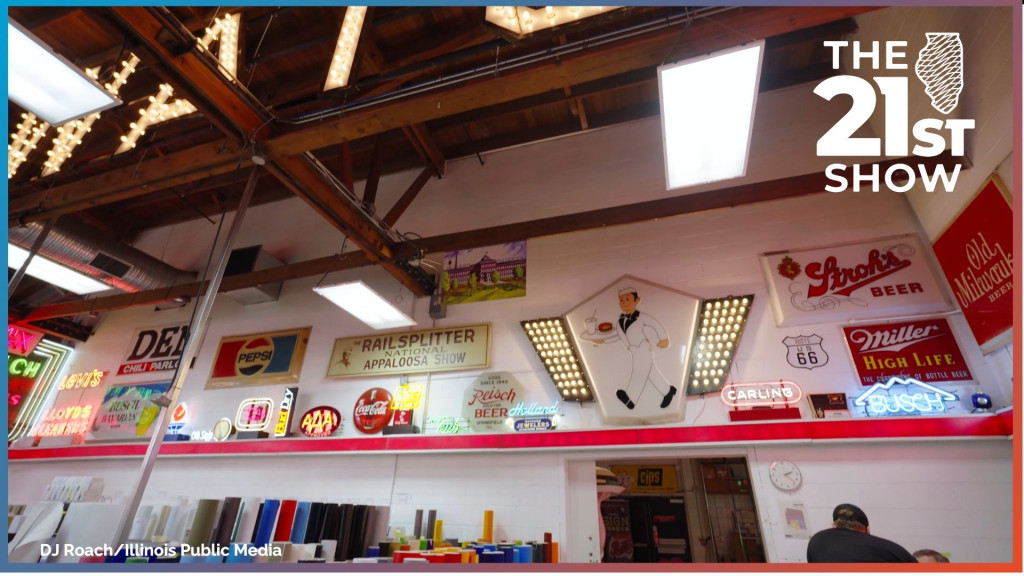
The Ace Sign Museum in Springfield collects signs that were on Route 66 in the past and restores and showcases them to preserve the history of the iconic highway. DJ Roach/Illinois Public Media
// This is a machine generated transcript. Please report any transcription errors to will-help@illinois.edu.

[00:00:00]
Brian Mackey: From Illinois Public Media, this is the 21st Show. I'm Brian Mackey. All this week, we've been sampling the sights and sounds of what's along the 300 or so miles of Route 66 that are in Illinois. Among the defining visual hallmarks of the highway is the warm glow that comes from applying electricity to neon gas in a glass tube, which is to say, the neon sign. Today there are many cheaper ways to make signs, usually evolving light-emitting diodes or LEDs. But in Springfield, the Ace Sign Company has been working to preserve our neon past. They've collected signs from along Route 66, restored them to their mid-century glory, and put them on display in their Springfield headquarters. Many of the signs they restore are their own, as Ace has been in the sign-making business for more than 80 years.

Our producer Jose Za[e]da recently toured [the] sign company's museum and workshop with Dennis Bring[ett], past president of the company. That means the first part of our show is on tape, but you can still let us know what you thought. Our email address is talk@[21stshow.org].

[00:01:33]
Speaker 1: So tell me a little bit about the Ace[ign] Company, you know, how it got started and everything.

[00:01:37]
Dennis Bringett: OK, well, it started from my grandfather, Franklin G. Horn. Actually, kind of an interesting story. He got out of school here in Springfield in the 8th grade. He graduated from eighth grade and then he went to work, like most people did in that generation, in that time. That was 1919. And he went to work for his father and uncle that were in the sign business. It was a Horn Sign System[,] and his name was Frank Horn, so that worked out well. He worked for them for 21 years.

And then along came this thing called the Great Depression. And he didn't get paid for 2 years, and so he thought he better do something to feed the family. So he started the Ace[ign] Company in his garage in his backyard right over on Spring Street, not too far from here, and so it has grown. And there's a picture of him in 19[--] — 1940 — that was on the timeline here.

But I had the pleasure of working with my grandparents and my parents at the same time in business, and then my grandparents retired and then my sister and I got more active. And then, now after I worked for 55 years in the company, I've retired. My two sons and my nephew — and my daughter-in-law — they're running the business now.

[00:03:12]
Speaker 1: You've been in Springfield your entire life here, and we're looking around at the facilities. I mean, it's pretty high-end, I would say. I mean, because you got the museum on one end and then some high-tech office on the other side and the factory as well. Have you always been in this particular location?

[00:03:27]
Dennis Bringett: No, we've only been at this location for 15 years now. Well, the first location was in his garage in the backyard, and then the second location he moved to downtown Springfield on 2nd Street. And then the year I was born, in 1954, he moved to a new location on 4th Street. And they were there for 60 years. They moved in there, you know, like I said, the day I was born. So it was kind of neat to be able to see it grow and develop.

And we expanded that particular location, bought lots on each side of us and expanded, but kind of ran out of room. So we moved here to this building. It was actually a Sears warehouse built in 1952, and we've been here about 15 years now, so it's worked out well. It's allowed us to grow, yeah.

[00:04:22]
Speaker 1: All right, well, I guess we could get the tour started and start looking at everything.

[00:04:25]
Dennis Bringett: Very good, we'll take you on through here. So we're actually doing two things here. One, we're celebrating the 100th anniversary of Route 66, and then we're also celebrating a lot of the businesses that we did business with since 1940. Unfortunately, sometimes they go out of business, and when they do, a lot of times they want their history to live on. So many times they'll donate their sign that we made for them to the museum. And that way the museum can grow and retain their history.

[00:04:58]
Speaker 1: So how did the museum itself come about? Did it start with businesses just donating signs,

[00:05:03]
Dennis Bringett: or, well, when we would take down a sign either because they went out of business or oftentimes they just wanted a new sign, bigger and better, you know, more appropriate for the era that they were in. So when we take them down, we would put them in a little warehouse space we had on 4th Street. And then when we moved here, we thought, you know, let's get these out and display them so people can enjoy them — and they did. So I think that was the start of the museum, and that's where now it continues to grow as we're fortunate enough to get people that donate additional signs to it.

[00:05:45]
Speaker 1: So as we look around, I mean, I'm seeing the Big Boy, that old burger chain, a bunch of neon signs, Schwinn bicycles, so forth. Talk a little bit about the production of signs and how that's changed, maybe from back in the 1940s to how it's changed over the years.

[00:06:04]
Dennis Bringett: Yeah, back in the 1940s, pretty much everything was hand-painted with brushes and paints. And then, of course, neon started coming on strong in the 1920s and 1930s, and it was very popular in the 1940s and 1950s. So we did that as well. And then, of course, there's a lot of different skills involved. There's sheet metal working, there's electrical, there's crane operators and welders and spray painters — just, you know, we've got a variety of different skills that are required to make some of these.

A lot of these are also very historic for Springfield. Up here we have the Illinois Watch Company. That's a building that was built in 1870 here in Springfield. They grew to become the world's largest maker of wristwatches and pocket watches for railroads. And then in 1920 they sold to Hamilton Watch Company. The letters you see in that picture up there, the word "watch," that's actually these letters up here, so that is again from 1870.

This is called a Sputnik. The Sputniks were very popular back in the heyday of Route 66, and that was at the Bel Air Manor here in Springfield, which was on Route 66, which unfortunately is no longer in business, but again we want their history to live on.

And then this Pepsi sign — that logo was first introduced in 1953, and it's now kind of come back as retro, as popular again. That was on a billboard in 1953 here in Springfield, and it's 16 ft. tall. But you might be surprised — it's only a quarter of an inch thick, so it's cut out and painted to look three-dimensional. But yeah, so there's a lot of history in every one of these.

[00:08:06]
Speaker 1: Talk about maybe the artistic choices that go into making a sign. Why go with, for example, with the watch sign — why go with the whites with the black outline, those kinds of,

[00:08:18]
Dennis Bringett: yeah, that's a good question. What we like to do is look at the customer's location and what his business is, or her business. Their business is very important. If it's a lawyer, maybe they don't need a big sign, maybe they don't need neon. But if it's a retail establishment that's on a busy street with a lot of traffic count, they have different needs. They may need a little larger sign, a little bolder. And it's also very important that they tell what they do, what they sell. So many times now, new businesses get started and they just put their name out there, but they don't tell what the product is — and that's a formula for failure.

So we like to do renderings for them first. We talk with them about, you know, what their budget numbers are. And if they have a logo already, we like to incorporate that in. But a lot of newer businesses don't quite have logos designed yet, so we have graphic designers that work with them to develop their branding — and that always helps them to be consistent with other printed materials that they're doing. And so we do a rendering of what the sign will look like, and then they can say if they like it or tweak it, you know, maybe change a color or a letter style and get it to where they're comfortable with it and get the price range where they need to be, and then we're ready to roll.

[00:09:55]
Speaker 1: How about for the lighting? You know, as we were talking about, neon was way more popular back then. I imagine it still is in some cases today.

[00:10:03]
Dennis Bringett: Um, yes, neon is still popular. There's also LED signs now — we do a lot of electronic message centers, so the customers can change the electronic sign themselves, or oftentimes we can change it for them. We can do it remotely from here, and that really helps keep it fresh. And if they have specials or sales, boom, you just type it in and you're [ready to] roll.

The Route 66 stuff, I think, is important. But a lot of it is somewhat local Route 66 stuff — like Cozy Dog, for example, maybe in Springfield, and people who come to Springfield. A lot of the books that are out there, they have great information about the businesses that are Route 66-related. So Cozy Dog's in most of those. Steak 'n Shake is obviously very popular as well.

The Tropics — the Tropics is in Lincoln, Illinois. They started in the 1950s and they survived up until 2004. And we did a recreation of their sign, so it's right here now. You see a picture — it's at the original location on the original poles in the middle of the McDonald's parking lot. But it's again a Route 66 relic.

And then up above that, Sunrise Donut Shop, that is very popular on Business Route 66. They're no longer in business, but again, their history lives on.

This is one of the first taxi cabs in Springfield, and they're still owned and operated by the same cab company, Lincoln Cab. What we like about this particular cab is down at the bottom, real small there, it says Ace[ign] Company. My grandfather actually hand-lettered all of this, and we kind of like to brag on the fact that our lettering enamels held up better than Chevrolet's paint on the car did. Yeah, no kidding.

And then the first parking ramp in Springfield was on the corner of 4th and Monroe Street, and so that's the original sign from the 1930s.

And then Chevrolet came up with this new idea in 1949 they called an automatic transmission. So the first one up here is called Powerglide. That was a two-speed automatic transmission.

And of course we also have [a] sign from the Illinois State Fairgrounds we made for them many years ago.

And then we have a Lincoln relic up here — the Great Western Railroad — that was actually the train station where Abraham Lincoln gave his farewell address when he left Springfield to go to Washington to serve as president. So that has a lot of historical significance.

So there's a lot of different skills required to make signs. Behind the amber curtains back there we have a welding department where we weld aluminum and steel. And then we have a spray boo[th] where we put the color on. And then we also have lasers back in that far corner that cut aluminum. And then underneath that neon over there we have a room that has CNC routers in it that cuts a variety of different materials.

You can come over this way and I'll show you what neon is, how neon colors are created. There's actually two things that create the color. One is the color of the glass, and the other is the color of the gas that's in it. So there's only two gasses. One's called argon and it's blue, and then the other is neon and it's red. So right behind you here we have a sample board that shows all those colors. Now this one here, there's only two of these that are clear glass — so it's this one and this one. This here, you're looking through the clear glass to see the blue argon gas inside of it, and the one next to it is also clear glass that you're looking through to see the red neon gas. And all the rest of those have a phosphorescent coating on the inside of the glass that mixes with the gas to form all those other colors you see. So that's neon colors 101.

[00:14:55]
Speaker 1: Now with the neon, can you kind of essentially do any color, or are there

[00:14:58]
Dennis Bringett: any — those are the only colors you can do, it's kind of limited. But that usually works out pretty good, yeah.

[00:15:06]
Speaker 1: Is there, what would you say — because of the limit — do you have to like think outside of the box when it comes to how to take advantage of the colors that are available?

[00:15:16]
Dennis Bringett: Yeah, well, you can introduce other colors into the background colors or the painted part of the sign, in addition to what you see there. Yeah, we're able to usually satisfy the needs of most of the customers in regard to the creation of colors.

[00:15:39]
Brian Mackey: All right, we have to take a short break on the program, but when we come back, more from our walkthrough of the Ace Sign Company's factory and museum, which is along Route 66 in Springfield. This is the 21st Show. Stay with us.

It's the 21st Show. I'm Brian Mackey. Let's get back to our producer, Jose Za[e]da, as he explores the Ace Sign Company's workshop and museum. The tour was provided by Dennis Bring[ette], former president of the company. Jose also spoke with Scott Bringett, Dennis's son and the chief experience officer of Ace. They talked about what goes into modern sign making. This part of the hour is on tape, but we still want to hear your Route 66 stories and experiences. Please consider leaving a voicemail at 217-[321-21 — that's] 217-300-2121. [⚑ Reviewer: Please verify this phone number in the original audio; it appears to be read twice with two different numbers.]

[00:17:27]
Speaker 1: So we were talking to your father a little bit earlier about, you know, the history of the Ace[ign] Company. Maybe you could talk a little bit about when you came into the picture and, you know, how it's evolved

[00:17:36]
Scott Bringett: since — sure. You know, I get asked when I started a lot, and the honest answer is I started probably in 1st grade. I grew up in the business in the summers and kind of around, but right out of college I've been with the company kind of full time now for, I guess, 16 years. But I've become — we had the generation change here recently. So it's been about 6 years of ownership with my brother and my cousin, the 3 of us as our partners. And we all the same way — we all grew up around the business and different aspects of it, and it's kind of in our blood.

[00:18:19]
Speaker 1: Do you feel like a sense of pride whenever you go around town and see

[00:18:24]
Scott Bringett: absolutely, absolutely, yeah. I think, and our staff too — that's what's cool about it. In the sign[ing] industry and what we do, it's like you can't help but drive past something that you see that you worked on or that you designed or had some piece of it, and to be able to say you were part of it, there's definitely a cool pride part of it as well.

[00:18:45]
Speaker 1: You know, I wonder if you could talk a little bit about the thinking process you go through when you're creating a sign. You know, I know you have to take into account whatever the client says and what they want, but what goes through your head when you're hearing these things, you know, and how it comes about — the sign?

[00:19:02]
Scott Bringett: Yeah, it's — you know, our team is very much focused on — we have a motto, we have something that we do really believe in, and it's that signs go beyond what they say. If you look at the color, the shape, the form, they say a message without literally saying a message. And that's something we're built to inspire — it's something that we do stick by, is kind of something we think about throughout the process. And whether or not that's a simple sign or something very complex, you can still connect.

And I think the old handshake mentality that my grandfather had when he started the business — sometimes it can seem lost in a world where there's so much automation and less face-to-face interaction, but we're trying to continue that face-to-face, handshake mentality and understand why people are doing what they're doing and help them accomplish their goal rather than just take their order.

And being able to make everything under one roof allows that — to be able to have the fabrication from the concept of that first call and the idea of why, to the output and installing it — it's all our staff and all our crews and all of our partners. And so it's cool to be able to see that and have that pride and hopefully, at the end of the day, make our customers successful.

[00:20:27]
Speaker 1: Yeah, has the production side of things changed much since you started? How does that evolve?

[00:20:34]
Scott Bringett: Yeah, no, it certainly has. There's been a lot of automation that we've adapted and continue to adapt — a lot of processes that were very hands-on. And that's one thing that you'll see through the facility and in our process, that with automation, some people threw away old techniques and said they're no good anymore. We don't believe that. It's not necessarily true. There's pros and cons to different methods.

So we have automation of CNC routing and cutting backgrounds and shapes. Of course, [there's the] advent of LED lighting and the efficiencies that go into it. We still use LED lighting, but we also still bend neon, because there's a time and a place for those still. We still print digital graphics, but we still hand paint. And that's where we just believe that keeping those alive and as options for our clients is something they still want. It's challenging, but it's something that's probably worthy of the challenge. Yeah.

[00:21:39]
Speaker 1: Yeah, it's — speaking of the neon, I think a lot of times when people think of — when you tell someone Route 66, they do think of neon signs. I wonder what you think of the fact that it has that association, and perhaps even talk a little bit about the legacy that a sign, you know, implemented into that.

[00:22:00]
Scott Bringett: Yeah, and it's interesting. Neon is really just one of those milestones in the evolution of sign making that we were there for the advent of and the innovation that was occurring at that time. And it was such a good technique that it became the way even a funeral home sign was made. So for example, you're never gonna see a funeral home today made out of neon, most likely. But back in the day, that was the way to do an illuminated sign. So trends come and go, styles come and go.

But yeah, neon — you're literally seeing the light itself. You're seeing gasses mixed and excited, and you're seeing light like you are looking at the sun, quite literally. It's science, you know. A lot of the artificial lighting that's created now is directional, and again, it's just different. It has its pros and cons — it could be more efficient. But neon, when done correctly and when protected, is the only type of lighting that will in theory last forever. With a lot of other newer techniques, they're little[,] shorter-term type[s] of products.

So [Ace] has been there since the advent of neon, and now we're continuing with the resurgence of it, too, and just keep that art alive. Being a company that is forward-thinking, innovative, scaling to be able to work with large corporations across the United States — doing that while also being a long-legacy-type company that's on Route 66 — has definitely molded us in a different way where we see both sides of that.

So yeah, being on Route 66, being a company that literally is just off Route 66, was there at that era, but now also at the mecca of people looking back on it and appreciating the nostalgia — that's affected us in a big way. I think our clients' preferences, the appreciation of the memories, the stories, the values that come with those stories — it's what's kind of led us [to] the museum, and in a lot of ways affects how we design, to remember those values when we're designing.

[00:24:31]
Brian Mackey: Thank you again to Dennis and Scott Bringett with the Ace Sign Company.

---

**Flagged for Human Review:**

- **[00:00:00]** "usually evolving light-emitting diodes" — likely a mishearing; consider "involving light-emitting diodes."
- **[00:00:00]** Producer's name transcribed as "Jose Zaeda" — spelling unverified; please confirm.
- **[00:00:00]** "Dennis Bringett" / "Dennis Bringette" — the name is spelled inconsistently in the original transcript (Bringett vs. Bringette). Please verify the correct spelling, and note that Scott Bringett's surname should be corrected to match if needed.
- **[00:00:00]** Email address transcribed as "talk@2firstshow.org" in the original, then as "talk@21stshow.org" — likely the same address read twice; please confirm the correct address.
- **[00:15:39]** Phone number is read as "217-32121" then "217-300-2121" — please verify the correct number in the original audio.
- **[00:01:37] / [00:17:27]** "Ace[ign] Company" — the original transcript renders the company name inconsistently as "Aceign Company," "Aign Company," and "Ace Sign Company." "Ace Sign Company" is used in the host's introduction and appears to be correct. All instances have been preserved with bracketed notation where the original was unclear.
- **[00:06:04]** "spray booszet" in the original — likely "spray booth"; preserved with bracketed correction as "spray boo[th]."
As we continue to tour across the 21st state’s portion of Route 66, we’re making a stop at the Ace Sign Museum in Springfield, which restores and collects signs of all kinds from Route 66’s past… from neon to painted metal and everything in between.
The 21st Show's Jose Zepeda visited the museum to learn about its work.
GUESTS
Dennis Bringuet
Past President, Ace Sign Company
Scott Bringuet
Owner and Chief Experience Officer, Ace Sign Company
