








U of I chancellor on AI, Chief Illiniwek and why enrollment keeps growing
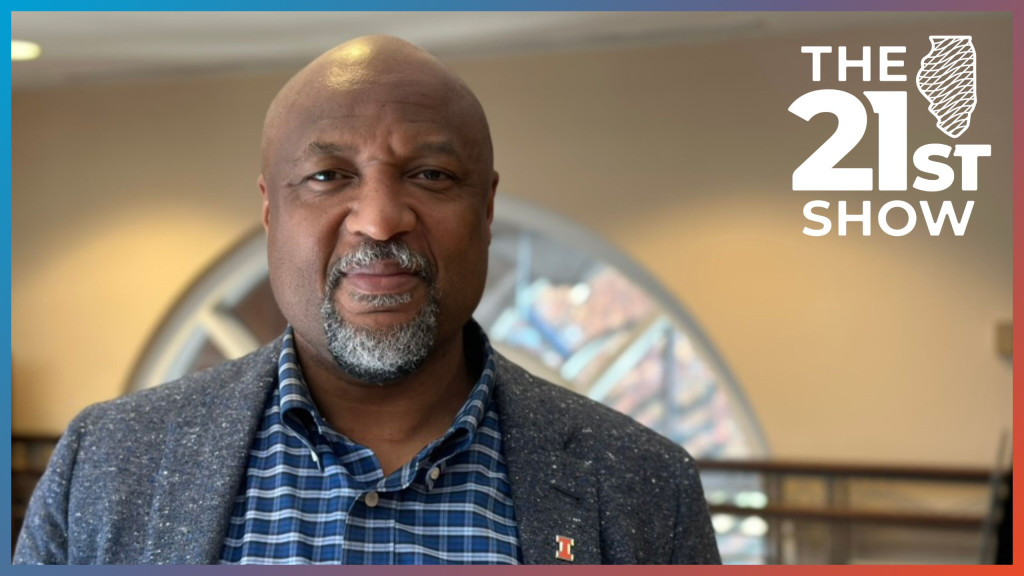
Charles Isbell, chancellor of the University of Illinois Urbana-Champaign, photographed Nov. 23, 2026 at Illinois Public Media in Urbana. Brian Mackey/Illinois Public Media
// This is a machine generated transcript. Please report any transcription errors to will-help@illinois.edu.

[00:00:00]
Brian Mackey: Today on the 21st show, Charles Isbell is the chancellor of the University of Illinois Urbana-Champaign. He's joining us live for the hour to talk about what's happening in higher education, from enrollment to federal funding threats to the dilemma created by artificial intelligence. Plus, we'll take your questions throughout the hour. Give us a call at 800-222-9455. That's 800-222-9455. I'm Brian Mackey, and that's all coming up today on the 21st show, which is a production of Illinois Public Media airing on WILL in Urbana, WUIS in Springfield, WNIJ in Rockford DeKalb, WVIK in the Quad Cities, WSIU in Carbondale, and Tri-States Public Radio in Macomb, Galesburg, and Keokuk. But first, news.

From Illinois Public Media, this is the 21st show. I'm Brian Mackey, and our topic today is the University of Illinois Urbana-Champaign, Illinois's flagship public university. Like many other schools, Illinois has been threatened by cuts to federal research funding, new rules limiting how long international students can stay in the country, and many other changes being pursued by the second Trump administration. And more broadly, higher education is reckoning with a decline in trust and a projected drop off in applicants in the coming years. That so-called enrollment cliff has already hit some schools, but U of [I] Urbana-Champaign announced in September that it had another record-breaking freshman class, more than 9,300 students, and overall enrollment is at around 61,000 students.

Overseeing all of them is Charles Isbell, the chancellor of the UI Urbana-Champaign. He's been in that role since August last year. Chancellor Isbell is a computer scientist who previously had the No. 2 job at the University of Wisconsin-Madison, provost. He's originally from Atlanta, studied at the Georgia Institute of Technology, and then earned a PhD in computer science at MIT. He joins me live today for the hour from our studios in Urbana. Chancellor Isbell, welcome to the 21st show.

[00:02:21]
Charles Isbell: Thanks for having me. Looking forward to a

[00:02:22]
Brian Mackey: conversation. And I've got to say full disclosure for our listeners, our producing station is a licensee of the University of Illinois and is part of the Urbana-Champaign campus. That means Chancellor Isbell is in some sense my boss, though there are many layers on the org chart between us. I work hard to not let that influence our journalism on the show, but you'll make your own judgment about that.

Again, we're live with the chancellor. If you have questions for him or thoughts on the state of higher education in Illinois and beyond, you can join the conversation at 800-222-9455. That's 800-222-9455. All right, I mentioned 61,000 students. To, to what do you attribute the UI's ability to keep enrollment up and growing when other universities are struggling?

[00:03:07]
Charles Isbell: Well, 61,060, um, the highest number we've ever had, as you pointed out at the top of the show, um, the largest incoming class we have ever had, and I think it's actually pretty simple. Illinois, both as a state and as a university, is highly regarded, not just in the state of Illinois, across the country and in fact around the world. What I expect is going to happen is that we will continue to see applications rise, we will continue to see more people who are interested in what we do and the opportunities that we help to enable, and we're going to continue to make it possible for people to achieve their dreams.

[00:03:40]
Brian Mackey: Enrollment cliff. Talk about that. How, how are you thinking about that — or the demographic cliff, some people call it, um. How are you preparing for that eventuality here?

[00:03:49]
Charles Isbell: You know, it's really interesting to ask the question because there's, I think when you sort of ask that kind of question, the first thing that pops into people's heads is, well, you know, what's going to happen when there are no more students. There's actually two separate things going on here. There's one is what's going to happen to places like Urbana-Champaign — uh, flagships and large universities across the country — and then there's what's going to happen to everyone else and what implications is that gonna have on, um, places like Urbana-Champaign. So we are not worried in the short term about the enrollment cliff. We will continue if we wish to see more and more enrollment growth. I am quite worried about what that means for public higher education, generally speaking, and what it means across the rest of the state and how we can work together and support one another for all of public higher education in particular.

I do think that there's a longer range question to ask here. What does it even mean to have enrollment? What does it mean to have people who are on campus? My view about a university, particularly a university like ours, is that we should be a hometown that people want to come back to again and again and again. And in a world where things like AI are happening, technology is moving apace, it means people are going to have to come back again and again all throughout their careers. So for me it's not going to be about 61,000 students. It's going to be about 150,000 students, most of whom are coming back for a class or coming back for a seminar trying to figure out how to get back, how to get their skills updated, how to change their careers, and how we are going to create a campus that is spread across both space and time to make it possible for our alum and other people to participate in education and continue their careers. That is going to be the answer to the enrollment cliff, at least for a place like us.

[00:05:22]
Brian Mackey: Talk about those uh other institutions here in Illinois because there is, I think maybe it's one-sided and they perceive it and you don't, but sort of a a rivalry. Uh, there's, you know, obviously competition for state funding with those places, um, you know, what schools that wanna, you know, begin engineering programs or something like that when obviously UI has a a world-renowned program here. How — talk about that relationship that you have with other, you know, smaller institutions around the state.

[00:05:48]
Charles Isbell: That relationship, particularly for me, is of course ever evolving, but I think my view — and I mean this quite seriously and quite sincerely — this is about what's best for the good people of the state of Illinois. It is important for everyone in this state to have a robust public higher education system. It is important for us to be able to work with campuses all over the state, both public and private, by the way, and with partnerships even outside the state so that we can bring economic development here in Urbana-Champaign, the county, Chicago and the rest of the state. I like to think of my relationship with them as a partnership. When there are things that we can do together, we do them together. I'm not at all threatened or concerned if someone wants to create an engineering program or an engineering technology program. What can we do to help? How can we work together so that we can reach as many people as possible? Pick whatever topic you want, whether it's medicine, it's nursing, anything else that you care about. I'm totally fine with that. If we work together, then the pie grows. And it'll be better for everyone.

Now maybe that's easy for me to say because we have 61,060 students, we're doing pretty well, our popularity is going up, we're going to the Final Four — like, things look pretty good at Urbana-Champaign — but I think that most of the folks that I talked to, and I do talk to the different presidents and chancellors across the state, I think they believe that too, and they just want to have a nice strong system and an ecosystem that we can all share.

[00:07:08]
Brian Mackey: Fill out your brackets now. Um, all right, so overall UI system experienced a drop in international student enrollment, around 6% undergraduates, more than 15% for graduate and professional students. How do you convince people from abroad to continue uh coming here to study when you know they're worried about whether they're even going to be able to get into America and how welcome they'll feel when they're here?

[00:07:33]
Charles Isbell: Right, so two different sets of students there, right? One of the set of students who are outside the United States and coming in, and then there's a whole set of students who are foreign nationals but actually already in the United States. They're either undergraduates here or they're in high school here and they're, they're just, they're just foreign nationals. They aren't, they aren't yet citizens, and they're, they're dealing with two completely different kinds of issues.

What you pointed out is the thing. There are things that are beyond our control. The federal landscape is what the federal landscape is, rules change and people think, well, I'm I'm — come here or I'm not gonna come here. If I do come here, maybe I'll get kicked out. That's a real issue and a real concern, I think for all of us who think about these things and whether we have a large international population or not. What I think that they know is that the country is welcoming in general. They are people who come here and they contribute to our economic development. They know this, we know this, and they will be welcomed here. We will welcome [them] in our university. I don't have the exact numbers on me because they change from year to year, but last time I did the math, uh, which required that I actually do math, um, about 46 to 48% of all non-, um, uh, non-Illinois students from the state of Illinois stay after they complete their degree, at least at the undergraduate level. That means that people are coming in here, they're staying here, they want to be here, they want to contribute to the community, and that's good for the state. So we will continue to support that in every single way that we can.

[00:08:58]
Brian Mackey: It's interesting you say that, and you say it as though it's a good thing, and I'm sure a lot of people think that, and there are people in the White House though who would hear that and think that's a horrifying thing. So how do you navigate that?

[00:09:07]
Charles Isbell: Well, we make the argument that we make. I mean, all of those people that they're talking to who are running these large companies that they're working with, a lot of them are foreign nationals. They seem to have a perfectly fine time working with the Elon Musks of the world and name 5 or 6 other people who came to this country because they wanted to be a part of this country. They saw the opportunities and they wanted to give back. You have to give people those opportunities and you have to support them. They come, they will do good things.

[00:09:33]
Brian Mackey: What is your pitch? I don't know, let's say you're talking to a family in India right now and you know, there — we know that if there's a hate crime somewhere in the Midwest, that story is going to reverberate, especially if it's a college town. That story is going to get picked up overseas in the home country of those, you know, if they were, uh, international students, for example, um, and I can't think of exactly where it was. This is an episode that happened a few years ago or an incident. Um, what is your pitch to a family like that, that this is, you know, Urbana-Champaign is still a safe place to send your children to come for a few years to get to improve their education?

[00:10:05]
Charles Isbell: I would tell them that the numbers show that this is a safe place and that I'm personally telling them that this community cares about everyone who's a part of it. We will support them. They will be able to pursue their dreams and we will all be a part of the same family. I mean that. I know that it is true and I think that they will see it in both the numbers and in the lived experiences of people they know. And I would tell them, don't just believe me, go talk to other people you know who have been here, who were here 5 years ago, 10 years ago, 20 years ago, or here last week, and you will see it.

[00:10:35]
Brian Mackey: So the Department of Homeland Security has tried to place an automatic four-year limit on international student visas. A federal judge has blocked that rule. What effect would it have if that were allowed to go into effect?

[00:10:47]
Charles Isbell: It would be devastating for everyone, not just us, but for the entire ecosystem across all the public higher — it'd be particularly bad for large research universities where a lot of the talent who comes in at the graduate level come from all around the world. They stay here and then they invent the next thing. It would be bad for us in the long term. I mean, the question you're asking, I think it's very easy for people to think about, well, what is this going to do for enrollment next week? What is this going to do for tuition? What is this going to do for support? And you can be on board with that or you can think that that's a crazy thing. I think the real question to ask is what is this going to mean half a generation and a generation from now?

We are bringing in people who are coming who want to be a part of the American dream. They believe in education and they want to participate in the world that we're in. If we block them out, maybe for a year or for two, it might be OK, but once we get to 4, 5, 6, 7 years, we lose an entire generation. And if we just look back on all the people, where we all came from, if we look back on the kind of contributions that have been made here, those are people who weren't necessarily born here or their ancestors weren't necessarily born here and we're better off for them. So we have to support this and we will continue to do this, and you see it not just from this university, but you see it from — well, I'll I'll just throw a bunch of alphabet soup at you. Well, there's the Big Ten, there's the [APLU], there's [AAU]. Organizations of universities who have never gone out against the federal government, have never sued, never before — they're getting together and they're doing this because we all recognize that this is existential and it's what's going to be better for higher education.

[00:12:16]
Brian Mackey: Yeah, to your point, I recently saw a list of all the sort of Nobel Prize winners and how many of them, you know, were not — did not, their origin in America — were immigrants here. You know, there, there are those who say, you know, maybe it's a good thing we would have fewer international students because they're taking slots away from Americans or Illinoisans, even. There was a film that was made within the last year or two about that in particular. What do you say to that argument?

[00:12:40]
Charles Isbell: They're not.

[00:12:41]
Brian Mackey: Say more.

[00:12:42]
Charles Isbell: They're not. Um,

[00:12:44]
Brian Mackey: how, how does that — it's one of those things that it doesn't intuitively make sense, right? If there's more, you know, percentage of students of, you know, from, from South Asia or Asia or wherever, Europe or wherever they are in the engineering program, how does that not displace students?

[00:12:58]
Charles Isbell: We have 61,060 students. We're growing. We're trying to grow more. We want to support everyone — from the state of Illinois, yes, the rest of the country, yes, and the rest of the world. It is important to create an environment where all kinds of students, faculty, staff, community members who aren't a part of the university directly nonetheless are a part of this sort of amazing place where people can be. We're all better off for it, first off, but secondly, even beyond that, if you just look at the number of students we accept and what percentage of our students from just within the state, never mind the United States, it is very, very large. We're not pushing people out for one kind of student or for another. We're bringing in as many people as we can and we're going to continue to do so. This is not a zero-sum game. We are all better off if we bring in as many people with as many perspectives and as much background as possible to create the environment that's going to be good for the state.

[00:13:48]
Brian Mackey: All right, if you want to join us today, 800-222-9455 is the number. We're talking with Chancellor Charles Isbell of the University of Illinois Urbana-Champaign. 800-222-9455. All right, a little more federal, uh, policy news. Under the [one big beautiful Bill Act] passed by the Congress last year, there are now caps on graduate school loans for many students, a bit over $20,000 a year, $100,000 overall. Um, there are higher limits in place for professional programs like med school. Um, I, I was looking at the list of tuition for some of these, and in, in quite a few cases, the cost is over that yearly limit set by the federal government. How do you support students who might not be able to afford the cost of further higher education, you know, if the loan can't cover it?

[00:14:35]
Charles Isbell: Yeah, it's a difficult question. So the, it's it's a difficult thing to do really because it's, it's money, it's support, and every single person has a different story. And so the best you can do is to make available to them all the resources you can, including fellowships, um, pointers to other kinds of scholarships and financial support, uh, loans that are subsidized by a variety of people. And we can, of course — we're a state institution and so we don't pick winners and losers and we can't go say go over here and don't go over there or anything like that. We don't and we shouldn't do that, but we do provide them as much information as possible. I do think that at the undergraduate level in particular, most students, many, many students do not graduate with debt. We would like for that to be true for the graduate students as well, and we want to make it certain that they will have the jobs afterwards and the career afterwards that will allow them to pay back any loans that they have.

[00:15:22]
Brian Mackey: You know, one of the arguments made by the current administration is that letting students borrow up to the full cost of attendance has allowed schools to basically charge what they want without any sort of constraints. What do you say to that?

[00:15:33]
Charles Isbell: Well, in order for us to raise tuition, there has to be a whole set of people who vote on it and say that it is allowed, so we're simply not doing that. And the truth is, I think even if you look carefully at these numbers, what you will see is that once you subtract out support from the state and a host of other things, the cost of education is not growing quite as fast as it feels with the sticker price. And I don't think that there's a lot of evidence that raising the loan amount has actually pushed up what people actually end up spending, as opposed to what's entirely possible for them, for, for example, some of our more expensive private universities.

[00:16:09]
Brian Mackey: Although, of course, like — I mean, I don't know exactly how old you are, but people of our generation and, you know, certainly those born in the '60s and '70s did have a cheaper time getting through colleges and universities. And maybe we can talk about that on the other side of the break. We're talking with Chancellor Charles Isbell of the University of Illinois Urbana-Champaign for the hour today. If you want to join us, the number is 800-222-9455. That's 800-222-9455.

I should mention coming up on tomorrow's program, we'll be revisiting our conversation on the book "An Inconvenient Widow" about the life of Mary Lincoln. Uh, that is by a journalist. That's coming up tomorrow on the show. Uh, again, you can join us today though, for the rest of the hour, 800-222-9455. This is the 21st show. We'll be back after a short break. Stay with us.

It's the 21st show. I'm Brian Mackey. For the hour today, we're speaking with uh Charles Isbell, chancellor of the University of Illinois Urbana-Champaign. If you want to join us, the number is 800-222-9455. 800-222-9455. We also asked members of our texting group if they wanted to write in with questions. We did hear from Karen in Champaign. Um, one of your questions: has the number of faculty increased to match the number of undergraduates that are being accepted?

[00:18:07]
Charles Isbell: That is an interesting question that I will admit, having only been here 1 year, 3 months and 22 days, I don't actually know the answer to what that's looked like over the years. I think if you think about all the teaching staff and, um, ways in which we support people, the answer I think is yes, but I don't know for sure. I will say this, if you count all the graduate students, um, you know, we have, for example, um, uh, [Gies] Business College has an online MBA, uh, that allows us to reach more and more and more people without having to hire more and more and more people to do, because the technology sort of supports it. So there's an interesting question. I mean, the way I would, the way I would want to think about the question is, is the experience of the students and the experience of the faculty teaching them getting better or worse? Whether we're growing the number of students or shrinking the number of students, growing the number of faculty or shrinking the number of faculty — that's a harder question to answer, but I think it is actually the important question.

[00:19:00]
Brian Mackey: Yeah, and I can say having sat in some very large lecture halls here in the late 1990s that the faculty-student ratio in those classrooms was not great.

[00:19:09]
Charles Isbell: Well, can I, can I tell you something about that? So I, uh, you know, as you pointed out, I'm a computer scientist. I, uh, uh, my first class had 40 students in it. My second had 85, and after those first two classes, I never taught a class below 200, 250 ever again. And by the time I stopped teaching, uh, I was teaching about 3,300 students a year.

[00:19:30]
Brian Mackey: A year — how many classes?

[00:19:31]
Charles Isbell: [One to] 1,000 students per class.

[00:19:37]
Brian Mackey: You don't know their names. You can't learn their names anymore at that point.

[00:19:41]
Charles Isbell: Yeah, I mean, at some point at 250, I couldn't have learned that. I do remember the names of some people, the students I worked with and who came and talked to me and the ones who bump into me on the street and tell me how much they appreciated the class or whatever — I get their names. But the point is I think that if you ask most of them, even though there was 1,000 of them, they still felt connected to the place and they still felt connected to the kind of education that we were giving them and the opportunities that we were creating. So I think even with a lot of students, you can bring people in, and with 2 or 3 students you can push them away. So the real question to me is the experience that people are having and if they feel that that experience is worthwhile, and if the answer is yes, then we're doing something right. If the answer is no, we need to do better.

[00:20:20]
Brian Mackey: Yeah. And I can remember some professors that I felt a great connection to even though they probably didn't know me, and it's probably for the best that they've forgotten me. Like [Ira], [Ira Carmen] taught a great con law class here in the '90s and a lot of people, you know, were very compelled by him. But how does that change your experience as a, as a teacher, as a faculty member? I mean, you, you know, you go from this, you know, you spend all this time getting this education, you think you're going to be inspiring young minds or doing great research, and maybe you are doing the research still, but you're like a clerk in some ways when you have so many students that you're responsible for.

[00:20:52]
Charles Isbell: Oh, I don't know. With a class of 1,000 students, I [interacted] with a lot of them, you know. We have, we have, you know, things that you can do to work with people and I, I worked with them. I talked to them, I [engaged] in [media] and online, on Reddit and a host of other things. You still created the environment and I think that people still felt connected to it, at least that's what they tell me. Or maybe just the students who liked me told me that and everybody else just ignored me. I don't know, but you can still find those connections even if you're online, even if you're in a time zone 9 hours away. You can still find those connections.

[00:21:25]
Brian Mackey: Another question from Karen: is there enough housing on and off campus that's considered safe and healthy for the undergraduate students?

[00:21:32]
Charles Isbell: There's a lot of housing that is safe and healthy. There is not enough housing. I think one of the big things that we're going to have to think about over the next couple of years is how do we partner not just on campus, but how do we partner with Champaign and Urbana to create the kind of housing ecosystem that all of our students — grad and undergrad — can live in. It's good for the cities. It's good for the campus, and it's one of the more important things.

So a thing that is happening right now, uh, we just rolled out our strategic plan, Illinois Leads, and now that that plan exists, uh, we're doing a host of other things and one of the most important ones is something called a master plan, and that's where you talk about uh, what are we going to do around buildings for the next 10 years? What is the campus going to look like? How do we, where are we going to plant trees? Well, you know, those kinds of things. Um, and normally when people work on a master plan, they just think about the campus. What I've asked our committee to do — they've started this work, uh — is to think about and partner with, uh, what isn't just happening on campus, but what's happening on the part of Green Street that has nothing to do with campus, what is happening with our partners in Champaign, what's happening in Urbana, so that we can all work together and make certain that they're not doing something that we're stepping on and they're not doing something that's going to hurt us. So we all work together on that and we go beyond the campus and think about the larger community. So the question of housing, the question of support, the question of community and environment is increasingly the most important question to ask for any university, whether they're deep in the middle of an urban area or they're surrounded by cornfields. The important thing is that people can feel safe and be a part of that community, whether they're on campus or not. So the answer is I think what we have is safe. We certainly strive to make it so. We don't have enough of it and we're going to have to invest in that decades and decades from now.

[00:23:12]
Brian Mackey: So this — I say this as somebody who was here in the '90s as an undergrad — what do you make of this, all this glass and steel, fancy apartment buildings, uh, you know, people living more off campus than in the dorms. I don't know if that's statistically true or not, but it's certainly a different-looking place and there seems like there's a lot more housing opportunities off campus than there were when I was an undergrad. Is that a good thing in, in higher education?

[00:23:34]
Charles Isbell: So long as people still feel that they're a part of the university, yes. So I said a little bit earlier that, you know, we're a hometown. Well, so think about what this means for me. Like, you might be sitting there and thinking to yourself, well, I'm talking to the CEO of Urbana-Champaign. Uh, you're not, for a whole bunch of reasons, um, but it is reasonable to think of this job as being a mayor, right? If you add the students and the faculty and staff together, that's 75,000 people, if not even counting the people who live around here but don't, don't work here. So I think of myself more like a mayor. That means that what you're doing is you're trying to build a city and you're trying to build a large environment. By the way, it's a city that has suburbs that don't contribute to the tax base but nonetheless has strong opinions about how the city is run. So there's all these constituencies to manage. So for me, if you think about it as you're the mayor of a city, then you begin to understand that this is about creating a larger environment where people feel comfortable when they come in and out. So I think it's a good thing so long as people feel that it's a part of the hometown, and it's a bad thing if they don't, but you could do that without a single glass or steel building, um, you know, a mile off campus. It could work either way.

[00:24:40]
Brian Mackey: All right, well, um, maybe you want to continue the mayoral metaphor, which I, I like that. I appreciate that. Um, I'm not gonna try though, because the university is having big problems with the federal government, as many public — the entire sector of public higher education is. How would you characterize uh Urbana-Champaign's relationship with the United States government right now?

[00:25:01]
Charles Isbell: Uh, I think like all, uh, public higher ed, we are in a, uh, intense conversation with one another about the proper role of higher education in general and public higher education in particular. And so, uh, I intend to continue that conversation. It's actually one of the reasons why I walked down this path in the first place, because I was interested in the role of public higher education. I live a life that I live only because I was able to go to college and later to grad school, that I had opportunity and access. That's what we're supposed to be, and the problem is, whether it's the federal government or not, if the public doesn't believe that we care about them and that what we're doing is in service of them, then we're going to be in trouble no matter what. So that's a conversation I want to have. I currently have some disagreement with how the federal government, this particular administration, thinks about it.

But you didn't mention one group that I think matters, and that's state government. We are very lucky in the state of Illinois to be in a place that supports higher education in general and public education in particular. Unlike many of our colleagues across the country, I am not spending all of my time fighting holding actions because neither the executive branch nor the legislature wants to destroy public higher education. [Go] 3.5 hours that way and just a couple of states over that way and you find places where they are fighting more for their lives than they are able to participate in building up the state. So I think where we are right now, the state of Illinois, this university has strong partners, and I think that enables us to take a few risks and to push forward and to try to be leaders at a time when higher education desperately needs it.

[00:26:34]
Brian Mackey: One of the areas of friction that has come up between uh institutions of higher education and the government has to do with, uh, how should we put it, universities that want to reflect the diversity of the states and communities in which they're located. So, um, is it your goal that the UI should reflect the, uh, diversity of Illinois and how do you define that?

[00:26:54]
Charles Isbell: The answer is yes. I think it not only should, it must reflect the diversity of Illinois, and diversity is measured on a whole — in a whole bunch of axes. What are some of those — uh, background and experiences, uh, perspective, uh, whether that's ideological or lived experiences. From there you can think of a whole bunch of things that would be different. It is different to be a young female in rural Illinois than it is to be a 6'3" Black male growing up in the city. These are just different experiences and different perspectives. There are people who have a lot of money walking around and are in their 7th or 8th generation or something. There are people who've never gone to — their first generation, um, and they don't have the support that, uh, that a lot of other people enjoy when they're trying to navigate through their college careers, right? We all have different experiences, whether we look the same or we look different or we live in the same town or not. It is that diverse — those diversity of experiences — that make, or partly that make, the college experience so important.

I have a very long story I can tell you, which I'm not going to do because we only have an hour and not two, but I will say that one of the things that I think I have learned over the years is diversity of experiences, diversity of perspective, diversity of history makes for a better environment, makes for better learning. And the part that people — and we know this, there's tons of data that support this, this is not a question — but what we often forget is that when we create those environments, that diverse set of people interacting and bumping with one another and learning things that we're never gonna learn, it's harder. People who are completely surrounded by people who are just like them, who think like them, who have the same background, they are happier people. They just get a lot less done and they have a less rich experience. People who are surrounded by folks who think very differently from them, who had different experiences, who challenge them, they're less happy because you're being challenged, but they come out of it stronger and they come out of it better. And what is the point of getting a degree if you aren't going to somehow be better? At the end of the day, if you get through college without ever feeling uncomfortable, then either you did something wrong or we failed you. And that requires a diverse set of people all bumping into one another.

[00:29:01]
Brian Mackey: And what's that expression, pressure makes the diamond. Well, uh, another area where there is pressure on the university has to do with sports teams, and it's been 20 years since the U of I retired Chief [Illiniwek] as a mascot — or if you ask the supporters, a time-honored symbol. There's still no replacement or successor. How do you weigh the trade-offs between, you know, free speech rights of students and alumni who still support the Chief? There have been demonstrations and rallies and so forth on campus outside the games this year. And the discomfort of students, faculty, especially those with tribal affiliations from Native American backgrounds that they've voiced over the years.

[00:29:44]
Charles Isbell: Uh, I balance it carefully. So first off, we are a public university. We cannot restrict people from expressing their feelings and beliefs. We cannot police what they wear, at least except in very specific circumstances. We simply can't do that. And that puts us in an interesting position. I actually think that that's the right thing. I mean, to your point about — I mean, this is really, really a question about diversity, diversity of experiences, diversity of how people experience things. My view is this: at the end of the day, we have to create an environment where we can all come together and have a real conversation.

I talk to people all the time. I travel a lot. We talked a little bit about this off air. Uh, I've been in — it feels like every time zone in just the last couple of weeks. I will sit in a car and I will bump into someone. They will see this Black [guy] and they'll ask me who I am or they'll recognize me or whatever, and some of them will talk to me about when are we going to get another mascot. Some of them will say when are we bringing back the Chief? And I try to have these conversations with people, and what I've learned is that people feel very strongly about what they feel very strongly about. Some of them understand that other people have different experiences and different views, and some of them it hasn't occurred to them. And the ones for whom it hasn't occurred to them, I say, well, let's take the other position. Maybe they're hurt by this. Maybe you shouldn't be advocating for this. And other people, well, maybe they see this as something that reflects their experiences and they feel that you're telling them that they had a bad experience or that they're bad people. How do we get past that to have that real conversation?

What I believe is — and that is the purpose of the university, I think — what I believe is that anything that we do to create a new symbol, to create a new mascot, to do whatever, has to be something that reflects the broad community and what they want, and that is a conversation that the broad community has to have. And I'm hoping that one day it's —

[00:31:27]
Brian Mackey: It's been 20 years, right? When, when and how does that happen?

[00:31:31]
Charles Isbell: I don't know. I wasn't here 20 years ago, so I, I, you know —

[00:31:34]
Brian Mackey: You were warned about this when you were, uh, you know, I don't know if you apply for this job or a recruiter — or how that works at such a high level, but yeah, yeah, it's complicated. So I mean, did, did people warn you like, uh, uh, hey, watch out, you're gonna have to deal with this.

[00:31:46]
Charles Isbell: Yes, literally when I was announced, um, as the, um, the sole finalist for the chancellorship, or whatever, however it was said, the very first comment on social media was, when are you bringing back the Chief? So yes. I'm aware of — lots, lots of people have talked to me about it. I do think we're, we're getting to a point where people really are having these conversations, and I think it will eventually come to a head. And when it does, we will deal with it.

[00:32:13]
Brian Mackey: You know, I almost wonder if there's a metaphor for um American politics, right? We — you think of the political science literature, which I'm more familiar with than computer science. Um, people have these deep disagreements, um, whether it's, you know, name, name your issue — abortion, uh, euthanasia, things like that, um, that, that — you know, they just, there's not going to be a meeting of the minds in some cases, and maybe you just have to learn to live with the unresolvedness of it. I don't know.

[00:32:44]
Charles Isbell: Sometimes. I mean, that's certainly true for a whole host of things. And if you force the issue, one of the things that happens is people do not give up from their position. The losing side holds on to that for a very long time, and I think we see that whether we're talking about the Civil War — or where I'm from, the war between the states and the war of northern aggression, right? — or whether you're talking about abortion or any of a number of things. It is better in the long term if we all agree — or not that we agree, but that we get together and listen to one another and just say, we were all heard, this is the decision that we made, this is where we're going to — this is what we're going to do going forward. I mean, does the world work that way? Is it really that easy? No, because if it were, we wouldn't be having this conversation.

[00:33:23]
Brian Mackey: Yeah, this is the land of Grant and Lincoln, we call it the War of Rebellion here. Um, what, uh, why not just make the kingfisher the new mascot? This is the bird. It's an orange and blue bird. Some students came up with this apparently a few years ago.

[00:33:36]
Charles Isbell: Like I said, this has to be a community conversation. I will say that, uh, um, I suspect that if you, uh, actually look at the — if you, if I were to push that, it would be just as controversial. If anyone were to push that, it would be just as controversial, uh, as not having a mascot or picking a different mascot. I see it all happening. I think we'll get there eventually.

[00:33:56]
Brian Mackey: Yeah. If a student — I mean, just briefly on the free speech aspect of this — if a student were to dress up in blackface and, you know, hold a rally outside, at their peril, I suspect, more so than dressing up as the Chief outside Memorial Stadium, would the university have anything to say about that?

[00:34:13]
Charles Isbell: I think that we would do what we always do, which is that we would say that you should think very carefully about how you treat other people and how you make them feel. And I think that's true for any number of symbols, whether you support that symbol or not — always think about how it makes other people feel and what their role is in having a conversation about how they are represented or not.

[00:34:34]
Brian Mackey: All right, we'll have more with Charles Isbell, chancellor of the University of Illinois Urbana-Champaign. If you want to join us, 800-222-9455. Uh, we're gonna take a short break. Again, 800-222-9455. This is the 21st show.

It's the 21st show. I'm Brian Mackey. We're talking with Charles Isbell today, chancellor of the University of Illinois Urbana-Champaign. He was a computer science professor before he got into academic administration. Maybe you still are technically a computer science professor — that's how these appointments tend to work — educated at MIT. That's where he earned his PhD. If you want to join us today, 800-222-9455. 800-222-9455.

Well, it's an interesting time in higher education for someone with a background in technology as you have. How do you see um the role of artificial intelligence, or what we're calling AI, right? Typically these large language models, uh, playing out in education right now.

[00:35:55]
Charles Isbell: Well, I think it's at the center of a lot of technological and research and education change that we're gonna see. Um, I'm going to both minimize it and say that it's the most important thing to ever happen at the same time, so give me a moment. So first off, as you point out, I'm an AI guy. I've been doing AI machine learning since I was 8 years old. It's the thing that motivated me to be a professor and to be a researcher. So I've been doing it a long time. So I feel like the guy who was really into this indie band, uh, and then now they, you know, got a big hit and everybody's talking about him like they've always been there with him, but I was there when there were only 10 people going to a show. So part of me just wants to scream every time people talk about it.

On the other hand, it is really, really important. I would ask the question by asking a question back at you. How important do you think computers are? Do you think this is a thing that maybe is going to have some kind of impact on, I don't know, journalism? Like, there's all of these kinds of things that are out there in the world. This is just the next thing that is happening. Of course it's incredibly important, but we've been living with this for years.

So let's look at something that happened, uh, here at this campus, this university, in the early 1990s, and it's gonna give me a chance to mention my third favorite law, which is [Amara's] Law. Have you ever heard of [Amara's] Law? It sounds vaguely familiar. So I'll tell you what it is. [Amara's] Law states that we overestimate the short-term impact of technology and we underestimate its long-term impact. This is not the hype cycle. This is not about bubbles. This is just about how we worry about what's going to change tomorrow without thinking about what's going to change tomorrow. So let's go back to the early 1990s. We're here on this campus. We've just invented, um, uh, the first graphical web browser. It's gonna change the way people interact with the internet. It's a really big deal.

[00:37:36]
Brian Mackey: I was doing my physics homework on [it].

[00:37:39]
Charles Isbell: Yes, so you've lived this, right? Now just think about that. This is the early 1990s, and go back and remember what people were saying back then. What they were saying was that it's gonna change everything. In just a couple of years we're gonna see everything that's very different. All the jobs are gonna go away, la la la la la la la. And, um, they use words like Gopher and FTP and, like, nobody knows what I'm talking about. [Waze] was going to change everything. Nobody knows what I'm talking about unless this is what you do for a living. It didn't happen.

But you know what did happen? 25 years later we have social media. We have an epidemic of loneliness, particularly among middle-aged men. We have a crisis of bullying and other kinds of harassment, particularly for teenage girls. We also have the opportunity for people to come together and foment revolution to try to take control of their lives in countries that are otherwise autocratic, but we also have those tools being used to crush dissent. The world has changed dramatically, but not in the ways that people were talking about it. Most people were talking about what it was going to look like in 1997. We're in a completely different world.

One of the purposes of a university is to think not about next week or next month, but to think about what's going to happen 10, 20, 30, 40 years from now. This is why I talk about being a good ancestor. We should be thinking about the next generation, the generation after that. Imagine what would have happened if we had sat down in 1992 when all of this stuff was happening and we thought about how do we properly design a world so that the things that might happen — and what we might, we will one day call social media, uh — were thought about and designed for in the very beginning. Think about how different that world will be.

So for me, for AI, yes, it's going to change everything, just not in whatever ways we think now. We need to think about 25 and 30 years from now. What is it we want to design? How do we want to prepare people so that they're ready for that world that we are going to see? I suspect the next question you're gonna ask me, or one of them, is going to be around jobs and employment and what does that look like. And if not, I'm gonna go ahead and answer it anyway.

[00:39:28]
Brian Mackey: Well, that's why — I do want to ask you, you know, where is your concern, from the spectrum of jobs and employment to we're all going to be turned into paper clips?

[00:39:36]
Charles Isbell: Right, right. So, I think the answer to that is to understand that it's a tool, right? Just like computers are a tool. Think of all the things that you're able to do now you're never able to do before because you have this tool. AI is a tool. The people who learn how to use the tool will do fine. The people who don't will find themselves falling further and further behind. You will note that this requires that we give people the capability of doing this, we support them, we find ways to educate them so that they are prepared, and we create a world, as I was talking about earlier, where people can come back as sort of technology goes around them.

One of my favorite little ways of thinking about this is, if you imagine the future, in the great utopia of the future, nobody works. And in the great dystopia of the future, nobody works. So it's not really about that. It's about the path that we take to get there and how we support people so that they can self-actualize and have a positive impact for themselves and for the world. And so for me, the question around AI is, it is inevitable, yes. I don't mean Skynet, I just mean the tools and the ability to use these tools to do things. That is inevitable. It should be thought of as a partnership, thought of as a way that we can work together so that we can do [more] for ourselves. We're not building robots to replace us. What we're building are tools that will help us to be more productive and to be able to think more interesting thoughts and do more interesting things. And if we design for that world and we educate for that world, then we'll be fine. And if we don't, we're going to see the world split in the people who have the technology and understand how to use it and the people who don't. And we will either be in that utopia or we'll be in that dystopia, but either way, we're going to end up somewhere like that.

[00:41:09]
Brian Mackey: I'm not feeling very optimistic about that because it seems like we often choose the road of dystopia when we have these choices before us. Um, how do you think about this conversation, you know, because — I mean, you said not Skynet, right? Not [HAL] 9000, uh, [born in Urbana in 1997]. Um, you know, how, how do you think about the, you know, what's your — [pee do], right? We're gonna — if we want to get this right, how, how much do you think that we could invent something that gets beyond humanity's control, and you know, is a real problem? And I mean, you're looking at this, we're seeing drones being used in warfare against the United States in the Middle East. Those are controlled by humans, but imagine them being autonomous. And I think in the Ukraine war there may be some of that happening right now.

[00:41:55]
Charles Isbell: So, here's the thing about computers, which is what this is. They do what we tell them to do, not what we want them to do. And so we have to get better at knowing what it is we want them to do and then telling them to do that. I'm not worried about Skynet. I'm not worried about the AIs taking over, and I'll tell you why, it's really simple. In the time that we've had this — just this part of the conversation, if you were a true artificial intelligent thing, 1,000 years will have passed because of how fast they're computing and they're doing things. Why would they bother to blow us up? It doesn't matter. They've already lived millennia by the time we've even thought about what to do. So at best they will not care and they'll leave. They'll, they'll transmit themselves somewhere so they don't have to worry about the sun exploding and that'll be the end of that. Feels very science fiction-y, but I think it's actually true.

I'm not worried about that. What I am worried about is what you brought up, which is, uh, we're going to have these tools, we are going to deploy them without thinking about them or understanding them, and then they're going to blow us up, not because they decided to, but because they did what we asked them to do. We [set] the drones out, we control them. Human beings make decisions. [Attacks are not.] That's one thing. We program them, we tell them this is what we want you to do, and then they go off and do it. It's still programming and they're still controlled, but they're just executing what we ask them to execute. And if we don't think about it carefully, we don't train people to think about it, we don't have the policymakers thinking about it, we don't have the citizens educated in a way that allows them to vote in a way that makes sense, then they will do something we won't like, but it'll be because we asked them to do it.

[00:43:26]
Brian Mackey: It reminds me of uh an expression I learned when I was doing, you know, basic computer programming on Apple IIe in the '80s — garbage in, garbage out.

[00:43:34]
Charles Isbell: Hey, me too, and that's exactly right. It is garbage in, garbage out. It will do what we ask it to do.

[00:43:37]
Brian Mackey: OK. Uh, we have a few uh people calling on the line. 800-222-9455. Um, uh, let's — all right, we have a question about the Chief. Steven in Urbana on line one. Steven, thank you for calling in.

[00:43:53]
Speaker 2: Good morning, uh, Chancellor, and thanks for taking my call. I'm curious, after 35 years of discussion both locally and nationally, with the debate on the use of Native American culture pretty much settled, what are you waiting to hear that will allow you to make a decision? Is it the words from the board of trustees, because when the last chancellor raised the issue, he was threatened to be fired, and the excuses that are continually given by the university administration don't seem to hold water. No one is asking for the curtailing of any First Amendment rights. In fact, the university administration should be using their First Amendment rights to make their position absolutely clear on the use of race-based mascots.

[00:44:50]
Brian Mackey: All right, Steve, thank you so much for calling in. I want to give the chancellor time to respond with the clock ticking down.

[00:44:55]
Charles Isbell: Oh, the clock is ticking down. Um, and I'm going to admit I missed the first half of that because I didn't have my volume turned up.

[00:45:01]
Brian Mackey: Oh, he wants to know what more information are you really looking for with regards to the Chief. It's been 20 years basically.

[00:45:08]
Charles Isbell: You know, it's not really about information. I mean, I, the — what I heard is true. I think it is absolutely the case that people feel very strongly about this and that, um, I think what we're missing is the actual conversation with everybody involved to get this to a place where it doesn't just blow up.

[00:45:26]
Brian Mackey: Because there's hundreds of thousands of alumni out there, you can't possibly get everyone on board, right? There's going to be — there's going to be dead-enders.

[00:45:32]
Charles Isbell: This isn't about, this isn't about getting everyone on board. It's — although that would be nice, wouldn't it? But we're not going to get everyone on board. What is going to happen is — or what needs to happen is — the community who is here now and the people who really care about this one way or the other need to have a conversation where they decide together what it actually is that they're worried about. To me, the framing of the question is an interesting one. So the way I tend to think about this is, who do you think you're representing? And how do they feel about it? And that's the real question to ask, but you have to elevate it that way, and the people who feel one way or the other should not feel attacked for wanting the thing that they want. But they should also know that they have to come to the table and talk with one another about how every other people feel about the conversation.

I'm beginning to see them again. I haven't been here for 20 years so I don't know whether this has been going on in that way, but as I hear this conversation more and more over the last year, at least what I'm hearing is we're moving towards actually having those kinds of conversations where people are willing. I mentioned earlier that I was in a car, you know, that I meet people all the time. I have now had these conversations with people and I try to ask them, how do you think people feel about this imagery? How do you think people feel when you tell them that what they're doing is wrong? What do you think they're thinking? And people, when I have these conversations one on one, they tend to get to a place where they at least understand that there is an actual position that might be different from their own and that they need to bring people along with it. And I'm hoping that we will do that. I don't think it's going to take another 20 years, uh, but if you do it, there are ways in which to do it in which we can get there together and there are ways in which doing it that all it will do — a lot of the examples you gave earlier is keep bringing up the fight over and over and over.

[00:47:17]
Brian Mackey: Would you set a goal for getting it done during your tenure here?

[00:47:20]
Charles Isbell: I don't know, how long am I going to be here?

[00:47:21]
Brian Mackey: I don't know. What's your contract for?

[00:47:24]
Charles Isbell: Well, I get reviewed every five years. I guess what I would say is, um, I sure hope we can get there before the next chancellor shows up.

[00:47:31]
Brian Mackey: OK. Um, we're short on time, so we have a caller — apologies, I'm not gonna — I'm just gonna summarize. Rolf from Woodridge: when it comes to Chinese students, are we talking students from quote unquote communist China? And if so, why are we educating people from a country many would consider our rival?

[00:47:48]
Charles Isbell: I mean, we could ask that question about Japan in the 1980s, which we don't think about that anymore. We could ask that question about a whole set of people. We want to bring in people who are going to contribute to the local Illinois economy and are going to be here. And I think the numbers show that when we bring people in, they want to stay, they want to contribute, and they want to have a positive impact on this country and this community, and we're going to — I think we need to keep doing that.

[00:48:12]
Brian Mackey: All right, we're gonna have to leave it there. I hope we can come back and, and continue this conversation at some point because there's a whole set of questions about trust in higher education that I'd love to explore with you. But unfortunately, we are out of time today. Charles Isbell is the chancellor of the University of Illinois Urbana-Champaign. Thank you so much for being with us. Appreciate your time.

[00:48:32]
Charles Isbell: Happy to be here and I will be happy to come back.

[00:48:34]
Brian Mackey: All right, that is it for us today. Uh, I'm gonna talk about what we have coming up the rest of this week. Coming up on tomorrow's show, we are gonna be rewriting the life story of Mary Lincoln. Many of us were taught she was a spendthrift and a little crazy and a drag on her husband's greatness. We'll challenge all that with journalist Lois Romano. Her book is called "An Inconvenient Widow." That's coming up tomorrow. Then on Wednesday, we're revisiting our conversation on The Onion, uh, the satirical newspaper, uh, based, uh — or founded, I should say, at least in the Midwest. Uh, it's come a long way from its humble beginnings. We'll talk about that with [Christine Wentz], who was part of the original team and has written the history of The Onion. Then Thursday, Thanksgiving, we're revisiting our conversation on Midwestern food, where it comes from, what it is, and how it has influenced American cuisine writ large. That's all coming up this week here on the 21st show.

We'd love to hear from you about what we have been talking about on the program. You can uh contact us via our website at [21stshow.org]. We've got our email address there, our voicemail line. You can also find links to subscribe to our podcasts or look us up on Apple, Spotify, YouTube, or wherever you listen. The 21st show is produced by [Christine Hatfield] and [Jose Zaeda]. Our digital producer is [Ksam Khan]. Technical direction and engineering comes from Jason Croft and [Steve Mork], and [Reginald Hardwick] is our news director. The 21st show is a production of Illinois Public Media. I'm Brian Mackey. Thanks for listening. We will talk with you again tomorrow.
The University of Illinois Urbana-Champaign hit a record 61,060 students this fall, even as colleges nationwide brace for a “demographic cliff.” Chancellor Charles Isbell says he’s not worried about Urbana-Champaign in the near term, and described a long-term vision of the campus as a “hometown” alumni keep returning to as AI reshapes careers.
Asked about a sharp drop in international enrollment across the U of I system, he pushed back on the idea that international students take slots from Illinoisans — “They’re not,” he said — and defended the university’s approach to new federal caps on graduate school loans.
Isbell also weighed in on artificial intelligence’s growing role in the classroom, saying he isn’t worried about an existential “Skynet” scenario, and addressed the stalled, two-decade search for a successor to Chief Illiniwek, the university’s retired mascot, after a caller pressed him on the holdup.
Discussed
- University of Illinois: Illinois welcomes its largest freshman class ever in another record enrollment year
- The Hill: Judge throws out Trump administration rule restricting foreign students’ time in US
- NPR: Will the new student loan limits actually drive down tuition? Economists weigh in
- New York Times: The Anti-A.I. Campus Movement Is Growing
Guest
Charles Isbell
Chancellor, University of Illinois Urbana-Champaign