







What Trump can — and can’t — do to the midterms
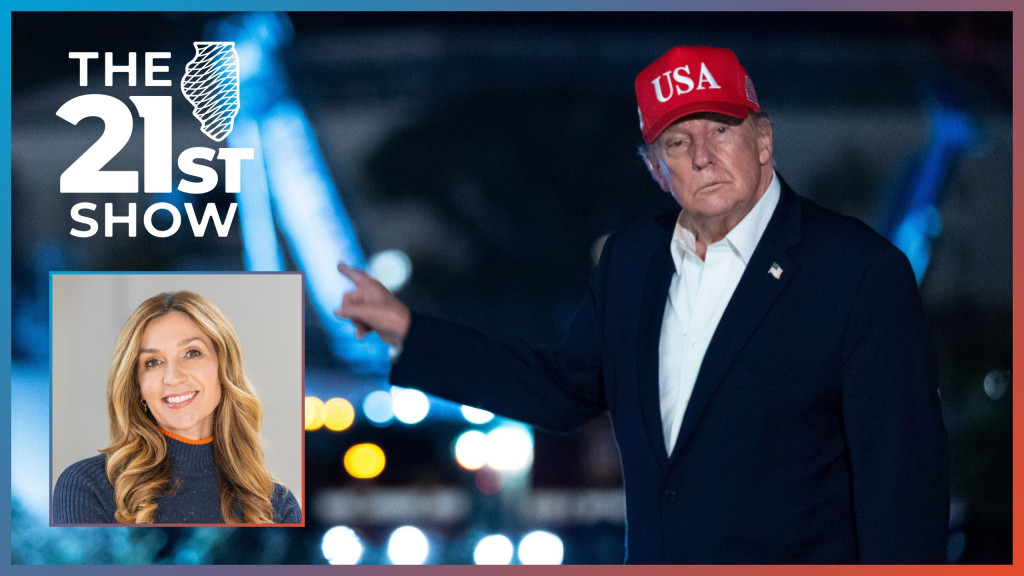
President Donald Trump points to the White House ballroom construction as he arrives on Marine One, early Thursday, Oct. 15, 2026, in Washington. Amanda Carpenter of Protect Democracy argues the ballroom presents a significant separation-of-powers problem that should be getting more attention. Trump: Manuel Balce Ceneta/AP • Carpenter (inset): Protect Democracy
// This is a machine generated transcript. Please report any transcription errors to will-help@illinois.edu.

[00:00:00]
Brian Mackey: It's the 21st show. I'm Brian Mackey, and for the rest of the hour today, we're focusing on the integrity of our elections. I've heard a lot in recent years from people sharing their fears about what could happen with these midterms. Federal agents deployed to intimidate voters, the post office interfering with the delivery of ballots, or even the federal government coming up with some pretext to, quote unquote, cancel the elections. My next guest is someone who's been thinking and writing and preparing for all of this for several years now. Amanda Carpenter is with Protect Democracy, a nonprofit group explicitly working against authoritarianism in America. She grew up in Michigan, went to college in Indiana after working in conservative journalism and politics, including as an advisor and speechwriter for Ted Cruz. She has become an outspoken critic of President Donald Trump. I first became familiar with her work when she was a writer and frequent podcaster at the Bulwark. And Amanda, even today, when I see Tim Miller has you back as a guest, the episode does get bumped up to the top of my queue. So I'm excited to talk with you and welcome you to the 21st show.

[00:01:12]
Amanda Carpenter: Thank you. That is so kind. Thank you for having me here.

[00:01:15]
Brian Mackey: And I should say we're normally a call-in show, but we tape this conversation in advance. So, nevertheless, we did ask members of our texting group, uh, what they think about some of these topics, and I'll share a few of their messages as we go. If people want to join, they can do that by sending the word talk to 217-803-0730. We heard from Chris in Rock Falls, who says the greatest threat to democracy are those who try to game the system for the sake of control. Free and fair doesn't seem to be their concern. We also heard from Jesse in Mattoon who says billionaires are ruining the world. I think President Trump will do and say many false and vile things, most of which will be about the election results. I am almost certain this will be the most consequential midterm election cycle in our lifetime. Midterms are supposed to be boring. This one is anything but. So thank you for those messages. Amanda, less than a month out, how are you feeling about what should be a boring election but is most definitely not?

[00:02:11]
Amanda Carpenter: Sort of how to quantify because there's been so many things on my radar for such a long time that it's a matter of like really taking inventory almost every day to try to see like, where are we going? Where do we think the threat level is the largest? Where do we search resources? Where do we draw people's attention? Because, you know, this is a president administration that puts so much stuff on the table that really sorting through what is actionable and what is not is, is probably our biggest challenge. But I do have to tell — I think one of the biggest things I was worried about, and frankly, was Donald Trump's plan was to establish some kind of national voting database that his appointees could use to essentially purge voters. I'm sure your listeners who are tuned into this have heard about the [save] database and these lists that DHS and even the Census Bureau has attempted to compile, and those efforts have largely been unsuccessful.

[00:03:07]
Brian Mackey: Illinois was targeted in that, yeah.

[00:03:10]
Amanda Carpenter: Yeah, there are tons of people targeted, and it's really because the letter of the law is so plain that the federal government does not have a role in election administration, but that has not stopped them. And if people are looking for any kind of reassurance, I think they should look at the voter data grabs that Trump's Justice Department has essentially tried to seize. They have sued a number of states, dozens of states, trying to get access to that voter data, which contains personal information. The federal government, even if you like the idea of a national voter registry, there is no infrastructure to set that up that has been vetted, let alone has people that are equipped to comb through it. But nonetheless, they've sued a number of states to try to get that data, forced them to turn it over, even threatening to withhold things like emergency grants if they didn't turn it over. And the states have [pushed] back and now the Trump administration is 0 for 25 in those court cases. They've gone to court 25 times. It's really remarkable that the administration would lose so many cases, and it's really because the issue is so clear, and those cases are losing in red states with Trump-appointed judges over and over again. So that is really something they have been unsuccessful in doing. And when we looked at the threat index, a few years ago, I was really worried about the ways that they would block access to the polls, that they would discourage people from voting, make them believe that their vote wouldn't count, and it has been tremendously reassuring to see that that fundamental block has been unsuccessful, and now at this moment, the path to the polls is completely clear. Like we don't know what's going to happen in the election. But you will be able to vote. Those efforts to stop you from doing that, to ban mail-in voting have not worked. And so I'm feeling good about the position, but, you know, anything — a lot of things can still happen.

[00:05:07]
Brian Mackey: Yeah, what are some of the things that you are then most worried about as we are heading into this election period that could still conceivably come up that people should be on guard for?

[00:05:15]
Amanda Carpenter: The things that are scenarios that I think the pro-democracy coalition has been effectively preparing for have to do with things that could occur on election day or in that critical counting period where you do think about the possibility that he would deploy federal agents to the polls for the purpose of taking voting machines and the like. And this isn't speculation because he and his allies, the president and his allies have talked about it, right? They sent the FBI down to Fulton County to seize voter data, when again, there was no evidence of new conspiracies, voter fraud, and the like, so they have been successful in doing these types of things, and you cannot rule out the possibility that in that counting period that there will be pressure again on state and local officials not to certify proper results, the possibility that there may be reluctance to see rightful winners. And so those are the things that we have been planning for. We've been working with organizations and preparing people for the possibility and really equipping people to know what to do in those moments because a lot of the ways that — I just call them the authoritarian faction here in America — has been successful is that they catch people off guard. It's really been a lack of imagination from the opposition, which has allowed them to be successful, but no one will be caught surprised in this midterm election cycle, because we are taking these things extremely seriously. You know, in the past we had the luxury of thinking that the idea of an insurrection was like some kind of a joke. We no longer have that luxury. And so there are more people than ever who are taking these threats at their word, planning accordingly, so that we are prepared and won't be caught off guard.

[00:07:06]
Brian Mackey: Maybe we can go through some of these concerns that I still hear about from people from time to time, sort of like a true or false, and you know, why you think that these statements are true or false. Um, Trump can cancel the midterms.

[00:07:18]
Amanda Carpenter: He cannot cancel the midterms. We are fortunate that we live in a country where elections are so decentralized in the states and in the counties, no single person can stop them or overturn them. Trump does talk about a number of extremely scary things. There's things floated out in the ether. For example, he said numerous times that he thinks because we don't have a federal voting database that constitutes a fraud that is a national emergency, is what the president has said on a few occasions. Because I don't have this thing I want, there could be fraud, therefore national emergency. The words national emergency are scary, right? It has to deal with a number of powers that are unlocked to the president that allows him to have all kinds of tools that he can use unilaterally without the consent of Congress. You can go read the statute, but the number one thing that people need to understand is that none of those powers have anything to do with the elections or election administration. There is no national emergency that he can invoke that will stop the elections because the elections — by the constitution — all those administrative duties belong exclusively to the states. So he may try to do one. No one knows what that would do because it has no practical application. Um, so that is one thing that, you know, people talk about — could he cancel the elections. He can't do it that way. And I don't — no one knows any other way that he would do it. The strongest possibility that we do anticipate is that he would unlawfully send some kind of federal agents into a state or locality where the election results are close, and they feel like that they could tip the results either by alleging some kind of voter fraud that would allow them to seize voting machines or something like that. But that's a few steps down the road. And again, there's a number of checks in place where we could slow that down or block it. But again, the thing that Trump does do, he puts things out there and then he forces other people to fill in the blanks. So again, I can't tell you this is going to happen, but these are the elements that they've put into place. And when they say things like, well, Secretary [Mullen], who is the head of DHS right now, he has been asked straight up several times, do you think you should deploy federal agents to the polls? And he and [Todd Blanche], Attorney General, will say things like, well, we don't see anything wrong with that. Well, there's a lot of things wrong with that, but now that you've said it out loud, we're going to take it seriously and start planning.

[00:09:54]
Brian Mackey: Another thing you hear from people is the idea that mail-in voting is a risky way to vote this year in particular. What do you think of that?

[00:10:02]
Amanda Carpenter: Mail-in voting is one of the most documented, tracked, reliable ways that you can vote. Um, number one, voters, you can vote any way that is best for you. If mail-in voting is the best option for you, you should absolutely continue to do that. It comes to your house, it is documented, they know who you are, you get it there in place, but I am not gonna refute the fact that this idea is out there because people ask me all the time, it's like, well, because Trump has attacked the idea of mail-in voting, is that the best way for me to vote this year? Number one, it's still super reliable, super secure, super safe. But if you want to vote another way, absolutely do that. Early voting is more popular, more available, more accessible than ever. And it's a great way to do it if you wanna make sure you have it in early and your vote is locked — in person, you can feed it into that machine. And then, of course, there's always election day voting. But, you know, there have been attempts to get the United States Postal Service in charge of determining who can vote by mail and how those votes will be counted. That has not been successful. He's wanted to do it. There's a chance he may implement more procedures after this election, but right now everything is exactly the same as it's always been.

[00:11:16]
Brian Mackey: What about some of the wild scenarios like, I don't know, sends, you know, half the postal service on vacation or something like that, you know, to try and just like do some sort of like backroom slowdown of mail delivery. I wonder if that's something that's been contemplated. Yeah, yeah,

[00:11:31]
Amanda Carpenter: the idea that there would be efforts to kind of slow down the count, I think people are pretty well familiar with the idea of the red and blue mirage from previous elections, right? So that is the scenario where traditionally, it looks like Republicans are doing better on election day because for whatever reason, there's more Republicans that vote in person on election day, and it takes a little bit longer for the mail-in votes for Democrats to come in. And so there's that shift where it looks like the Republicans are winning, and that's a mirage because it shifts over into the blue category. And that has consistently been a time period that Trump and other election-denying allies have tried to exploit by saying, OK, we're ahead now, we want to stop the counts — these votes that are coming in later somehow don't count. Personally, I don't think it's great that we have late counts, but this is the way that some states set up their system, like Utah, for example, entirely all mail-in state, traditionally Republican state. So we know like this works and this is traditionally a tactic that they just use to slow down the count and stop it when they're ahead. But as of now, there's no way that they are going to stop ballots from being delivered. But that said, if you do have that concern, go and vote early. I mean, the number one thing, if you're concerned about any of this, just make a plan of what you're gonna do and then have a backup and do it early. The number one thing is do not wait. We think that election turnout is gonna be big. You know, maybe you live in a small town where it's very easy to walk up to the ballot that day and don't have to stand in line for a long time, but you may have to stand in line for hours and trust me, that is not a way anybody wants to spend their day, even though we all think it's our civic duty. So just take advantage of whatever early option is best for you and do that.

[00:13:19]
Brian Mackey: What do you think about the idea that the president could, you know, announce an immigration enforcement surge in certain districts, in certain communities within certain districts, right? Where maybe the vote is, you know, potentially swingable by intimidating people from showing up.

[00:13:34]
Amanda Carpenter: Yeah, I personally think that would be politically crazy because people have seen how he's deployed, you know, ICE agents on the streets now and have not liked it. Um, he has the ability now to send ICE troops wherever he likes because unfortunately, Congress hasn't stopped them and they've funded that particular agency to the hilt. So, I'm not gonna say that isn't a possibility, but it's another reason to make a plan to vote early, quite frankly. And that also, like, it does apply to mail-in ballots. Don't wait to get it in. Don't wait. If you know who the candidates are, and you don't have any more like education and research to do into the candidates, get that ballot in and don't wait. If you don't want it to be one of those ballots that's counted a week after, depending on where you live, where it might sometimes take a long time, just get it in. Bank it and then tell the people to do the same because there could be things that happen. I mean, I'm not gonna say these things are not possible and everything is absolutely gonna be OK. If you want to be OK, get your vote in early.

[00:14:36]
Brian Mackey: One of the other things you hear from people is like, look, the outcome is predetermined. Why even bother to vote? Can we just set that to rest briefly as well. I don't know if that's something you encounter in the world, but

[00:14:47]
Amanda Carpenter: absolutely, you know, that kind of reminds me — you know, I talked to my kids, my kids are playing sports in middle school and high school, and sometimes we go up against, you know, a school that's a lot bigger because it's just a scrimmage game. They go in there saying, well, you know, we're probably gonna lose. I said, well, that's why we play the game, right? Like, if you think you're gonna lose, why are we playing the game at all? You have to go out there and execute on your plays and see what's gonna happen. And people that are listening to this show, I'm sure they're looking at the polls, and they are — you know, it looks like we're on pace to have some surprises, some upsets, potentially do something unprecedented in many states. And so the only factor here is the people. I mean, if you are worried about any of these scenarios, right — ballots not being counted, ICE agents going somewhere — the best thing to do is have such a massive turnout in one direction or the other where the results are not disputable, right? Because the scenarios where we're looking at where there could be federal agents coming in to take voting machines and things like that, they're only deployable to certain areas. They're not going to go worldwide in any scenario. There's just not enough of them. We the voters outnumber the federal agents if that's your concern. Um, it's going to happen in places where they feel like if they surge resources, it can really tilt the outcome of an election. And so, if you don't want them to be tiltable, have a massive turnout so that they're not tiltable and the direction is clearly, clearly going in one way or the other.

[00:16:26]
Brian Mackey: All right, we're gonna take a break on the program. Uh, we are speaking with Amanda Carpenter of the group Protect Democracy, which works to safeguard the integrity of American democracy and elections and, I guess to be blunt about it, to prevent authoritarianism here in America. We tape this conversation in advance, so no calls today, but you can always let us know what you thought. Talk at twentyfirstshow.org is the address. We'll have more after a short break. Stay with us.

It's the 21st show. I'm Brian Mackey. We are talking today with Amanda Carpenter of the group Protect Democracy. It's a nonprofit working against authoritarianism in America. We taped this conversation in advance, so we're not taking calls, but we did ask members of our texting group what they thought about the upcoming elections. By the way, you can join that by texting talk to 217-803-0730. We heard from Wayne in Savoy, who says, were it not for Trump, I would not be worried the least bit about the integrity of our elections or the peaceful transfer of power. With him in office, I'm starting to worry a lot. His minions excel at finding technicalities, and he excels at simply ignoring or breaking laws. His Supreme Court must bear a lot of the responsibility for this. Thanks for the message, Wayne. Amanda, when the voting is done, right, the ballots are counted, where are some of the vulnerabilities that you see in the days after the election itself?

[00:18:36]
Amanda Carpenter: So you have to keep in mind the time period between election day and the day that the new Congress is seated — you have 61 days. It is quite a long time. People think, you know, in normal times, when things go smoothly, people go vote. You maybe flip on the news that night, check your local news channels, you know the winners sometime in the next day or two, and your job is done, right? Like you don't think about it again. That's how it should work. Unfortunately, after the 2020 election, I think a lot of us got a quick course in all the election processes that happen from election day until January 6th when the new Congress is seated and the new president is certified. And so what happens in that time period is that the states and local officials, they'll certify results. That is the time period where you saw a lot of pressure coming from the administration to get people to slow down, hold baseless investigations, or potentially even overturn the results. That also happened when the states met their certification deadlines, which depending on where you live, can happen sometime in mid-Decemberish. It's all a little bit different. And then there was all the mobilization that happened from late December until January 6th where people were really focusing on former Vice President Mike Pence to try to get him to somehow overturn the results. But you know, the one thing that we all learned — and it was always a law, but we're continuing to do a lot of education about it — is that when it comes to certifying results, many officials, including the vice president, have what's called a ministerial duty. That means they just count the votes that are given to them. They actually have no mechanism to overturn it. That is not a place for them to decide, well, I don't like the way that Pennsylvania or Illinois ran their elections, therefore I'm just not gonna count it. That's not a thing, which is why Vice President Mike Pence didn't do it in actuality. And when there are disputes about what happened in the election, like there have been legitimate allegations of voter fraud that do need to be [treated], you need to have audits. Like there are mechanisms to do this. There always have been mechanisms to do this, and that takes place in that period between November 3rd and January 3rd. And depending on the states, there's different deadlines because you can't just draw it out forever, right? Because everyone knows if you're just going to litigate it forever, rightful winners would never be [certified]. So there's accelerated deadlines so that these things can be resolved quickly on a smooth timeline so that our democracy is just not held up forever while people fight over the results. And those processes work. After the 2020 election, you know, Donald Trump went to court dozens of times to settle these voter fraud allegations. They were rejected again and again. And so we have a process to resolve them as we've done in previous elections, even when Bush v. Gore happened. And so that is why we have that time period to sort through things in a very orderly, previously decided way. But that doesn't mean people won't try to exploit it again, but I do think because there's been organizations like ours and so many others who are talking to people and doing the education about, OK, this is a way to resolve it. You know, if you're a polling official or a county clerk somewhere and you get this crazy call from the president potentially — which did happen to commissioners in places in Michigan the last election — here's what you do. Here's what your duty is. Here's the right way to resolve it. And so we have a saying at [PD] — that's Protect Democracy, my organization — panic is the enemy. And so we're not gonna be panicked this time because we do have a system that works if we use it.

[00:22:28]
Brian Mackey: I've been covering midterm elections, I think, uh, 2008, 2014, 2018, 2022. No president wants to lose control of Congress. What do you understand to be the reason President Trump seems to be so concerned about it at this time? I mean, I guess the polling is one answer, but you know, what does he have to lose?

[00:22:49]
Amanda Carpenter: He fears the accountability that potentially comes with the Republican Congress losing control and Democrats getting gavels on committees like judiciary, oversight, uh, banking, finance. And I think this is, aside from protecting our elections, this is the next biggest issue of our time — the unprecedented amount of corruption that is coming from this administration that we have never seen before. Um, going into this, I thought one of the biggest things we'd have to confront is pardon abuse, like the way that Donald Trump mass-pardoned January 6th rioters, continues to pardon all kinds of sketchy figures that I don't think are deserving of the amnesty. Traditionally, presidents can, you know, use pardons to exercise some kind of public policy good. It's based on issues or some kind of scale, though, of course, presidents have abused it in the past, like President Clinton's pardon of Marc Rich and others, but Donald Trump has taken that to a much bigger scale. What I didn't expect to see is the huge amount of financial entanglements and the private amount of profit that Trump is generating for himself and his family off government decisions that he makes. Listen, members of a president's family have a right to make money. I think it is objectionable how much money they're making directly off regulatory and approval decisions that their own father makes. I mean, when you look at the crypto profits, Donald Trump reported making $2.2 billion sitting as president in 2025. About $1.2 billion of that came from their crypto empire, which is a new business, essentially created out of thin air, that is heavily financed by people with all kinds of foreign entanglements, including sovereign wealth funds for the United Arab Emirates, where, you know, his son-in-law Jared Kushner is flying around holding meetings. His sons are trumpeting the stock while at the same time claiming that they're passive investors. And so when you begin to look at all of these different things, you certainly have to wonder if they're putting the public good or family interests at the center of major decisions regarding things like national defense and defense contracts, and also when it comes to international diplomacy. And the matters are just really, really spiraling in a way that is so systematic and difficult to understand and track by the general public.

[00:25:29]
Brian Mackey: Yeah, $2.2 billion. The presidential salary last time I checked was still $400,000. That is 5,000 times the presidential salary.

[00:25:39]
Amanda Carpenter: Yeah, one thing that's super interesting to think about, potentially, where the reform needs to go is — yes, reporting requirements need to be much more stringent, but the old nepotism laws that were essentially passed in 1967 were designed to stop, say, a president from giving their sons fancy government jobs. Let me tell you what, these people don't need a government paycheck. The amount of money that they're generating outside in the private sector off decisions that their father is making makes a government salary, even at the highest scale, seem like peanuts. We need to urgently update these laws so that they capture these kinds of relationships where you have fathers like Donald Trump and Secretary [Lutnick] and Special Envoy [Steve Wetkoff], um, who have sons who are profiting off these decisions. And when you start to look at it, they're so entangled between the crypto and the foreign capital and the mining contracts and defense contracts, it is really stunning. And there is going to be stories to tell and a lot of investigations. So one of the reforms that we're thinking about at Protect Democracy have to do with — well, knowing that Donald Trump likes to wield the pardon pen and has talked about how he'll pardon anybody within 200 feet of the Oval Office — what do we do to stop this? And the good news is there's a path with civil — they're called disgorgement laws — that essentially allow you to claw back any money from ill-gotten gains. Anything that can be tied to bribery, extortion, insider trading, and the like. And so I do think there is going to need to be a lot of accountability coming in the future years. Otherwise, the presidency is just going to be a vehicle for generational family enrichment.

[00:27:29]
Brian Mackey: Are you confident that if Democrats take control of the House and Senate that they are going to take up those issues or, you know, are they gonna say, hey, we need to focus on the future and the economy and that sort of thing.

[00:27:43]
Amanda Carpenter: I'll be honest with you, I know that they know it's an issue they should do something about. I think it's difficult to determine what to do and so I think a lot of smart people are thinking about what are actionable things that we can put on the table that are meaningful to show people that there are consequences to this sort of unethical behavior. And you know, they may need to push. They may need to push if Democrats get into power to do more than just oversight and saying, well, you know, the [ballroom's] there. What are we going to do now? Um, if we don't want to go back to this, and if we want to stop the corruption, we absolutely need accountability and reforms and new regulations and laws with teeth, because otherwise we'll just see the next party come in and point to the other party and say, well, they did it, so what I did is OK. And I've been seeing people pointing the finger at each other since I've been working in Washington, which hasn't been forever, but it's been long enough to know that's what they do.

[00:28:46]
Brian Mackey: You've been writing and thinking and working on these issues with Protect Democracy for what, three years now. Voters still say, you know, they put sort of lowercase-d democracy as a lower-rank concern of theirs. What have you learned about communicating with people that this is something they should care about and that they should really prioritize in their voting, you know, especially beyond people like me and maybe some of our listeners who wrote in, who are primed to be worried about this stuff.

[00:29:13]
Amanda Carpenter: Yeah, it's certainly a thing that most people take for granted and because we're Americans and we live in the greatest country on earth, we've had the luxury of taking it for granted. And I do think January 6th was such a wake-up call to so many people, but it is a continual struggle. You have to explain to people why democracy matters, why your vote matters, why corruption matters. That's been something — since I've been doing more corruption work more recently, I always have to remind myself, explain to people why the corruption is corrosive to them. And it's like, well, it's because it makes government services a lot crappier for you. Look at the reflecting pool. If you want to know why corruption is bad, the reflecting pool — I swear to God, it's the best example we've ever had because everybody was so focused in on it. Number one, it was like this egotistic, unneeded project that the president just decided he wanted to do as this vanity thing ahead of America 250. They, you know, they fired all the experts who could have done a good job with this, hired some person with no experience who said that they could do it on the cheap. Turns out it didn't work, is falling apart. Um, then they ended up prosecuting people who dared point it out — that poor canoeist or bicyclist who came down, I can't remember [whose fraud] — the charges were dropped, but they still smeared the guy and everybody else who said, hey, that water's green. There's a piece floating here. Oh my gosh, I might pick it up. But this is what authoritarians do. Like they screw things up so bad and anybody who points it out, they throw the hammer at. And still it's not fixed. This is supposed to be some, we'll get it done in two weeks and $2 million. We're paying for it over and over again. It's at least $14 million. Who knows how much more it's going to cost?

And so I do fear slash expect this is how the ballroom is going to go too. Do you know how big the ballroom is? No one does. Where is he getting the money for it? No one consented to this thing. He came out and told people that he would have private donors to pay for it — never mind we don't know who those people would be, what oligarch from what country wanting what favor. Who knows? That said, he was stealing the money through the Office of Management and Budget from things like national parks and the Secret Service. Even though Congress declined to fund it — he went to Congress, asked them to fund it last summer, um, I think Senators [Grassley], maybe [Graham] got it into some bill, and they stripped it out because there was this outcry saying we don't have a billion dollars for your ballroom. So Congress said no, but somehow he's getting $900 million according to the Washington Post anyway. I mean, that's corruption too. And so if you think that a president who followed no process to get the money for the ballroom — I don't know how there's any expectation that this will be a quality product. I mean, the Washington Post also reported a couple of weeks ago that they just fired the architect because the architect — or the architect resigned — because there were fire concerns that people wouldn't be able to get out of the ballroom if something did go bad, so he actually left. And so I don't know what kind of bag potentially the next president is going to be holding on that. Could be a giant hole in the ground, but this is like the corruption at work.

[00:32:28]
Brian Mackey: Amanda Carpenter with Protect Democracy, thank you so much for sharing your work with us today on the 21st show. Thank you. We'll have a link to some of Amanda Carpenter's writing on democracy as well as corruption in the current administration at our website twentyfirstshow.org. That's it for us today. The 21st show is a production of Illinois Public Media. I'm Brian Mackey. Thanks for listening.
With just weeks until the Nov. 3 midterm elections, many people are worried about what could happen — from federal agents at polling places to the president trying to "cancel" the vote. Amanda Carpenter of Protect Democracy, a nonprofit working against authoritarianism in America, says some of those fears are unfounded, while others are worth preparing for.
Carpenter says President Donald Trump cannot cancel the midterms, because elections are run by states and counties, and the national emergency powers he's floated have nothing to do with election administration. She says the Justice Department has lost all 25 of its court cases seeking states' voter data, by her count, and that mail-in voting remains one of the most reliable ways to cast a ballot.
Her advice: make a plan, have a backup and vote early. The bigger vulnerabilities, she says, come in the roughly two months between Election Day and the seating of the new Congress, when results are counted and certified. "Panic is the enemy," she said.
Carpenter also discusses what she calls the unprecedented corruption of the Trump administration — from the Trump family's cryptocurrency profits to the White House ballroom — and why she says control of Congress matters for accountability.
Discussed
- Protect Democracy:
- Amanda Carpenter's recent writing:
Guest
Amanda Carpenter
Writer and editor, Protect Democracy