








Why a virus hunter fears human behavior more than viruses
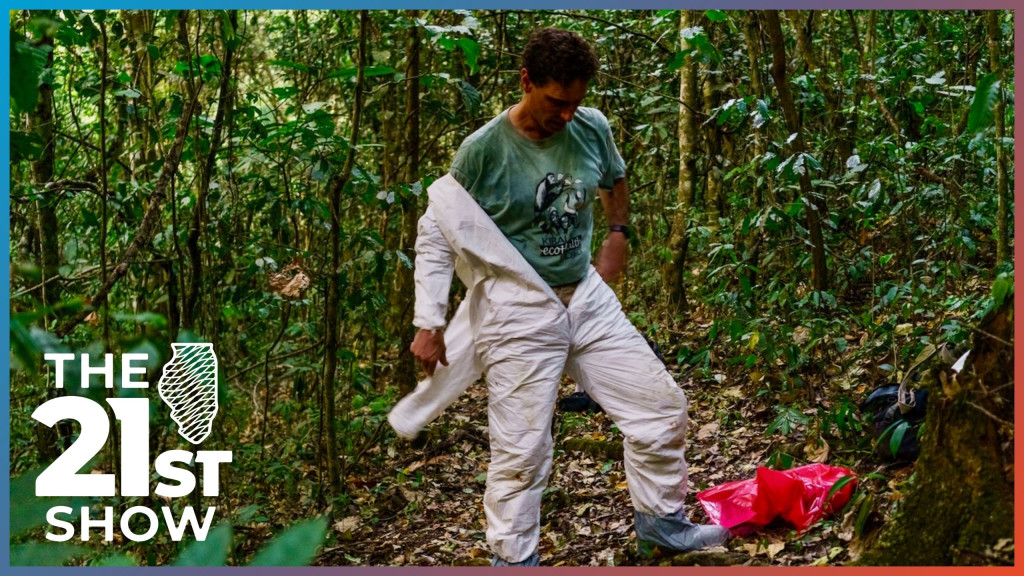
Tony Goldberg prepares to conduct a post-mortem exam on a chimpanzee in Uganda. Ronan Donovan via Tony Goldberg
// This is a machine generated transcript. Please report any transcription errors to will-help@illinois.edu.

[00:00:00]
Brian Mackey: Today on the 21st show, Tony Goldberg has traveled the globe investigating diseases that can move between animals and people. And sometimes that means studying the parasites that attack him along the way, including a tick that hitched a ride from Uganda up his nose. Goldberg is based at the University of Wisconsin, but he was educated in part at the University of Illinois. He's returning this month for a public lecture. We'll talk with him about his work and the status of international disease research after last year's cuts in government funding. I'm Brian Mackey, and that's all coming up today on the 21st show, which is a production of Illinois Public Media airing on WILL Urbana, WUIS Springfield, WNIJ Rockford DeKalb, WVIK Quad Cities, WSIU Carbondale, and Tri-States Public Radio, Macomb, Galesburg, and Keokuk. Now news.

From Illinois Public Media, this is the 21st show. I'm Brian Mackey. Back in 2012, a scientist came home from a research trip and felt something irritating in his nose. When he investigated what it was, he found a tick. It was not his first, but this one had flown across an ocean with him. For Tony Goldberg, that's just part of the job. He studies how diseases move between animals and people — in chimpanzees and monkeys, in bats, and in freshwater mussels, including in the upper Mississippi River. Goldberg earned a PhD in anthropology at Harvard in 1996. Then he came to the University of Illinois in Urbana, where in 2000, he earned a master's degree in epidemiology and a doctorate in veterinary medicine. Today he's a professor of epidemiology in the John D. MacArthur Research Chair at the University of Wisconsin-Madison. He also directs the [Kabbale] Eco Health Project and the UW Madison Global Health Institute, which is a center of excellence in [thelo virus] network.

Goldberg is returning to Illinois next week for a public lecture titled Scary Viruses, Killer Tapeworms, Nostril Ticks, and Armpit Maggots, Unexpected Findings from Ecological and Genomic Research on Emerging Infectious Diseases. I hope you're not eating during the show today. More about all that later. For now, I'll just say Doctor Goldberg, welcome to the 21st show. Thank you for being with us.

[00:02:37]
Tony Goldberg: Thanks so much, Brian. It's great to be here.

[00:02:39]
Brian Mackey: And uh listeners, if you want to join us throughout the hour today, the number is 800-222-9455. That's 800-222-9455. All right, we, we have to start with some of the creepy crawlies. So take me back to the moment you discovered that tick in your nose. What was that like?

[00:03:00]
Tony Goldberg: Sure, well, um, before I get into that, I will say that I don't think I'm any more parasitized than most other people I know, so — to hear that. It's true and we can talk about that, but, um, my, my particular experience and my notoriety for having parasites is just from the fact that I decided to publish about them. So yeah, that's a, that's I guess a, a curiosity-killed-the-cat sort of thing.

But yeah, this is, this was back in 2012. And as background, one of my long-term field sites is a beautiful national park in Uganda called [Kibali], where there's a great biodiversity and biomass of primates including chimpanzees, and that's why I go there. But at that particular time I was coming back from the field and I was on the plane between Amsterdam and Chicago when I felt something unusual in my nose, and I knew what it was because I'd had a few of them before. They're not uncommon to people who visit [Kibali] National Park. I knew that it was the infamous [Kibali] National Park nostril tick. So the first reaction is of course to try to claw your own face off if you, if you know that you have a tick up —

[00:04:26]
Brian Mackey: That's good to know. I was a little worried that you did not have that natural reaction.

[00:04:30]
Tony Goldberg: No, I'm, I'm a human last time I checked, so yeah, I wanted to like go to the, to the restroom on the airplane and like do something, but I knew better than to try because these things go way up there and they're very difficult to get out, so. I, I practiced mindfulness and thought about other things for a while until I got back to Madison. Then I went to my lab and using a mirror, a flashlight, and a pair of tweezers was actually able to extract the specimen. I, I won't go into any more detail than that except to say that my aim was good, so I didn't get any collateral nose hairs.

And um I became curious about it because again these things are not unheard of. Many people who go to [Kibali] National Park get them and they fall out on their own, usually like in the checkout line at Walmart or something, and that clears the store right away. But I was kind of interested in what, what these things could be because I'd never heard of this happening anywhere else. So I sent the tick to a colleague of mine, Sarah Hamer at Texas A&M University, who's an expert in ticks, and she did some DNA sequencing to try to identify what this tick was. It's a member of the genus [mblioma], but its DNA sequence did not exist in any database. So we think it's either a species that's never been sequenced before or a new species of tick.

[00:06:06]
Brian Mackey: So what does that tick tell you about how disease moves between, you know, chimpanzees and people?

[00:06:14]
Tony Goldberg: Yeah, well, I mean, the chimpanzee part is, is the interesting part of the story too. Well, I guess it's interesting that I had a tick in my nose, but the chimp link is, is really interesting. So, OK, this was a new species of tick. I started to wonder, why did I get it and why do people in this one particular location tend to get these things, but you don't really hear about it from other places.

Well, there was a study going on at the time of juvenile development in chimpanzees, so cute baby chimps grow, of course, and one of the hallmarks of development, as anyone with a child knows, is when the teeth erupt, you know, when they start crying and teething. So my collaborators were interested in when the molars of baby chimpanzees erupted or came out from the gums. So how do you do that in the wild where you can't go near the chimps except for like binoculars and cameras? They hired a photographer to take pictures of baby chimps yawning. And if it was just right, if the angle was just right and the light was just right, you could see to the back of their mouth and see if their molars had erupted.

So as you can imagine, there were hundreds and hundreds of photos where they missed, where they couldn't, you know, the chimp turned its head or the lighting wasn't right, but with a chimp yawning like that you can see up its nose, and we noticed that about 25% of the photographs had evidence of ticks up the noses of these chimpanzees. So it became apparent over time that these were chimpanzee ticks. They're ticks that habitually go into the nostrils of chimpanzees. Why? Well, if you're a chimp, the thing you like to do most in the world is groom, and if you're a tick on another chimp and you're spotted by a grooming chimp, you will get picked off and eaten. So you need a place to hide. And what better place than a nice warm vascular nose. And I'm 99.something percent chimpanzee genetically, so the ticks didn't really care that I wasn't the chimp — I was close enough and it got into me.

[00:08:27]
Brian Mackey: I'm also learning that the chimpanzee grooming practices, I guess, extend to the human taboo of not picking each other's nose, right? You can pick your friends, but you can't pick your friend's nose.

[00:08:37]
Tony Goldberg: That's right, you can't. Uh, you can try, but I wouldn't recommend it, especially not with a chimpanzee — and they have these fat stubby fingers that, yeah, it would be a real stretch to get it up there. So it's a good place for a tick to hide.

Now in terms of your question about disease — so far, I don't have any unusual cravings for bananas or any symptoms like that, but, uh, you know, it, it did make me think quite a bit about just how globalized the world is. I was able to fly back from East Central Africa to the Midwest United States in, you know, 24 hours essentially with a hitchhiker. How many times does that sort of thing happen and how responsible is that sort of globalization that we live in today for the rapid spread of infectious diseases that come from wildlife.

[00:09:36]
Brian Mackey: Uh, now you're getting to the rub, right, which is where we think about modern spillover events and the possibilities and, you know, how, how long it would take or how little time it would take for something like this to get around the world.

Yeah, so maybe we can talk about another, uh, uh, episode of, uh, parasitization — that is a verb form of a noun that I had not previously heard. I gather from a little quick, uh, internet search that it's common in the scientific literature, but, uh, it's in the title of your talk, and that is armpit maggots. What is that story?

[00:10:10]
Tony Goldberg: All right, well, I guess I feel OK telling this story because we are approaching Halloween, so people are in a grossed out, scary kind of mood. Um, yeah, the armpit maggots. So same place in Africa, [Kibali] National Park, uh. Nose ticks are fairly uncommon, but bot flies are very common. So if you spend any length of time there, chances are you're going to get infested with the larvae of a flesh fly called a bot fly that burrows into your skin and grows there in a little pimple. These are small, so thank goodness they're not as big as the South American variety which grow huge and are very difficult to get out.

These are small. We think that the flies lay eggs on laundry that's hanging out to dry, and then if you don't iron it well enough, the eggs get on your skin and the larvae burrow in, start to grow, and you notice something that feels kind of like a pinprick, and then if it's in an accessible location, you can squeeze it out yourself. If not, then you find out who your friends are when you ask someone to please squeeze out your fly.

Um, so for all the time I've been working in this part of the world, people had a name for these flies. They called them mango flies. That's the common name for a parasite called [Calobia anthropophagga], which is a common bot fly in the region, and its species name, anthropophagga — you know, eats people — tells you kind of how it makes a living. So I thought these were mango flies just like everybody else did. I was doing a study at the same time on primates in the area and we were able to get a hold of some primates and collect their bot flies.

Then just like with the nose tick, I came back from the field and found that I had another hitchhiker, this time in my armpit, and it was a mango fly. This is not uncommon. Lots of people come back from the tropics with bot flies, but I started to, to think about how to put two and two together with the primates and my fly. So I, I harvested my bot fly and told some friends who also work on the same site about it and received — very kindly received — some donations of bot flies from them, who had also made the transatlantic journey. And did a little bit of genetics on these flies, and it turns out they were not mango flies at all. They are a species of lesser known bot fly called Lund's fly — L-U-N-D apostrophe S — named after Commandant Lund, who was a Belgian officer in the Belgian Congo in the early 1900s, and there was a whole history of research on this particular fly way back then.

And it was never really clear what its ecological niche was, so like with the nose tick, I stumbled upon a clue about what the ecological niche of this fly is, and I think it's primates. So primates had a lot of these things. People are primates. People get them in places in Africa with a lot of forests and a lot of primates. So it's, again, one of these — I was not going to Africa to get parasitized. In fact, I was taking great pains not to get parasitized, but it's a, it's a good example of how, you know, unexpected things happen when you do field research and if you keep your eyes open, you can sometimes find out interesting things that matter in ways you never would have imagined.

[00:13:56]
Brian Mackey: Yeah, well, and I think, you know, what, what strikes me is that you react not only with horror — although it sounds like with some horror — but also with curiosity. You did say near the beginning that you're no more parasitized than anyone else. Say more about that.

[00:14:11]
Tony Goldberg: Yes, well, it is true that we — humans — are our own cells, but also the cells of many microbes that live in and on us and some not-so-small microbes, so I can pretty assuredly say that almost everyone listening to this broadcast has some sort of parasite. Maybe that's, you know, a bacterium that lives in your gut and makes you sick sometimes, or maybe it's a mite. There are mites that live in our hair follicles, for example, and they're considered normal. So parasitism is a fact of life. It's gross, but, you know, as, as a colleague of mine likes to say, the bright side is that you're never alone when you're parasitized.

[00:15:03]
Brian Mackey: That is not — that is not reassuring. Uh, it is not the, uh, "you'll never walk alone." It does not make me want to burst into song. Um, just, just a couple of minutes until we need to take a break. Uh, given, given everything you've said so far, I'm almost afraid to ask you about the killer tapeworms of the, uh, title of your talk, but what is that about?

[00:15:24]
Tony Goldberg: OK, so that's another story. This was not me who got a killer tapeworm, by the way.

[00:15:30]
Brian Mackey: Good to know. Good to know. Yeah, so is this Mahal, the orangutan?

[00:15:33]
Tony Goldberg: That is correct. So, uh, this was a tragic story from the Milwaukee County Zoo where one of their beloved orangutans, Mahal, who was a baby, had this wonderful origin story. He was abandoned by his birth mother in Colorado and flown to Milwaukee on a private jet to, uh, be reared by a surrogate mother who took to him wonderfully and they loved each other — and then he suddenly died, Mahal, for reasons unknown, and the community of Milwaukee was really in grief about this. So because I work on infectious diseases of primates, the Milwaukee County Zoo folks called me and asked if I could help with the investigation.

And to make a long story short, what killed Mahal was a species of tapeworm that is not uncommon in Wisconsin. And that takes a little bit of explanation because when I say tapeworm, you're probably thinking of that long ribbony thing that lives in the intestine, or maybe if you had a dog or a cat and it poops out little squiggling segments that we call proglottids, maybe you'll understand what a tapeworm is that way, but this is another life stage of the organism. Tapeworms, before they become those long tapey things, go into the muscles of prey species. And encyst there — E-N-C-Y-S-T. So they, they set up shop there waiting —

[00:17:05]
Brian Mackey: Let's, let's, let's pause on that. Yeah, we will take a break and we will continue with Doctor Tony Goldberg — PhD, doctor of veterinary medicine, master of epidemiology and professor at the University of Wisconsin-Madison. More after a break. This is the 21st show. Stay with us.

It's the 21st show. I'm Brian Mackey. We are speaking today with Tony Goldberg, who is a professor, John D. MacArthur Chair in the Department of Pathobiological Sciences, the School of Veterinary Medicine at the University of Wisconsin-Madison. He's also a leader of the Global Virus Network lab at UW Madison and the [Kibali] Ecohealth Project in Uganda. And he was educated — uh, his doctorate of veterinary medicine as well as a master's in epidemiology were from the University of Illinois. He is returning to central Illinois next week to give a talk on scary viruses, killer tapeworms, nostril ticks, and armpit maggots. If you want to join us today, 800-222-9455 is the number. 800-222-9455.

So before the break, we were talking about Mahal, the orangutan at the Milwaukee County Zoo. He died of the killer tapeworm of your talk title. Um, you were brought in, you found that this is a species, um, I guess what is the term, endemic to Wisconsin or it lives in Wisconsin. Um, and I guess the, the bigger question is here, what are the implications of this for the people in Wisconsin or, or animals in Wisconsin zoos or, or take it where you will.

[00:18:59]
Tony Goldberg: Yeah, thanks for the question. So — and apologies if I droned on a bit about parasites. One thing — anyone who studies parasites can talk for a long time about them. So feel free to interrupt me anytime.

But yeah, without going into too much detail, this endemic Wisconsin tapeworm was the thing that killed the orangutan at the Milwaukee County Zoo. And when we published the article, I made sure to put in a little note in the discussion saying, you know, orangutans and people are pretty closely related, so we should watch to see if this could potentially infect people. And about two years later, a couple of reports were published about this parasite infecting people. So mainly these people were immunocompromised. This is not a tapeworm you really have to worry about at all. Its natural host is weasels, actually, which we have a lot of up here in Wisconsin. So it's not anything anyone has to really worry about unless you're severely immunocompromised.

But still, the lesson of this story for me is that if we find a new, interesting, and potentially dangerous or deadly parasite or pathogen in an animal, it should ring some alarm bells and we should kind of move it up on our list of concerns and watch out for it in people.

[00:20:29]
Brian Mackey: Well, maybe this is a good uh segue to talking about simian arteroviruses — and please correct my pronunciation throughout our conversation today — but, uh, related to simian hemorrhagic fever, which is another uh area where you and your team have done some work.

[00:20:43]
Tony Goldberg: Yes, um, yes, perfect pronunciation, by the way. Um, so this was another unexpected but very interesting finding. So the reason I work in Africa is that primates — nonhuman primates — are thought to be a source of many important human infections. We know most about HIV, the virus that causes AIDS. The globally distributed strain of HIV, we call it HIV-1 group M, a very specific type, originated in Central African chimpanzees and evolved into HIV that has spread throughout the globe. So the AIDS pandemic had its origins in chimpanzees in Africa, so it's, it's observations like that that interest me and my colleagues who study similar things to try to understand what else is out there that could potentially cause problems.

So in my lab, one of the techniques we use is, for lack of a better term, virus hunting. We can take biological samples of any sort really and use a modern DNA sequencer to sequence millions upon millions of DNA and RNA molecules at random. Then we ask the computer to tell us what's monkey and we throw that out and we look at what's left, and that contains all sorts of interesting things like viruses. So the first time we did this on a monkey from Uganda, lo and behold, out of the computer screen popped a virus that had been a mystery for 40 or 50 years — simian hemorrhagic fever virus. It sounds really scary. It is if you're a monkey. It causes a disease in macaques, which are Asian monkeys, that's clinically indistinguishable from Ebola, so a severe hemorrhagic fever. And this virus and the disease it caused were known from 1964 when it popped up in the United States and the Soviet Union at the time and was an existential threat to the space monkey program, so it's got a lot of history.

But we stumbled upon the first natural, wild primate infections of a virus related to this, and from that point forward, um, we followed that lead, found a lot of other viruses, began studying them in the lab. I collaborated with folks from the NIH and from the U.S. Navy, um, and I'm still working on that today. My, my very gifted virology colleague Cody Warren at Ohio State just got an NIH award to do some fancy molecular investigations as to whether this virus could infect people and become the next pandemic.

[00:23:44]
Brian Mackey: Yeah, you, you had one of your team's papers on this — it was titled "Primate hemorrhagic fever-causing [arteroviruses] are poised for spillover to humans" — and you have characterized that as a pretty controversial assertion. So maybe talk us through that, you know, what, what passes for like, oh no, he didn't, in the, uh, you know, virology world.

[00:24:05]
Tony Goldberg: Yeah, no, that's a, that's a good question. So that title was intentionally provocative. Um, my, my colleagues and I — you know, if you think about pandemics, like, of course SARS coronavirus 2, but also influenza, HIV AIDS — our responses are largely reactionary. We notice that people are getting sick, we investigate the cause, we find out it's something new, and we scramble. It doesn't have to be that way. We know that there are certain types of viruses and certain types of wildlife — or not even just wildlife, but animal hosts in general — that are the riskiest from the perspective of human spillover and pandemic potential. So we are intentionally making the argument that viruses like simian hemorrhagic fever are things we should watch even though they've never been detected before in people.

Imagine if we had known about SARS coronavirus 2 in bats before it emerged into people and we had a ready vaccine at the very, very early stages of the COVID pandemic — it would have been a game changer. So we're arguing, you know, to quote Benjamin Franklin, that an ounce of prevention is worth a pound of cure.

[00:25:30]
Brian Mackey: What happened when you tried to get funding to study whether these viruses could infect people?

[00:25:36]
Tony Goldberg: It was a battle. We had several failed attempts to get funding from different federal funding agencies, but in the end we succeeded. I think just because of the sheer volume of convincing evidence that my virology colleagues were able to generate showing that these viruses very happily infect human cells, don't need to change at all to do it. And, you know, look — at least in cell culture, in a dish — just like they're infecting their natural monkey hosts. So that was enough of an alarm that I think we convinced people it's worth studying. And I — certain people in federal granting agencies at NIH or NSF, for example, also believe this idea that we need to understand pathogens before they get into people in order to have the most effective countermeasures.

[00:26:35]
Brian Mackey: You know, the, the idea of where viruses come from and, and spillover events, right, which is when, when, uh, uh, an infection goes from one species to another — notably, I think when, when humans talk about, well, only humans can talk, right? So when we talk about spillover, we're talking about potentially infecting humans, or at least that's what, you know, the public conversation — uh, I still hear people arguing about the origins of COVID-19 and whether it was a, you know, a natural event in a wet market, uh, you know, bat, bat feces gets into a pangolin cage or, or whatever, or something that escaped from a lab. I wonder how you processed that public conversation and the controversy around it as someone who has studied this very, you know, process of disease spillover.

[00:27:22]
Tony Goldberg: Yeah, good question. So, you know, in, in full disclosure, my money is very squarely on natural zoonotic infection from a bat somewhere. Um, but it reminded me — the earliest days of the COVID pandemic reminded me a lot of the early days of the AIDS pandemic when back then there were lots of theories about where AIDS came from. Some people said, you know, it was divine punishment. Some people said it must have come in on a meteor because it was so different from anything we'd seen before. Some people thought it was a, a, a government lab leak. There was that. And there was a, a huge controversy for a while where a, a particular journalist wrote a book claiming that the origins of AIDS had to do with contaminated polio vaccines used in Africa in the 1950s, which caused a lot of worry because, you know, polio vaccination is one of the great success stories of public health.

So in the end, all those theories were disproven and we know now that the origins of AIDS were through a natural infection somehow of, of humans with a chimp virus. We don't know exactly who or where or when or how it happened. We'll never know that. But it reminds me very much of the COVID pandemic. People are afraid. People are confused. People, um — now, now we have the internet to amplify voices. So I think people are rightfully searching for answers. Why is this happening? Um. So yeah, that's, uh, you know, I, I think that's the genesis of this, this type of reaction that we see.

[00:29:13]
Brian Mackey: Is there something — is there a lesson here? In the idea of, I mean, you mentioned AIDS, right? And I, I think AIDS, it was such a, a fraught conversation because so many of the earliest victims, at least the ones we knew about, were, were gay men. And that, that brought in a lot of this, you know, the sort of divine retribution aspect you were talking about. And I mean, correct me if I'm wrong on this — my understanding is, is our best guess is, you know, maybe it was people hunting chimps and, you know, uh, primate species and butchering them and getting blood infection that way, not, not anything, you know, sort of sexual, even though that was sort of the early sort of valence or connotation that, that AIDS had. Um, I mean, what, what does this say about learning to live with uncertainty in scientific research, right?

[00:30:00]
Tony Goldberg: Good question. Um, well, first I should say you're absolutely right. You know, the leading hypothesis for the initial zoonotic infection that led to the AIDS pandemic was something like somebody hunting a chimpanzee, butchering it, and getting blood on an open wound. In, in primates like chimpanzees, these viruses are transmitted mainly by fighting and biting, so it's only in humans where they've really adapted to sexual transmission as well as needle-borne transmission and things like that.

But yeah, uncertainty — it's a source of great, great difficulty, and I think great confusion when the scientific community talks about uncertainty and the non-scientific community talks about uncertainty. So no scientist worth their salt will talk in absolutes. So, you know, where did this virus come from? Well, we're pretty sure it came from here. You know, it's, it's highly likely it came from here, but any scientist who's pressed will of course say, well, of course, we can never be 100% sure. We have to keep an open mind. We have to be scientifically objective. And that, to many people, sounds like either the scientist is being noncommittal or the scientist is covering something up. Because in TV shows where people are watching, then you know there's these very dramatic plots where people are covering things up and there's crazy, you know, chains of events that happen that wouldn't happen in real life. So uncertainty is really important for science because it allows you to revisit your ideas and change them as needed, but that same uncertainty can be interpreted in different ways by non-scientists to mean lack of knowledge or the possibility of a very unlikely alternative explanation.

[00:32:07]
Brian Mackey: What have you learned about science communication in these past six years and especially, you know, during the height of the COVID pandemic and, and the sort of political and discourse controversy around COVID?

[00:32:22]
Tony Goldberg: I have learned that, for one, I was not nearly as prepared in science communication as I thought I was. And number two, that the main impediment to preventing global infectious diseases and pandemics is related to science communication. I mean, we have effective vaccines to a lot of the agents that are causing disease around the world, and it's hesitancy to use those that is the reason we don't have them eliminated — and some of them are coming back, like measles, for example. So I think science communication has emerged as not just like a side project for a laboratory-based study, but a central problem that we need to get better at if we're to safeguard global health.

[00:33:18]
Brian Mackey: All right. Well, uh, let me invite people again to join us today at 800-222-9455. We are talking with Tony Goldberg, Doctor Tony Goldberg. He's got a PhD in anthropology. He's got a doctorate in veterinary medicine from the University of Illinois. He's gonna be returning here uh to central Illinois next week for a talk that's titled Scary Viruses, Killer Tapeworms, Nostril Ticks, and Armpit Maggots, Unexpected Findings from Ecological and Genomic Research on Emerging Infectious Diseases. Perfect talk title, just in time for Halloween. Um, he is today based at the University of Wisconsin where he is the John D. MacArthur Chair and a professor. Also director of the [Kibali] Eco Health Project and the Global Virus Network at UW Madison. Again, if you want to join us, 800-222-9455.

We're gonna continue with Doctor Goldberg for the rest of the program today. I should also say, coming up on tomorrow's show, we're gonna be talking with Whitfield Harrington Jr. He is a pastor from Chicago. He's running for the U.S. Senate seat in Illinois. There's a debate tomorrow night featuring the two major party candidates. Mr. Harrington has not been invited to participate in that, but we will be talking with him here on the show. If you have a question for him, or if you just wanna weigh in about what you think about how well the two major parties have served Americans, let us know. Talk at twentyfirstshow.org is the address. That's coming up tomorrow.

But first, more with Doctor Goldberg after a break. This is the 21st show. Stay with us.

It's the 21st show. I'm Brian Mackey. We're talking with Tony Goldberg, who is a, uh, epidemiologist, veterinary, uh, doctor, uh, based at the University of Wisconsin. He's on the faculty there, also does a lot of work in Uganda, in Africa, uh, studying chimpanzees and other primates and diseases that can, uh, have in the past and can potentially in the future spill over between humans and some of our, uh, primate, uh, fellow — fellow, uh, fellow creatures. If you want to join us today, 800-222-9455 is the number.

Doctor Goldberg is gonna be coming to Illinois next week to give a lecture. We'll have more information about that on our website if you happen to be in Urbana and wanna go next Tuesday. Um, before the break, we were talking about, um — one of the things we were talking about is some of the work your team has done on, um, simian hemorrhagic fever. We talked about federal funding there. Um, and you said you were successful in eventually getting funding. And then last year — and I don't know if this affected this grant or something else you were working on — but there was a tremendous amount of scientific research funding that was cut from the federal government by the, uh, Department of Government Efficiency. This is Elon Musk's DOGE group — $4 billion from NIH National Institutes of Health projects, a billion dollars from the National Science Foundation, tens of millions from the Environmental Protection Agency, um, well more than $3 billion among thousands of grants to hundreds of colleges and universities. Have you been affected by some of the DOGE funding cuts that went through last year?

[00:36:50]
Tony Goldberg: I have been affected, um. So I had a grant from the U.S. Fish and Wildlife Service through a program called the Great Ape Conservation Fund. This is a program that was established by Congress at the time that it became illegal in the United States to do biomedical research on apes — chimpanzees, gorillas, orangutans, bonobos — and this fund was, was sort of to compensate for the work we'd had done in the past and to help conserve these animals. So it was a congressionally approved program. I had funding and it was cut in the middle of a project to study a deadly bacterial disease in West African chimpanzees. Fortunately we've done enough work that we were able to get something out of the study, but many of my colleagues were not as lucky. I don't know exactly why this grant was cut. We were never told. But maybe something to do with the fact that, you know, Fish and Wildlife Service was running a program on nonhuman animals in Africa. I'm, I'm not sure, but yes, I was affected, as were many of my colleagues.

[00:38:06]
Brian Mackey: What have you — I mean, talk, talk about that. What, what effect has the DOGE — I mean, is this something where you're still seeing the effects, you're still feeling the effects among you and, you know, what, what do you see at research conferences, that sort of thing?

[00:38:17]
Tony Goldberg: Absolutely, we're still seeing the effects. I mean, getting a federal grant is not easy. It takes — it can take years of work to build up the preliminary data, to write a competitive application, to submit it and get rejected, and then have to resubmit it with modifications based on the reviews the first time. It is a long process that is — you know, it's like — many people in academia liken it to giving birth each time you submit a grant application. So to have these things taken away summarily is dispiriting to say the least. I mean, this is what you work for so hard.

It has definitely reduced interest in science as a career among American students. It has derailed research programs and waylaid some current graduate students who would have been doing certain projects and made them do other things, and I don't think we really know what the long-term consequences are going to be, but certainly America's preeminence in science took a hit.

[00:39:35]
Brian Mackey: We had a caller, uh, the phone system, uh, uh, the, the call seems to have dropped, so we don't actually have them with us, but they were curious to learn more. Earlier, we were talking about a tapeworm that had infected, uh, an animal, uh, an orangutan at the Milwaukee County Zoo. Um, and you were mentioning before we had to go to break, uh, that the tapeworm gets into — not people's, I shouldn't say — but gets into a, a, a host, I guess is the term, muscles. Um, what happens to the muscles after the infection, this caller wanted to know.

[00:40:07]
Tony Goldberg: Yeah, that's a, that's a good question. We didn't quite cover that, but you know, tapeworms have complex life cycles. The adult is the long tapewormy thing that lives in your gut, but the larval stage, if you will, is a little microscopic organism that is eaten by — let's say for example, a mouse — and it goes into the gut of the mouse and migrates out and, and gets into the muscle and sits there, can even get into the brain and other organs. And it's waiting for the mouse to be eaten by a cat, say, and then when it's eaten by the cat, it develops into the tapeworm-like thing. So when it's in the mouse, it's kind of quiet for the most part, but there is some evidence that it can make the mouse a little bit tired or not quite as afraid of cats, or, you know, more susceptible to be eaten, because that's in the parasite's interest.

Now if the tapeworm egg gets into what we call an aberrant host — not its normal host like a mouse, but something else that's kind of like a mouse — sometimes it can grow out of control and then it can cause things that look like tumors and can even kill the host. That's what happened to the orangutan. We think he ate some soil that had a tapeworm egg and the tapeworm thought it was in a mouse and went into his organs, grew out of control, and killed him. And that can on rare, rare circumstances happen in people. There are tapeworms that are known to, in their larval forms, get into human tissues and grow out of control. And, you know, a typical story from one of these things is that somebody gets into a fender bender and they die, and on the autopsy, there's a fluid-filled tapeworm cyst they never knew they had that was ruptured and caused an anaphylactic allergic reaction from all the tapeworm proteins getting dumped into the blood. So again, that's really rare, not something you have to worry about on a daily basis, but yes, these tapeworms are fascinating.

[00:42:14]
Brian Mackey: Right.

[00:42:16]
Tony Goldberg: Easy for me to say.

[00:42:18]
Brian Mackey: All right, I'm gonna ask you something. This may seem like it's a little out of left field. I do have a reason for asking. Uh, a man is walking down the street. There are two panhandlers, one male, one female. Which panhandler is more likely to get money from the man?

[00:42:31]
Tony Goldberg: Oh my goodness. Uh, yeah, so, um, I think all scientists in their careers have early publications that, um, they question later on.

[00:42:43]
Brian Mackey: Oh no, I'm fascinated by it. I don't mean to call you out in a negative way. I guess the reason — so this is one of your early papers,

[00:42:49]
Tony Goldberg: one of my very first when I was a graduate student, yes,

[00:42:52]
Brian Mackey: which is now — your list, the list is well more than 200 long. I guess I'm curious how you go from anthropology to epidemiology and veterinary medicine. I, I'm curious about that, that, uh, you know, that, that path, the evolution, uh, if you will, of your career.

[00:43:09]
Tony Goldberg: Well, thanks. Yeah, that's a, that's an easier question to answer than what — who will give what to the panhandler. So it has to do with the origins of AIDS. When I was in graduate school, I was studying chimpanzees, and I thought I would be like a Jane Goodall type, you know, out in the forest studying primates, learning about their behavior and, and gaining insights into the human condition from that. But in the middle of my graduate program, that's when it was discovered that chimpanzees were the source of the virus that evolved into AIDS. Um, so I became fascinated with that and realized, wow, you know, this is a brand new area of exploration. I should look into this.

And, you know, at the time there were no official programs in emerging infectious diseases or zoonoses, or one health as we call it now. So that's why I wound up going to vet school, because I wanted to learn a lot about animal health and disease. So it was one of these examples of how you can't really plan your life, but when interesting opportunities come your way, you should try to take advantage of them.

[00:44:23]
Brian Mackey: When you are thinking big picture here, right, um, we talked about COVID-19 and future spillover events. And I, I guess what, what keeps you up at night, right? What are you most worried about, um, you know, and maybe in light of some of the disease research funding we're not doing anymore.

[00:44:46]
Tony Goldberg: Good question. Yeah, if you'd asked me a number of years ago, I would have thought about all the horrible, dangerous pathogens I knew, uh, and, you know, imagining scenarios where they could infect people and cause terrible disease. Honestly, what frightens me the most right now is human behavior and human beliefs. Because we've learned that even with the tools, it's difficult to get a species like us with our complex minds to, to do things that will reduce disease and benefit others.

So I'm scared honestly about some of the diseases that are coming back like measles, or even in some areas of the world, polio. There are probably listeners on this show who are old enough to remember when polio was endemic in the United States and the fear it caused to people growing up — of paralysis or death, you know, these visions of the iron lung and these horrible outcomes — and getting rid of that virus was a major medical achievement. And now we're in a time when some of those preventable diseases are coming back. So yeah, I'm, I'm not necessarily most scared of the scary virus lurking in some unknown reservoir in the jungle. I'm more scared of where our current behavior is going to take us and how far back it's going to take us in the realm of public health.

[00:46:32]
Brian Mackey: And do you really think it's — I mean, is science communication the key, because I worry that — I, I don't know. I used to think that a pandemic would bring us together, right? You'd hear people talking about this. We were so divided in the, you know, a decade ago, but it would take a war or a pandemic to unify people. But I think we've learned that pandemic is not the answer to unifying people.

[00:46:54]
Tony Goldberg: I'm, I'm with you, and I, I would have believed the same thing that you believed. I would have thought this would be a clarion call. I mean, you see, like, some of these dramatizations on Hollywood, like the movie Contagion, where there's a new outbreak, the hero develops a vaccine, and 1 hour and 45 minutes later the world is better. Um, it doesn't work that way. Human behavior is the key. You know, people making decisions, doing things or not doing things is the, the stuff on the ground that determines how healthy individuals and populations of people are, um. I don't know of another way to tackle it besides science education and communication. If you've got ideas, let me know, because we sure need them.

[00:47:41]
Brian Mackey: Yeah, talk at twentyfirstshow.org. Let us know. Uh, just a couple of minutes left in our time together. What are you working on next?

[00:47:49]
Tony Goldberg: I'm working on a couple of interesting projects. One of them that's really kind of cool is in the same vein of learning what's out there. So I'm working with a lovely group of museum scientists, and we are searching archives of animal tissues from around the world and trying to characterize as many viruses as we can that are unknown in mammals, in the world's mammals. So we're getting shipments from Australia and, you know, Europe and Asia and the United States, and we're trying to piece together what the true picture of the virosphere — or the virome as we call it — of mammals across the world is. We're obviously not going to find every single one, but we're going to get a picture of what it looks like. That's kind of fun. And —

[00:48:36]
Brian Mackey: Then you can do that from like dusty museum samples from 100 years ago?

[00:48:41]
Tony Goldberg: No, you can't. I should have clarified.

[00:48:43]
Brian Mackey: So,

[00:48:44]
Tony Goldberg: so yeah, museums — when you know, for quite some time when they go out on collecting expeditions, also take samples and store them in liquid nitrogen or buffers that preserve RNA. Yeah, so no —

[00:48:58]
Brian Mackey: I've seen some of the drawers at the Field Museum in Chicago and I, I was surprised. OK,

[00:49:03]
Tony Goldberg: yeah, no, no, we don't have Jurassic Park technology yet, so, um. No, this is from high quality tissues, but it's been really interesting to see patterns of viral infection emerge across the different lineages of the world's mammals.

[00:49:19]
Brian Mackey: Yeah, fascinating. All right, well, if you would like to hear Tony Goldberg speak about these and, and other topics — especially those nostril ticks and armpit maggots and, and scary viruses and, uh, killer tapeworms — you can do so next Tuesday. This is open to the public at the University of Illinois in Urbana, 4 p.m. Tuesday. We'll have more information and a link there — they're asking people to RSVP, again free, open to the public — but that'll be on our website twentyfirstshow.org. Tony [Goldenberg] with the University of Wisconsin-Madison, thanks so much for sharing some of your work with us today here on the 21st show.

[00:49:54]
Tony Goldberg: You are most welcome.

[00:49:57]
Brian Mackey: And that is it for us today. Again, coming up tomorrow on the program, Whitfield Harrington Jr., pastor from Chicago, is the American Center Party candidate for U.S. Senator from Illinois. He's not gonna be in the debate tomorrow night from WTTW, but you can hear him here live on the 21st show. That's it for us today. The 21st show is a production of Illinois Public Media. I'm Brian Mackey. Thanks for listening.
Tony Goldberg has traveled the globe investigating diseases that can move between animals and people. Sometimes that means studying the parasites that attack him along the way, including a tick that hitched a ride from Uganda up his nose.
Goldberg is based at the University of Wisconsin-Madison but was educated in part at the University of Illinois, where he's giving a free public lecture at 4 p.m. Tuesday, Oct. 27. He talked with The 21st Show about his work, how cuts in federal funding have affected disease research, and why human behavior — more than science — may be the weakest link in preventing disease.
Want to go?
What: “Scary Viruses, Killer Tapeworms, Nostril Ticks and Armpit Maggots: Unexpected Findings from Ecological and Genomic Research on Emerging Infectious Diseases”
When: 4 p.m. Tuesday, October 27, 2026
Where: Bevier Hall 180, 905 S. Goodwin Ave., Urbana
Admission: Free, but reservation requested
For further reading
- University of Wisconsin-Madison: Goldberg Lab
- Science (2025): ‘It’s like a horror movie pregnancy.’ Researcher studies maggots — by letting them eat him
- Science (2013): Invasion of the Nostril Ticks
- U.S. Fish & Wildlife Service: Great Ape Conservation Grant Fund
Guest
Tony Goldberg, Ph.D., D.V.M., M.S.
John D. MacArthur Chair & professor, Department of Pathobiological Sciences
School of Veterinary Medicine, University of Wisconsin-Madison
Director of Kibale EcoHealth Project and Global Virus Network / UW-Madison