








Why it’s up to parents to raise informed citizens
// This is a machine generated transcript. Please report any transcription errors to will-help@illinois.edu.

[00:00:00]
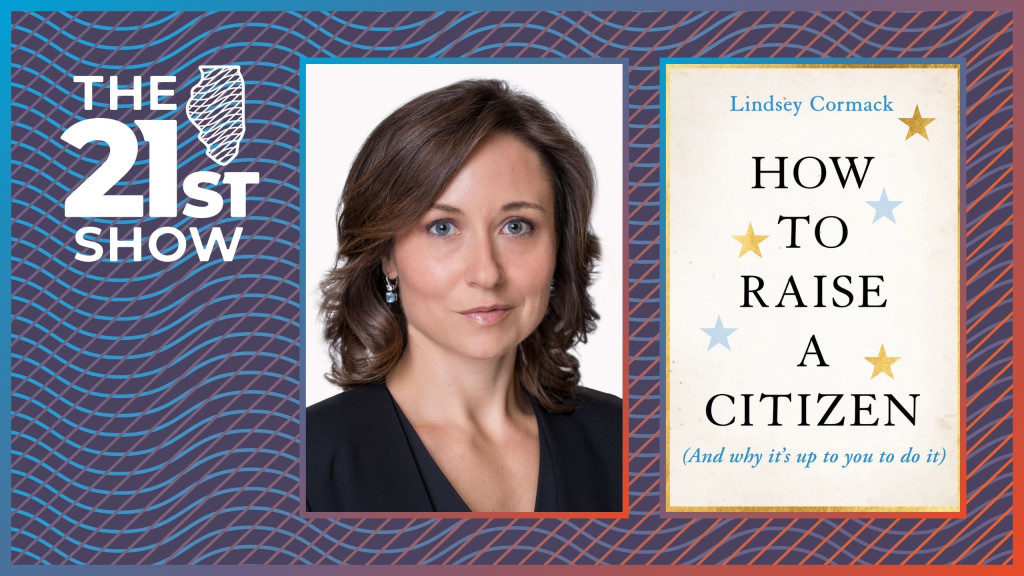
Brian Mackey: Today on the 21st show, civic education is an essential part of democracy. But if you think our young people are learning what they need to know about it in school, my guest today says that is not the case. Political scientist Lindsay Cormack argues parents have to take civics education into their own hands. Her book is called "How to Raise a Citizen and Why It's Up to You to Do It." I'm Brian Mackey and that's coming up today on the 21st show, which is a production of Illinois Public Media, airing on WILL in Urbana, WUIS in Springfield, WNIJ in Rockford DeKalb, WVIK in the Quad Cities, WSIU in Carbondale, and Tri-States Public Radio in Macomb, Galesburg, and Keokuk. But first, news.

From Illinois Public Media, this is the 21st show. I'm Brian Mackey. And today is Election Day. Polls across Illinois are open until 7 this evening. We have interviewed all the candidates for governor, U.S. senator, and several downstate congressional districts, and you can find those in a post pinned to the top of our website, 21stshow.org. Tomorrow we'll talk about the outcome of the election, but today we're gonna take a step back to talk about how much Americans know about their government and politics. And more importantly, we'll ask whether our young people are being adequately prepared to take part in our civic life. My guest today argues they are not, and she says we should not be counting on schools to fill that gap. Rather, she says it's up to parents to make sure children are prepared to be full participants in American democracy.

Lindsay Cormack is an associate professor of political science at the Stevens Institute of Technology, a prestigious university in New Jersey. But more to the point for our conversation, she's the author of "How to Raise a Citizen and Why It's Up to Us." I first spoke with Lindsay back in September 2025. Because of that, we're not taking calls live today, but you can always let us know what you thought. Our email address is talk@21stshow.org. Lindsay, welcome

[00:02:34]
Brian Mackey: to the 21st

[00:02:34]
Lindsay Cormack: show. Thank you so much for having me. I'm excited to chat with you.

[00:02:38]
Brian Mackey: All right, Lindsay, how would you grade the average American's knowledge of how government and politics works?

[00:02:45]
Lindsay Cormack: Well, it wouldn't be just my assessment. It would be the nation's report card assessment and I'd say we are insufficient in our knowledge.

[00:02:51]
Brian Mackey: What does that mean? Say more about that, insufficient.

[00:02:54]
Lindsay Cormack: So, we have this assessment that happens from time to time to ask eighth graders some basics about what they understand about the government and we have since 1998 not moved upwards at all in terms of what we know and if we were to think about things as like proficient or basic or insufficient, only about 22% of our eighth graders get a grade of proficient or above. So we're really not doing enough.

[00:03:18]
Brian Mackey: What are the kind of things that people don't know?

[00:03:21]
Lindsay Cormack: Well, they don't know about checks and balances. They don't know about the different branches and the powers that they might have. They oftentimes won't know how to activate their own vote. They won't know the pathways to power, what levers to pull on people who are in government. There's all sorts of ways that we can assess political knowledge and on nearly every one of them, the United States falls short.

[00:03:40]
Brian Mackey: So you mentioned this report card. This is for students, but I mean this extends up through adulthood as well, right?

[00:03:45]
Lindsay Cormack: Absolutely. You can look at plenty of survey data that'll say, you know, a sad number of people know that there are 3 branches. And so this is something where we know that we're not teaching our young people and so it's not surprising that everyone has to play catch up as they become adults.

[00:03:59]
Brian Mackey: Maybe we should make the case. Why is it important for someone to understand that there are 3 branches of government and, you know, who the Speaker of the House is and how many Supreme Court justices there are, etc.

[00:04:12]
Lindsay Cormack: Yeah, so in my book, I sort of argue that these are not necessarily on their own individual markers of do you understand what government is, but they all sort of point to a disregard for this type of knowledge. And so while it might not be consequential in your life to know that there are 9 Supreme Court justices, if you never interact with that information and it's never made relevant to your life, then there's probably many other parts that are more relevant and localized to your life that you're never going to have an exposure to. And so it's important that we give people an overview so that they can then figure out what really matters for them in their particular situations.

[00:04:46]
Brian Mackey: There was a political scientist who came out with a book in the last year or so talking about the real divide in America is not left or right. It's between people who are engaged in politics and those who aren't. And, you know, maybe for somebody listening to an interview of a political scientist on a public radio show, um, that might be surprising, but we're the weirdos, right?

[00:05:09]
Lindsay Cormack: A minority certainly in terms of people who are really interested in this, put it into their day to day and try to information seek. But I do think that as we try to create a more perfect union and continue this founding of the United States, that we need to be engaged in this sort of information and we want to know more and it can actually be a point of patriotic pride for us to pass these sorts of lessons down to our younger citizens.

[00:05:31]
Brian Mackey: All right, so to the extent you can generalize, what is the average — let's say high schooler's civic education — what does that consist of?

[00:05:38]
Lindsay Cormack: Yeah, so I'm glad that you said to the extent you can generalize. All 50 states approach this differently in terms of how much time in the classroom, if you're going to have an assessment at the end, if you need to pass, whatever. But on average, the way that we do this is we'll usually in 7th or 8th grade have some sort of world history, U.S. history or social studies class, and then we will wait again until your second semester of your junior or senior year of high school and give you a half semester government class. That's like the modal delivery style around the United States. And so when you step back and think about that, it's just too little, too late, and I'm not really sure what you were like in your second semester of your senior year of high school, but I know what I was like and it wasn't, oh yeah, teach me a lot of new things that I need to know about something that I've never been able to participate in. And so we don't do the layering or the scaffolding that allow our young people or our youngest eligible voting people to participate because we really haven't prepared them for it.

[00:06:30]
Brian Mackey: Maybe if you'll indulge me a brief digression — and I don't remember if this was junior or senior year — but I just want to shout out Robert Rhode, who was my American government teacher at Marion Catholic High School in Chicago Heights. I mean, he introduced us to the New York Times and, you know, what's now the PBS NewsHour. I loved that class, though I'm probably a bit of an outlier. What was your civic education like?

[00:06:50]
Lindsay Cormack: So I actually don't think you're that much of an outlier. Most people remember and like their government teacher because they had a snapshot of time with them. And there's this joke that we had when we were doing interviews for this book, which is everyone knows who teaches AP U.S. government. His name is Coach. And that joke sort of got play in all the different states that we were doing interviews in because in most U.S. high schools, having the job of teaching government might not provide you with full-time employment and so those people are coaching your track teams, your football teams, your wrestling teams, your swimming teams. And I was lucky to have a really good set of people who were teaching this in my world. Um, Mr. Ken Thomas is who I had as my AP government teacher, and I think people remember those because it is when children get to interact with really big issues and adult issues. And so it's generally a positive memory, even though it's a little fleeting and too short of a memory.

[00:07:40]
Brian Mackey: So you said we can't generalize, every state is different. What are some of the ways that states are doing things right in your view?

[00:07:48]
Lindsay Cormack: So, something that allows you to interact with civics every year K through 12 is probably the right way to go because if you think about any sort of complicated subjects, it takes time to build up the vocabulary and the associations and the understanding of how the different pieces work together. If we're teaching kids about the term federalism when they are in 12th grade and they haven't even had an opportunity to think about what states might do that's different than local governments, than federal governments, it's not surprising that they can't synthesize that information. So if we can start in the kindergarten years just giving them little bits and building up over time, we'll be better prepared.

The other thing that I think, if you ask someone who says, how can we best teach kids about something, it's through experiential things. So the idea of experiential civics would be getting a group of kids together in the class and saying, go find something that's challenging or problematic in your neighborhood and let's figure out how we could change that. Now, oftentimes they won't change that. They might say, you know, I don't know how to do this, but they'll find out that there's a city council or some committee or some executive like a mayor who's responsible for these things. They can do outreach, they can try to get that person's attention and in that experience of learning how to activate your own agency, it sticks more than just this theoretical understanding of the government as some abstract thing or something that happened in history. When you see yourself in it, you're more likely to be able to participate.

[00:09:10]
Brian Mackey: So, let me take a moment to remind listeners, this is the 21st show. We are talking with political scientist Lindsay Cormack, who is a professor at the Stevens Institute of Technology in New Jersey. She does other things too, like, uh, as a lead researcher with a group called Everything Policy and runs a site called DC Inbox. We can talk about that a little bit later. But more to the point for our conversation today, she is the author of the book "How to Raise a Citizen and Why It's Up to You to Do It."

Let's talk about some of the consequences of this lack of political knowledge before we get into the more, you know, sort of practical advice for parents and other caregivers. What are some of the downstream consequences of people not feeling engaged? And maybe you can talk about this through your experience as somebody who interacts with fresh college freshmen every year, right, who are taking American government courses.

[00:10:04]
Lindsay Cormack: Yeah, I mean, so the things are different, but no one acts positively if they're out of the loop. It's like if you think about playing a board game, it's much more fun if you understand the rules of the game to play it. And so I was just speaking with a college class today and we were talking about if they had ever voted before. I have freshmen to seniors in my classes and one of them from out of state said, well, I tried to vote. And he explained to me his task of trying to get an absentee ballot mailed here and then sending it back and he failed to actually vote, not really through any fault of his own, but because it's difficult and things are out of your control when someone else is having to mail you a ballot. And not realizing, sort of like, oh, I can register where I live, I could have done this in person — that makes people unhappy.

It's also the case that we are far more prone to misinformation or disinformation or outrageous information if we don't have a rooted understanding of what's possible or feasible in that system and that's only going to be a reality for us if we learn that system. If we're getting sort of this notion of what government is based on whatever we see on Instagram or TikTok or whatever, then it's understandable that people are afraid or scared or really reactive very quickly because they don't have a more rooted understanding. There's no benefit to not knowing the system that you're going to be in. And I'd actually argue that one of the beautiful things about being born in America or living in America is that we have the agency to change our laws and to change our politics because we can participate. And that's something that I think too many of us maybe take for granted or don't realize is a really big perk of being here that we should be proud of instead of thinking that politics is boring or for someone else to do.

[00:11:45]
Brian Mackey: Yeah, or for someone else to do, you know, that's something you do hear a lot. Oh, it's rigged. Oh, what does it matter? My vote doesn't matter. I live in a blue state. I live in a red state, etc. How do you respond to that?

[00:11:55]
Lindsay Cormack: Yeah, so I get that every year during a presidential election. Someone will say like, well, it doesn't matter because I'm in a blue state and I wanted to prefer a Republican candidate. I have a few answers to that. One is that it is good muscle memory to build no matter what. The thing that's most going to predict if someone votes is if they've voted in the past. So even if you think your presidential choice is not going to win in your state, that's not a reason not to do it. Take the opportunity to go to that gym and build your muscle memory.

Two is, anytime there is a president on the ballot, there is a House member on the ballot. Every presidential election, every member of the House is up for reelection. A third of the Senate is up for reelection. So even though we have that winner-take-all system in the Electoral College, that's not the case for a House rep and that's always on the ballot with the president.

Three is something that I think is not really understood as well, which is when we're thinking about how the parties themselves — the Democratic Party and the Republican Party — organize their primary systems, in states that have greater shows of force, even if their candidate loses, they tend to get different things that are going to make it better for their primary seasons next time around. It might be a better time on the calendar, it might be more delegates, but the parties can only operate in response to the activity of voters themselves. And so you have to show that you're there, that maybe you wanted a different outcome, even if you find yourself in a state that generally prefers the opposite candidate. And you can't do that if you just hide behind the idea of like, well, your vote won't count in that one election.

[00:13:14]
Brian Mackey: One of the things you write about in the book is that the complexity of the U.S. political system also factors into the difficulty people have with their civic knowledge. Talk about that.

[00:13:25]
Lindsay Cormack: I mean, it is a hard system. This is an intricate system. It's not easy. There's some basic premises, but it's complex. And in saying that, what I mean to ask us to consider is if we can really do this all in a one-semester time window in high school. And I think the answer is a resounding no. None of our indicators say that we should. So we don't need to have all of our parents or community members being political government trivia experts. We do need to recognize that there is a complexity that means that you're going to have to give it some attention if you want to figure it out in a way that is reasonable to you or you get an outcome that you like. And so accepting that complexity is not something that you throw your hands up and say like, well, you know, it's a big system, I'm a little piece of it. It's understanding that the complexity is a part of it and in order to change that in a way that you like, you have to be willing to engage with it a little bit deeper and we can't really get that done in schools alone.

[00:14:18]
Brian Mackey: We got a call from somebody who couldn't hang on the line, but Del in Homer says back in the '70s, there was a full year of civics education included in the middle school curriculum. Wishes we could go back to that, Del said. Thanks for calling in, Del. Talk about, is this something that has changed over time?

[00:14:36]
Lindsay Cormack: It has changed over time and it's very state and locality dependent. But if we think about the trade-off that we have had with the rise in STEM education — so science, technology, engineering and math — the trade-offs are in places like history, civics, arts, and if you look at the time in the classroom, civics has had the most precipitous decline. It has the least amount of minutes in the classroom against all other subjects and if we think about it in just dollars and cents, for every $50 that the federal government spends in K through 12 schools for STEM education, it spends 5 cents on civics. And so really, no matter how you look at it or slice it, we are not doing enough and we haven't been for a very long time. So I empathize with what Del called in to say because if you had that life, that was probably something you thought would be passed on to your children and it's simply not the reality that we're in.

[00:15:27]
Brian Mackey: Yeah, one of our producers mentioned that she got a full year of civics education, but it took signing up for AP government and politics. And is that something that's a factor — like, elite students get this kind of benefit, but students who are not interested in AP classes maybe don't?

[00:15:44]
Lindsay Cormack: Well, it's certainly the case that there is a sort of divide on wealth and education of your parents on whether or not you're going to be having the opportunity to be in an AP class based on where those AP classes are offered. But even when we look at AP U.S. government, one of the saddest things is that it is routinely one of the lowest five AP tests that are administered in terms of passage rates. So out of the 38 or so AP tests that are administered every year, more students fail AP government than pass it in terms of getting a 3 on the test. And it has the lowest rates of people who are doing this. Only 2% of people ever take AP U.S. government, and that's the top 2%. And even then, the majority of them are not passing the exam at the end of that class.

[00:16:28]
Brian Mackey: All right, we need to take a break on the program. In a moment, we'll have more from my 2025 conversation with political scientist Lindsay Cormack, whose book is "How to Raise a Citizen." I do want to remind you, the polls are open today until 7 p.m. We have same-day registration here in Illinois, so even if you aren't already registered to vote, that is not an excuse for skipping out on your civic duty. We'll recap the results tomorrow, but if you don't want to wait, you can join me tonight for Illinois updates during NPR's national election coverage. We'll have our first one at 7:15, then at 7:15 [past] every hour through at least 10 o'clock. And if you want even more analysis as results come in, I'll be live on Illinois Public Media's YouTube channel starting at 8. Again, that's all tonight. More information on our website, 21stshow.org. We'll be back with Lindsay Cormack on civic education in a moment. This is the 21st show. Stay with us.

It's the 21st show. I'm Brian Mackey. If you're just joining us, we're listening back to my interview with Lindsay Cormack, associate professor of political science at the Stevens Institute of Technology in New Jersey. She's the author of the book "How to Raise a Citizen and Why It's Up to Us." I first spoke with her back in 2025 in advance of a couple of appearances at Constitution Day events in Springfield, sponsored by the Center for State Policy and Leadership at the University of Illinois Springfield. Because our program is on tape, we're not taking calls today, but you can always let us know what you thought. Our email address, talk@21stshow.org.

[00:18:17]
Brian Mackey: All right, let's talk about one of the other things you mentioned in the book, this idea that, um, for people of a certain age, there was a culture of silence around politics. What form does that take?

[00:18:30]
Lindsay Cormack: Yeah, so in doing the research for the book, you know, I had six research assistants and we talked to people in 47 states about this and there's sort of two approaches to politics that we found and they're kind of regionally divided, whereas in the Midwest and the South, you'll find one and on the coasts, you'll find the other. So in the Midwest and the South, there's this tradition of not talking about politics and the idea is that you might, you know, offend someone, say something that someone would disagree with, and so it sort of sits in this taboo bucket of like sex, politics, drugs, religion. And when we don't talk about politics or if we don't practice doing that with and around our kids, then they don't have a model for how to do this and they look up to us for what we do and what we don't do. And if they never see us caring about these things, then it's hard for them to develop that care on their own.

And then when you get to the coasts — and this can happen anywhere, but what we found — is that there's generally this tradition of hating politics or saying everyone who's in it is a liar, a cheat, the system's rigged, they're egomaniacs and in it for themselves. And so that too is not attractive to children. Why would you want to go learn about all the liars? Why would you want to aspire to someday be a cheater? And so these are things that make it harder for our kids to understand our politics in a productive way because they don't have a tradition of hearing or talking about them or when they do, it can be really negative.

[00:19:43]
Brian Mackey: I don't know if the sociology of this is beyond your sort of academic reach, but what do you understand about why the Midwest has a culture of silence and the coasts have a culture of disparagement?

[00:19:55]
Lindsay Cormack: So the only sort of insight that I might have is I grew up in Kansas and I was there till I was 22 and then I moved to New York. So I've gotten to see both of the systems in different ways and I think there's this notion of politeness that maybe permeates a little bit more, which is, you know, I'm going to do my thing, you might do your thing and we'll be polite on the surface, whereas the confrontational nature of sort of a coastal or urban environment demands something different and so those traditions and cultures are a little bit different.

[00:20:21]
Brian Mackey: Yeah, I can certainly say that's true for my wife's family. We saw one of her relatives had like a sticker on her car endorsing one of the presidential candidates, and it was really shocking because people on that side of the family just do not talk politics. Um, I guess that sort of lines up with what you're saying.

So, you mentioned this idea that especially on the coasts, there's this negativity. How does that affect political engagement?

[00:20:47]
Lindsay Cormack: Well, and it's not just something that individuals are responsible for. If we look at children's media or children's literature, oftentimes there's going to be some sort of government figure like a mayor, and that person is at best perceived as like this bumbling doofus who sort of gets things right. But at worst, like if you think about "The Simpsons," you have like a mayor who's out to do harm to the city that they're meant to protect. And so if that is the narrative or model that kids have in the back of their heads, even if they don't know why, it's really hard to get to the other side of it where you can see being in politics as aspirational, of people who are trying to realize the greater good, even though it might diverge from your vision of that. If we just think they're all in it for bad, nefarious reasons, it's hard to get a better outcome because we're primed to think about it in negative ways.

[00:21:31]
Brian Mackey: You're cracking me up. I'm remembering one of my favorite moments from "The Simpsons" is when Mayor Quimby gets bribed by the mobster on the show and says, uh, thank you for the bribe, Fat Tony, but next time I would prefer a nondescript briefcase rather than a sack with a dollar sign on it. Um, which I guess goes right to your point.

[00:21:49]
Lindsay Cormack: Yeah, that's the image that our kids get exposed to, whether or not it's TV, literature, parents, conversations around them, media — it's a lot of negativity for them to ingest.

[00:21:59]
Brian Mackey: Let me remind listeners, this is the 21st show. I'm Brian Mackey. We're hearing a conversation we first broadcast live back in 2025. At the time we did take calls from listeners. Because we're revisiting that conversation today, no calls, but you are gonna hear some of the people we heard from on our original broadcast. Back to the show.

[00:22:19]
Brian Mackey: All right, let's go to the phones at 800-222-9455. Ryan is calling from Dixon. Ryan, thank you for calling in.

[00:22:27]
Speaker 3: Hi, thanks for taking my call. My question sort of talks, uh, or, uh, thinks about the states as laboratories of democracy. Um, I was wondering if your guest knows of any states that tend to have higher rates of civic participation or even extending that, uh, other countries that are comparatively similar to the United States that enjoy higher levels of civic participation than we do, however you choose to measure that. And if that is the case, you know, what we can attribute those increased rates to — there's got to be somebody out there doing it a little bit better than us. Do we know what they are doing better?

[00:23:05]
Brian Mackey: Great question, Ryan. Thanks for that.

[00:23:07]
Lindsay Cormack: Yeah, thank you for this question. Um, in the book we do get into like which states tend to be doing better than other states, and there is variety. The states that are closer to D.C., so like Maryland, Virginia, D.C. itself, they tend to do more participation around this, more preparation around this, and they have kids who are registered to vote at higher rates than in other places. We also have some schools in like Colorado, Idaho, parts of New York state that'll have like a civics-for-all curriculum which will be that K through 12, we're gonna have at least a touch point every year and so that tends to spill over into more political awareness and the likelihood that you're registered to vote generally going up. It's not true everywhere though, like New York state, you know, they have these sorts of things like a civic seal or you can have the civics-for-all curriculum, but they have pretty low voter registration of their 18- to 24-year-olds. So it's not a solution for everything.

When we're thinking about international contexts, my first answer on questions like this is very much that I'm through and through an Americanist and I focus so much on the American political experiment. But when you look at us relative to other countries, provided that someone is registered to vote, our participation rates, even for the youngest ones, tend to be pretty high, provided that they're registered. So it's that hurdle of getting registered in the first place that's really the damning part for our young people. They do vote at lower rates even after they're registered, but once you sort of normalize it that they've gotten through that hurdle, it's not so bad.

I will say internationally, the sorts of stuff that I take in now is that nearly every country is grappling with some version of a civic crisis and sort of an analogous one to our own is Australia, where the researchers who are talking about young people not understanding their systems are pointing to different solutions that are either in schools or communities or families because this generational transmission of information is something that's been a little bit broke because of how we consume media, news, school, and so everyone's sort of grappling with it.

[00:25:02]
Brian Mackey: All right, thanks again for that question, Ryan. Let's go to line 2 where Holly is calling from Champaign. Holly, thank you for calling in.

[00:25:10]
Speaker 4: Yes, I just wanted to point out that I grew up in Arkansas before the Bill Clinton era. When they had certain state standards for education and we were required to take a civics class in 9th grade, everybody — there were, it wasn't an elective. And so we learned the ins and outs of the Constitution and the way government is supposed to work. And I just don't understand why states have cut back on that. And in addition, when I was in the 4th or 5th grade, I can't remember, it was 1968, we had a mock election in our elementary classroom. And it was when Nixon — and I was trying to think who else was running for president — and we voted for the president and everybody else in that lineup.

[00:26:09]
Brian Mackey: Alright, Holly, thank you so much for calling in. Um, Lindsay, maybe that's a good lead into one of the other topics you addressed, which is why schools are not up for doing this education the way maybe that they once were, or at least we think they once were.

[00:26:28]
Lindsay Cormack: Yeah, thank you so much for this question, um, because it is the case that schools, you know, have had this charter of the notion of not just making little students who can grow up and then work in the workforce, but also to create citizens. But when we think about the last 50 to 70 years, there are a few things that have sort of worked against this.

One of the biggest ones is the focus on the SAT and the ACT as the terminal sort of assessment of a student and a school at the end of that K through 12 journey. So when we think about what is taught, it is what is tested and something that we heard when we were interviewing teachers is if it's not tested, it's not taught, and there is no component of social studies that's tested on the SAT or the ACT. So when you're in a curricular time crunch and you have to figure out what to prioritize, you want your students to learn the things that are gonna help them on these terminal exams because that helps them get into college, but that also helps schools in their rankings, blue ribbon designation, pay for teachers — all of those things are influenced upwardly when those test scores are better. So that's a really big chunk.

There's also challenges in that state legislatures are sometimes sort of conscripting what you can say, so the topics that can be talked about in this way or that way. And I think this is something that's hard for a lot of us to hear, but it's something that I heard in the course of the research of this book. It's something that the [Sandra Day O'Connor] Institute hears in the surveys that they have of teachers, which is one of the number one reasons that teachers don't want to talk about politics or government, even in sort of a nonpartisan, basic-facts way, is they are afraid of parents. There is a fear of controversy and pushback from parents that if someone says something that they even believe to be like, you know, this is just the lay of the land, if a kid hears that and talks to their parents about it, that parent can then inflame a Facebook group or go to the principal or barrage the teacher themselves with emails or texts or however they're going to communicate, and our teachers don't want that. And so there are a lot of reasons why this is really hard to get done in schools despite the fact that every educator I talked to seemed to try to do their best, and I think that there are plenty in schools who want to work towards this. It's just very hard to get it done given all these demands.

[00:28:29]
Brian Mackey: Well, I'm sure you've experienced this somewhat. Well, I shouldn't assume, I should ask — have you experienced this? I mean, we're in a time when even basic facts can come across as partisan posturing. How do you handle that as an instructor?

[00:28:46]
Lindsay Cormack: Well, I'm lucky in that I'm at the college level and so I'm dealing with like proto adults who are really trying to figure things out and I sort of table-set at the beginning of the semester, which is like, we're going to try out ideas together. We might not get them all right the first time. We might hold ideas that are counter to other ones in our classroom, but we're going to practice getting some sort of collaborative outcome instead of one where you say like, oh, you're wrong, or oh, I disagree with you. And it's never really about my sort of personal politics going into a thing because that's not really how I run a classroom, but we do get into political topics because that's the subject matter that we're dealing with.

And something that I have found to be really useful is I will have students send in something that they've seen online. So whether it's like a meme or a story or whatever, and we'll start class with what's good or new in politics, and it can be anything. It can be, I found this on TikTok or this was in YouTube Shorts or whatever. And then we get to see, we're all exposed to different things, we're all seeing different viewpoints, and so it's not surprising that this is a contentious area — we're not living in the same online realities. And that has been a way for us to sort of take the temperature down of saying like, oh, it's my personally held belief that this or that or whatever — it's, here's what I'm exposed to, let's set the table with what we're seeing and then we can move from there.

[00:29:56]
Brian Mackey: All right, so what we've been driving toward is that schools are not going to do this. It has to be parents or caregivers. Make that case briefly. Like, why do the parents have to be the agents of change?

[00:30:08]
Lindsay Cormack: Well, our kids look up to us. We know that. We know that they're the best teachers for them. If we understand that the schools are just not equipped to get this done right now, I don't know any parent who doesn't want their kids to be as healthy as possible, as successful as possible, and able to realize their future in the vision that they think good. Children are curious about politics. They are capable of learning about politics. And one way that we sort of know that we have to do it in this childhood era is if you think about religions, so something like Judaism or Catholicism or any sort of religion that has some sort of coming of age around 12, 13, 14 — whether that be confirmation, bar or bat mitzvah — you have to teach the kids these things early on so that they can realize them more fully as they're going to maturity. If we think we can wait until they're 18 for them to value our politics or understand our history or care about our government, we're fooling ourselves, and no parent wants their child to be incapable of participating in the world that they're going to grow into.

Because we want that for our kids — to be healthy, to be successful — we should do this work. And if that's not enough, I will tell you there is only a benefit from the parent side. Kids come at these things in so many different ways and they're so less prejudicial than we are because they haven't experienced enough to sort of have those things embedded into their minds. So having political conversations with them is great, because you'll realize that they pull on notions of like fairness or something that they think is right, not what they believe a political party told them to think. And that's a really helpful way to encounter politics.

[00:31:38]
Brian Mackey: Just a minute and a half until we need to take a break, but you say that the children are curious about politics and that might surprise people, right? But I guess it's like drugs or sex or any of the other things that parents should be talking with their kids about — they're going to get the information somewhere.

[00:31:56]
Lindsay Cormack: They are going to get it somewhere and they want to be adults. Kids like hearing about what they can do when they grow up. They like hearing about how we messed up in the past and how they can make things better. It's also the case that even if you perceive your child not to be interested, the idea that they are living in a vacuum of politics is not true. It gets to our kids no matter what. If they have access to the internet, politics is going to get to them. It might not be as overt as someone recruiting you to vote for this person or that person or be in this party or that party, but politics permeates everything that we do. It is inevitable and so we might as well know a little bit more about the process so we can make our go in it better.

[00:32:32]
Brian Mackey: And I like how you frame that in the book, that you may not want to be part of politics, but politics is going to happen to you. And even if a kid doesn't have the internet, if they're doing, say, an active shooter drill, I mean, that's the consequence of decisions that have been made in politics that have led us to where we are in this country.

[00:32:49]
Lindsay Cormack: Absolutely, it's unavoidable.

[00:32:51]
Brian Mackey: All right, if you're just joining us, this is the 21st show. I'm Brian Mackey. We're listening back to my 2025 conversation with Lindsay Cormack, an associate professor of political science at the Stevens Institute of Technology in New Jersey. She's also the author of the book "How to Raise a Citizen and Why It's Up to Us." After the break, we're gonna hear more from Cormack about these topics and some other projects she works on, including DC Inbox, which collects newsletters from members of Congress that they send to their constituents and analyzes them for trends. She's also a lead researcher with the group Everything Policy, which provides nonpartisan information on some of the most challenging and controversial issues in American policy and politics.

I do want to remind you the polls are open today until 7 p.m. You can go vote until that time. We'll recap the results on the show tomorrow with Dan Petrella of the Chicago Tribune. And if you're interested tonight, you can join me back here on the radio for Illinois updates during NPR's national election coverage. We'll have those at 7:15 past the hour from 7 p.m. until after 10:00. And if you want even more analysis as results come in, I'll be live on Illinois Public Media's YouTube channel, starting at 8 p.m. I'll be joined by friends of the show, Kevin Anderson, a professor at Eastern Illinois University, Brian Gaines, an expert in Illinois politics at the U of I, and [Connortownn] O'Neill of NPR who's been reporting on the local ballot initiatives that are calling for breaking off downstate Illinois from Cook County to form two states. More of those are gonna be before voters today. Again, that's all happening tonight. More information on our website, 21stshow.org. We'll be back with Lindsay Cormack on civic education in a moment. This is the 21st show. Stay with us.

[00:35:05]
Brian Mackey: It's the 21st show. I'm Brian Mackey. We're listening back to my interview with Lindsay Cormack, an associate professor of political science at the Stevens Institute of Technology in New Jersey, and the author of the book

[00:35:15]
Brian Mackey: "How to Raise a Citizen and Why It's Up to Us." Our program's on tape today, so no calls, but you can let us know what you thought. Talk at 21stshow.org.

Let's talk now, practically speaking. So, how do we start to have these conversations with our children? And maybe that's a good place to start — it's a series of conversations over time, right?

[00:35:36]
Lindsay Cormack: It's definitely a series of conversations over time and I get variations of this question when I talk to PTAs and I think the first thing that you just have to accept is that it is yours to do and that you have to actually do it. Now, I can't say, make sure they know this, that or the other, or make sure you've done this or covered that. In the book, I go over five things that I think your kids should know before they leave your house, but it is the hardest thing is accepting that it's a role you have to take on. I know parents have a lot to do and we think schools should maybe do this lift for us, but we have to accept that it's ours to do. We don't have to know everything, but we do have to be willing to do it and learn more alongside our kids.

[00:36:13]
Brian Mackey: You break these ideas down into different age groups. One of them is young childhood, 5 to 9 years old. How do you start young?

[00:36:21]
Lindsay Cormack: With the little ones, you know, you're not going to be teaching them the intricacies, but you should teach them something that allows them to understand the personalities and something that's prideful for them to look up to. And so that can be introducing them to people who are doing the work in your local government. I had a 7-year-old niece when I was writing this book and she asked me, she was like, Aunt Lindsay, I don't know who my mayor is. And I was like, of course you don't, Piper, but I don't either. We can find out together. And we sat down at a computer, we looked up who her mayor was, we sent him an email together and in three months' time, she was shaking his hand at an event. And if you can do that and show them that politics are just people, it's your neighbors, it's your potential friends, they're trying their best, that's a really good thing to start them thinking about a role for themselves instead of thinking it's nameless, faceless bureaucrats who might be out to do ill to them. So when they're young, they need a little bit of push and it's just that sort of thing that personalizes it.

[00:37:11]
Brian Mackey: You also mentioned books — Brad Meltzer's "I Am" series. My kids loved the "Who Was" or "Who Is" series of books.

[00:37:20]
Lindsay Cormack: Yeah, yeah, I mean, there's plenty of literature. This is something that we are not really in an information dearth here. We're sort of in an information overload, but a lot of us don't know whose responsibility it is to do that with their kids. And so sometimes it can be like, is there a book my kid can read? There's plenty of books for your kids to read. But I think the more useful thing is to make sure that you show them how to engage, and that takes effort on your behalf.

[00:37:41]
Brian Mackey: What about adolescents, ages 10 to 14 years old?

[00:37:44]
Lindsay Cormack: So I really like this age. I happen to have a 13-year-old right now, and something that I find is really fun is if you have an election coming up and you have a number of candidates — so for instance, a city council race or maybe a mayor's race or something — you can sit down and in 10 to 15 minutes say, you go figure out who you would vote for. You don't have to tell them anything else. They know how to navigate the internet and they'll go find things and their results are probably not going to be, oh, this is the Republican Party and I prefer the Republican Party. No, they're probably going to go look up what they've done online and that sort of information seeking and then coming back and sharing is really practical because you're going to have to do that for the rest of your life because you're going to have to assess information that you don't know a lot about. And so if you can sort of fold them into the process of decision making at that age, you certainly don't have to vote in the way that they say that you should, but you could sort of get them in that mode. That's a very helpful thing to do in adolescence.

[00:38:33]
Brian Mackey: And you also talk about, you know, like if the basketball rims are missing at the park playground, right, you can sort of take that on as a project.

[00:38:40]
Lindsay Cormack: Absolutely, and I have done this with my own family and I have done this with my neighbor's family where the kids were unhappy about the status of our parks and I was like, you know what, you're unhappy, but the people who are responsible for this, they are not playing on those courts. They don't know that. And so you have to be able to communicate that message to them so that you can get an outcome that you like, and that's something that they can do. They can't vote, they can't donate, but they can certainly complain. They can certainly show up and ask for something to change, and that's something that's valuable to start at that age.

[00:39:06]
Brian Mackey: And what about teenagers, young adults, 15, 16, 17, 18?

[00:39:10]
Lindsay Cormack: Yeah, this is the crunch time. This is our last window with our kids. They leave our homes for most of us and so you need to make sure that they understand how to register to vote and have probably registered by the time they've left your house. And this is something that we need to help them with because schools oftentimes don't, and the reason that our young people don't vote isn't necessarily because they don't care, it's because they don't know how to. So we need to teach them about how to register to vote. We need to teach them that there are different things that states and cities and federal governments do. It's not all one big government, there are different things.

I do think that your children should have read the Constitution at one point at least before they have left your house. Now you might say, oh, I don't have time to read government documents. If you print this out, it's 19 pages on a standard size paper, standard size font, and it's not that you sit down and read it all in one day, but you should know the rulebook of the system that you get to participate in. So that's important.

They need to know the difference between general and primary elections because there are different rules and they matter in different ways. And finally, they need to have practice having hard conversations because if the first time they're doing it is, you know, as an adult on their own, they don't have a model to look at other than what they see online, which tends to be really inflammatory. So we have to do this work with them and in front of them if we want them to be able to be fully realized adults who can make our politics better.

[00:40:25]
Brian Mackey: Hard conversations. I mean, goodness, I've had to talk with my kids about political assassinations now twice in the last year. How do you go about talking about that when we are in a time that a lot of us think is heading toward a crisis, in a crisis, right? Our constitutional order seems to be changing by the day depending on court rulings. How do you approach that?

[00:40:46]
Lindsay Cormack: Yeah, I think the biggest thing is that our emergency flashers have been blinking brighter, the sirens are louder, but we have to not ignore them. We have to opt in to having conversations about what we are doing here, why it is a good thing to be concerned about your country, why it is a good thing to want to work in government or politics to make your country better. And even if those conversations are hard because they deal with scary things like death or terrorism or things that our children don't want to think about, they're going to be confronted with it. The sort of media environment that we are in means that this stuff goes through our schools and tears through them through smartphones, laptops, however media gets to them. And so we have to be willing to sit down and what I always encourage parents to do is have the first question be, what have you heard about this? It should never start with like, here's the right way to think about it. It should be, what have you heard about this? And this offers us an opportunity to really sort of keep tabs and understand what sorts of influences our kids are being exposed to in a way that not only can help them participate in politics, but hopefully can curb against extremism. No parent wants to read about their child doing something in a school or any other sort of setting that's under the guise of political violence. And that's far less likely if we keep an open line of communication with them on these topics.

[00:42:00]
Brian Mackey: You know, a lot of people in this era find it hard to talk about politics without getting into partisanship. But you say that can backfire. Talk about that.

[00:42:10]
Lindsay Cormack: Well, partisanship is inevitable. It's going to be a part of our national politics, but I would like to think about it as raising an athlete versus raising a fan. If you are raising an athlete, you teach them the rules of the game, you run practice things, you do scrimmages and drills, then they're better at doing that. If you're raising a partisan or if you're raising someone who's a fan, you just teach them who to cheer for and what chants and what colors to paint their faces. In politics, we are all athletes, whether we like it or not. We can be more or less capable athletes, but no one's truly a spectator, and you want to raise your kids to understand the games that they're going to have to play. And so partisanship is inevitable. It's not something that you necessarily need to know which team they're going to play for. You need to make sure that they understand the rules of the game so that they can win in whatever situation that they find themselves in later.

[00:42:53]
Brian Mackey: All right, let me take a moment to say this is the 21st show. I'm Brian Mackey. We're listening back to my 2025 interview of Lindsay Cormack. She's an associate professor of political science at the Stevens Institute of Technology in New Jersey and the author of the book "How to Raise a Citizen and Why It's Up to Us." That was actually the end of our conversation during our live broadcast. This was just after former Illinois Governor Jim Edgar died, and we spent the rest of that program remembering his life and legacy. But in order to have a full show with Cormack, she and I connected later for a brief interview on some of her other projects. The sound quality is slightly different here, so I wanted to explain why that was. But here now is the continuation of my conversation with Lindsay Cormack.

[00:43:41]
Brian Mackey: In the time we have remaining, I want to talk about another project you have long worked on. It's called DC Inbox. It's a database of the email newsletters members of Congress send out. To be clear, these are official government communications, not campaign messages. Before we get to a few examples, how did you get started with this?

[00:43:59]
Lindsay Cormack: So, in 2009,

[00:44:00]
Lindsay Cormack: I was in graduate school at NYU and I was really shocked to learn that everyone who was getting a political science Ph.D. was going to become like a statistician, someone who was also a computer programmer, or someone who sort of created a resource for others to use. And I sort of saw my lane as creating something that would be valuable for the discipline, and I thought someone else would have already done it. I thought maybe the Library of Congress had this, and then when I found out that that wasn't the case, I got started making it.

[00:44:28]
Brian Mackey: So, we don't have to get exactly into how it works, but I gather it's, you know, now at this point, what, hundreds of thousands of records of these constituent newsletters people send out?

[00:44:38]
Lindsay Cormack: Yeah, uh, I checked it this morning, there were like 210,000 that are in there and it every day gets bigger and bigger. Usually it's about 30 new emails a day. Some days are higher days, some days are lower, but it grows all the time.

[00:44:52]
Brian Mackey: I wonder how many of these things are being read by you for the first time. Not that constituents aren't reading their member communications. All right. I think one of the best ways to understand this is by hearing a few of your sort of research use cases. So, what did you learn about how members of Congress use the word evil?

[00:45:10]
Lindsay Cormack: So, it's interesting, the use of the word evil in terms of who's using it looks like it's really correlated with religiosity. And so I have found that Republicans are far more likely to say that things are evil than Democrats, and in looking at who they target as evil most of the time — but not all — it is foreign powers. It can be like the evil Iranian regime or the evil Chinese communists or the evil Russians and so it's usually looking outwards at foreign adversaries, but sometimes there are domestic people who will come and say like, you know, the evil leftist ideology of insert whatever it is. They use it more. Democrats also use it, but when Democrats use the word evil, they also identify foreign adversaries, but they will take on individual members within the government, and they will say things like this regime is evil or this action is evil, referring to policy things that they disagree with that the other side has done.

[00:46:05]
Brian Mackey: Regime is another one of those interesting words. What about, uh, Nazi? Who mentions Nazis in their communications?

[00:46:11]
Lindsay Cormack: Yeah, Nazi is a really interesting one. Both sides do this. Republicans say Nazi more overall, but in the recent period it has been more Democrats. And oftentimes a lot of these messages are talking about like our victory over Nazis or saying something really nice about veterans from World War II. Um, and then in the just very recent period, people have started to echo the idea that some of the activities that they're seeing at the level of the government now sort of remind them of something that they might see in a Nazi or fascist government.

[00:46:39]
Brian Mackey: What about, uh, Charlie Kirk — after he was killed, you looked into which members of Congress had mentioned him before he became more widely known.

[00:46:48]
Lindsay Cormack: Yeah, that one was interesting because prior to September 10th, Charlie Kirk had only been mentioned about 46 times, 45 of those came from Republicans. And if you look at who those [senators] are, it's sort of this crowd of House Republicans that were led for a period of time by Matt [Gates], um, and they were the ones who asked to vacate the chair that led to Speaker [McCarthy] no longer having that position, and so it's sort of this like club of guys within the House caucus for the Republicans that had mentioned him and Turning Points USA, not really mainstream Republicans. Only one Democrat had ever mentioned one thing about Turning Points USA, and then after his untimely and awful death, there was an influx in attention on his name or use of his name, both from Democrats and Republicans.

[00:47:37]
Brian Mackey: If you had to distill it down, what would you say are some of the key insights you've learned from analyzing 15 years of what members of Congress are saying to their constituents?

[00:47:49]
Lindsay Cormack: Yeah, I'd say, well, Republicans use this far more than Democrats. It's a free perk for any incumbent. They all get a budget to do this, but Republicans do it way more than Democrats. Republicans have also been really good at sending images and memes and things that you can kind of take at a glance, whereas Democrats tend to have really text-heavy messages that they send. Um, one way that you can kind of think about polarization or at least heightened political discourse is that the use of capital letters has increased over time where no one [115] years ago was sending things with all caps and now you sometimes do see this.

But there's also really good indications that members of Congress are sort of doing follow-the-leader politics. For instance, in the beginning period of COVID when we were learning about this, the surgeon general was telling people you should put on masks. We had a Republican in the White House in President Donald Trump, and we had a Republican surgeon general. Republicans in Congress were also telling constituents for a few months that they should wear masks. Democrats weren't doing it as much. But as soon as President Trump came out — and I think it was early May where he had said something about how, you know, we didn't really need masks or it was for sissies, that is not a verbatim quote, but he made some sort of derogatory term towards masks — and then you see it flip in terms of who's talking about wearing masks. So then Democrats bring it up and Republicans don't talk about it as much. So you can see a lot of these interesting trends because you have the whole forest of all the congressional communications, that would be really hard to understand if you only ever focused on your rep and your two senators.

[00:49:13]
Brian Mackey: Lindsay Cormack, thank you so much for talking with us on the 21st

[00:49:16]
Lindsay Cormack: show. And thank you for having me and for doing this work.

[00:49:20]
Brian Mackey: Lindsay Cormack is the author of "How to Raise a Citizen and Why It's Up to Us." She also runs DC Inbox and writes about that on Substack, and she's a lead researcher with the group Everything Policy. In addition to all that, she's associate professor of political science at the Stevens Institute of Technology in Hoboken, New Jersey.

That's it for us today. One final reminder. Tonight after the polls close, you can join me for hourly statewide updates during NPR's national election coverage. We'll have our first update at 7:15, then every hour after that through at least 10:15 as the news warrants. And if you want live analysis as results come in across the 21st state, join us on Illinois Public Media's YouTube channel for a live stream starting at 8:00 p.m. We'll recap the results on tomorrow's show, plus, what effect is legal marijuana having on public health in Illinois. We'll talk with a researcher behind an annual report. The 21st show is a production of Illinois Public Media. I'm Brian Mackey. Go vote, then we can talk again tomorrow.
Civic education is an essential part of democracy. But political scientist Lindsey Cormack argues American schools are not up to the task — which means parents have to take matters into their own hands.
On this Election Day, we're listening back to our conversation with Cormack about her book, How to Raise a Citizen. We also talk about DCinbox, her database of the official email newsletters members of Congress send to constituents, and her work with the nonpartisan group Everything Policy.
This conversation was originally recorded in September 2025.
Election Day
Polls in Illinois are open until 7 p.m. Tuesday, and Illinois has same-day voter registration. You can find your polling place through the Illinois State Board of Elections — and catch up on all our candidate and issue interviews ahead of the 2026 midterms.
Tonight, The 21st Show host Brian Mackey will anchor Illinois updates during NPR's election coverage at 7:15, 8:15, 9:15 and 10:15 p.m. CT on WILL-AM 580 and most other stations that carry the show. Starting at 8 p.m. CT, he'll also host a livestream with real-time returns and analysis on the Illinois Public Media YouTube page, joined by Kevin Anderson of Eastern Illinois University, Brian Gaines of the University of Illinois and Connor Towne O'Neill of NPR.
Discussed
- Lindsey Cormack: How to Raise a Citizen
- DCinbox Insights:
- The 21st Show: All our candidate and issue interviews ahead of the 2026 midterms
Guest
Lindsey Cormack
Associate professor of political science, Stevens Institute of Technology
Author, How to Raise a Citizen
Runs DCinbox
Lead researcher, Everything Policy