








Why we’re still not done with Lincoln
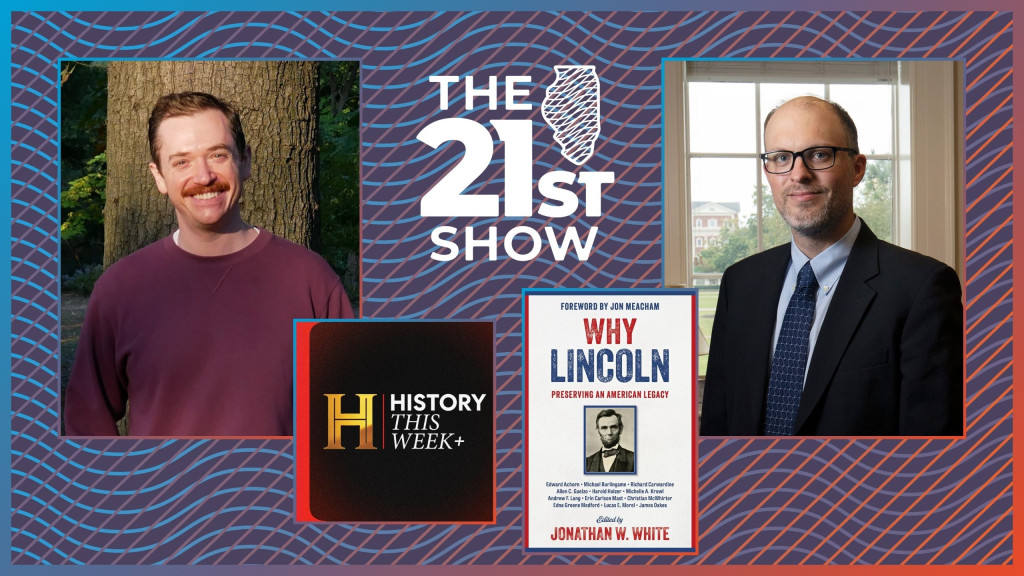
Ben Dickstein, left, is showrunner for the "History This Week" podcast; Jonathan W. White is a Lincoln scholar and editor of the new collection, "Why Lincoln." author photos provided / History Channel / Reedy Press
// This is a machine generated transcript. Please report any transcription errors to will-help@illinois.edu.

[00:00:00]
Brian Mackey: Today on the 21st show, Abraham Lincoln is often said to be the subject of more books than anyone except Jesus. But why is that the case? And honestly, what more is there to say about the 16th president? We'll talk about that with Jonathan White, who describes himself as an accidental Lincoln scholar. He's edited a new collection of essays, Why Lincoln Preserving an American Legacy. We'll also be joined by Ben Dickstein, the showrunner and executive producer of History This Week, the History Channel podcast. Both men are going to be in Springfield later this week for an event at the Lincoln Presidential Museum. I'm Brian Mackey, and that's coming up today on the 21st show, which is a production of Illinois Public Media. But first, news.

From Illinois Public Media, this is the 21st show. I'm Brian Mackey. There's a line you hear a lot about Abraham Lincoln, that more books have been written about him than anyone else in history, except Jesus. Whether or not anyone has actually done the count, the Lincoln shelf is a long one. So why do historians keep coming back to him? And after all those books, what is there left to learn? Those questions are at the center of a new collection of essays, and they'll be part of the conversation Friday night in Springfield when the History Channel's podcast comes to the Abraham Lincoln Presidential Library and Museum for a live recording about presidential power from Lincoln's time to our own.

Jonathan White is the guest at that podcast taping. He is a professor at the University of Texas at Austin. He's written or edited 22 books about Lincoln, the Civil War and the Constitution. He calls himself an accidental Lincoln scholar. He edited the new collection, Why Lincoln Preserving an American Legacy, which was just out last month. Jonathan, welcome to the 21st show. Thanks for being with us.

[00:02:13]
Jonathan White: Thank you so much for having me.

[00:02:15]
Brian Mackey: Ben Dickstein is also with us. He is the showrunner and executive producer of History This Week, the History Channel podcast. Ben, welcome to you as well. Thank you, thank you. And listeners, we wanna hear from you. What is it about Lincoln that draws you in or maybe doesn't? If you've lived in Illinois for a while, especially if you're around Springfield or elsewhere in central Illinois. How much Lincoln is enough Lincoln? And what do you want to know about the power of the presidency then and now? Give us a call, 800-222-9455. That's 800-222-9455. Also, I should say that that recording at the Lincoln Museum, 6:30 Friday, it's free. You do need to reserve a seat and we've got a link to that right now at twentyfirstshow.org. All right, Ben, I'm gonna start with you. Tell me a little bit more about your podcast. What is your project? What is your mission?

[00:03:09]
Ben Dickstein: Yeah, of course. So the podcast is called History This Week and the title kind of has the premise in it. So we take an event from that week and use that as a jumping off point to tell a wider story from history, you know, usually something maybe you've heard of a little bit but might not know too much about. That history class thing that's like, oh yeah, I know that thing, but not really. Um, so in this case, we're building this episode off of the Gettysburg Address, which obviously, you know, a major moment in Lincoln's history. But we're using it, and I guess we'll get into this later, but we're using it as a framing device to kind of get into Lincoln's use of executive power and how he used the office of the presidency in a way that it hadn't been used before. And that really reflects the model of a lot of our episodes where we can take that idea and maybe change the way someone thinks about history.

[00:04:03]
Brian Mackey: Yeah. Other recent episodes, I guess this was a rebroadcast, includes one on Salem's first witch trial, right? So you can be very timely, as you said.

[00:04:13]
Ben Dickstein: Yeah, exactly. But you know, we'll do the occasional kind of overlooked history too. We did a recent episode on John James Audubon kind of reexamining his legacy, which his organization is doing. We've, you know, this season we've really gone all over the place. I think our most [popular] episode after that was about the year 1066 in England. So it really runs the gamut.

[00:04:35]
Brian Mackey: This is a sidebar. I just saw the headline on that Audubon episode. Was he the man who ate bald eagles?

[00:04:41]
Ben Dickstein: Uh, he ate every bird he drew. It is really, uh, yeah, that was, that was one of those, uh, we call them like dinner table facts in the episodes where, like, oh, you're gonna tell, you know, you're gonna tell people about that later. That's a big one.

[00:04:57]
Brian Mackey: I love that — dinner table facts. It's like driveway moments we have in public radio. OK. Um, this is only the second time you've stepped out of the studio. What prompted you and, you know, the rest of your team to consider Lincoln as a subject for an out-of-studio discussion?

[00:05:13]
Ben Dickstein: I mean, Lincoln is just one of those topics where, you know, it's history, right? It's American history. It's just an iconic name. We did our first live event this year, like you mentioned, at the Tenement Museum in New York City, where we're based, and that was a huge success. We did that around St. Patrick's Day, around Irish immigration. And actually, I mean, I believe the Lincoln Library reached out to us at first after hearing that and started that conversation because they have this beautiful theater. It honestly is the perfect venue for the kind of thing that we do. And they were the ones that linked this up with Jonathan. So we're just so excited to be able to do this.

[00:05:54]
Brian Mackey: All right, well, that is a great entree to bring Jonathan White into the conversation. So you're joining this podcast discussion in the release, you know, in the midst of the release of your book, Why Lincoln Preserving an American Legacy. Talk about what animated this collection of scholars. I should say at least four of whom have been previous guests on our show. So we appreciate that.

[00:06:21]
Jonathan White: Yeah, there are a lot of Springfield connections in the book. You know, Lincoln is one of these figures who touches our lives in so many different ways. One, by preserving the nation we live in, but also by speaking to questions that are really relevant to all of us today. I think that's why he still resonates so much with Americans. And so I wanted to pull together a collection of essays by academic historians and public historians, people who work in museums, and then also by journalists who've written bestselling books about Lincoln and get them to sort of peel back the curtain and show readers, how did I become interested in Lincoln. So you learn a lot of stories about people that, you know, their books are widely read. And we get to see what makes them tick, what questions they ask, or why they ask the questions they do, why Lincoln became relevant to them, many of them when they were very young, and then why he still continues to be, you know, our obsession today for those of us who are Lincoln scholars.

[00:07:16]
Brian Mackey: Talk about your own journey then as a — accidental, as you say — Lincoln scholar.

[00:07:22]
Jonathan White: Yeah, I had always been interested in history. I actually started college as a business major and then very quickly switched to history because I was just so captivated by one of my classes. I went on to get my PhD and I studied the Civil War broadly. But then in — I guess about 2006 — I found a letter that someone had written describing why he had done something that got him arrested by the Lincoln administration. So this was a guy named John Merriman. He got arrested for burning bridges at the beginning of the Civil War. He got thrown into Fort McHenry and was held in prison for 66 weeks, and his arrest ended up leading to a major conflict between Abraham Lincoln and the Chief Justice of the United States Supreme Court, Roger [Taney], in 1861. And in the end, [Taney] declared that John Merriman should have been released from prison, but he had no power to do anything about it. He sent his opinion to Lincoln at the White House and Lincoln just ignored the Chief Justice of the United States. And so this case is very famous. It still gets taught in some law schools today.

And in 2006, I found this letter that John Merriman wrote describing why he had burned the railroad bridges. And I sat on that letter for three years. And in 2009, I got invited to a Lincoln conference at Eastern University in Philadelphia. And while I was there, I met a famous Lincoln scholar named [Matt Pinsker], and I told him about the letter that John Merriman had written. And [Matt] said, oh, you should write something about it. And over the next 10 months, I ended up writing a book about Abraham Lincoln and civil liberties and this trial of this guy named John Merriman. And I published it and started getting invited to Lincoln conferences. And at the time, I was young, I was in my 30s, and there were not a lot of people in their 30s writing about Abraham Lincoln. And so these older Lincoln scholars would keep inviting me back and then invite me to join their boards and be in leadership. And before I knew it, I was a Lincoln scholar. I never set out to do it, but I've loved the journey and I teach a lot of Abraham Lincoln in my classes and just find it utterly fascinating.

[00:09:28]
Brian Mackey: He is a sort of an endless well, isn't he? Um, at least we haven't hit bottom yet. So, Ben, let me come back to you. The story that Jonathan told just there does get at these questions of presidential power that I understand are going to be one of the main topics of the podcast conversation later this week. So talk about how you and your team are approaching that, how you're thinking about framing these historic conversations for modern audiences and, and really modern concerns, right?

[00:09:59]
Ben Dickstein: Yeah, I mean, that's really the constant challenge that we have, you know. We're balancing this idea of making history relevant, right? You know, famously, history repeats itself, or history rhymes, history echoes — that whole idea. But we're not a news podcast, we're not a political podcast. We don't really discuss current events in any real way. But history can, you know, inform the present, as Jonathan well knows too.

So we're constantly trying to balance that and I think in this story in particular, you know, the Merriman case being one of them, but there are a lot of moments in Lincoln's presidency that feel very modern. There's this one — and Jonathan can obviously speak better to this than I can — but there's a moment where Lincoln has two editors of newspapers, I believe in New York, arrested for publishing what he believes are state secrets, right? So it becomes this freedom of speech or freedom of the press controversy that would certainly, you know, it almost feels very modern, right? A president warring with the press. And then, you know, in 1864, we're gonna get into this idea of how Lincoln was in a very politically vulnerable position in that election. It was not inevitable that he was going to get re-elected, right? I mean, obviously now, again, like I said before, Lincoln is this icon, but he is very much a politician, a president trying to pull the levers of power, trying to use his office as best as he can in order to survive politically and, of course, ultimately win the Civil War.

So I think what we try to do best is just present this history in as relatable a way as possible, and often, you know, that doesn't take that much work. I think just because something happened in this case, you know, 150, 160, 170 years ago, a lot of the dynamics are still the same and we just try to hook into those ideas.

[00:12:00]
Brian Mackey: Yeah, I remember that — we actually spoke with an author of a book about this, gosh, six years ago now. It's called Lincoln's Lie, Elizabeth Mitchell, who I think was a journalist, not a historian, if I'm remembering correctly. I don't want to slander her. Maybe she's both. Um, but Jonathan, let's talk about that episode, right? Because there was an accusation — I mean, you can take it — of fake news being published by these news outlets, what we would at least call today fake news.

[00:12:29]
Jonathan White: Yeah, so there were two journalists in New York City who wanted to get rich in the gold market and so they bought some gold and they had this plan. That they would publish a bogus draft proclamation and their thinking was, if Lincoln calls for hundreds of thousands of new draftees, that's going to cause public confidence to drop. And when public confidence plummets, the gold prices go up and then they'll be able to sell the gold. So they wrote this bogus proclamation in the summer of 1864. At 2 in the morning, they leaked it to the Associated Press, which was fairly new at the time. And it went out to the New York City newspapers. And most of the newspaper editors, even at 2 in the morning, were aware enough to think something about this isn't right. But two of the Democratic newspapers were so eager to publish anything that might make the Lincoln administration look bad that they ran it.

And when Lincoln found out about it, he was furious, and he was furious in part because he actually was working on a draft proclamation. And he thought it had been leaked, and all presidents hate White House leaks. And so this is one of the few times where Lincoln personally orders the arrest of people and he orders the arrest of these two editors, one of whom was named [Manton Marble]. And [Manton Marble] then wrote to the governor of New York and said, essentially, hey, the state of New York should interpose its authority and protect me here. I'm a citizen of the state of New York. But the governor of New York knew that there was nothing he could do to stop the federal government from doing this sort of thing. Eventually, the newspaper editors were released when it was found out what had happened and the journalists were then arrested for what they had done. But it was a massive scandal and it really shows Lincoln at his angriest. You don't see an angry Lincoln very often, but this is it.

[00:14:20]
Brian Mackey: You know, and it's interesting because the context of New York — if I'm, if I'm, please correct my facts here — the timeline of the — was the New York draft riots, right? Some people might remember this. It was dramatized in that Scorsese film Gangs of New York. I think that was the year before. So this was a live concern. Yeah. So I mean, talk — and that's interesting because I think a lot of us think back on the Civil War as this great time of unity, at least in the North, the loyalists, you might say. Talk about how, you know, that was not necessarily always the case.

[00:14:53]
Jonathan White: Yeah, New York was a very pro-Southern city in a lot of ways. So the mayor of New York in 1861 was a Democrat named Fernando Wood, and he actually contemplated trying to figure out a way to have New York secede from the union to be its own independent city. And the reason is that New York was a financial hub of the nation and so they had financial and banking ties to the South. If you're a Southern slaveholder, you probably don't have enough money to buy large numbers of enslaved people and so what do you do? You take out loans from New York bankers. If you are a plantation owner in the South, you need clothes and you buy it from manufacturers in places like New York City. And so the Civil War had potential to be devastating for the New York City economy and so you have people in 1861, including the mayor, calling for secession.

Then you also have a very large immigrant population in New York, especially Irish immigrants. And the Irish tended to vote Democrat and they also were very concerned about things like emancipation. And their fear is if you free the slaves and Black people decide to move to the North, they're going to take jobs away from the Irish immigrants. And so as you alluded to, in the summer of 1863, in July of that year, there's an enormous riot in New York City when they begin drafting names and, you know, the Irish rise up in opposition to this because they see this as a rich man's war but a poor man's fight. They see it as a betrayal that they're going to be the ones who are undercut by emancipation. And so they target Black people throughout the city. They lynch and murder Black people who are just walking on the streets. They break into Black people's homes and try to kill them in their own homes. There was what was called a colored orphanage in Midtown Manhattan that they burned to the ground. Miraculously, none of the children were killed in that attack, but it was just a horrible period of about 10 days of unrest in the city. And that sets the backdrop for the kind of politics you face in New York. In fact, in 1864, when the election was held in November —

[00:16:58]
Brian Mackey: Let me, let me — I'm sorry to interrupt you. Let me — maybe that's a good place to pause because we're on a fixed clock. We need to take a break on our program, unlike a podcast where you can just talk and talk and talk. We have to break. So we're gonna do that. We will continue with historian Jonathan White. He is the editor of the new collection, Why Lincoln Preserving an American Legacy. We're also speaking with Ben Dickstein from History This Week. More to come after a short break. Stay with us. It's the 21st show. I'm Brian Mackey.

We are talking today about Abraham Lincoln. Before we get back to that conversation, I do want to remind you that after polls close tomorrow, you can join me for hourly statewide updates during NPR's national election coverage. That's between 7 and, uh, 10 or 10:30 p.m. on many of the same stations that carry this program. And if you want live analysis as we get results across the state, you can join us on the Illinois Public Media YouTube channel for a live stream starting at 8.

But back to today, we are talking about presidential power through the lens of Abraham Lincoln, who is the subject of an upcoming taping of the History This Week podcast happening at the Abraham Lincoln Presidential Library and Museum, 6:30 Friday in Springfield. You can attend, but they do require reservations and you can find a link to do that on our website, twentyfirstshow.org. The primary guest for that podcast is Jonathan White, who is an Abraham Lincoln scholar and a professor at the University of Texas at Austin. He's written or edited or contributed to almost two dozen books on Lincoln, most recently editor of the collection Why Lincoln Preserving an American Legacy. We're also speaking with Ben Dickstein, who is the showrunner and senior producer of the History This Week podcast. Again, that's going to be Friday in Springfield. If you want to join us today, 800-222-9455 is the number. 800-222-9455.

All right, so Jonathan, before the break, you were setting up, I think, how the, you know, 1864 was such a combustible year. We also have Lincoln with a very uncertain prospect for reelection that year, right?

[00:19:23]
Jonathan White: Yeah, that's right. So what I was going to say right at the very end was that in the fall of 1864, they actually had gunboats and troops stationed around New York City to make sure that violence wouldn't erupt again on Election Day. That's how worried they were about the city.

Lincoln was convinced in August of 1864 that he would lose in his bid for reelection. In the summer of 1864, Union armies were stalled outside of Petersburg, Virginia, trying to capture Richmond. They were also stalled outside of Atlanta and unable to capture that Confederate stronghold. And so by August, Lincoln was completely convinced that he was going to lose. And we know that through two pieces of evidence, or a few. One is he wrote a secret memorandum, which is now known as the blind memo, where he pledged himself and his administration to work with whoever beat him to save the Union before he was out of power, because he was convinced that whatever Democrat defeated him wouldn't be able to save the Union after. And the second is he had a meeting with Frederick Douglass in August of 1864 where Lincoln and Douglass concocted a plan to free as many slaves as they could before Lincoln was out of power. And that was an incredible moment because it showed Douglass just how deeply Lincoln's heart was in Black freedom. Freeing the slaves in that way had nothing to do with saving the war or saving the Union or winning the war. It was just about freeing people and making freedom as permanent as possible.

[00:20:48]
Brian Mackey: Ben Dickstein, I want to come back to you. So when you are thinking about an event like this — and we've been talking about presidential power, whether it's through habeas corpus, which is the case of Mr. Merriman that Jonathan wrote about earlier in his career, or these newspaper editors — talk about how you think about presenting this for a modern audience, although maybe, you know, maybe you don't want to get too much into what's happening now because we're in such polarizing times, right?

[00:21:19]
Ben Dickstein: Right. I mean, I, again, I think in a lot of ways, you know, the facts can speak for themselves. However, you have to choose the facts, right? You have to present them in a way that has a narrative that is going to relate to a modern audience. So I think, you know, like I mentioned before, our show History This Week is based on that week in history and we're using the Gettysburg Address for this episode. And when we were looking at the Gettysburg Address, which has obviously been covered maybe more than any speech in American history, what's our angle gonna be, right? How can we take this well-trodden event and somehow, you know, cover it or represent it in a way that is gonna really resonate with modern audiences. And I think I'm happy with what we did. I'm excited for our conversation with Jonathan, obviously.

But every episode we do has this very cinematic, sound-designed opening scene. And that will be true for this one too, which will be playing live for the audience before the conversation with Jonathan. And so we're going to be talking about Lincoln's morning that day before he delivers the address. He goes to the battlefield, he's looking over the dead. I, you know, it's been, I think, a few months by this point, but there's still a smell in the air, there's still dead horses on the battlefield. There's all these makeshift graves everywhere. And so it's this very stark imagery that he's seeing right before he's delivering this address that's meant to commemorate this battle. So it almost feels like the battle's still active. And so he's very particular about the words he chooses. I think he makes some edits that morning after going to the battlefield.

But what we really wanted to draw from that address is, you know, again, in this theme of executive power — what does the speech really do, right? And what's so interesting, at least something that I discovered, that I'm sure Jonathan's very familiar with, is Lincoln's really the first president where his speeches get transmitted to the country immediately, right? You have the technology of the telegraph. I think I saw the term, he's the first wired president in a way. And so he knows that's gonna happen. And so he's almost using, you know, Teddy Roosevelt would later call it the bully pulpit, right? He knows that these words are going to carry a lot of weight and they're going to be in every city that day or the day after.

And so, for example, he's starting the speech with "four score and seven years ago," right? That's a — we all know that phrase, but what does it really mean? And I'd be curious what Jonathan has to say too, but he's not connecting the founding of the country to the Constitution. He's connecting the founding of the country to the Declaration of Independence, which implies that those are his values. That's why he's prosecuting this war. It's not necessarily a letter-of-the-law sort of conflict. It's a more humanistic, more philosophical, more moral imperative that he thinks the Civil War is all about. And Jonathan, feel free to correct me if I'm wrong, but that was our take on tying this to the Gettysburg Address.

[00:24:39]
Brian Mackey: No, that's a great point. And I'll bounce it to Jonathan in a second, but there's a reason that the semiquincentennial was this year and not in — what is it — 2039, I guess, will be the 250th anniversary of the Constitution. Jonathan, take it where you will.

[00:24:54]
Jonathan White: Yeah, I mean, everything Ben said is exactly right. And I always point out to my students this very thing Ben just said, that Lincoln is pointing to the founding as being 1776, meaning we were founded on an idea. So the idea is in the Declaration: we hold these truths to be self-evident, that all men are created equal and endowed by their Creator with certain unalienable rights, among which are life, liberty and pursuit of happiness. In that declaration, the founders called that idea self-evident. Lincoln changes it to a proposition. And I think what Lincoln was doing was he was saying essentially, we as a nation now are proving that to be true. A proposition in math is something that has to be proved.

And it's interesting, you know, talking about how divided we are today. I also try to get my students to think about how divided we as a people have been in the past, whether it's the 1790s or the 1850s and 1860s, we've always been divided over politics, sometimes worse than other times. But in this moment in 1863 when Lincoln reads this address, Democrats interpret it as the start of his political campaign, his reelection campaign for 1864. When they see Lincoln talking about dedicating themselves to the great task remaining before them, they see that as Lincoln saying we've got to finish this process of emancipation. And when they see Lincoln talk about a new birth of freedom and government of, by and for the people, they rightly interpret Lincoln as saying Black people will be part of "we the people" moving forward. And so for us, this is a timeless speech that transcends time and place because the ideals are so lofty. And yet in the moment, the way it was interpreted depended on who you were, and Democrats looked at it as a highly partisan speech that was intended to divide Americans — in a way that we would never see it that way today.

[00:26:51]
Brian Mackey: And indeed he picks up that thread in his second inaugural, right, and makes explicit some of the points you've been talking about.

[00:26:58]
Jonathan White: Yeah, that's right. And at the very end of the second inaugural, he talks about a just and lasting peace among ourselves and with all nations. And by Lincoln calling for a just peace, that's him saying we've got to move away from slavery. We have to have a nation that will be equality for all.

[00:27:16]
Brian Mackey: Ben, you mentioned something about the sort of elaborate cinematic sound design, and I think there's a way — now we have such a visual shorthand for the Civil War, right? You get skinnier people, a little on the shorter side, dress them up in blue or gray, and you've got your people. People instantly know what that's referring to. How do you go about conceiving of what the sonic soundscape would have been at a time where all we have are text descriptions, right? This is long before any sort of audio — well, not too long, but certainly long before high-fidelity audio recordings — and we could know what it actually sounded like back then.

[00:27:59]
Ben Dickstein: I mean, honestly, the answer really is just research. You know, we're lucky, especially this day in history — the day the Gettysburg Address was delivered — has a lot of, you know, scholarship that we can dive into, right? We know that Lincoln was riding in this carriage with these people, with members of his cabinet, going to — oh boy, I'm blanking on the destination. What is it? [Sanctuary?] No, Jonathan, what is — yeah, Cemetery Hill, right? Exactly. And so we know the crowd that was there.

One of the details I found that was interesting is you would think this would be, you know, this day is meant to commemorate the dead, and so you think there would be a somber atmosphere, but it's actually the opposite. There are so many brass bands playing that they're actually like drowning each other out, and they're just so excited to have Lincoln there, right? Because you think about it, he's the president. It's a huge deal. And so while this day is sort of meant to be this commemoration of the dead, it's really quite celebratory. And so you have these brass bands playing, and in the distance you have artillery firing as a salute to Lincoln. You have just this parade, thousands of people marching. So you try to pull all those details in, right? And highlight the ones that are either going to best create that atmosphere — you know, I'm sure a lot of listeners have heard the phrase "theater of the mind," right? So using sound in a way to stimulate your imagination and really try to put you there. But sometimes that's with things like horses and carriages and cannons that you might expect, or the sound elements that you might less expect — like in this case, a kind of celebratory atmosphere on what's supposed to be a somber day.

[00:29:56]
Brian Mackey: Yeah. All right, we are speaking with Ben Dickstein, who is the showrunner and executive producer of History This Week, the podcast of the History Channel, which is going to have a live taping at the Lincoln Presidential Museum this Friday. And the main guest of that program, Jonathan White, a Lincoln scholar and professor at the University of Texas at Austin, editor of the new collection Why Lincoln Preserving an American Legacy. You can join us at 800-222-9455. And let's go now to the phones again. The number is 800-222-9455. We have Doug calling from Naperville. Doug, thank you for calling in.

[00:30:33]
Speaker 3: Thank you, Brian. Would be grateful if Professor White and Ben would add more reflection on the relationship between Abraham Lincoln and Frederick Douglass. Douglass perhaps moved Lincoln more than anyone to the second inaugural address in March of 1865. Uh, the Lincoln historians — Douglass came to the White House after the speech and Lincoln asked him, how did I do? And — you did well, Frederick Douglass. The picture of Frederick Douglass in the second inaugural address in March 1865 — Frederick Douglass, think of his life after Lincoln died. And, uh, all of his life, but be grateful if, uh, for your thoughts on the relationship with Frederick Douglass and Abraham Lincoln.

[00:31:25]
Brian Mackey: Yeah, Doug, thank you for the call, and Jonathan, I'll say we have about three minutes till another break, but go ahead.

[00:31:31]
Jonathan White: OK, that's a great question. I've actually done two books on this. I did a book called A House Built by Slaves: African American Visitors to the Lincoln White House, and then last year I published a collection of everything Douglass wrote about Abraham Lincoln called Measuring the Man.

It's interesting. The first time Douglass encountered Lincoln was in 1858. He read Lincoln's House Divided address from the old state capitol in Springfield and Douglass loved the sound of it. By 1860 and 1861, Douglass is very disheartened by Lincoln. He is very upset that Lincoln will enforce the Fugitive Slave Act of 1850. And that is the most egregious law ever enacted by Congress, and Lincoln knew it was a bad law, but he believed it was constitutional and that he had to enforce it, whereas Douglass thought that law was unconstitutional and should not be enforced. So Douglass is a very harsh critic of Lincoln's for the first two years of the war. When Lincoln issues the Emancipation Proclamation, Douglass becomes a big fan of Lincoln's and says so publicly. But then when the Union Army does not treat Black soldiers as equals, Douglass again becomes a critic.

And in August of 1863, Douglass went to the White House and met with Lincoln and pushed him on the issues of Black equality in the army, unequal pay, and Confederate atrocities. Because the Confederates were threatening Black soldiers. That was the first time they met. And while Douglass was not altogether satisfied with everything Lincoln said to him, Douglass was really impressed by the fact that Lincoln listened to him and shook his hand, which most white people, politician or not, would not have done in that era.

They met again in August of 1864, like I alluded to, and then as Doug said, in March of 1865. I think these three meetings gave Douglass an incredible appreciation for Lincoln, and Douglass came to see Lincoln as a friend. And for the rest of his life, Douglass would point to those meetings with Lincoln, talking about meeting Lincoln to public audiences. And if you think about the end of the 19th century with the rise of Jim Crow segregation, I think Douglass was telling white Americans, if the president of the United States could treat me as a man in the White House and treat me with dignity and respect, how much more should white Americans do that for Black Americans as well? And so those meetings between those two men were tremendously important.

[00:33:51]
Brian Mackey: All right, we are gonna take another break. We are talking with Jonathan White, who is a Lincoln scholar at the University of Texas at Austin and the author of numerous books and editor of collections, including most recently, Why Lincoln Preserving an American Legacy, which features essays by a number of Lincoln historians and writers of popular books on Lincoln, including several who've been guests on this program in the past: [Allen Guelzo], Harold Holzer, and Michael Burlingame, among others. And we're also speaking with Ben Dickstein, who is showrunner and — or, excuse me — executive producer of the History This Week podcast from the History Channel. And they're gonna be at a live taping of that podcast this Friday at the Lincoln Museum in Springfield. We have information about going on our website, twentyfirstshow.org. We're gonna continue this conversation after a short break. 800-222-9455. This is the 21st show. Stay with us.

It's the 21st show. I'm Brian Mackey. We are talking today about Abraham Lincoln and his lasting legacy, why he still matters to America and what lessons we can learn from him on subjects such as presidential power. We are speaking with Ben Dickstein, who is executive producer and the showrunner of the History This Week podcast from the History Channel, and Jonathan White, a Lincoln scholar based at the University of Texas at Austin and the editor of the new collection, Why Lincoln Preserving an American Legacy. If you want to join us, 800-222-9455. 800-222-9455.

I want to come back to this idea of Lincoln's communication style. Ben alluded to this when he talked about, you know, the idea of how Lincoln sort of anticipated this speech would be widely distributed to newspapers. It was relatively short compared to many other speeches on the day, I understand. And Jonathan, you have an essay in the book from Harold Holzer who makes the case that Lincoln was photogenic and used the emerging technology of photography to his advantage. We've certainly seen President Trump using the technology of social media to his advantage in that way. Can you talk about those echoes and say more about Lincoln's sort of understanding and use of not just photographs and wire communication as well in that era, which was just — to borrow a phrase from Ulysses Grant in his memoir — annihilating space.

[00:36:45]
Jonathan White: Yeah, I mean, Lincoln understood the importance of technology. So for photography, he knew that if he had his picture taken, it could be reproduced on a massive scale. And in the 19th century, families would fill their photo albums not only with grandma and grandpa and the siblings but also with celebrities. So Lincoln knew that the photograph would be purchased and put into people's personal homes. It would also be reproduced in illustrated newspapers so that people would begin to see his face. And then actually, Lincoln was put on currency in his lifetime, beginning in 1861, and until today, Lincoln has appeared on many, many different notes. And so during that period when the soldiers were getting paid, they were getting paid with pictures of Lincoln to put into their wallets. And so that was a way for his name and his image to be put out to the American people.

With his speeches, he was very careful with most of his speeches, and with many of the most important ones, he would then produce a copy to give to a newspaper editor so that it would appear in the newspapers exactly the way he wanted it to appear, and then it would circulate. The other ways that I think Lincoln was able to use technology to his advantage, he would have some of his private secretaries write op-eds essentially anonymously that would put out talking points, and he would use public letters. He would write a letter about a major issue of the day and get it into the papers and published as a pamphlet so that it would circulate widely. And once a big New York or D.C. paper picked up a story or an article, it would get reproduced throughout the nation. And so all he had to do was get something placed in one important paper and then every other major paper would run it.

[00:38:30]
Brian Mackey: And talk about the telegraph, right? Cause this is — and maybe, you know, you think just a few generations earlier when we had the American Revolution, people were still reliant on horseback for getting messages from place to place. Whereas I — again, I'm sorry, I probably bore listeners with my references to Grant. I've been on a bit of a kick for the past couple of years now. But I can remember him talking about having conversations with Stanton, the Secretary of War, over the wires at an era when, you know, I hadn't really thought that possible.

[00:39:04]
Jonathan White: Yeah, Lincoln — one of his favorite places to hang out during the war was at the War Department telegraph office, which was just near the White House. And he would stay there late at night waiting for returns to come in from different theaters of the war. One of the Confederate strategies for disrupting that was by cutting telegraph wires. So following the Battle of Hampton Roads in Virginia in March of 1862 — that famous battle between the ironclads Monitor and Merrimack — they cut the telegraph wires. Guerrillas out in places like Arkansas or Missouri would constantly be cutting telegraph wires to try to disrupt that new mechanism. But for Lincoln, that was how he could stay in touch with his generals in the field, send them messages very quickly, or receive news about what was going on.

[00:39:50]
Brian Mackey: So Ben, as someone who runs this podcast that ranges quite widely over history — you're not primarily focused on Lincoln — I wonder what interests you about the 16th president.

[00:40:03]
Ben Dickstein: Oh boy, I mean, just the — just, just, just the ability to see — and again, I'm obviously not a Lincoln scholar, but you know, from just reading a lot of books — just the ability to, I mean, obviously guide the country through war, but in a way he never — you know, nobody thinks of Lincoln as a warlike president, right? He doesn't have this demeanor of like a warrior. He's not this, you know, uh, a general. He's not this — I mean, I guess, you know, legally he is, right? He's commander in chief. But I feel like that's almost, you know, in the background to what he's doing in Washington as a wartime president. I've always found it fascinating that he never has this sort of, you know, dictatorial or authoritarian tilt that you would think maybe someone who is managing a country, to put it lightly, in civil war would need to adopt. And instead he relies on things like his rhetoric or his oratory ability or his, you know, legal maneuvering, right? I mean, the Spielberg movie Lincoln, all about how he's getting the amendment passed. I mean, I've always just found that fascinating — these quiet wartime presidents.

[00:41:29]
Brian Mackey: Yeah, and although of course his opponents probably would accuse him of trying to be a dictator, politically speaking, yeah. Um, you know, Ben, another question for you. We're at this time where — and I guess history is always being written and rewritten through a present lens. And in America in 2024, one of those lenses is not focusing as much on the bad parts of our history, right? People — we see plaques being taken down at national parks, books being removed from the libraries at West Point and Annapolis and places like that. What do you make — how do you all think about telling history that sometimes paints America not as a shining city on a hill, but as a rather dark place where dark things happened?

[00:42:17]
Ben Dickstein: Yeah, I mean, obviously, those kinds of censorships are just, I mean, kind of offensive to what we do. To edit, you know, America's story — which is not all good, not all bad, but certainly not all good — it's just a horrible tack to take. I mean, especially looking ahead, like, again, how can we use history to inform the present? There's no way to appropriately do that if you're censoring what history is.

And so, you know, the kinds of stories we try to tell bring in the good and the bad. You know, this week's episode that dropped today actually is about this woman named Biddy Mason, who was enslaved in the American South and then brought by her owner across the Oregon Trail to California, which is allegedly a free state at the time, and yet she is still enslaved there. And it's only through legal action that she's able to become emancipated and ultimately becomes one of the wealthiest women in California by becoming a real estate developer. So there's a story right there where you're dealing with slavery, you're dealing with injustice, and then here's this beautiful story of someone using their hard-fought freedom to become, in a way, an American success story, right? So I think that kind of perfectly encapsulates that.

At the same time though, and this is something that comes up a lot too, even the good stories, we don't want people to have this sort of inevitability bias, you know. The Civil War worked out for the Union, so everything will be fine now. Doesn't really work that way, right? Or something like World War II — the good guys won. We don't wanna give people that sense of false complacency either. So it really is a tightrope walk when it comes to that kind of thing.

[00:44:15]
Brian Mackey: That's an interesting point and Jonathan, that sort of puts me in mind of this idea that you do hear people nowadays talking about this is the worst time in American history, we've never had a crisis like this. The word "unprecedented" — I'm sure if you did a Google News search, you'd find a lot of "unprecedented" in there. And you know, that's not to undersell — there are things that are happening now that are certainly unprecedented in modern history. And yet you do hear people from across the political spectrum saying, you know, we're facing the end of America as we know it. Put in context for us the crisis of the Civil War, the dangers we faced then, the dangers we face now in America. And I guess that's the big question, right? How does history help us get through some of these difficult times we're living through now?

[00:45:06]
Jonathan White: Yeah, it's a great question. I teach a class every other year called Treason in American History, where we look at nefarious scoundrels from the colonial era to the present and how the nation has dealt with disloyalty and seditious speech or things that are seen as dissenting in wartime. And I think it's often very eye-opening for my students to see just how the issues we deal with today have come up in the past.

I think the main difference today is that our political debates are amplified in a way that they haven't been in the past. So you mentioned technology a moment ago — social media, 24/7 news cycles, the internet — these things put the divisions we face in our faces at all times, especially if we're glued to our phones, like I too often am. But human nature doesn't change. And so what I try to get my students to see is that we've been divided before. And that's not — I think Ben's right — you know, that's not to say we'll always come out of it, but we have come out of it in the past. And I think when my students can have that historical context to see, wow, in the 1790s, the Jeffersonians and the Federalists in Philadelphia would cross the street from each other so they wouldn't have to doff their caps at each other — that's kind of like people unfriending their friends on Facebook because they voted differently. So we've been here before.

And when I teach, actually, what I try to do is bring these issues forward by looking at primary sources. You mentioned just how divisive things are and these problems of censorship. And so I find if I use primary sources, the students can see the words for themselves of different historical figures and they can then make sense of what was going on and try to understand it or interpret it in light of our own time. And I think that's a helpful way to try to circumvent some of the political debates that we have by just saying, look, I'm going to the source and letting students see it for themselves.

[00:47:07]
Brian Mackey: And as we're coming to the end of our time together — Ben, live show, what goes into a live show? What do you hope people take away from it?

[00:47:15]
Ben Dickstein: Yeah, I mean, we try to combine what we normally do with those live elements. So like I said, we're gonna have a very immersive soundscape experience for our audience at the start to really get them in the moment, get them in the mood of this era, try to put them in the mind of Abraham Lincoln. What is he thinking about as he's dealing with the Civil War and delivering the Gettysburg Address, and really just trying to put them in his shoes.

And then, of course, you know, a ton of work goes into preparing a conversation that we're gonna have with our host Sally Helm and Jonathan, breaking down this idea of executive power, and like you already said, it's about making people think about today while still keeping it to the past. So we really have tried to create this narrative that takes us through all of these decisions that Lincoln has to make when he's confronted with these ideas, whether it's freedom of the press, whether it's the Merriman case, whether it's — you know, we haven't even discussed the Emancipation Proclamation. I mean, that's one of the most prominent uses of executive power that's often cited, and we'll obviously be discussing that. So we really try to curate a story as part of this and really make people understand how Lincoln was thinking through all of these issues in real time. And again, trying to remove some of that inevitability bias. Things didn't turn out this way on their own. There was a person making decisions that made these results.

[00:48:51]
Brian Mackey: Ben Dickstein is the showrunner and executive producer of History This Week, the History Channel podcast. And Jonathan White is a Lincoln scholar and professor at the University of Texas at Austin. His most recent book, a collection of essays he edited, is called Why Lincoln, Preserving an American Legacy. It's available now wherever you get your books. Jonathan, Ben, thank you so much for being with us and sharing your work with us today on the 21st show. Thank you so much.

Again, that event — a live taping of the History This Week podcast — is gonna be 6:30 Friday at the Lincoln Museum in Springfield. We have information about how you can go. It's free, but they do request reservations. That is on our website, twentyfirstshow.org.

Coming up tomorrow, a step away from the day-to-day of politics — we're gonna talk about democracy and education. Teacher and writer Lindsay Cormack argues schools are not up to the task, which means parents have to take matters into their own hands. Her book is How to Raise a Citizen. And maybe you want to take the young people in your life to the polls — they're open from 6 a.m. to 7 p.m. tomorrow across Illinois. And then after the polls close, you can join me for hourly statewide updates quarter after the hour during NPR's national election coverage on many of our partner stations, and we'll have live analysis as results come in on the Illinois Public Media YouTube channel on a live stream starting at 8. The 21st show is a production of Illinois Public Media. I'm Brian Mackey. Thanks for listening.
Abraham Lincoln is often said to be the subject of more books than anyone except Jesus. So what's left to say about the 16th president?
Plenty, according to Jonathan W. White, a professor at the University of Texas at Austin who calls himself an “accidental” Lincoln scholar. White edited Why Lincoln: Preserving an American Legacy, a new collection in which Lincoln scholars explain why they keep coming back to him. White and Ben Dickstein, showrunner and executive producer of the History Channel podcast History This Week, joined The 21st Show to talk about Lincoln's use of presidential power — including his suspension of habeas corpus during the Civil War — and what it can tell us about the presidency now.
White and History This Week host Sally Helm will continue the conversation at a live taping of the History This Week podcast at the Abraham Lincoln Presidential Library and Museum on Friday, Nov. 6. Doors open at 6 p.m., and the taping begins at 6:30. It's free, but reservations are required.
Want to go?
What: Live taping of History This Week featuring Lincoln scholar Jonathan W. White and host Sally Helm
When: 6:30 p.m. Friday, Nov. 6, 2026
Where: Abraham Lincoln Presidential Library and Museum, 212 N Sixth St, Springfield, IL 62701
Admission: Free (reservations required)
Guests
Ben Dickstein
Showrunner and executive producer, History This Week
Jonathan White
Lincoln Scholar and Professor, University of Texas at Austin
Editor, Why Lincoln: Preserving an American Legacy