






Interesting Instruments (182)
// This is a machine generated transcript. Please report any transcription errors to will-help@illinois.edu.

[00:00:00]
Jason Croft: It's the Atomic Age Cocktail Party. I'm Jason Croft, and this time around, it's interesting instruments. Welcome to the Atomic Age Cocktail Party featuring music from the golden age of the hi-fi and beyond. Doctor Samuel J. Hoffman, along with Billy May and his orchestra, and this room is my Castle of Quiet. That's from the 1950 album Music for Peace of Mind. Now, Hoffman, he was a podiatrist by day and musician by night, and his instrument of choice, the strange-looking electronic box known as the theremin. It was a popular instrument during the space age for that otherworldly sound that it made. A favorite for sci-fi flicks and horror films of the era.

This week, we're looking at all sorts of interesting instruments that found their way onto records during the hi-fi era. Usually for music of this time, you had the standard combination of brass, woodwinds, and strings that made up most bands and orchestras. But every once in a while, you would hear an additional something that would stand out because of its rarity in the genre. It's not that the instrument was weird in and of itself, it was just not usually heard on these recordings. So on the way, we have hi-fi harmonicas, easy listening sitars, way out Moog synthesizers, and a whole bunch of whistlers. Right now, a little jazz harp, and I will make up any excuse to play some jazz harp. Here's Corky Hale and There's an Island in the West Indies, and it's right here on the Atomic Age Cocktail Party.

[MUSIC: There's an Island in the West Indies - Corky Hale]

It's the ultimate in transistorized stereophonic high-fidelity sound. It's the Atomic [Age] Cocktail Party. I'm Jason Croft. We're looking at interesting instruments this time around, and they're a set featuring the harp in space-age pop and jazz settings. Robert Maxwell there with some hi-fi high jinks. Accidental Slip on an Oriental Rug. That's his own composition. That comes from his album Hi Fi Harp from 1956. Maxwell, a man who went to Juilliard, and then parlayed his musical skills into a recording career that spanned from the late 1940s through the 1970s.

We also heard from Dorothy Ashby along with Frank Wess, and a super cool version of the classic Taboo. [Wes] on the flute and Ashby on the jazz harp. This is from the release In a Minor Groove from 1958. Dorothy Ashby, probably the coolest jazz harpist that ever was. She did several albums with Frank Wess and also recorded with other notable artists like Bill Withers, Billy Preston, and Stevie Wonder. And we kicked off that set with another well-known hi-fi harpist, Corky Hale, and There's an Island in the West Indies. This is from her great record, Modern Harp from 1956. And on this album, Hale is not only on the harp, but she also takes turns on the flute and piano as well.

It's interesting instruments this time around, and if you consider the voice an instrument, well, by extension, you must also include the mouth and the lips and the sounds they make. I'm talking about whistling, and you would be surprised how many popular whistlers there were during the atomic age. Let's start with a man who could be heard on many TV and movie soundtracks. It's [Muzzy Marsceino] and Willow Weep for Me, and it's right here on the Atomic Age Cocktail Party.

[MUSIC: Willow Weep for Me - Muzzy Marcellino]

It's the radio show that always whistles a happy tune. It's the Atomic Age Cocktail Party. Interesting instruments is our theme this week, looking at those recordings that have unusual bits of instrumentation. And they're a big set of music featuring the very human instrument of the mouth and whistling. That's the [Bob] classic [Boblicity], as performed by Ron [McCrobi]. He was a popular whistler in the 1980s, making the rounds in the jazz and easy listening worlds. This is from the 1983 album Ron [McCrobi] Plays [Puckallo], which was the term that he used for whistling, trying to make it sound more instrument-like.

We also heard from Fred Lowry and Whispering. Whistle a Happy Tune from 1960 is the album this comes from. Lowry, one of the famous whistlers of the hi-fi era who hit fame starting in the late 1930s with his versions of the William Tell Overture and Indian Love Call. And we began that set with a couple of tracks from the other well-known whistler of the era, [Muzzy Marcelio]. We had some movie music courtesy of [Marcellino] and Victor Young and his singing strings. That was the theme to the early airplane disaster flick, The High and the Mighty from 1954. And the version that was in the movie was actually recorded by and a hit for Fred Lowry, who we just heard a little while ago. [Mozzy Marcellino] himself did other TV and movie tunes. The other notable big one, the theme to The Good, the Bad and the Ugly. And we start with [Marcellino] from his own album, Birds of a Feather from 1958. That was a tune made first popular in the 1930s, Willow Weep for Me.

We're exploring songs with interesting instruments this week, and sometimes it's not just the novelty of the instrument that makes it stand out, but the quality of the musicians who are playing it. Case in point, Jerry Murad and his harmonica-based band, The Harmonicats. Here they are with the Robert Maxwell composition Ebb Tide, and it's right here on the Atomic Age Cocktail Party.

[MUSIC: Ebb Tide - Jerry Murad and The Harmonicats]

It's the Atomic [Age] Cocktail Party. All sorts of interesting instruments this week. Martin Denny there, one of the big names of the exotica movement, with a number titled Cobra, bringing out all sorts of sounds that invoke the movements of a snake, as well as a snake charmer. Denny was famous for adding non-Western instruments and percussions into his works to give them a more exotic sound. This is from the album Forbidden Island from 1958.

Before that, Leroy Anderson and the typewriter from 1959. And yes, that is actually a typewriter being played on that track. And Anderson, a man known for lots of tunes like this, he was the master of making music with those fun elements that really stand out. Just think of his other compositions like the Syncopated Clock and the big holiday tune, Sleigh Ride.

We also heard from the master of the cocktail record, Jackie Gleason taking a detour into 1960s psychedelic culture with the number Live for Life featuring the stringed instrument known as the sitar. Yeah, even Jackie Gleason had to get hip with the times. This comes from his album, The Now Sound for Today's Lovers from 1968.

And we started with the harmonica group Jerry Murad's Harmonicats and Ebb Tide. The Harmonicats were an all-harmonica group that formed in 1946. They actually hit it big during the big musicians strike of the 1940s because harmonicas and harmonica players were not included in the list, and they could keep recording new records. And what we heard was actually later on in the Harmonicat's career. It's from the 1962 album Sentimental Serenade.

Well, you're listening to the Atomic Age Cocktail Party, celebrating music from the golden age of the hi-fi and beyond. If you like what you're listening to, don't forget to stop by our website at atomicagecocktailparty.com for playlists, show archives, and a lot more. If you have any show ideas or comments, you can get a hold of us there as well. atomicagecocktailparty.com.

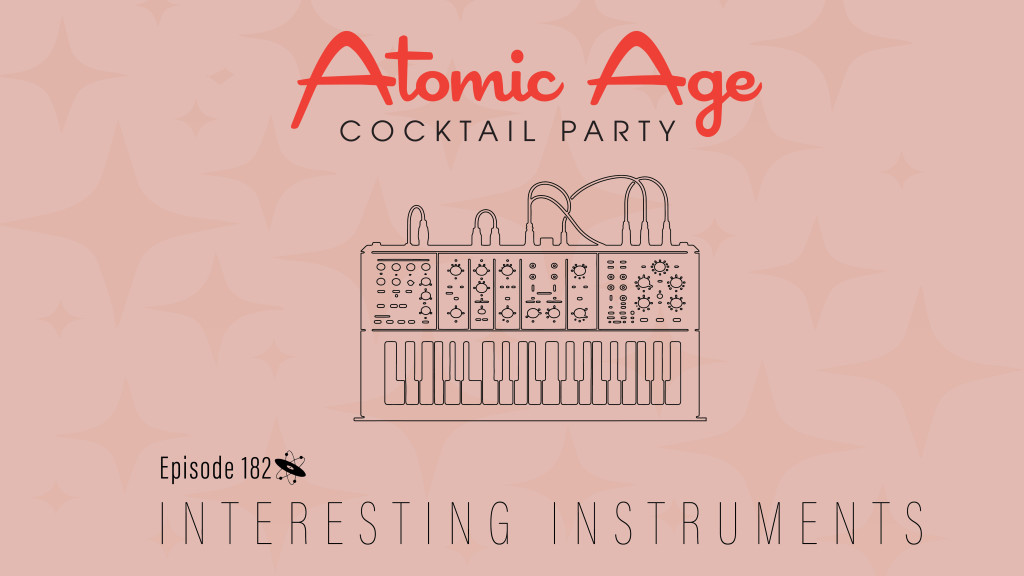
One more set of music left in our interesting instruments program, and one of the most interesting instruments to take hold in the 1960s was the Moog synthesizer. With that instrument, things became electronic and futuristic sounding very quickly. Now, we just heard Martin Denny going deep into his exotica sounds. Well, let's hear him again experimenting with the Moog. It's a song, A Taste of Honey, and it's right here on the Atomic Age Cocktail Party.

[MUSIC: A Taste of Honey - Martin Denny]

[00:46:26]
[MUSIC: unable to identify]

[00:55:03]
Jason Croft: Wrapping up our interesting instruments program here on the Atomic Age Cocktail Party, and there are the strange space-age sounds of the Moog synthesizer. Enoch Light, the master of the stereophonic record, first with Command Records and then with Project 3. This is from his Project 3, 1970 release, Enoch Light Presents Spaced Out.

We also had Dick Hyman and his very spacey version of the movie theme to Alfie, another Burt Bacharach and Hal David number. And Hyman himself, one of the many artists who were part of Enoch Light's Command Records stable of artists. What we heard was from the album The Age of [Electronicis] from 1969.

[Jean-Jacques Perry] also in there with [Gossippo Ppito], or Perpetual Gossip. That's from his 1970 release, Moog Indigo. A little pun on the classic song title. Moog albums always like to do that either with the official pronunciation Moog or the other version, which would be Moog. And Perry here with this track, adding the Moog synthesizer to a lot of spliced-up recordings of human voices.

And we started with some more Martin Denny, although heard here in a whole different light. That was the standard A Taste of Honey a la Moog. It's a song that Martin Denny previously recorded as a straight-ahead tune, but here it's a little bit more soulful and a lot more space age. It's from Exotic Moog from 1969.

Well, that just about does it for our show this week. Make sure you're here again for more fun from the golden age of the hi-fi and beyond. Gonna leave you with one more, and for fans of 1980s TV you may remember the commercials for one George [Zamfer], the Romanian artist who was referred to as the master of the pan flute. He would take old standards and hits of the day and give them the pan flute treatment. Here he is from his 1996 album, Songs of Romance with the number Smile. Until next time, this is Jason Croft saying, keep swinging. The Atomic Age Cocktail Party is a production of Illinois Public Media.
This week, we’re looking at all sorts of interesting instruments that found their way onto records during the hi-fi era. Usually for music of this time, you had the standard combination of piano, percussion, brass, woodwinds, and strings that made up most bands and orchestras. But everyone once in a while, you would hear an additional something that would stand out because of its rarity in the genre. It’s not that the instrument was weird in of itself…it was just not usually heard on these recordings. We’ll hear from Muzzy Marcellino, Dorothy Ashby, Jean-Jacques Perrey, and many others.
Playlist
| Title | Artist | Album |
|---|---|---|
| This Room Is My Castle of Quiet | Samuel J. Hoffman | Music For Peace Of Mind Featuring The Theremin With Orchestra |
| There's an Island in the West Indies | Corky Hale | Modern Harp - Vol.17 |
| Taboo | Dorothy Ashby (with Frank Wess) | In A Minor Groove |
| Accidental Slip on an Oriental Rug | Robert Maxwell | Hi-Fi Harp |
| Willow Weep for Me | Muzzy Marcellino | Birds Of A Feather… |
| The High and the Mighty | Victor Young & His Orchestra | The High And The Mighty |
| Whispering | Fred Lowery | Whistle A Happy Tune! |
| Boplicity | Ron McCroby | Ron McCroby Plays Puccolo |
| Ebb Tide | Jerry Murad's Harmonicats | Sentimental Serenade |
| Live for Life | Jackie Gleason | The Now Sound... For Today's Lovers |
| The Typewriter | Leroy Anderson | Leroy Anderson Conducts Leroy Anderson |
| Cobra | Martin Denny | Forbidden Island |
| A Taste of Honey | Martin Denny | Exotic Moog |
| Gossipo Perpetuo | Jean-Jacques Perrey | Moog Indigo |
| Alfie | Dick Hyman | The Age Of Electronicus |
| Walk on By | Enoch Light And The Light Brigade | Enoch Light Presents Spaced Out |
| Smile | Gheorghe Zamfir | Songs Of Romance |