







“I Hear America Singing” Celebrates American History Through Song
NOTE: This article was originally published in March 2026. “I Hear America Singing” will be repeated at the Krannert Center for the Performing Arts on September 10 and 11. Tickets and more information can be found on Krannert Center's website.
How does one encapsulate everything the Declaration of Independence has meant to Americans over the past 250 years? That is the question Dr. Julie and Nathan Gunn had to contend with when they were approached by the Peoria Riverfront Museum to curate a concert in honor of the 250th anniversary of the signing of the Declaration of Independence.
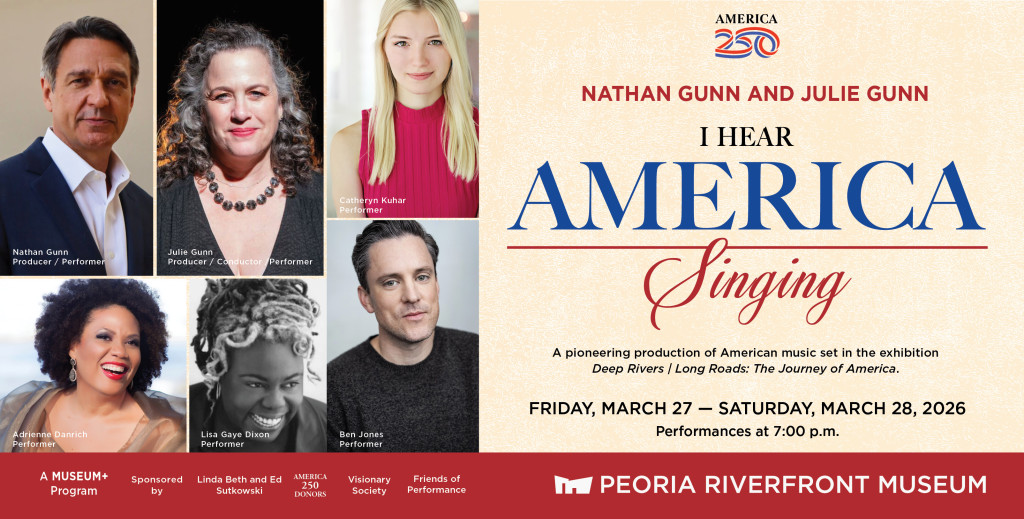
“I didn’t feel super comfortable like speaking for all Americans over 250 years,” Julie Gunn said, “but we wanted to say something meaningful, so we started with poetry.” Gunn, a pianist, educator, music director, and producer, is Professor of Accompanying and Co-director of Lyric Theatre @ Illinois. She curated the concert alongside her husband and artistic partner, baritone Nathan Gunn, through their production company, Shot in the Dark Productions. The concert is a part of the museum’s Museum+ Performance Initiative and is made possible through the support of Linda Beth and Ed Sutkowski.
They started with the poetry of Walt Whitman, particularly his poem Crossing Brooklyn Ferry, which meditates on the passage of time and the shared experience of being American across generations. This led them to Whitman’s poem I Hear America Singing. “From there, we realized how Whitman’s vision echoed in the work of other poets—notably Langston Hughes in I, Too and Allison Adelle Hedge Coke in America, I Sing You Back,” she writes in the concert’s program booklet.
Using Whitman’s poem and its poetic responses as a starting point, they settled on the theme of America singing. But what do Americans tend to sing about? Having dedicated much of their careers to exploring and promoting American song, the Gunns quickly noticed a common thread: yearning for the promised land.
This theme of longing for the promised land ties in with the museum’s exhibit The Promise of Liberty, guest-curated by acclaimed documentarian Ken Burns for the museum’s America 250 celebration. This landmark exhibition features a collection of historically important documents, including a 1776 copy of the Declaration of Independence, an Emancipation Proclamation signed by Abraham Lincoln, and the manuscript of Dr. Martin Luther King Jr.’s “I Have a Dream” speech. Gunn explained that the exhibit highlights how, despite our many differences, Americans share a belief in the promise of liberty, even if we “haven’t quite perfected it yet.”
The concert will be held in the gallery of the Deep Rivers | Long Roads: The Journey of America exhibit, which also ties in with the concert’s theme in its celebration of the nation’s path toward a “promised land,” forged by those who came before us and continued by those who come after. Objects drawn from the museum’s permanent collection feature alongside videos of actors reading I Hear America Singing and the responses by Hughes and Hedge Coke. Plus, a video titled “Voice of America” features various people reading the Declaration of Independence, culminating in a mosaic of their faces forming an American flag quilt. Gunn suggests arriving early to take in both of these exhibitions before the concert, as the videos will be silenced during the performance.
Like much of the Gunns’ work, the program will weave together music from across genres, from traditional spirituals and classical art songs to the works of celebrated contemporary songwriters and composers such as Paul Simon, Jason Robert Brown, and Stephen Schwartz. To bring the program to life, they have assembled a diverse group of performers from the realms of classical music, jazz, cabaret, and musical theater. Their unique perspectives as artists and people have helped “give shape to this vision and journey of America Singing, expanding and deepening its expression,” Gunn writes in the program booklet.
Performers will include baritone Nathan Gunn, soprano Adrienne Danrich, Peoria-born vocalist Ben Jones, and recent Lyric @ Illinois alumna Catheryn Kuhar. Lisa Gaye Dixon, Professor Emerita of Theatre and Dance at the University of Illinois, will narrate using her own words, functioning as “the Spirit of America,” Gunn says. “We don’t name her exactly, but she comes and goes, and when others can’t see her, [it means] we’ve lost our way a little bit, and then when we start to find our way again, we see her again.” A seven-piece band will accompany the singers. Alongside Julie Gunn on piano, this band of accomplished central Illinois musicians will include Steve Meadows on guitar, Kiersten Scheret on violin, Kevin Kierspe on trumpet, Kavi Naidu on woodwinds, Maddi Vogel on percussion, and Emma Taylor on bass.
After identifying the promised land and going down to the river to pray in the style of Alison Krauss, each singer will offer a selection that resonates particularly with them. For instance, Danrich will sing “Joy,” a Ricky Ian Gordon setting of a Langston Hughes poem, while Kuhar will offer Dolly Parton’s “Coat of Many Colors."
Next, the program moves into songs about impending change. This change starts out on a dark note, with meditations on national conflicts such as the murder of George Floyd and the Civil War. At this point comes a poignant connection to a document in the exhibit, “A Letter from Sullivan Ballou,” set to music by John Kander (of Chicago and Cabaret fame). The letter is from a Union soldier to his wife, written on the night before he died in battle. It reads, “If I do not [return], my dear Sarah, never forget how much I love you, nor that, when my last breath escapes me on the battle-field, it will whisper your name.”
The darkness eventually gives way to hope through songs on the theme of community and togetherness (e.g., “Brother, Can You Spare a Dime,” “Bridge Over Troubled Water,” “You’ve Got a Friend in Me”). Then, Gunn explains, “having restored our community and our hope in the promised land, we set back out for the promised land.”
Gunn emphasizes that, like the museum’s exhibits, this program is “curated” rather than “created.” She hopes that the familiarity of many of the songs and their wide-ranging styles and eras will demonstrate that in America, there has always been a “concern about the future, and division and worry, but also hope.” She continues, “We may disagree—and sometimes strongly so—on how to move forward, or how to guarantee this liberty for everyone, but you can see that we’ve never lost connection with that hope and that forward movement, as hard as it sometimes has been.” As she puts it in her program note, she hopes that audiences will “hear a story that feels very familiar—an inspirational encounter that reminds you of the enduring love so many of us share for our country and for one another as Americans.”
I Hear America Singing will run Friday, March 27, and Saturday, March 28, at the Peoria Riverfront Museum, but for those who cannot travel to Peoria, fear not. The program will come to the Krannert Center for the Performing Arts this fall, as well as to other cities across the country throughout 2026 and beyond. Community members from each location will be invited to submit videos of themselves reading the Declaration of Independence to be added to the “Voice of America” video so that the exhibit will continue to grow, change, and encompass more voices.