








National spotlight shifts to Central Illinois choreographer Cynthia Oliver
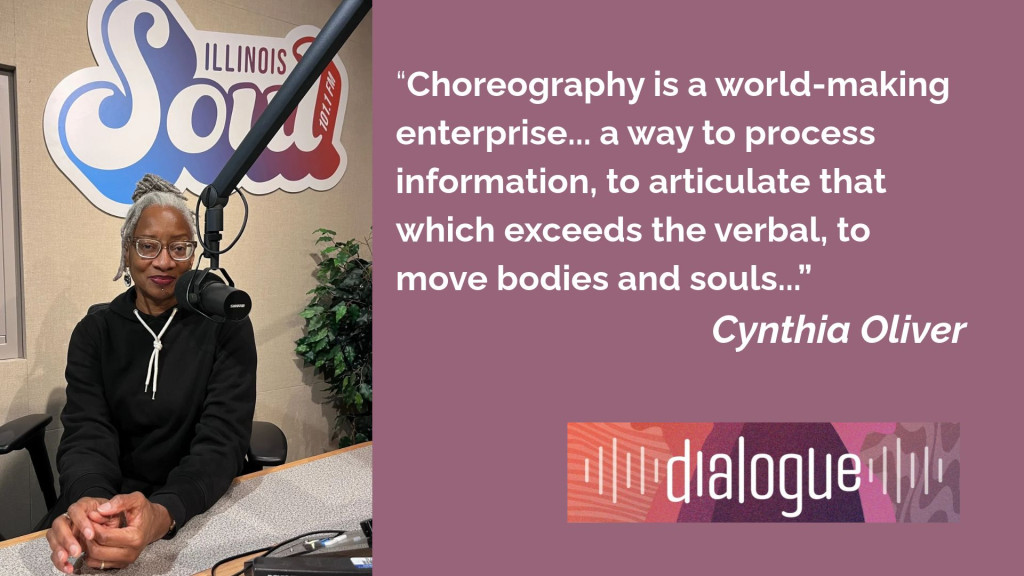
Cynthia Oliver, University of Illinois Urbana Champaign dance faculty member Reginald Hardwick/IPM News
// This is a machine generated transcript. Please report any transcription errors to will-help@illinois.edu.

[00:00:00]
Reginald Hardwick: From Illinois Soul, this is Dialogue. I'm Reginald Hardwick, news and public affairs director at Illinois Public Media. Dialogue is an exchange about culture straight from the soul. Perhaps you've been dazzled by the dances of Debbie Allen, captivated by the moves of Dance Theater of Harlem or the Alvin Ailey Dance Company. Or try to emulate music videos by Janet Jackson or Beyonce. I know I have. Martha Graham once said dance is the hidden language of the soul. For more than a quarter century, Doctor Cynthia Oliver has been on the faculty of dance in Illinois. Her choreography incorporates dance, theater, spoken word performance art with African and American sensibilities. And now her stage is even larger as she is the recipient of the Knight Choreography Prize. Doctor Oliver joins me in studio now. Welcome to Illinois Soul.

[00:01:04]
Dr. Cynthia Oliver: Hi, thank you. Thank you for having me.

[00:01:07]
Reginald Hardwick: When I say the word choreography to you, how do you describe it?

[00:01:12]
Dr. Cynthia Oliver: Um, choreography is a world-making enterprise. Um, I find it a way to, uh, process information. To articulate that which exceeds the verbal, um. To move bodies and souls and to express.

[00:01:37]
Reginald Hardwick: What is your earliest memory of dancing or leading others in movement?

[00:01:42]
Dr. Cynthia Oliver: Oh, those are two very different things. Um, my earliest memory of dancing is being in the living room with my family, um, dancing to some pop song that everybody loved. Uh, I am the last of a large family and um we danced, we danced in the living room with my dad, with my mom, my brothers and sisters and so that's the earliest memory, um. I went to my first dance lessons with two of my older sisters and we performed to Hugh Masekela's music. I remember that, um, but leading dance, I remember at around 12 or 13, uh, I grew up in the Virgin Islands and my mentor at the time was a woman named [Otsie Vandenberg]. She was uh, Dutch and she had been in the Virgin Islands for many years and she had danced with a famous company in Europe called the [Kurt Joos] Company. Uh, it was a dance theater company and I was talented in, um, ballet and modern and and um improvisation and she had me teach the young people. She had me teach the babies. So that was my first experience of like leading other people. I had to design my class and um teach the little ones.

[00:03:22]
Reginald Hardwick: I had the pleasure of viewing [Turn Turning Turt] at [Crannert] Center for the Performing Arts in October. Those who missed the incredibly energetic performance, and since this is audio, could you describe a little bit about it?

[00:03:37]
Dr. Cynthia Oliver: Wow, um, it is a torrent of dancing is what it is, um. It came out of me, uh, working with students here at the University of Illinois, um, where I've been teaching since 2000, um, and realizing that there was some kind of connection between the way that I choreographed for students before COVID, what we negotiated during that sort of represented how we had to kind of live life — quick changes of direction, repetition, um. Talking with each other during COVID and then um how we were regrouping after and so there was a drive to it that I wanted to reproduce and at the same time I wanted to celebrate aspects of black culture that um that we all recognize like double dutch. That's the first piece — has something about it, it's inspired by the driving rhythms of double dutch. I don't represent double dutch, but I am inspired by what that rhythm does and I think of it as sort of like a life lesson um for young black girls and black women and more so across gender now, but um yeah, that drive that makes you figure out how you're going to get into something, how you're going to sustain it and then how you're going to elegantly get out of it. And so the work is that and it's also um it's interspersed with language, um, with video, with uh projection images. I have brilliant colleagues who I work with who uh do the music, do the lighting, you know, so it's a full experience for the audience, at least that's what my intention is.

[00:05:32]
Reginald Hardwick: When you're creating a project like [this], where do you draw inspiration from? You talked a little bit about your students, but how do you decide on the movement and the media and the music?

[00:05:46]
Dr. Cynthia Oliver: Movement often is just something that moves me. Uh, we go into the studio and, uh, I might pose a challenge, a problem, or I might just turn on something and start moving and the dancer's responsibility is to pick it up. And then I'll watch them with it and I'm always interested in how other bodies do the same movement. Um, I am interested in that, uh, and then I enlist other fabulous creators to come in and look at something and tell me uh what is inspiring to them or what it makes them think. Uh, so like my lighting designer — her name is Amanda Ringer — um, she knows that I love a density of color, so that will inspire how she thinks about how she's going to light it. My, uh, costume designer, Susan Becker, she knows that I'm interested in texture and uh Africanist, um, and values around different kinds of materials, and so she will do research around that and bring something to the table for me to look at. Um, my husband and partner in crime, composer Jason Finkelman, knows that I'm interested in different kinds of sounds, so he will back something up or support something with a particular set of sounds and we'll go back and forth. I mean, sometimes we disagree and we'll go back to the drawing board, but often these folks bring to the table really interesting um elements that make the work even that richer.

It is a testament to endurance. Uh, I'm interested in endurance, I'm interested in exhaustion, um, and I've been interested in that, um, since I've been making work and since I've been teaching. Um, one of the things about exhaustion and endurance is that it breaks down certain kinds of layers of artifice. Uh, I wanna see what you really look like when you have to uh pull it up from your gut and you're not, um, you are not putting on a certain kind of persona, you're not performing a particular kind of movement based on your uh preconceived idea of it, but you're just trying to survive it. That's a very different way of uh approaching how you accomplish something and I'm interested in that — how we accomplish something when we are under duress and that's what, you know, kind of the the COVID moment required of us, um.

How we thought about time before that was very different and so in that journey of those three pieces, um, my hope is that one sees — you see the drive, the excitement, the engagement, the play, um. The repartee back and forth, um, you see, uh, environments, neighborhoods, color, uh, graffiti, the city, the landscape and all that and then we go into a period when it's really about like the present and how you navigate and survive the present and who you have to collectively depend on to do that, um. And then people drop in and out the way folks did during COVID, you know, you'd have a collective something and then suddenly somebody's not there because they were sick or they were navigating some other kind of situation and then um in the last work we're thinking more in terms of uh futurity — what's going to happen in the future? How are we gonna approach the future? How are we gonna be a collective? What are we gonna do? Are we gonna celebrate each other and our differences and move toward that kind of future? Um, so I try to bring all of that into the physicality of the work as I'm making it.

[00:09:54]
Reginald Hardwick: You're listening to Dialogue. I'm Reginald Hardwick. We're speaking with Doctor Cynthia Oliver, who is with the dance at Illinois faculty. She is also the winner of the National Choreography Prize. Congratulations. What will you be able to accomplish with this honor?

[00:10:08]
Dr. Cynthia Oliver: Oh, thank you. Wow, that's a that's a great question. I mean, for one, they promote it in a way that I — I have just always made my work and um promotion has been sort of a happy accident, um, but they have been intentional about getting the word out about this um and I appreciate that. I think a broader audience for my work um will come out of it um. But also there's a portion of the grant and the support that you imagine with the [Akron, the NCC Akron] team. And one of the things I've been working on for the past couple of years is a memoir slash meditation on choreography. There are not many texts written by people of color, black people in particular, and definitely not many women who have written about choreography and how they think about choreography, and I think that is something that is worthwhile having um in our collective record and so I'm going to be working on on that with them.

[00:11:23]
Reginald Hardwick: I grew up watching Fame and Debbie Allen choreograph dancers at award shows. I remember Paula Abdul working with Janet Jackson in the 1990s. Nowadays you see squads of people dancing alone or together and putting it on YouTube or TikTok or Instagram. What is your advice if you're listening to this and you're a young person who wants a career in dance? How do you get noticed by an instructor like you?

[00:11:50]
Dr. Cynthia Oliver: There's so many different ways, um. Well, first of all, I love the fact that there's so many young people dancing and dancing in their own ways and uh publishing it in, you know, in YouTube or on Instagram or however they're choosing to do it. I think that is awesome. Um, also, it's important that um the training becomes a part of that vocabulary, a part of their understanding of how they get better. Um, it's not just about choreography. What happens a lot, um, you see these days is folks learning dances and then publishing those dances. Um, training needs to be all around. And so, um, a university experience is a great uh experience for a young person wanting to get better and wanting to be versatile. Um, for a professional dancer it is essential for us to be versatile. Um, I remember my early years I danced with a couple of different companies and I had to do different styles with each of those or I did a couple of commercial gigs, um, some uh commercials for television or uh something for a particular event and you need to be able to do another choreographer's work easily. In order to do that you need good solid training and uh college experience, especially for a contemporary dancer or modern dancer, um, is an important part of the ecosystem of the professional world. So you have certain training during high school, you go to your various studios, you keep that up and then college is a really great place to continue that and then once you graduate from say undergrad like I did, um, then you audition and get into a company hopefully um or you start making work early in your college experience and as you get out you start working with your peers and and make things in a collective environment or something like that, um, but training is critical.

Because without training, you're just doing steps. With training, you start to develop a body that can be versatile and strong and can do um what is expected of a professional.

[00:14:09]
Reginald Hardwick: What if you're an amateur listening to this and you like to dance, but you're a little bit embarrassed because you think you have two left feet — that expression. You know, what do you, uh, do you have any advice for someone who's just like embarrassed to do it in public or something?

[00:14:26]
Dr. Cynthia Oliver: Are you talking about

[00:14:27]
Reginald Hardwick: yourself? Occasionally,

[00:14:30]
Dr. Cynthia Oliver: um, I think, you know, there's no shame in the game. I think, you know, find what you love and do that thing. It is critical to be passionate about dancing. Um, so if there's an environment that you feel safe and comfortable in, do that, go there, do that, do that to the fullest. Maybe you start to, um, get exposed to other people who might offer some kind of training in that particular area, um, and then you can become better in that particular area and who knows, that could lead to a different um practice. I know folks who have studied capoeira, for example, uh, Afro-Brazilian martial art, that have been, you know, that leads them to samba and then samba leads them to, you know, tap or, you know, so you never know the the trajectory that you'll be on with with training and um I think you do what you love and the rest will take care of itself.

[00:15:31]
Reginald Hardwick: You've been listening to Doctor Cynthia Oliver, faculty member at the University of Illinois Urbana-Champaign and recipient of the Knight [Choreography] Prize. Thank you for joining us here at Dialogue.

[00:15:41]
Dr. Cynthia Oliver: Thank you for having me. Keep dancing.
For more than a quarter century, Dr. Cynthia Oliver has been on the faculty of Dance in Illinois at the University of Illinois Champaign Urbana. Her choreography incorporates dance, theater, spoken word, performance art with African and American sensibilities. And now her stage is even larger as she is the recipient of the Knight Choreography Prize.