








Pumpkin or sweet potato pie? There’s a rich history behind both
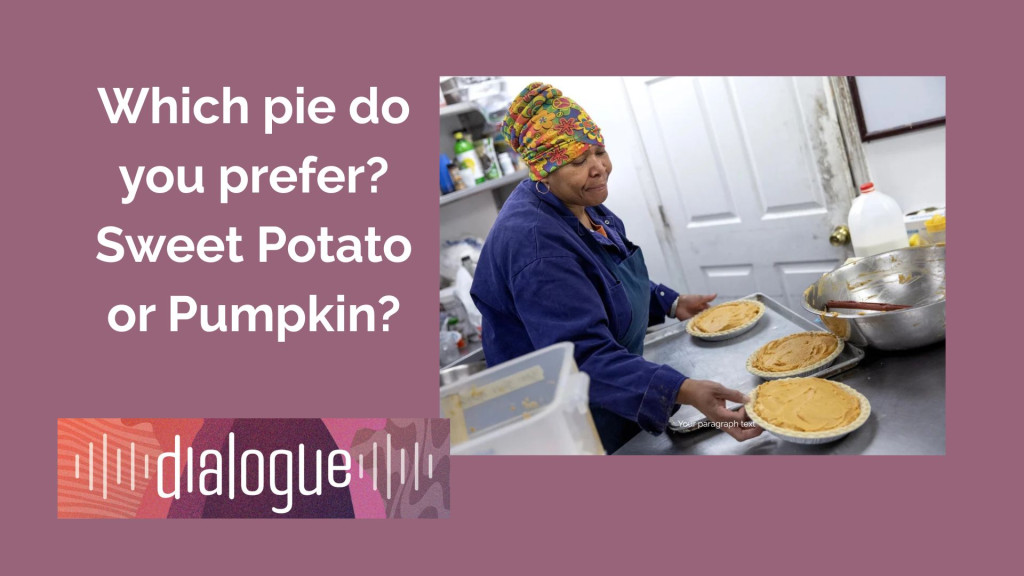
Pastry chef Carla Jones loads a trio of sweet potato pies onto a tray destined for the oven on Nov. 15 at Ol' Henry, a restaurant in Berkeley, Mo. Tristen Rouse/St. Louis Public Radio
// This is a machine generated transcript. Please report any transcription errors to will-help@illinois.edu.

[00:00:00]
Speaker 0: This holiday season, millions of Americans will be hosting Thanksgiving dinner. In many households, one important question for guests: did you bring pumpkin pie or sweet potato pie? Chad Davis of Saint Louis Public Media reports that while both dishes are similar, they carry different histories.

[00:00:26]
Chad Davis: Photos and memorabilia line the walls of Ole Henry restaurant in suburban St. Louis. It's one of those restaurants with a wall of pictures of local and national celebrities, and longtime customers come to the cafeteria for soul food staples like fish, mac and cheese, and greens. When it comes to Thanksgiving pie, owner Ada Joyce Taylor and her granddaughter Adriana Black have a definite opinion.

[00:00:52]
Adriana Black: Yeah, definitely, yeah.

[00:00:54]
Ada Joyce Taylor: Sweet potato pie because I, I'm looking for that sweetness in a pie.

[00:00:58]
Chad Davis: The flaky crust contains a deep orange filling made from boiled and peeled sweet potatoes. In the weeks before Thanksgiving, executive chef Tracy Stevenson and other bakers are cranking out even more pies.

[00:01:11]
Tracy Stevenson: [Number] of weeks, I would say that we go through at least 15 to 20 sweet potato pies. During the holiday, I would say 40 to

[00:01:20]
Chad Davis: 50. Millions of Americans will choose between sweet potato pie or pumpkin pie for Thanksgiving dessert. Both are American staples with a starchy custard-like filling. But pumpkin pie tends to be more spice-heavy than sweet, and sweet potato pie is typically sweeter and lighter. The reasons why people choose one over the other often trace back to where the person was raised and their race. Sweet potatoes may have resonated among enslaved people because they're somewhat similar to yams grown in West Africa, according to soul food historian and James Beard Award-winning author, Adrian Miller. But he says cooking the natively grown sweet potato in a pie, that's a more European food.

[00:02:03]
Adrian Miller: So it's really the expertise of these enslaved cooks making someone something unfamiliar to them. To please their slaveholders that eventually gets embraced and adopted. It's the same with things like fried chicken, you know, barbecue and all these other things that were not necessarily part of the West African food heritage.

[00:02:23]
Chad Davis: Since then, sweet potato pie has become a hallmark of black cuisine and common on dinner tables across the South. But it's pumpkin pie that plays a central role in our portrait of the quintessential Thanksgiving dinner. The pie dates back to the colonial period where settlers learned how to boil or steam native pumpkins and mash them into a filling. Bruce Craig is an Illinois-based culinary historian. He says a book from 1827 by author and activist Sarah Josepha Hale is largely responsible for the dessert's connection to Thanksgiving.

[00:02:57]
Bruce Craig: She said pumpkin pie is the American pie from our founding fathers,

[00:03:02]
Chad Davis: but he says Hale got it a bit wrong.

[00:03:05]
Bruce Craig: Pilgrims who came to New England brought this pie with them. They didn't. It's not true, but she said so. So it became the thing. It became the Yankee

[00:03:15]
Chad Davis: pie. 36 years later, Hale convinced President Abraham Lincoln to proclaim Thanksgiving as a national holiday, and pumpkin pie remains incredibly popular to this day. At the Blue Owl Bakery in [How] Springs, Missouri, owner Kim Byerly and an assembly line of bakers will create all kinds of pumpkin pie variations.

[00:03:35]
Kim Byerly: These are our pumpkin gooey butter cheesecakes, so they've got like a pumpkin spice crust on the bottom and then a pumpkin pie filling with the pumpkin mousse on top and whipped cream.

[00:03:45]
Chad Davis: When restaurant bakers like Cindy [Watu] takes a bite of the pie, it takes her back to her childhood.

[00:03:51]
Cindy [Watu]: I'm partial to the spices that are in it. Um, it's not like so sweet, and then, um, it, it just reminds me of home, of

[00:03:59]
Chad Davis: family. And for many across the country, that's why they stick with pumpkin or sweet potato pie, because of the memories they've made when they've eaten it. For Harvest Public Media, I'm Chad Davis.

[00:04:12]
Speaker 0: This story first aired in November 2023. Harvest Public Media is a collaboration of public media newsrooms in the Midwest and Great Plains. Coming up, a black international student at the University of Illinois explains how and why he documents every day of his life in central Illinois on social media.
For many Americans, the Thanksgiving feast just isn't complete until they dig into a slice of pumpkin or sweet potato pie — and for some, there's simply no room for both.
The two desserts have similarities — both are orange, sweet and have a bit of spice — but they have distinct histories that have led to dedicated followings.
At Ol' Henry Restaurant in suburban St. Louis, opinions are strong.
"Sweet potato pie. Definitely," said owner Ada Joyce Taylor.
Her granddaughter, operational manager Audrianna Black, agrees. "I'm looking for that sweetness in a pie," she added.
Taylor started the soul food business almost 10 years ago, naming it after her late husband, Henry Edward Taylor. Today, the walls are lined with signed photos and memorabilia, and it's a well-known destination for those craving sweet potato pie.
"On a normal week, I would say that we go through 15 to 20 sweet potato pies," said chef Tracy Stevenson. "During the holiday, I would say 40 or 50."
Both sweet potato and pumpkin pies are American staples with a starchy custardlike filling. Pumpkin pie tends to be more heavy on spice, while sweet potato pie is typically sweeter and lighter.
But the reasons why people choose one over the other often trace back to where they were raised and their race.
"Always sweet potato pie"
The origins of these two desserts stretch back to the 15th and 16th centuries, when European settlers brought sweet potatoes and pumpkins back to Europe from the Americas.
With sweet potato pie, settlers may have been trying to replicate the European dish carrot pie, a dessert with layered slices of carrots, according to soul food historian and James Beard Award-winning author Adrian Miller.
"You'll see recipes in the historical record that have sweet potato pie in layered slices," Miller said. "They know that they're sweet and saying, 'Hey, we've got this natural sweet vegetable that's orange, I could use this as a substitute for carrot pie.'"
Miller said carrot pie recipes of the time had similar methods and spicing as those used for sweet potato pie.
As colonization expanded across the Americas, enslaved Africans learned how to cook sweet potatoes. Miller said the potatoes may have resonated among enslaved people because they're somewhat similar to yams, a root vegetable grown in West Africa.
However, he said, the idea of putting sweet potato into pie form came from European culture.
"It's really the expertise of these enslaved cooks, making something unfamiliar to them to please their slaveholders, that eventually gets embraced and adopted," Miller said. "It's the same with things like fried chicken, barbecue and all these other things that were not necessarily part of the West African food heritage."
Since then, sweet potato pie has become a hallmark of Black cuisine and common on dinner tables across the South.
For Miller, sweet potato pie means family and culture.
"We've never had a pumpkin pie grace our table, unless somebody who doesn't know us brought one over, if we invited someone," Miller said with a smile. "And that's on us, right? Because we should have given them a warning not to bring that stuff over. So it's always sweet potato pie."
"The perfect Thanksgiving dessert"
But it's pumpkin pie that plays a central role in the portrait of a quintessential Thanksgiving dinner.
Like sweet potato pie, pumpkin pie's roots go back to a time when European settlers were experimenting with foods grown locally. They learned how to boil or steam pumpkins that were first domesticated by Native Americans. Early pumpkin pie recipes can be found in both early Colonial and French cookbooks.
"The pumpkin pie itself has this whole world history within it, not only the Columbian Exchange, but the spice exchange," said culinary historian and Roosevelt University Professor Emeritus Bruce Kraig.
But an 1827 novel is largely responsible for the dessert's connection to the holiday. In Northwood: A Tale of New England, author and activist Sarah Josepha Hale dedicated a chapter to describing what is the now-classic Thanksgiving dinner.
"She virtually invented it — the turkeys, the cranberry sauce," Kraig said. "She said pumpkin pie is the American pie."
In 1863, Hale convinced President Abraham Lincoln to declare a national day of Thanksgiving.
Pumpkin pie remains closely linked to the holiday.
At The Blue Owl Bakery in House Springs, Mo., owner Kim Byerly said demand is through the roof for the restaurant's pumpkin pies. They expect to sell several hundred and are expanding by shipping the pies across the country this year.
Byerly is a fan of pumpkin pie, even if it took her years to actually try it.
"I just like the flavor and the consistency of it," Byerly said. "You mix it with that whipped cream and it's just like the perfect Thanksgiving dessert."
The Blue Owl's bakers also make several variations of the traditional pumpkin pie, including pumpkin gooey butter cheesecake, but so far, no sweet potato pie.
Cindi Wittu, a baker at The Blue Owl, said that while she's had both pies, she prefers pumpkin.
"I'm partial to the spices that are in it," she said. "It just reminds me of home, of family."
Chad Davis is a reporter for St. Louis Public Radio. This story was produced in partnership with Harvest Public Media, a collaboration of public media newsrooms in the Midwest. This story was originally produced in 2023.