



Race and class on center stage at The Virginia Theatre as cast prepares to debut ‘Ragtime: The Musical’
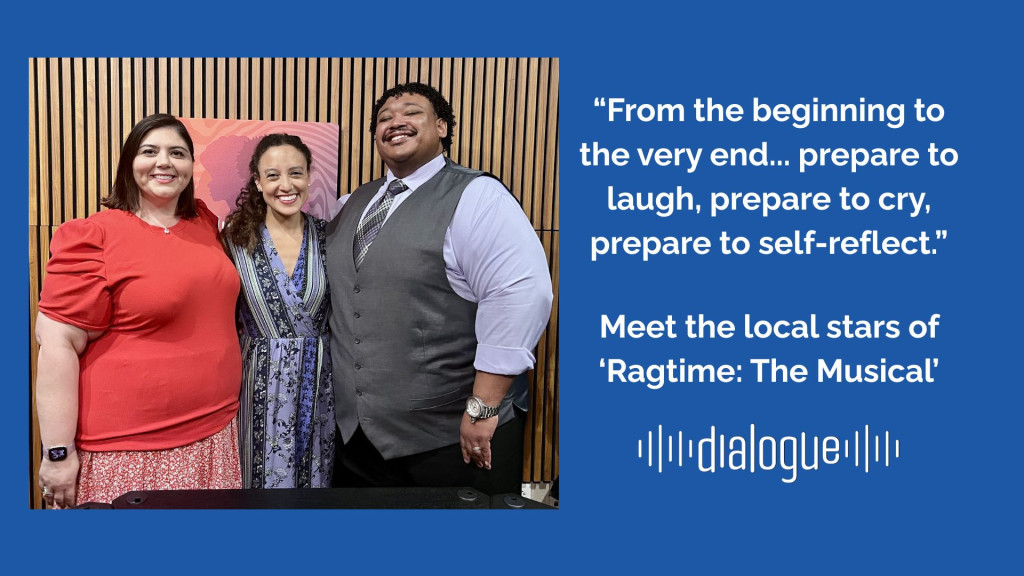
Left to right: Monica Samii-Porter, Kimberly Schofield, and Alonza Lawrence. Reginald Hardwick/IPM News
// This is a machine generated transcript. Please report any transcription errors to will-help@illinois.edu.

[00:00:00]
Reginald Hardwick: You're listening to Dialogue from Illinois Soul. I'm Reginald Hardwick. Dialogue is an exchange about culture straight from the soul.

A Tony Award-winning Ragtime the Musical will debut July 30th and run until August 2nd at the Virginia Theater in Champaign. The production is set at the beginning of the 20th century, the 1900s. It follows a working-class Black family, a wealthy white family, and an immigrant Jewish family. Some say it's a reflection of both the past and present.

Joining me in the studio are two of the cast members. Dr. Alonzo Lawrence is a vocal performer and studio teacher with extensive performing experience from Los Angeles to Virginia. He's also the professor of voice, gospel studies, and a vocal coach for the Lyric Theater here at the University of Illinois Urbana-Champaign. Welcome to Dialogue.

Thank you for having me.

And Kimberly Schofield is a well-known actor and singer here in central Illinois, having recently performed in Rent, Gypsy, and Romeo and Juliet. And of course, longtime listeners know her as the former host of Morning Edition at Illinois Public Media. She also hosted this show, Dialogue, a few times. She left us in June and we're still weeping about that, uh, but, uh, she's at the Humane Society of Champaign County. Kimberly, welcome back.

Thank you. Thanks for having us.

And Monica Sammy Porter is the producer for this show's run at the Virginia Theater. She's also a manager at Christie Clinic and co-owner of Mr. and Mrs. Auto Detailing. Welcome to you as well.

[00:01:39]
Monica Sammy Porter: Thank you so much. Thank you for having us.

[00:01:41]
Reginald Hardwick: What are your roles in Ragtime the Musical, and how do they interact with each other?

[00:01:46]
Kimberly Schofield: I play Sarah and Alonzo plays [Coal][house], and we interact with each other. I guess love interests is a fair, a fair call for our descriptors. A child, yes, yes, yes, but yes, we — we at some point, of course, the story will veil itself as you see it, but we meet, we part, do we come together? It's about kind of the — at least our relationship is the development of how we love each other and how we learn to love each other and bring life into the world.

[00:02:20]
Reginald Hardwick: What about this role spoke to you?

[00:02:22]
Dr. Alonzo Lawrence: Um, the role — it covers so many different things, so many different facets, uh, particularly the character of [Coalhouse], um. I always find it strange, and I don't want to give too much away, uh, from the story, but hopefully people are kind of familiar with this idea. He works so hard to get Sarah back after making mistakes and then something happens. And instead of choosing Sarah over the thing that happened, he chooses the thing. And um, chooses to avert his attention there. And uh, I — I think it speaks to how we can kind of get caught up on, or caught up in, things that aren't as important as we realize they are. Um, but not saying that it justifies the actions of what happened to him. So, but the idea of the humanity — or the human experience — of being this person who is loving things versus loving people.

[00:03:27]
Kimberly Schofield: Strictly character-wise, Sarah also goes through a lot and feels a lot of things very deeply and extremely. Acting-wise for me is always kind of — I would consider myself actor, then singer, then dancer. So the acting that has to go into how much Sarah feels and how she interacts with — very specifically [Coalhouse], but also the entire world — is something that I think would be really challenging and also is reflective, I think, of people, and I've experienced this as well, where you feel something so deeply and you don't know how to express it and you don't know how to deal with it. And that comes out in whatever way it comes out — whether it comes out where you are quiet and you don't speak to anybody and you're not able to express your feelings, or you are completely elated and you are shouting from a mountaintop. And being able to kind of navigate so many emotions, to just try to live and survive and do what you think is best for you — I think is a challenge that people will face all the time. Not to get too deep, but in Sarah's case, you see a pretty big arc in a pretty short amount of time for Sarah, from all of the huge emotions and experiences that she goes through, and I find it very captivating.

[00:04:44]
Reginald Hardwick: Monica, as producer, tell me about the story that unfolds in this musical.

[00:04:50]
Monica Sammy Porter: We start meeting the different types of ensembles in this show. First, we have our New Rochelle ensemble, and that is the upper-class white families. Uh, then we are introduced to our Harlem ensemble — of course, of course — that makes up the Black community. And then the immigrants who speak Yiddish and are Jewish, and you see them interact in the very first scene as enemies and they're polarized. And it really sets the stage for how the character arcs happen, how the relationships unfold, and it becomes a beautiful, devastating, gorgeous story that surpasses, I think, all of time. Truly.

[00:05:42]
Reginald Hardwick: How big is the cast and how challenging is that — working with that many people?

[00:05:47]
Monica Sammy Porter: Uh, the cast is about 51, which is a larger cast for us with the community theater — Champaign-Urbana Community Theater — plus a 22-piece orchestra. Uh, [it] will definitely be a challenge. Uh, that's why we have, you know, tech week, so we can space everything out on the beautiful Virginia stage, make sure everyone is safe, make sure everyone has room, and that the story isn't hindered in any way.

[00:06:14]
Reginald Hardwick: Well, let's take a moment to listen to "Wheels of a Dream," produced by the Broadway cast of Ragtime the Musical, performed on the CBS Late Show with [Stephen Colbert] in late [2025]. [🔍 Flag for review: The Late Show is hosted by Stephen Colbert; "CBS Late Show" is the common informal reference, though the show's full title is "The Late Show with Stephen Colbert." Please verify the date "late 2025" against the broadcast record, as this may be inaccurate given the production timeline.]

[00:06:27]
[Music — "Wheels of a Dream," Ragtime the Musical Broadway cast]

[00:07:20]
Dr. Alonzo Lawrence: So "Wheels of a Dream" takes place right after the reunion. Um, there has been quite a significant amount of time, uh, that [Coalhouse] and Sarah have been apart. Through banter, they discover that, wow, we really can make a future here. And, um, it's the first time — well, second time — that [Coalhouse] has an intimate moment with his child, his son, and sings about the beautiful things that can be — probably in relation to the life not too long ago for people that look like him in this country, uh, that couldn't exist. So the idea of owning a car and raising a family and building the American dream together and moving to California is the dream. And uh, we sing together with child in hand, um, just about the unyielding possibilities of a wonderful future together.

[00:08:23]
Kimberly Schofield: As part of the duet, one of the moments where Sarah is also seeing how her life is unfolding in the best way possible — it is everything that she dreamed of, even if it was for just a moment and then she thought she lost, and now she is back and she is seeing this man who she loved and was devastated by express their future entirely together. And it is just such a hopeful, beautiful song. And like Alonzo said, thinking about a life together and also just what it means to be a person living in America. And you see that throughout the show because of course we have the three different sectors of people, but this is them existing in, in this moment together, in one of the happiest times that they — that they will share in their life together. [Coalhouse] — the song and the harmonies — I mean, the music is beautiful in every single song. This one is especially, though, really just has so much depth to it. And the parts where Sarah comes in and then harmonizes with [Coalhouse], you were just blown away. It is, it is beautiful, and it's a happy song and people are crying.

[00:09:35]
Reginald Hardwick: If you're just joining us, we're talking about Ragtime the Musical with cast members Alonzo Lawrence and Kimberly Schofield and producer Monica Sammy Porter. The production runs at the Virginia Theater in Champaign from July 30th to August 2nd.

Because this is America and race and class are ever present in this conversation — are you — what are the reflections that you have had, or have heard maybe from Black audiences versus white audiences? Or, you know, has — is that a discourse that you all talk about?

[00:10:09]
Kimberly Schofield: We had some of the people who are in the Harlem ensemble talk about actually meeting outside of rehearsal to kind of gather together and talk about if they do see any reflection of the experiences. We have had a lot — a lot of conversations in rehearsal. Like, there are slurs that are used in the show. So we have had conversations since day one, and also even on the audition forms, about we are not going to say those until this time and we will use these words instead, and we have to recognize where they came from.

And seeing — I don't know anybody in the community who's not in the show who has seen the show, so I can't speak to what their interpretation is. But it is — every time you hear songs or you hear words that should not be said, because words do have power behind them, it still is like kind of a sharp feeling that I get, at least in my chest, like, oh yes, that's right. This is something that is reflective of what has happened and also even what we can see today, whether it's with class or with race, or if there are even like notes of feminism and things throughout the show as well — that oppression still exists.

[00:11:21]
Monica Sammy Porter: I'd like to say we've moved so far. We have moved so far, but still not enough. Still not enough. Um, I know that we had — at our very first rehearsal, our dramaturg[e], Samantha White, presented a bunch of history. Like, she had an hour-long presentation on the background of every single group of all of the characters in the show that were truly alive back then. Like, even Harry Houdini is a character in Ragtime, and she presented about him. And I feel like starting the rehearsal process with that information, and everyone hearing it, was a great place to start, because I would never, ever want anyone to feel uncomfortable at a rehearsal.

[00:12:12]
Reginald Hardwick: In the experience of maybe audiences, or maybe reviews that we read, do people see a through line between that time — the 1900s — and now?

[00:12:22]
Monica Sammy Porter: I think it's easy to draw a parallel. Absolutely. Yeah, yeah.

[00:12:28]
Kimberly Schofield: I would say yes.

[00:12:30]
Dr. Alonzo Lawrence: It's a member of our cast who has a son, um, and just for discretion I'm not going to mention, but, um, they still have that family member, uh, that is unsure if the reason why they're consistently pulled over is racial or is it for some other reason. Uh, so regardless — it seems to be consistent and almost on a weekly basis, and it is outside of the [city] of Champaign-Urbana. When we talk about the other areas — [Monticello], Tuscola, other areas where it's maybe not as diverse, uh, as the city — uh, and it's, it's a hard, hard truth and it's scary. I'm not a parent, but, uh, for them it's scary. So, um, even to today, um, we can see the threads that kind of still exist from the themes that are expressed in here. And I think it's a good thing that the conversation is still happening. I don't think they should ever stop. [🔍 Flag for review: Speaker says "crisis of champagne Urbana" in the original — likely "city of Champaign-Urbana." The word preceding Tuscola is unclear; "Monticello" is inferred from context as a nearby less-diverse Illinois community, but please verify.]

[00:13:46]
Reginald Hardwick: I'll start with you, Monica, and go down the line. Why should someone who's never seen Ragtime the Musical — or maybe not [accustomed] to see big musicals like this — uh, why should they [come] see that? [🔍 Flag for review: Original transcript reads "why should they say that" — likely "why should they go see that" or "why should they come see that." Please verify against audio.]

[00:13:59]
Monica Sammy Porter: I think someone who has never seen Ragtime before should see Ragtime because of the talent our community has. It is so cool to see, uh, members who are lawyers during the day and then come and rehearse at night and sing their hearts out and dance their hearts out. And I feel like our community should support community. And, um, you know, these are all volunteer positions. No one's getting paid, um, when they're on that stage. To be on that stage, they actually have to pay a membership fee to the [Champaign-Urbana] Theater Company to be in the production. Uh, so I — I am awed by the talent we have in this community, and it just keeps getting better and better. And for that reason, I would recommend anyone to come see this show. No matter how much musical theater knowledge you have — if you've never seen a musical on stage before, start with this one. You'll be wowed. [🔍 Flag for review: Original transcript reads "champaagne Urbanda Theater Company" — likely "Champaign-Urbana Community Theatre" or similar. Please verify the organization's full official name against audio.]

[00:15:06]
Dr. Alonzo Lawrence: It's a pleasure working with students and being in a field where this is our norm — we're putting on shows, we're preparing for shows — and, uh, a lot of people have no idea what it takes to do this, what is involved. So absolutely, supporting our local community — because the amount of jobs that it takes: uh, catering, you're talking about buying supplies in order to build sets, paint, renting from a local theater — there are so many things tied that keep the money within the community itself. But also the idea of — yes, you can see a movie, and you can see all the effects and everything of that nature, but it's impersonal. It is something that was mass-produced, and regardless of how you feel, there's no intimate connection per se, maybe unless you have a personal tie to the message.

There is nothing like being in the audience, being in the place, in the space — if we're going to say that in church terms. Um, there's nothing like being at a live show, to see a movie of sorts being made right before your eyes. And there are no redos, there are no takebacks, there's no edits. This is life. What happens, happens, and we must make it work to the best of our ability. And then we must do that consistently, day after day after day.

And then particularly this musical, um — the music is so gorgeous.

[00:17:05]
[Music]

[00:17:39]
Dr. Alonzo Lawrence: From the beginning to the very end, bring your Kleenex — bring, bring the tissues — and prepare to laugh, prepare to cry, prepare to be angry, uh, prepare to self-reflect, and then prepare to allow the message of the show to affect you. Kimberly.

[00:18:02]
Kimberly Schofield: I have a friend who has said before that Ragtime might be the closest thing to a perfect musical, and I did not know Ragtime because I am a terrible theater person and I don't know shows until I am in shows. But it's also an exciting way to go into theater. And every time — I think I mentioned this at [sitzprobe] — or the orchestra sing-through. [Sitzprobe] is where you sit and sing with the orchestra. And I said, wow, there are all these songs that I don't know, and then I hear them and I think, oh, that's the best song, and that's the best song. And there's a song that — [the character] wanted to say — and listening to it on the cast album, I've, I've skipped through it. Um, where are my songs? OK, great, move on. And then I heard them perform it and I was sobbing, and I thought, why — possibly, why did they do this to me? Why did this — and it, I mean. It is amazing. [🔍 Flag for review: The phrase "there's a song that is he wanted to say" is unclear in the original; the inferred rendering is approximate. Please verify against audio.]

The people who wrote it also wrote [Seussical], which is also a very — a lot of good fun songs, but entirely different than Ragtime. So appreciating the talent that goes into it and hearing the pit and watching the pit play and [Jamie] conduct — not that the audience can, like, really see down into the pit, but knowing that yes, this community has come together, this community is supporting us, everybody has worked so hard to put this production on. And then just sitting back and listening to what the creators of this show did is completely mind-blowing. [🔍 Flag for review: "Suzal and" in the original is likely "Seussical," a musical by the same songwriting team (Lynn Ahrens and Stephen Flaherty) as Ragtime. Please verify. Additionally, "Jaime" in the original may refer to a conductor named "Jamie" or similar — please verify spelling against production materials.]

The music is absolutely gorgeous. It is not just ragtime music itself, though it is in there and it is incredible. But you hear a lot of different styles and a lot of different voices, aside from just the characters who get to present you with this story. And no matter who you are or how old you are — we have little, little kids in this show, and we have a lot of people who are seasoned in this show and everything in between — you will get something out of it, even if that is just seeing a really pretty show.

[00:20:06]
Monica Sammy Porter: Well, never having been a producer at this magnitude before, I have learned a lot. And I, um — when it comes to producing itself, I definitely feel like I'm an organized person, but not anywhere near enough organized. Um, so I'm working on that. I'm taking that note. Uh, that is, you know, completely about me. Um, but, uh, during this process — it's theater. It's all about collaboration. Truly. That's — that's what I learn and continue to learn every time I'm involved in a production. It's all about collaboration.

[00:20:52]
Dr. Alonzo Lawrence: Absolutely. Um, I love learning the community. Um, there are times, uh, associated with the university — especially being on tenure track and trying to meet all the demands that that has — you become isolated. I live between three of the four music buildings, between [Krannert] and the main building and Smith, and that's my entire life. And um, I — yes, I have some interaction with the community, with like the MLK mass choir, I do that every year, and uh, working, uh, a little bit in the past with Dr. Davis and Black Chorus — and um, but it is wonderful to make ties. For me, the first time now, kind of outside of the gospel community — this will be my first time kind of doing that. And I think it's important, um, to make ties with everyone, with everyone, regardless if they sing gospel or not. Um, I, I think it's wonderful, um, teaching musical theater, of course. Um, it's also wonderful for [the] students, um, from our school that are also part of the, um, the cast, if you will — and they get to see their professors having to work, having to memorize, having to take notes, having to do lines, having to not be perfect, right? And but still, we can use this as a teaching moment to show: this is what it takes, and this is what we expect of you when you go out in the field and you start to perform. So it's wonderful to have that interaction and to build that community. [🔍 Flag for review: "Cranard" in the original is likely "Krannert," referring to the Krannert Center for the Performing Arts at the University of Illinois. Please verify.]

[00:22:40]
Kimberly Schofield: I also really like learning about my fellow castmates and their quirks, and also their sensitivities, especially in this show. I haven't done a show that I can think of that specifically revolves around different races and different classes so heavily as this show does. So learning about their characters, but also how they respond to them outside of being on the stage — I personally commend myself for being able to go on stage and do something and then leave it on the stage, and not everybody is like that. And learning kind of how to navigate that in a show like this, that has such intense topics, has been something that I've just been trying to pay a lot of attention to.

[00:23:18]
Reginald Hardwick: Well, that was Kimberly Schofield and Dr. Alonzo Lawrence, two cast members, and producer Monica Sammy Porter from the production of Ragtime the Musical at the Virginia Theater in Champaign. The run is from Thursday, July 30th, to Sunday, August 2nd. And Monica, Alonzo, and Kimberly, thank you for joining us.

[00:23:39]
Dr. Alonzo Lawrence: Thank you for having me.

[00:23:51]
Reginald Hardwick: That's all for this edition of Dialogue. If you have any thoughts on our show today, please share them on the Illinois Soul Facebook or Instagram pages. Our producer, editor, and intern is Curtis Peasley the 4th. Jill Clements is Illinois Soul's station manager. Special thanks to the Abraham Lincoln Presidential Museum and Library in Springfield. Dialogue and Illinois Soul are part of Illinois Public Media, a service of the University of Illinois Urbana-Champaign. I'm Reginald Hardwick. Thank you for joining us. We'll talk with you again next week.
From July 30-August 2, Champaign Urbana Theatre Company will perform the Tony-award winning production of ‘Ragtime: The Musical.’ The story centers around Black, White, and Jewish families around the start of the 20th century. Producer Monica Samii-Porter was joined by Alonza Lawrence and Kimberly Schofield, two performers of the 51-member cast.
