



What does it take to earn a spot on the Eastern Illinois University soccer team?
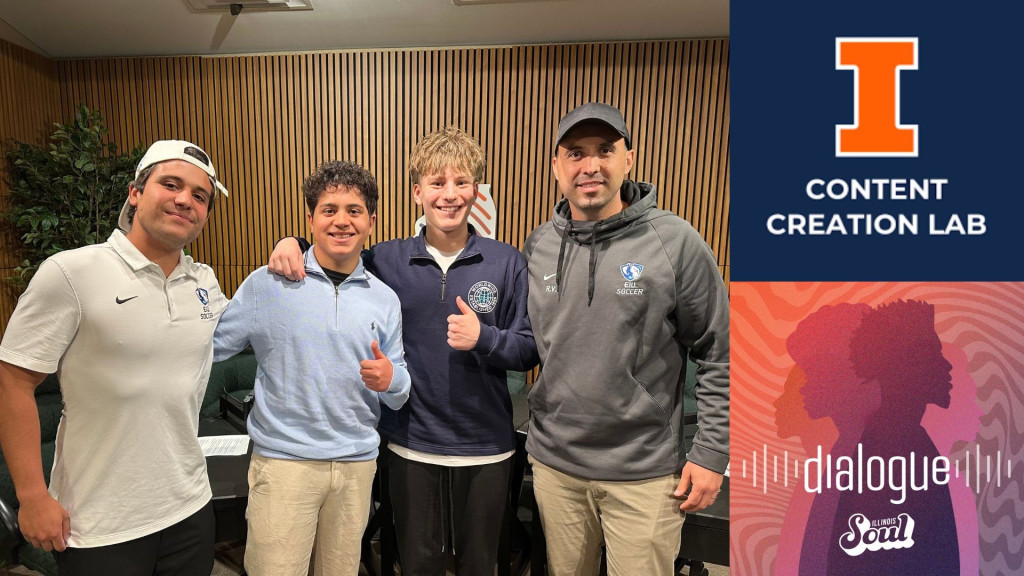
L-R: Eastern Illinois Univ. soccer player Gui Gragnano, Dialogue Teen co-hosts Felipe and Zac, and Eastern Illinois Univ. soccer head coach Ruy Vaz. Angela Aguayo
Curtis Beasley  00:12
Welcome back to dialog on Illinois. Soul. I'm University of Illinois journalism student Curtis Beasley, thanks to Logan for from Champaign for playing his guitar to help us get our third segment going. Let's introduce you to the teens in this segment. What's your first name, your hometown and what sport you play?

Zac  00:27
I'm Zac. I'm from Carbondale, Illinois, and I play soccer.

Felipe  00:31
I'm Felipe. I'm from Champaign, Illinois, and I play soccer.

Curtis Beasley  00:35
Zach and Felipe are two of the two and a half million young Americans who play soccer, according to us, youth soccer a little under the population of Chicago, not counting the suburbs. Two people who know a lot about soccer are here with us today. If you two would like to introduce yourself, starting with coach.

Ruy Vaz  00:51
I am Ruy Vaz I am from Sao Paulo Brazil, and I'm the head soccer coach at Eastern Illinois University.

Gui Gragnano
Hey guys, I'm Gui Gragnano from Sao Paulo, Brazil, and I am a forward at Eastern Illinois University.

Curtis Beasley
Awesome, Zac and Felipe. If you'd like to start with your questions, we can get started.


Felipe  01:10
So for you coach, like, just a little bit about your journey in becoming just a soccer player. So like, from playing in Italy, what's the difference in Brazil, Italy, America, just like the whole thing.

Ruy Vaz  01:23
Yeah, my career was a little unorthodox. Let's put it that way. I played futsal in Brazil, and then, up until was 16-17 [years old], and then I migrated to the 11 to 11, big field soccer, and I was pretty much playing, studying and playing. In Brazil, we say it's an agents club, you know, for players to be seen. And I had the European passport, and I had a chance to go to Italy in back in 2005 and so I never really played in Brazil, you know, never, never had a career in the youth in Brazil like Gui did. So I went to Italy, and then I played the lower division there for for a few years or two, three years. And then I moved to Portugal to  play third division there, and I played two years there. And at that time, I already knew I wanted to coach, you know, I was 22-23 and then I had a chance to come here to the US to play. And I came to junior college in Kansas, Cowley college, I played there for two years. Transferred to Oklahoma City University. It's an EIA in Oklahoma City. I was a 23-year-old freshman, you know. So I graduated. I was 27-28 and after that, I started coaching. Right away, I went back to Cowley to be a volunteer assistant coach, and my career start there, and I coach at Cowley for 8-9 years. I say those numbers 8-9 because I don't really know specifically the time, but last year, February, I started my journey at Eastern Illinois.

Felipe  03:17
And for you, just the same thing, like a run through about, like, just your life and your journey to getting here and like, what about it? What about Eastern Illinois made you feel like that was your right choice?

Gui Gragnano 03:29
Well, like, coach, we said, I started really young in Brazil with the academies. In Brazil, we have the academy system starting when you were six. So when I was six, I joined the Portuguesa Academy on Futsal, because field soccer right? Regular soccer starts only at U11, youth 11. So at six, I joined the Portuguesa futsal team, and then I did my whole futsal career there, U6 U7 U8 U9 and then on U10 a little bit earlier, immigrated to field soccer. So I had my first field soccer tournament when I was 10, and then I played my first U11 as a true U11 player at portuguesa. Had a really good year for this transition for field soccer. Had a great experience there came back to Portuguesa, and COVID hit, yeah. And then when that happened, I was on an academy contract,

And we know Brazil is an undeveloped country, so we never knew when the COVID would end and everything. And agent that I had at the time introduced me to to an agency that used to bring players to the United States, and that's how I got my first scholarship to do high school here. So I went to Chattanooga, Tennessee School for high school, and then played there for around two years. And.
then started my college career. Went first at Barry University in Miami, transfer to UAB Division program in Birmingham, and then coach we gave me a call to come to EIU. Was midnight. Call was very, very late midnight.


Ruy Vaz  05:19
I was driving from from Illinois to Kansas, And then I was speaking with a former player of mine, who was Gui’s teammate.

Zac  05:30
Did, like, um, being from the same place, like, help at all, like, with this, like interaction?

Ruy Vaz 05:37
For me, always helps, because kind of, especially knowing people that knew him, So much easier to get a feedback. And when you, when you do some scouting, you have to ask, How is this guy? And yeah, and then he played with three guys that played for me different occasions, so I had three different perspectives, you know, and they were all positive. And then there were positive things that I heard, there were negative things that I heard. And you have to look at his equation and make a decision, and ultimately, he came, and it was the right decision.

Felipe  06:16
What was it like in that call in the middle of the night?

Gui Gragnano  06:18
Yeah, it was kind of funny, because it was just pretty much the day that I I decided that I needed to move. I wasn't happy in Birmingham at all. And just going on your question right about being from the same place, from the same country. I was done with college soccer, to be honest, my second year, I didn't, know if I wanted to play college anymore or go overseas, because, again, it's a really different culture here, right? When you have somebody that comes from a different country, it's a little bit hard to adapt to culture coaching staff sometimes, and I feel like that's what I really need to work with, somebody that understands my culture, understands my way. So being from the same country helps a lot, for sure,

Ruy Vaz  07:04
Because I know that he knows that I'm being truthful with what I say. You know, sometimes feels like I have to walk on eggshells when I have to do that with someone from the US, for instance, you know, because even though I've been here for 15 years. I know the differences in culture. The US is a huge country, you know, people come from different places. I coach people from Kentucky, from Michigan, from Texas. So how am I going to approach that? You know, and then I have my way of doing things, but you still have to understand, how is the player gonna take this, you know? And with him, I have no regard, because I know exactly how he's gonna take it. It’s sometimes I know when I say I don't have any regards. It's not that I don't care about him. It's just like I know that he's gonna absorb in a way, and he's going to respond, you know, and for me, that's what makes it good this relationship, because he knows how hard of you know him, but he knows that we have the the best intentions in our heart. Because I want to get something for him.


Zac  08:15
Right, of course. So I'm also coach like you're new to Eastern Illinois, and I'm like, building a program like this, what was the biggest challenge? And like, just what's the possibilities? Like, what was the biggest challenge in coming to this new university and transferring from Cowley to Eastern Illinois?

Ruy Vaz  08:37
Well, the biggest challenge is starting from scratch, you know, because you have to build a to build a foundation, and to bring a new culture, a new way of seeing things. We want to be we want to obviously win. We want to bring positive results. But for that to happen in a sustainable way, you have to build a foundation, and you have to do something that's going to be good for the future. Not just Okay, we're gonna win now and then next year we're gonna have to rebuild again. No, we want to do something that's going to be strong, that's gonna be firm.

Zac  09:10
This is for Gui. What is like a typical week like, look like with balancing, like school practices, like all different type of stuff, games, what? What is it like,

Gui Gragnano    09:21
Yeah, it depends a lot if you're in the fall or in the spring. Yeah, but I would say when we're in season, we usually practice every morning, so wake up very, very early locker room, have a report time and practice in the morning. So around from 7:30 to 9:30 from there, we go to school. I usually take two classes a day, so I started at 11. I'm probably done by 1:30 lunch break and everything. And if it's a regular day, we usually lift. On the afternoon, so we have the lift of 4 or 5pm and have to go back to bed early, because we have very early as well.

Ruy Vaz  10:09
He says, they go they go to bed early. Some we can see in their eyes like, Oh, we didn't go to bed.

Gui Gragnano    10:15
But it depends if the day before a game we then it's a different preparation, right? You probably not going to live the day before a game, but if it's a game day at home, most of the times we're excused from class, so then you probably have a meeting in the morning, right? The team meeting walk through and get yourself ready for the game, right? Have a good lunch and then play. Usually afternoon, 3pm 4pm depends on the game time, but that's usually a training in the morning class and then lift in the afternoon.

Zac 10:54
What do like away games look like?

Gui Gragnano    10:58
Oh yeah. It also depends on the distance, right? But if it's most of the away games, last year we we would train in the morning and then go to and then travel… spend the night, and the game day is usually the day after we travel. So last year, we had trips to Milwaukee, Purdue,

Felipe  11:26
Arkansas,

Gui Gragnano      11:26
Arkansas. I didn't have the chance to go to Texas because I tore my shoulder. But we have lot of trips, you know, spending nights away in the hotels. It's a very nice experience. That's something that division one has to offer that it's unique. You know, I've been in Division Two, and I'm sure that in terms of the experience, division has to offer, a lot of these things that can attract international players, the best players in the nation as well. Wants to be in Division One for that.

Felipe  11:57
And then you obviously must have your own experiences with practicing games. What's it like for you, having to balance practice games, scheduling everything?

Ruy Vaz    12:07
Yeah, I love it. It's a it's my job, and it doesn't feel like a job at all, you know? I, I look forward for Mondays, you know? And, you know, we, for me, it's just the same thing. I wake up extra early to prepare the field, because we prepare the training session the day before, you know, and then we prepare the field. Run training sessions, and then had some have some rest, have lunch, and then start thinking about the training sessions, or scouting the other teams, or watching the games, watching the other players, preparing all the logistics for the trips and everything, you know. So game days, we prepare the games and we prepare all the operations that needs to be done, you know. So we just, ultimately, we just try to make sure the players have the most fulfilling experience, you know, so we have to work hard in the background and make sure they they just go there and play

Curtis Beasley  13:07
All right. Well, that was an amazing conversation. I just want to wrap it up and say, let's thank our guests, EIU, head coach, Coach Vaz and Gui for coming to speak with us.

That's all for our show. The content creation Lab is a collaboration between the College of Media and Illinois public media Professor Angela Aguayo is the director of the content creation lab. Teaching staff includes Gillian Paxton, Angela Conde, Leonor Carrillo and our Lab manager, Tom Farrenkopf. DJ Roach is our Video Manager. Reginald Hardwick is IPM news and public affairs director. I'm Curtis Beasley. University of Illinois, journalism, student and dialog in Illinoisa Soul are part of Illinois public media, a service of the University of Illinois. Urbana Champaign, you.
On this special edition of Dialogue, we learn about the journey from Brazil to Charleston, Illinois for two members of the Eastern Illinois University soccer team. Teen soccer players and co-hosts Zac and Felipe sit down with EIU head coach Ruy Vaz and Gui Gragnano. Dialogue for Teens is produced by the Illinois Public Media and the Content Creation Lab at the University of Illinois Urbana-Champaign.
Host
Curtis Beasley, University of Illinois Urbana-Champaign Journalism Student
Teen Hosts
Zac and Felipe (only first names are being used since they are minors)
Guests
Ruy Vaz, Head Soccer Coach, Eastern Illinois University
Gui Gragnano, Forward, Eastern Illinois University
