



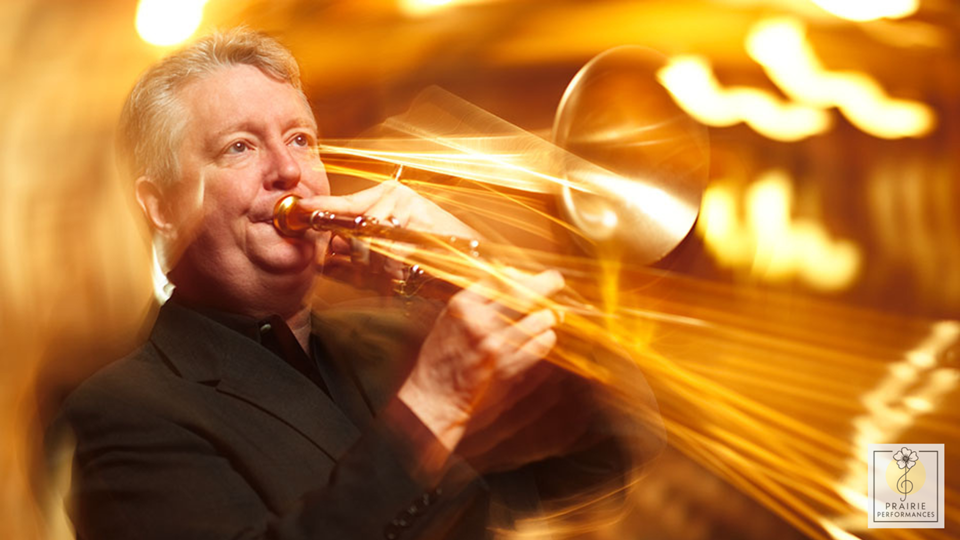
Featured Artist: Jim Pugh
// This is a machine generated transcript. Please report any transcription errors to will-help@illinois.edu.

[00:00:00]
Jason Croft: Good evening from Urbana and the University of Illinois, it's Prairie Performances. WILL's weekly show presenting classical and jazz from the heart of the prairie in central Illinois. Prairie Performances is made possible in part by funding from the John Frayne Graduate Student Classical Music Work Experience Endowment.

[00:00:28]
Mel Miller: Good evening and welcome to Prairie Performances. I'm your host, Mel Miller. On tonight's episode, we're featuring the works of renowned trombonist, composer, and professor emeritus of jazz trombone at the University of Illinois, Jim Pugh. Born in Butler, Pennsylvania, after studying at the Eastman School of Music, Pugh toured with the Woody Herman Band and Chick Corea and has recorded with a wide variety of artists ranging from Yo-Yo Ma to Pink Floyd and Madonna. Jim Pugh's latest album, New American Symphonies, was released in August and features the world premiere recording of Roy Harris's once-lost trombone symphony. You'll hear more later in the hour about how Jim Pugh came across this work, but first, a few pieces to familiarize you with Pugh's sound. Starting us off, Pugh appears in Marc Beacco's "Live at Scampi Fritti." After that, you'll hear his horn on "Nocturne," or "Noturna" from the album A Love Affair, Music of Ivan Lins, and again on Helen Merrill's rendition of "If I Were a Bell." That's up next here on Prairie Performances.

[00:14:52]
Mel Miller: Helen Merrill singing "If I Were a Bell" with Jim Pugh on trombone. Before that, you heard Pugh in "Nocturne" and "Live at Scampi Fritti," all part of this Prairie Performances featuring trombonist, composer, and Professor Emeritus of Jazz Trombone at the University of Illinois, Jim Pugh. I'm your host, Mel Miller. Here's Jim Pugh on how he made his way from New York to Central Illinois.

Mel Miller: You were born in Pennsylvania. You went to school at Eastman. Somewhere along the way, you ended up at the U of I. How did that happen?

[00:15:27]
Jim Pugh: Yeah, after — after Eastman School of Music, I went on the road with Woody Herman's band for about four years, then went to New York. About six months after I got to New York, I hooked up with a horn band that Chick Corea was putting together, and I played with him for a couple of years. I went back to New York and basically just freelanced, mostly studio work, 'cause it was at that point in time, there was still a very active, very vital sort of recording scene going on there. It still exists, but not quite in the same volume it did.

And a friend by the name of Carl Kramer, who ultimately was director of the music school here a number of years ago — he was director of the music department at Purchase College, which is part of the State University of New York system — and invited me to come up and start teaching there. So I taught there a little bit, sort of a little bit kicking and screaming, because it was always the, you know, "those that can do, those that can't teach." But it's not, it isn't really that, and he brought me up there, and I found out I really, really loved it. I loved working with the students. Their energy was sort of infectious. I enjoyed stealing some of that energy for myself, and also playing it, and the fact that like, when you're — when you're doing like particularly like one-on-one lessons — you're constantly, I guess, challenged in a way. It's like they're never the same. It's like this week's lesson is nothing like what last week's lesson was with the same person. It was challenging in a way I hadn't been challenged before, and I found I really, really enjoyed it.

And then Karl left there and came out here at the University of Illinois, and he invited me to come out and be the trombone side of the jazz department here. And I was, I guess, in my early 50s. I was in New York — had been, had been great, had been absolutely wonderful. The scene was changing. It was a different working environment than what I had gone there for originally. And it just seemed like the great thing to do at the right time. You know, I've had some asks about things like that before, and it was not the right time. Then this was absolutely perfect, and, you know, packed up and loaded the dogs into the car, and out we came. It's been great. It's been a wonderful, wonderful journey out here, you know, very different from New York.

[00:17:46]
Mel Miller: As I mentioned before, while Jim Pugh is of course a distinguished performer, he also composes his own music. Next up, you'll hear Pugh performing one of his compositions along with the Colorado Symphony Orchestra. This is Pugh's concerto for trombone and orchestra, the 1st and 3rd movements. After that, Pugh plays tenor in the tenor and bass trombone duet Duo Concertante, composed by Daniel Schnyder. That's up next here on Prairie Performances.

Daniel Schnyder's Duo Concertante with Randall Hawes on bass trombone and Jim Pugh on tenor trombone. Before that, you heard an excerpt from Pugh's Concerto for Trombone and Orchestra performed by Pugh along with the Colorado Symphony Orchestra on this Prairie Performances. I'm your host, Mel Miller.

Jim Pugh's latest album, New American Symphonies, was released in August and features the world premiere recording of Roy Harris's once-lost trombone symphony. So how did he happen across this work? Jim Pugh can tell you more.

[00:39:05]
Jim Pugh: I was reading a biography of Bernstein by Meryle Secrest, and she sort of very offhandedly mentioned about these composers that were writing for big band ensembles. And she said Roy Harris was writing for Tommy Dorsey, and it was like, huh? It's like this is something nobody knew about. Nobody, you know, and trombone is like a small community, so if there's like this — these urban legends and stuff, they exist, you know — or rumors of this music that was written for trombone, because we don't have, you know, Brahms never wrote a trombone concerto, so we have to — we have these little things we have to like latch onto. But nobody in the trombone community knew about it. It's like it just wasn't known. I have no idea how she researched that, or found — or her people. It's like it was a really incredible piece of esoterica.

So I sort of latched onto that, got a hold of Dr. Dan [Staman], who was Harris's archivist at that point. And he had a copy of all the parts to the second movement, which is the movement that got rehearsed by the Dorsey band before they decided against it. And there's a couple of holes towards the end of it to be filled by piano, but of all the parts we had, there was no piano part, so I didn't know what was supposed to go in those holes.

So I ended up — found out all the Roy Harris materials were with the Library of Congress. So I got hooked up. His wife allowed me permission to go and look at all those — all the stuff — and it turns out it's uncatalogued. It's just in tons of boxes down in the basement of the Library of Congress. So we're down there going through all these boxes of stuff and scores and parts and, you know, sketches and this and that, looking for that piano part. And all of a sudden a page shows up that's not that material — it's, oh, it's a big band instrumentation on the side. Oh, here's page 7. OK. And over in this box we get pages 5 through 11, and, you know, little by little going through all these boxes, assembled the score of a first movement. No third movement was ever done. The first movement was never even copied. In fact, there's a notation on the first page of the first movement about the decision to like abort the project. And so I put that together, copied that out, and it's like, since we eventually got the entire score out to the double bar at the end — and I just felt like I wanted to record it, you know, 'cause I want to hear what this sounds like.

[00:41:34]
Mel Miller: I'll leave you tonight with two tracks from Jim Pugh's New American Symphonies. First, the world premiere recording of the second movement of Roy Harris's American Symphony with Jim Pugh playing the trombone solo. After that, Eventide from Scott Ninmer's Night Suite. Thank you so much for listening with me this evening here on Prairie Performances.

Prairie Performances is a production of Illinois Public Media. I'm your host, Mel Miller. I hope you'll join me next time.
This week, Prairie Performances is featuring the works of renowned trombonist, composer, and Professor Emeritus of Jazz Trombone at the University of Illinois, Jim Pugh. His latest album, New American Symphonies, brings to life Roy Harris’s once-lost trombone symphony. You will hear Jim Pugh talk about how the symphony was recovered, along with a few selections from the album.
Tune in on Thursday, September 24 at 7pm CST on Illinois Classical 90.9 or stream now!
Playlist
| Title | Artist | Album |
|---|---|---|
| "Live at Scampi Fritti" | Marc Beacco | Scampi Fritti |
| "Nocturne" | Brenda Russell | A Love Affair: The Music of Ivan Lins |
| "If I Were a Bell" | Helen Merrill | Christmas Song Book |
| Jim Pugh's Concerto for Trombone and Orchestra | Jim Pugh, Colorado Symphony Orchestra, conductor Jeff Tyzik | X Over Trombone |
| Daniel Schnyder's "Duo Concertante for Tenor Trombone and Bass Trombone" | Randall Hawes and Jim Pugh | Liquid Architecture |
| Roy Harris's "American Symphony" - 2nd movement | Jim Pugh | New American Symphonies |
| "Eventide" from Scott Ninmer's Night Suite | Jim Pugh | New American Symphonies |
